Honda Pioneer Registration in Georgia
You own a Honda Pioneer, maybe a hardworking 500 for the farm or a 1000-5 for hunting club weekends, and you have heard Georgia now lets some side-by-sides carry a plate and use certain county roads. Then you discover that Georgia has never titled these machines, the rules come with an eight-point eligibility test, and the tag office wants paperwork you may not have. This guide walks a Pioneer owner through what Georgia’s multipurpose off-highway vehicle registration requires, how each Pioneer model tends to measure up, and how to get through the county tag office without a wasted trip.
How Georgia’s MPOHV Registration Works
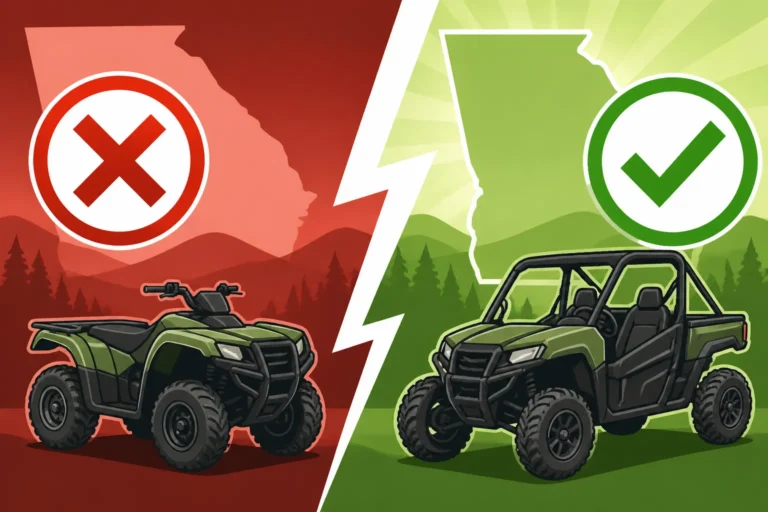
Georgia treats most off-road machines very differently from cars and trucks. For years, there was simply no way to register an ATV or side-by-side for road use, and there still is no Georgia title for these machines. What changed is that the state created a separate category called the multipurpose off-highway vehicle, or MPOHV, and opened an optional registration system for machines that fit it. Georgia MPOHV Registration Explained gives the full overview of the category and how it came about.
The key points every owner should know
- Registration is voluntary. You do not need to register a Honda Pioneer that only works on private land, and plenty of owners will never bother. Georgia MPOHV Registration Is Voluntary explains who benefits.
- Registration is annual. Once registered, the machine needs renewing every year, in a similar way to a car tag.
- There is no title. Georgia proves ownership of a registered MPOHV through a certificate of registration rather than a certificate of title, which is why title ad valorem tax does not apply to these machines. Why No Title Means No TAVT goes into the tax reasoning.
- Sales tax must have been paid. The tag office will want to see that Georgia sales tax was paid on the machine, or that an exemption applies.
- Insurance is required. A registered MPOHV must carry liability insurance, and the registration depends on keeping that coverage in force.
- Registration happens at the county tag office in the county where you live, using the state’s MV-OHV application.
Where a registered Pioneer can go
Registration is mainly about limited road access. A registered MPOHV may be operated on certain county roads, subject to state law and any local restrictions, and only by a properly licensed driver. It does not turn a Pioneer into a highway vehicle, and it does not give you blanket permission to use state highways or interstates. Rules on crossings and local ordinances vary, and the road access provisions have been written with a sunset date of July 2027 unless lawmakers extend them, so check the current position before relying on road access for long-term plans. Georgia MPOHV Road Rules: County Roads Only and Georgia’s July 2027 Sunset on Road Access cover the details.
Whether Your Honda Pioneer Meets the Eight-Point Test
Georgia only registers machines that meet a specific set of design standards. The test is designed to separate utility side-by-sides, which are built more like small trucks, from straddle-seat quads, dirt bikes and similar machines. Honda Pioneers are side-by-sides with bench or bucket seats and a steering wheel, so they start in a good position, but each model still needs checking.
The criteria in plain terms
| Requirement | What Georgia looks for | How Honda Pioneers usually compare |
|---|---|---|
| Width | No more than 80 inches wide | Pioneer models are built well under this, including the narrow trail-width 500 and 520 |
| Payload | Payload capacity of at least 350 pounds | Check the specific model’s rated capacity in the owner’s manual or spec label |
| Weight | Gross weight no greater than 4,000 pounds | Pioneers sit well below this ceiling |
| Steering | Steering wheel, not handlebars | All Pioneers use a steering wheel |
| Seating | Non-straddle seating | All Pioneers use bench or bucket seats |
| Speed | Capable of a top speed between 25 and 65 mph | Check model specifications, and note any governor or speed limiter settings |
| Safety equipment | Seat belts, headlights, brake lights and rearview mirrors | Seat belts are factory fitted; mirrors and sometimes brake lights may need adding depending on model and year |
| Build date | Manufactured on or after January 1, 2000 | Every Pioneer was built well after this date |
Georgia MPOHV Eligibility: The Eight-Point Test explains each criterion in more detail, and Headlights, Brake Lights and Mirrors on the Checklist focuses on the equipment items that cause the most problems at the counter.
Model-by-model considerations
The Pioneer family covers several sizes, and the issues that come up differ between them.
- Pioneer 500 and 520: these are compact, narrow machines designed for tight trails and farm work. Width and weight are not a problem, but owners should confirm the payload rating and check the lighting and mirror setup carefully, since compact utility machines are often sold with minimal road-oriented equipment.
- Pioneer 700 and 700-4: mid-size utility machines popular on farms and hunting land. They generally fit the dimensional limits comfortably. Look closely at mirrors, which many owners add as accessories, and confirm brake lights function.
- Pioneer 1000, 1000-5 and 1000-6: larger, more powerful machines with greater capacity. They fit within the width and weight limits, but owners should confirm top speed specifications and any aftermarket changes, such as tuning, that might affect them.
If your Pioneer has been heavily modified, with a lift kit, oversized tires, removed equipment or engine tuning, the tag office or an inspecting officer may look more closely at whether it still meets the criteria. When in doubt, keep your machine close to factory specification, or keep records showing that the key features remain in place.
Getting the equipment right before you go
The most common reason for a wasted trip is missing safety equipment. Before visiting the tag office:
- Check that both headlights work on low and high beam where fitted.
- Have someone stand behind the machine while you press the brake pedal to confirm the brake lights come on.
- Fit at least one rearview mirror, and ideally side mirrors as well, if your Pioneer does not have them.
- Confirm every seat position has a working seat belt.
- Take photos of the equipment in case questions come up later.
If a clerk or officer questions an item, being able to show it working on the spot usually settles the matter quickly.
Paperwork and Steps at the County Tag Office
Once your Pioneer qualifies, the next challenge is paperwork. Because Georgia never titled these machines, many owners do not have the kind of ownership documents they would have for a car.
Documents to gather
| Document | Why it matters | Common pitfalls |
|---|---|---|
| Completed MV-OHV application | The state form used to register an MPOHV | Missing signatures, wrong county, incomplete machine details |
| Proof of ownership | Shows the machine is yours | No paperwork from a private sale, or a bill of sale lacking the serial number |
| Proof of sales tax paid or exemption | Required before registration | Private sales where tax status is unclear |
| Proof of liability insurance | Required to register and to keep registration active | Policy not yet in force, or wrong vehicle listed |
| Valid ID and proof of residence | Registration goes through your home county | Address on ID not matching the county |
| Serial number or VIN details | Identifies the machine | Worn or missing serial plate |
Georgia Form MV-OHV and What It Asks walks through the application section by section, which helps if you are completing it for the first time.
Proving ownership of a Pioneer bought privately
If you bought your Pioneer new from a dealer, you probably have a manufacturer’s certificate of origin, a dealer invoice and sales tax records, which usually makes registration straightforward. Private sales are where things get complicated. Many Pioneers have changed hands for cash with a handshake and nothing in writing.
A good bill of sale should include the date of sale, the buyer and seller’s names and addresses, the price, the make, model and year, and the full serial number. Both parties should sign it. Many people use a template from a legal forms service such as LawDepot to make sure the essential details are included. A LawDepot style bill of sale is not a magic document, and the tag office still needs to accept it, but a clear, complete bill of sale avoids many of the problems that arise from a scribbled note. Bills of Sale That Hold Up at a Tag Office explains what tag offices tend to look for.
When you have no paperwork at all
Georgia anticipated that many owners would have no ownership documents, especially for older machines bought years ago. For qualifying machines owned before June 30, 2024, there is a route to a branded certificate of registration, which involves a law enforcement inspection of the machine and its serial number, documented on a T-22B form. The brand on the certificate warns future buyers that ownership was established without the usual documents. Georgia Branded Certificates of Registration explains this route and the inspection, and Georgia Machines Owned Before June 30, 2024 covers the date rule.
Step by step at the tag office
- Confirm your Pioneer meets every part of the eight-point test, and fix any missing equipment.
- Arrange liability insurance on the machine before your visit.
- Gather proof of ownership, ideally a dealer invoice, certificate of origin or a complete bill of sale.
- Locate proof that sales tax was paid, or documentation of an exemption.
- If you have no ownership documents and the machine qualifies by date, arrange the law enforcement inspection and T-22B.
- Complete the MV-OHV application carefully, matching every detail to your documents.
- Visit the tag office in your home county with your ID, proof of residence and all documents.
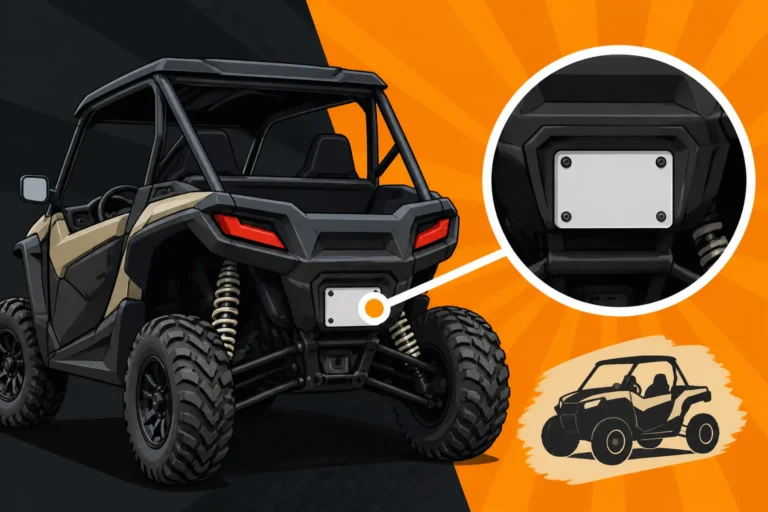
- Pay the registration fee, receive your plate and decal, and mount the plate as required.
Keep copies of everything you hand over. If the clerk sends you away for a missing item, you will know exactly what to bring back.
A realistic scenario
Imagine Darnell, who lives near Milledgeville and bought a used Pioneer 700-4 from a neighbor two years ago for cash. He wants to register it so he can drive to his hunting club along a quiet county road. He checks the eight-point test, adds a rearview mirror and confirms the brake lights work. He calls his insurer to add liability coverage. Because he has no bill of sale, he and his neighbor sit down and complete one using a LawDepot template, listing the full serial number, sale date and price, and both sign it.
At the tag office, the clerk asks about sales tax on the original private sale, which Darnell had not considered. He returns a week later with the extra documentation and leaves with his plate. His story is common: most of the delays come from paperwork, not from the machine itself.
Problems that most often send owners home
Tag office staff see the same issues again and again. Knowing them in advance can save you a second trip.
| Problem at the counter | Why it happens | How to avoid it |
|---|---|---|
| Serial number on the paperwork does not match the machine | A digit was copied wrongly on a bill of sale or form | Photograph the serial plate and copy the number directly from the photo |
| No proof of sales tax | The machine was bought privately and tax was never addressed | Ask the tag office in advance what it accepts for your situation |
| Insurance card lists the wrong vehicle | The policy was added to a truck or another machine by mistake | Check that the card names the Pioneer and its serial number |
| Wrong county | The owner tried to register where the machine is stored | Register in the county where you live, and bring proof of residence |
| Missing safety equipment | Mirrors or brake lights were never fitted | Run through the equipment checklist the day before |
| Unsigned or incomplete forms | Sections of the application were skipped | Read every line of the form and sign where required |
The serial plate on an older Pioneer
Pioneers that have spent years in mud, creeks and pasture sometimes have serial plates or frame stampings that are hard to read. Before you visit the tag office, clean the area gently and photograph it in good light. If the number is partly worn, do not guess at the missing characters. Ask the tag office how it wants you to proceed, since a law enforcement check of the frame number may be needed. A machine whose serial number has been altered or removed is a far more serious problem, and it is one reason buyers should always check the serial number before handing over cash.
Farm, hunting club and family use
Many Pioneers in Georgia never see a public road, and that is perfectly fine. A machine used only on your own farm, on leased hunting land or on a private family tract does not need MPOHV registration at all. The registration matters when you want to drive between properties on a county road, ride to a neighbor’s farm, or reach a hunting club gate without trailering.
Think about how often that actually happens. If you only cross a road once or twice a season, the cost and paperwork may outweigh the convenience. If you drive the same county road every week to check cattle or run feeders, registration may save a great deal of trailering and give you clearer legal footing.
Insurance for a registered Pioneer
Liability insurance is a condition of registration, but it is worth thinking beyond the bare requirement. A Pioneer on a county road shares that road with pickup trucks, log trucks and school buses. Ask your insurer about liability limits that genuinely protect you, as well as coverage for damage to the machine itself, theft and injuries to passengers. Some homeowner or farm policies cover off-road machines only on your own land, so confirm that the policy covers road use once the machine is registered. Keep proof of insurance in the machine, in a waterproof pouch, so it survives the creek crossings.
Life After Registration
Getting the plate is not the end. Registered owners need to keep up with renewals, insurance and local rules.
Renewals and insurance
Registration renews every year. Keep your insurance active continuously, because a lapse can create problems with the registration and leave you exposed if there is an accident on the road. Set a reminder a few weeks before the renewal date, and check that your insurance renewal and registration renewal do not leave a gap between them.
Selling or buying a registered Pioneer
When a registered Pioneer changes hands, the registration needs to be dealt with properly. Sellers should provide a clear bill of sale and the certificate of registration, and buyers should check whether that certificate is branded. A LawDepot style template can again help both sides record the essentials. A buyer looking at a branded certificate should ask how ownership was originally established and should check the serial number on the machine against the paperwork.
Riding responsibly on county roads
- Only use roads where MPOHV operation is permitted, and respect local ordinances.
- Carry your driver’s license, registration and proof of insurance.
- Wear seat belts and make sure every passenger does too.
- Use headlights and stay visible, especially at dawn and dusk.
- Keep speeds sensible and give way to faster traffic.
- Remember that registration does not change Georgia’s helmet rules for younger riders. Younger riders still need to follow the age and helmet rules that apply to them.
When registration is not worth it
Not every Pioneer owner needs to register. If your machine never leaves your land or a private hunting tract, registration may add cost and paperwork without real benefit. Georgia Registration Versus Just Riding Private Land helps you weigh the decision, including the yearly fee, insurance and time spent on paperwork.
The bottom line
A Honda Pioneer is generally a good fit for Georgia’s MPOHV registration, because its design already matches the side-by-side profile the law was written for. The work lies in confirming the equipment, gathering ownership and tax paperwork, keeping insurance active and staying within the road rules. Prepare carefully before you visit the tag office, and your Pioneer can go from farm-only workhorse to a legally plated machine for the county roads near home.
Disclaimer
This article is for general informational purposes only and does not constitute professional advice. Laws, prices and regulations vary by location and change over time. Consult a qualified professional for guidance on your specific situation.