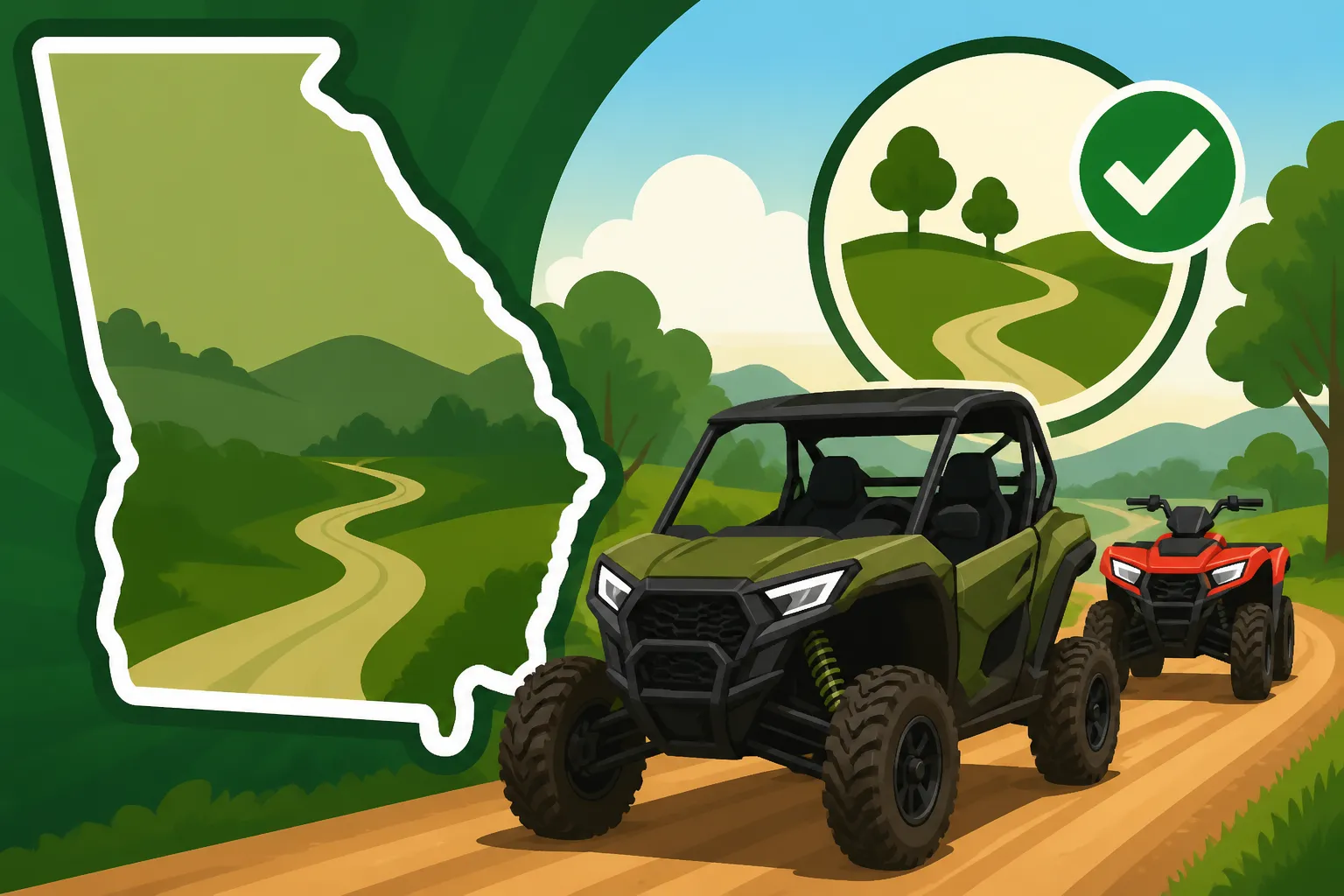
Georgia MPOHV Road Rules: County Roads Only
Getting your off-highway vehicle (OHV) out of the woods and onto a public road in Georgia used to be a complicated, often frustrating, maze of local rules and outright prohibitions. Many riders simply avoided it, fearing tickets or confusion. This guide cuts through that confusion, focusing specifically on Georgia's MPOHV designation and the clear, albeit limited, path it provides for legally riding your side-by-side or UTV on county roads.
Understanding Georgia's MPOHV Designation: What It Means for Road Use
For years, the dream of riding your side-by-side or UTV legally on Georgia's public roads felt like a distant fantasy for many enthusiasts. There was no statewide framework, leading to a patchwork of confusing local ordinances or, more often, an outright ban on operating these machines anywhere but private land or designated trails. That all began to change with the creation of the MPOHV designation and the associated registration process. This isn't about making every quad or dirt bike street legal; it's a very specific pathway for certain types of utility-focused off-road vehicles.
The Core Concept: County Roads, Not State Highways
The absolute most critical distinction to grasp about Georgia's MPOHV rules is that they are almost exclusively about county roads. This means that while you might be able to legally drive your registered MPOHV from your hunting cabin down the dirt road to the general store, you absolutely cannot take it onto a busy four-lane state highway. It's a fundamental difference that many riders initially misunderstand, often leading to costly tickets or dangerous situations.
Think of it this way: the state recognized that many rural communities and landowners rely on UTVs and side-by-sides for everyday tasks that might involve traversing a short stretch of public road. These machines are tools, often equipped for utility work, farm chores, or accessing remote property, and restricting them solely to private land became a logistical headache. The solution wasn't to throw open all public roads, but to create a specific, limited allowance for county roads where traffic patterns and speeds are generally lower and local needs are different.
So, when you consider registering your MPOHV, remember that its road-legal status is confined to the network of county-maintained roads. These are typically marked with county road signs, often have names like "Old Mill Road" or "Jones Road," and are generally less traveled than state routes. Understanding this limitation from the outset will save you a lot of grief and ensure you stay within the bounds of the law.
Why the Distinction Matters: Safety and Legality
The reason for limiting MPOHVs to county roads is multi-faceted, but it primarily boils down to safety and the fundamental design differences between these machines and traditional passenger vehicles. While your side-by-side might feel sturdy, it wasn't engineered for sustained high-speed travel, unpredictable traffic, or the rapid braking often required on state highways. These roads, by their nature, have higher speed limits, heavier traffic volumes, and designs that cater to vehicles capable of faster speeds and more precise handling.
Imagine trying to navigate a busy state route where cars are traveling at 55 mph or more, while you're in a machine that might max out at 60-65 mph, has a wider turning radius, and potentially less robust occupant protection than a car. The speed differential alone creates a significant hazard, not just for you but for other motorists. Furthermore, MPOHVs typically lack the crumple zones, advanced airbag systems, and structural rigidity found in cars, which are designed to protect occupants in high-speed collisions.
From a legal standpoint, this distinction is also crucial. Violating the road restrictions by operating an MPOHV on a state highway or interstate isn't just a minor infraction; it can lead to significant fines, points on your license, and even impoundment of your machine. More importantly, if you're involved in an accident on an unauthorized road, your insurance coverage could be jeopardized, leaving you personally liable for damages. The state's intent is to allow practical, limited road access where it makes sense, not to encourage risky behavior.
What MPOHV Actually Stands For
It can feel like a mouthful, and the acronym itself doesn't immediately tell you what it means for your machine. But understanding the full term behind "MPOHV" sheds a lot of light on the state's intent and which vehicles qualify. [What MPOHV Actually Stands For] breaks down the specific language and intent behind this designation, making it clear why certain machines qualify and others do not.
The "MPOHV" stands for "Multipurpose Off-Highway Vehicle." Let's dissect that for a moment. "Multipurpose" speaks to the utility aspect – these aren't just recreational toys, but machines often used for work, hunting, or other practical purposes that may involve short stints on public roads. Think of farmers needing to cross a county road to get to another field, or hunters accessing different parts of their leased land.
The "Off-Highway Vehicle" part is self-explanatory, reinforcing that these machines are primarily designed for off-pavement use. This designation is what differentiates them from traditional "street-legal" vehicles like cars or trucks. It's an acknowledgement of their off-road capabilities while still attempting to integrate them into a limited road-use framework. This specific phrasing helps state legislators and local law enforcement apply the rules consistently, as it clarifies the type of machine they're dealing with.
The Legal Framework: Where Georgia's Rules Are Written Down
When you're dealing with anything related to vehicle registration and road use, it's easy to feel like you're diving into a swamp of dense legal text. Georgia's MPOHV rules are no different, but knowing where to look and understanding the core legislation can demystify the process significantly. It’s not just about a single rule; it's a specific section of the Georgia Code that outlines everything from eligibility requirements to road restrictions.
Digging Into the Georgia Code for Off-Highway Vehicles
The foundational rules for MPOHVs in Georgia are enshrined within the Georgia Code. Specifically, you'll want to look at O.C.G.A. § 40-2-20, which outlines the registration process, and O.C.G.A. § 40-7-4, which details the operation rules for these vehicles. These sections define what an MPOHV is, the criteria it must meet to be registered, and crucially, where and how it can be operated on public roads. Many people wonder [Where Georgia's MPOHV Rules Are Written Down] and these are the places to start.
This legal framework isn't just bureaucratic jargon; it's the blueprint for how the state intends for MPOHVs to be integrated into its transportation system. It details the physical characteristics your machine must possess, like width, weight, and speed capabilities, as well as mandatory safety equipment. For example, it specifies the need for seat belts, headlights, brake lights, and mirrors—items that aren't always standard on purely off-road machines but are essential for public road operation.
Understanding these sections of the code is vital because ignorance of the law is never an excuse. If you're pulled over or involved in an incident, law enforcement will refer directly to these statutes. Having a basic familiarity with the legal basis for MPOHV operation empowers you to ensure your machine is compliant and that you're operating it responsibly within the state's guidelines.
Key Dates and Sunset Clauses to Remember
Georgia's MPOHV rules weren't always around; they were established relatively recently, which means there are some important dates to keep in mind, including a specific sunset clause that impacts their future. The legislation allowing MPOHVs on county roads had a defined start, and it also has a defined end date, unless renewed. This is a crucial piece of information for anyone investing in a new side-by-side or UTV with the intent of registering it for county road use.
The ability to register MPOHVs began in December 2023, offering a clear path that didn't exist before. This was a significant moment for many riders and landowners who had been lobbying for clearer rules. However, the current law includes a provision that states these specific road access rules will expire, or "sunset," on July 1, 2027. This isn't a hard stop to all MPOHV use, but it means the specific allowances for county road access could change or disappear entirely unless new legislation is passed. [Georgia's ATV Road Access Law Sunsets in July 2027] provides more detail on this critical date.
For current and prospective MPOHV owners, this sunset date introduces an element of uncertainty. It means that while you can currently register and operate your machine on county roads, this privilege is not permanent under the existing law. It's a call to stay informed about legislative efforts to extend or modify these rules. Being aware of this timeframe allows you to make informed decisions about your investment and participation in the MPOHV program.
How These Rules Came to Be
The journey to establishing statewide MPOHV road rules in Georgia was a long one, driven by a combination of public demand, practical necessity, and legislative debate. For many years, the legal status of UTVs and side-by-sides on public roads was ambiguous at best, leading to frustration for both riders and law enforcement. Local communities often had to grapple with the issue on a case-by-case basis, resulting in a confusing patchwork of ordinances.
The push for a statewide framework gained momentum as the popularity and utility of side-by-sides surged. Farmers, ranchers, hunters, and recreational riders alike expressed a need for a consistent, legal way to travel short distances on public roads connecting properties, accessing trails, or performing essential tasks. The previous situation often forced people to risk fines or incur the expense and inconvenience of trailering their machines for very short road segments.
Legislators eventually recognized the growing need and worked to craft a solution that balanced public safety concerns with the practical needs of the state's residents. The MPOHV designation, with its strict eligibility criteria and road restrictions, was the result of this compromise. It wasn't about fully legalizing ATVs for road use, but rather creating a specific category for utility-focused machines that could meet certain safety standards for limited county road operation. This thoughtful, albeit cautious, approach aimed to provide clarity and legitimate access while minimizing potential risks on Georgia's roads.
The Strict Limits: What Roads Are Absolutely Off-Limits
While Georgia's MPOHV registration opens the door to legal county road access, it's absolutely crucial to understand that this privilege comes with very strict limitations. Not all roads are created equal, and mistaking one type for another can lead to serious legal consequences and, more importantly, put your safety and the safety of others at risk. The state has drawn clear lines, and crossing them, whether intentionally or accidentally, is simply not an option.
Why Georgia State Highways Stay Off Limits
It might seem tempting to cut across a state highway on your MPOHV, especially if it's the most direct route. However, Georgia's rules are unequivocal: [Why Georgia State Highways Stay Off Limits] is because they are designed for faster, higher-volume traffic, and your MPOHV simply isn't built for that environment. State highways, often identified by route numbers like "GA-19" or "US-41," carry significant traffic at higher speeds, making them incredibly dangerous for slower, less protective off-highway vehicles.
Operating an MPOHV on a state highway creates a dangerous speed differential. A side-by-side that can reach 55 mph is still a slow-moving target compared to cars and trucks cruising at 70 mph. This difference dramatically increases the risk of rear-end collisions, which can be catastrophic for MPOHV occupants due to the lack of extensive crash protection. Furthermore, the design of state highways, with their longer sight lines and fewer immediate exits, isn't conducive to the kind of quick maneuvers an MPOHV might need.
Beyond the safety aspect, operating on a state highway without authorization is a clear violation of state law. Law enforcement, including Georgia State Patrol, actively monitors these routes. Getting caught can result in hefty fines, vehicle impoundment, and potentially a criminal record, depending on the circumstances. It's a risk that far outweighs any perceived convenience.
Interstates and Why They Are Never an Option
If state highways are off-limits, then interstates are an even more emphatic no. This might seem obvious, but it's important to reiterate: [Interstates and Why They Are Never an Option]. Interstates, like I-75 or I-20, represent the pinnacle of high-speed, high-volume transportation. They are explicitly designed for vehicles capable of sustained high speeds and often prohibit even slower-moving conventional vehicles. An MPOHV attempting to merge or operate on an interstate would be an immediate and extreme hazard.
The speed and volume of traffic on an interstate would utterly overwhelm an MPOHV. Even a brief moment on the shoulder could be incredibly dangerous. These roads also often have minimum speed requirements that MPOHVs cannot meet, making them illegal on multiple fronts. The noise, the wind shear from passing trucks, and the sheer speed of other vehicles create an environment that an MPOHV is simply not equipped to handle safely.
The penalties for operating any unauthorized vehicle, let alone an MPOHV, on an interstate are severe. Beyond the immediate danger to life and limb, you're looking at significant legal trouble. There is no scenario where it is legal or advisable to take your MPOHV onto an interstate in Georgia. This is one of those rules where there is absolutely no gray area or exception.
Crossing State Routes: Designated Points Only
While state highways are generally off-limits for continuous travel, Georgia law does acknowledge that sometimes, you might need to briefly cross one to get from one county road segment to another. This is a very specific and limited exception, and it's surrounded by strict conditions. You cannot simply drive on a state route; you can only cross it. [Georgia Crossings at Designated Points] outlines exactly how this is intended to work.
The key phrase here is "designated points." This means you can only cross at an intersection where a county road meets a state highway. You cannot drive down the state highway for any distance, however short. The crossing must be as direct as possible, essentially going straight across from one county road to the opposite county road. This requires extreme caution, as you are still entering a high-speed traffic flow environment.
Before attempting such a crossing, you must yield to all traffic on the state route. Look both ways, and then look again. Wait for a clear, wide-open gap in traffic before proceeding. If you have any doubt about the safety of the crossing, do not attempt it. It is always better to find an alternative route, even if it's longer, than to risk a collision on a state highway. These crossings are designed for absolute necessity and demand the highest level of driver awareness and judgment.
Operating Your MPOHV on Georgia County Roads: The Practicalities
Now that we've covered where you can't ride, let's dive into the practical aspects of where you can – the county roads. Operating your MPOHV legally on Georgia's county roads isn't just about having the right registration; it also involves ensuring your machine is properly equipped, you as the operator meet certain criteria, and you carry the necessary insurance. Think of it as preparing your machine and yourself for a very specific type of road-legal experience.
Essential Equipment Your MPOHV Needs to Be Road Legal
For your MPOHV to be considered road-legal on county roads in Georgia, it needs to be more than just a stock off-road machine. The state has specific requirements for safety equipment that bridge the gap between trail-only use and limited public road access. [Georgia Equipment a Road Machine Must Carry] details these necessities. Without these items, your registration might not be valid, or you could face citations during a traffic stop.
First and foremost, your MPOHV must have working headlights, brake lights, and at least one rearview mirror. While most modern side-by-sides come with factory headlights and taillights, ensuring they are fully functional and visible is paramount. The rearview mirror is often an add-on for many off-road machines, but it's non-negotiable for road use. Beyond these, the machine must be equipped with seat belts, and they must be used by all occupants. This is a critical safety feature often overlooked by those accustomed to off-road riding without restraints.
Your MPOHV also needs a horn, a parking brake, and a muffler in good working order to ensure it doesn't create excessive noise. And, of course, a visible license plate is required. Some owners turn to aftermarket suppliers like SuperATV for high-quality, durable rearview mirrors, turn signal kits, or LED light bars that meet or exceed road-legal requirements, ensuring their machine is not only compliant but also safer for limited road use. It's not just about ticking boxes; it's about being seen, hearing, and communicating effectively with other road users.
Driver's License, Age, and Passenger Rules
It's a common misconception that because an MPOHV isn't a traditional car, you might not need a standard driver's license to operate one on public roads. That's simply not true in Georgia. When you take your registered MPOHV onto a county road, you are operating a motor vehicle on a public thoroughfare, and that comes with specific responsibilities and requirements for the operator.
Firstly, anyone operating an MPOHV on a Georgia county road must possess a valid Class C driver's license. A learner's permit is not sufficient, nor are any other non-driving IDs. This means that if you're under 16, or if you've had your driving privileges suspended, you cannot legally operate an MPOHV on a public road, even if it's a quiet dirt county road. [Georgia Driver's License Rules for MPOHV Operators] goes into more detail about these specific requirements.
Regarding age, while the operator must be a licensed driver, there are also rules concerning passengers. Generally, passengers must be able to sit upright, with their feet on the floorboards, and be secured by a seat belt. Children must be old enough and large enough to use the available seat belts safely, and car seats or booster seats are generally not designed for the specific seating configuration of most MPOHVs. The spirit of the law here is to ensure that anyone on board is as safe as possible given the vehicle's design and its intended use on public roads.
Insurance Requirements You Can't Ignore
Just like any other vehicle legally operating on a public road in Georgia, your registered MPOHV must be covered by liability insurance. This isn't an optional extra; it's a mandatory requirement to protect yourself and others in the event of an accident. Operating an MPOHV on a county road without the proper insurance is a serious offense that can lead to fines, suspension of your registration, and even impoundment of your vehicle.
Georgia has specific minimum liability insurance requirements that apply to all registered motor vehicles, and your MPOHV is no exception. This typically includes coverage for bodily injury per person, bodily injury per accident, and property damage. [Georgia Insurance Minimums for Road Use] details the exact figures you'll need to meet. It’s crucial to contact your insurance provider and explicitly inform them that you intend to register and operate your MPOHV on public roads. Do not assume your existing ATV/UTV policy, if it’s an off-road only policy, will automatically cover public road use.
Many insurance companies offer specific MPOHV policies or endorsements to existing off-road policies. It’s worth shopping around to find comprehensive coverage that includes both liability for road use and protection for your machine against theft or damage, especially if you've invested in quality accessories from brands like SuperATV. Carrying proof of insurance, such as an insurance card or declaration page, is also required whenever you operate your MPOHV on a public road, as law enforcement will ask for it during any traffic stop.
| Road Type | MPOHV Legal Access | Key Restrictions/Notes | Safety Implication |
|---|---|---|---|
| County Roads | YES (with MPOHV registration) | – Must meet all MPOHV equipment requirements | – Lower speed limits, less traffic. Generally safer for MPOHVs. |
| State Highways | NO (except direct crossing) | – Only direct crossing at designated intersections | – High speeds, high volume. Very dangerous for MPOHVs. |
| Interstates | NO | – Never permitted under any circumstances | – Extremely high speeds, heavy traffic. Unsafe and illegal. |
| Private Property | YES | – Owner permission required if not your land | – Safest environment, no MPOHV registration needed. |
Navigating Your County's Specific Rules and Enforcement
While the state of Georgia provides the overarching framework for MPOHV registration and county road access, it's important to remember that local jurisdictions still play a role. Counties and municipalities often have the authority to implement specific ordinances that might impact MPOHV operation within their borders. This means that while you might be legally registered with the state, there could be nuances to navigate at the local level.
Local Ordinances and Variations: Can a Georgia County Close Its Roads to UTVs?
This is where things can get a little more granular. While the state law allows MPOHVs on county roads, individual counties do have some leeway to regulate further. [Can a Georgia County Close Its Roads to UTVs?] is a question many riders ask, and the answer is yes, to a certain extent. A county, through its board of commissioners, can pass ordinances that restrict or prohibit MPOHV use on specific county roads, or even within certain areas, if they deem it necessary for public safety.
For instance, a county might decide that certain densely populated areas or county roads with exceptionally high traffic volumes are unsuitable for MPOHVs, even if they technically fall under the "county road" designation. They might also impose specific hours of operation or noise restrictions. It's crucial for any MPOHV owner to check with their local county government—specifically the county clerk's office or sheriff's department—to inquire about any such local ordinances before assuming full access to all county roads.
This isn't an attempt by counties to completely override state law, but rather to apply localized safety measures. A county's ability to regulate ensures that the unique characteristics of a particular area, such as a busy suburban county road versus a remote rural dirt road, can be taken into account. Always remember that state law sets the baseline, but local ordinances can add further restrictions that you must comply with.
What a Georgia Deputy Checks on a County Road
When you're out riding your registered MPOHV on a county road, you're just like any other driver on a public road, and that means you can be pulled over by law enforcement. A Georgia Deputy checking on a county road isn't just looking for speeding; they're ensuring that you and your machine are fully compliant with all state and local regulations for MPOHV operation. [What a Georgia Deputy Checks on a County Road] covers the full spectrum of what you might encounter during a stop.
First, the deputy will verify your identity and ensure you have a valid Class C driver's license. They will also ask for proof of your MPOHV registration and current liability insurance. These are the basic documents required for any vehicle on a public road. Beyond paperwork, the deputy will conduct a visual inspection of your machine to ensure it meets the state's equipment requirements. This means checking for functioning headlights, brake lights, a horn, a rearview mirror, and seat belts. If you've added aftermarket parts like a robust windshield or a hard top from SuperATV, they'll be looking to ensure those don't impede visibility or safety.
They'll also be looking at the machine itself to confirm it generally fits the definition of an MPOHV and hasn't been modified in a way that would make it ineligible (e.g., exceeding width limits, removing safety features). Finally, they'll observe your driving. Operating recklessly, creating excessive noise, or exhibiting any signs of impairment will, of course, lead to immediate and severe consequences. The goal of these checks is not to harass riders but to ensure safety and compliance for everyone sharing the road.
Common Misconceptions and Costly Violations
Despite the clear rules, several misconceptions persist among MPOHV owners, often leading to costly violations. One of the most common is the belief that because it's a "county road," it automatically means any kind of unpaved road or trail. This is false; it must be a county-maintained public road. Another major misconception is that MPOHV registration somehow makes your machine "street legal" in the same way a car is, allowing unlimited access. This ignores the critical distinction between county roads and state highways.
Operating an unregistered MPOHV on a county road is a direct violation, as is driving without a valid license or insurance. These offenses can result in significant fines, towing and impoundment fees for your machine, and potential points on your driving record. Furthermore, if you're involved in an accident while operating illegally, you could face immense personal liability, as your insurance might deny coverage.
The most dangerous, and potentially most costly, violation is venturing onto state highways or interstates. The fines for these infractions are often higher, and the risk of a severe accident is exponentially greater. Understanding and respecting the specific limitations of MPOHV operation in Georgia is not just about avoiding tickets; it's about protecting yourself, your passengers, and your investment, and ensuring the MPOHV program continues to be viable for those who use it responsibly.
The Future of MPOHV Road Access in Georgia
The current MPOHV registration program in Georgia has been a significant step forward for many residents who rely on these machines for work or recreation. However, like many legislative initiatives, it's not set in stone indefinitely. Understanding the future outlook for MPOHV road access involves being aware of the sunset clause built into the current law and considering how continued advocacy might shape future regulations.
Understanding the Sunset Date: Georgia's ATV Road Access Law Sunsets in July 2027
As mentioned earlier, the legislation that currently allows MPOHVs on Georgia county roads includes a specific expiration, or "sunset," date. [Georgia's ATV Road Access Law Sunsets in July 2027] is a critical piece of information for all MPOHV owners. This means that, as of July 1, 2027, the specific legal framework enabling MPOHV registration and operation on county roads will cease to be in effect, unless new legislative action is taken to extend, modify, or make the provisions permanent.
This sunset clause was likely included as a way for lawmakers to evaluate the program's effectiveness, safety record, and public impact before committing to it long-term. It provides an opportunity to review data on accidents, enforcement challenges, and the overall benefit to the community. For riders, it means that the current rules are not guaranteed to continue past this date, and there's a possibility that road access could revert to its previous, more restrictive state.
Staying informed about any proposed legislation or discussions regarding the extension of these provisions is vital. Rider organizations, industry groups, and agricultural associations are typically at the forefront of these discussions. Keeping an eye on state legislative updates will ensure you are aware of any changes that might affect your ability to operate your registered MPOHV on public roads.
What Happens to Registered Machines at Sunset
The question that naturally arises is: [What Happens to Registrations at Sunset]? If the law is not extended or renewed before July 1, 2027, what becomes of all the MPOHVs that have been legally registered and are currently operating on county roads? It's a valid concern, especially for those who have invested significant time and money into their machines and the registration process.
Without legislative action to extend the MPOHV road access provisions, it's highly probable that new registrations for MPOHVs for road use would cease. Furthermore, existing registrations would likely become invalid for public road operation. This doesn't mean your machine becomes illegal to own or operate on private land, but its specific privilege to travel on county roads would be revoked. You would no longer be able to use it to cross the road to a hunting spot or drive down the county road to a neighbor's farm.
It's important to understand that the state generally tries to provide guidance and clarity when such changes occur. However, the exact process for "un-registering" or invalidating current MPOHV road plates and decals would depend on the specifics of any non-renewal. The most practical outcome would be that, while you could keep your MPOHV, its unique ability to traverse county roads would end, effectively pushing all MPOHV use back to private property or designated off-road trails.
Advocating for Continued Road Access
For those who find the MPOHV registration and county road access invaluable, advocacy is key. The sunset date isn't necessarily an end; it's a legislative checkpoint. This is where MPOHV owners, enthusiasts, and user groups can make their voices heard. Engaging with local and state representatives is crucial to demonstrate the value and responsible use of MPOHVs on county roads.
This advocacy can take many forms: contacting your state senators and representatives, joining local ATV/UTV clubs that actively lobby for rider rights, or participating in surveys and public hearings related to off-highway vehicle policy. Highlighting the economic benefits (e.g., for farmers and small businesses), the recreational opportunities, and the general safety record of MPOHVs under the current rules can all contribute to a positive outcome.
Presenting responsible usage, demonstrating adherence to safety guidelines, and showcasing the utility of these machines are powerful tools. If the program has been successful and MPOHV owners have generally complied with the rules, it creates a strong case for its continuation. The future of MPOHV road access in Georgia depends not just on the legislature, but also on the collective voice and actions of the riding community.
Disclaimer
This article is for general informational purposes only and does not constitute professional advice. Laws, prices and regulations vary by location and change over time. Consult a qualified professional for guidance on your specific situation.