Georgia Registration Versus Just Riding Private Land
It's a common dilemma for ATV and UTV owners across Georgia: do you really need to go through the hassle of getting your machine registered, or can you just stick to riding on private land? Many folks find themselves scratching their heads, unsure if the rules even apply to their trusty side-by-side or quad, especially if they've always just used it around the farm or on hunting property. This guide is here to untangle that confusion, clearly laying out the fundamental differences between enjoying your off-road vehicle purely on private property and the distinct set of opportunities and obligations that come with registering it as a Multi-Purpose Off-Highway Vehicle (MPOHV) in Georgia.
The Fundamental Difference: Private Play vs. Public Passage
Let's be real, the thrill of tearing up a trail or tackling a muddy pasture is what draws most of us to ATVs and UTVs in the first place. For years, as long as you weren't on public roads, the rules were pretty straightforward: if it was your land or land you had permission to be on, you were generally good to go. The recent changes allowing MPOHV registration in Georgia have introduced a new layer, but it doesn't erase the classic way of enjoying your machine.
Unrestricted Fun on Your Own Land (or Permitted Land)
If your ATV or UTV never touches a public road, be it a paved state highway or even a dirt county road, then the MPOHV registration simply isn't something you need to worry about. This is the traditional way many Georgians have always used their machines: for work, for play, for hunting, or just for exploring their own slice of the wilderness.
On private land, you generally have a lot more freedom. State-mandated equipment like headlights, brake lights, or specific width restrictions usually don't apply. You're not typically required to have a driver's license to operate the machine, nor do you need specific liability insurance from the state for private land use (though having personal property insurance is always a smart move for your own financial protection). The freedom means you can often customize your machine without worrying about inspection standards, and you can ride pretty much whenever you want, provided you're respecting your neighbors and local noise ordinances.
The key here is ownership and permission. If it's your land, fantastic. If it's someone else's, ensure you have explicit permission. A simple handshake might work in some families, but for peace of mind, especially with hunting leases or shared property, a written agreement is always better. Even without a formal title from the state (which Georgia typically doesn't issue for ATVs anyway), you should always be able to [Proving You Own an ATV in Georgia Without a Title]. A clear bill of sale, even for private transactions, is vital. You can find templates and resources on platforms like LawDepot to ensure you have a legitimate document outlining the sale and transfer of ownership, which can be invaluable if you ever decide to sell the machine or need to prove ownership for insurance purposes.
Venturing Onto Georgia's County Roads with an MPOHV Plate
Now, if the idea of connecting your hunting parcels by a short stint on a county road, or taking your side-by-side into the nearest small town for gas appeals to you, then Georgia's MPOHV registration comes into play. It's crucial to understand that this registration does not magically transform your ATV or UTV into a fully "street legal" vehicle like a car or truck. It's a very specific, limited allowance to operate on certain public roads. The law defines specific types of roads (primarily county roads) where an MPOHV can be ridden, and it comes with a strict set of rules and equipment requirements.
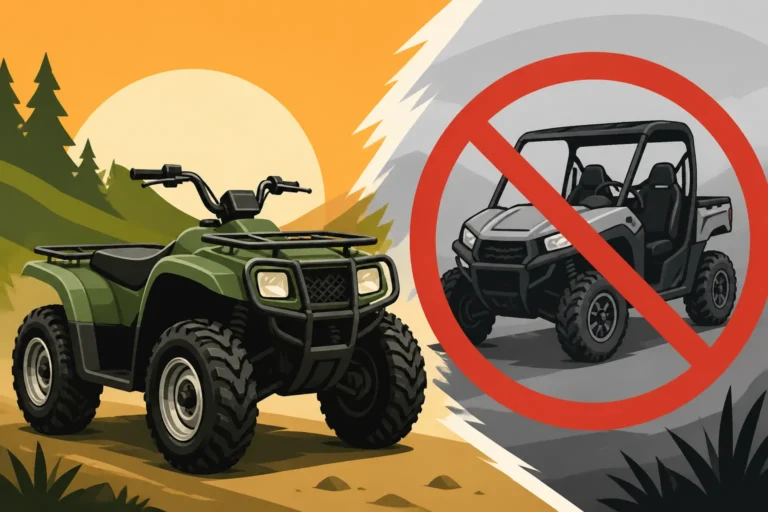
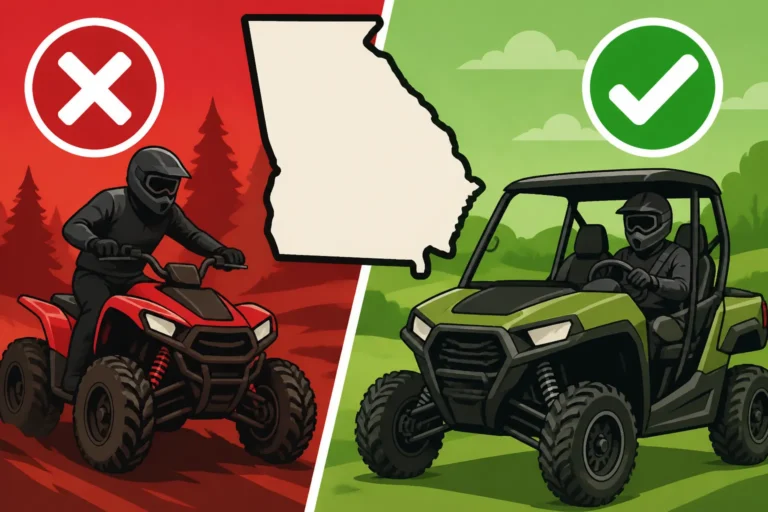
The MPOHV registration is entirely [Georgia MPOHV Registration Is Voluntary]. You don't have to get one if you're happy sticking to private land. However, if you plan to venture onto any public road, even briefly, you absolutely must meet all the registration criteria and display a valid MPOHV license plate. Failure to do so can lead to citations and penalties, which is a headache nobody wants. The intent behind this law was to provide a legal pathway for certain larger, more stable off-highway vehicles, like many side-by-sides, to traverse local county roads where traffic is minimal and speeds are lower, assisting in daily tasks or recreational access. For most ATVs, which involve a straddle seat and handlebars, this registration pathway is generally not an option, as the MPOHV definition excludes them. [Are Side-by-Sides Street Legal in Georgia?] delves into this distinction further.
Navigating the Georgia MPOHV Registration Process
Deciding to register your machine for road use in Georgia isn't just a matter of showing up at the tag office. There's a comprehensive set of hoops you need to jump through, primarily centered around ensuring your machine meets very specific criteria and that you have all your ducks in a row paperwork-wise.
Why Even Consider Registration for Road Use?
For many, the question isn't just can I register, but why bother? If you've always ridden on private land, adding another layer of regulation might seem unnecessary. However, the benefits of MPOHV registration for certain users are considerable. Imagine being able to legally drive your UTV from your property directly to a nearby trailhead, or to connect two non-contiguous parcels of land without having to trailer your machine. For hunters, it can mean easier access to remote hunting grounds via county roads during hunting season. For farmers, it simplifies moving equipment or supplies short distances between fields. This newfound access can significantly enhance the utility and convenience of your off-road vehicle. Understanding [What Registration Buys You on a County Road] highlights these advantages.
It's also worth noting that this road access isn't permanent. [Georgia's ATV Road Access Law Sunsets in July 2027], meaning the legislation enabling this registration has an expiration date. While it's always possible laws could change or be renewed, for now, this limited road access has a defined lifespan. This adds another dimension to the decision-making process for those considering registration.
The Gauntlet of Eligibility Requirements
This is where many machines, especially traditional ATVs, hit a roadblock. Georgia's MPOHV rules are designed to be quite selective, focusing on machines that more closely resemble a small car in terms of stability and operator position rather than a typical quad. The state has an [Georgia MPOHV Eligibility: The Eight-Point Test] that your machine must pass to even qualify.
These points scrutinize everything from your machine's width and weight to its top speed, seating arrangement, and safety features. For example, your machine needs a steering wheel, not handlebars, and seat belts are a must. It also requires side-by-side seating, explicitly excluding machines where the operator straddles the engine. This immediately disqualifies most traditional ATVs. This is why [Why Georgia Will Not Register an Ordinary Quad] or [Why a Georgia Sportsman Cannot Be Registered] is a common frustration for many riders. The rules are specifically tailored for Utility Task Vehicles (UTVs) or side-by-sides that meet strict safety and design criteria.
Essential Paperwork and the County Tag Office Role
Once you're confident your machine meets the physical requirements, you'll need to gather a stack of documents before heading to your local [Where the County Tag Office Fits In]. The process is handled at the county level, just like car registrations. You'll need proof of ownership, which, for an MPOHV, often comes in the form of a bill of sale or an ownership affidavit if the machine was purchased privately without a traditional dealer title. [Georgia Ownership Affidavit for an MPOHV] can be a crucial document here, especially for older machines or those with a long chain of private owners.
You'll also need to prove that [Georgia Sales Tax Paid Before Registration]. Even for a private sale, Georgia typically requires sales tax to be paid before you can register the vehicle. If you've already paid it to a dealer, you'll have documentation. If it was a private sale, you might need to declare it at the tag office. Additionally, [Georgia Liability Insurance Tied to Registration] is non-negotiable. You cannot get an MPOHV plate without proving you have the minimum liability coverage required by the state. When preparing your bill of sale or other ownership documents, especially for private transactions, resources like LawDepot can be incredibly helpful to generate legally sound forms that clearly establish ownership and transaction details, smoothing out the process at the tag office.
The Practical Implications: Rights, Responsibilities, and Restrictions
So, you've weighed your options, navigated the requirements, and your MPOHV now proudly displays a Georgia plate. What does this new status actually mean for how and where you can ride, and what responsibilities do you now carry?
What Registered Road Use Entails
The most important takeaway is that MPOHV registration does not grant you carte blanche to drive anywhere. The primary allowance is for [Georgia MPOHV Road Rules: County Roads Only]. This means you can't cruise down state highways (like those marked with "GA-"), federal routes, or interstates. Even crossing these larger roads requires specific conditions and is generally only permitted at designated intersections where it's safe and legal. [Georgia UTV Rules Crossing a State Route] explains this nuance.
Your machine must also be equipped with certain safety features. [Headlights, Brake Lights and Mirrors on the Checklist] are non-negotiable. Many UTVs come standard with these, but if yours doesn't, you'll need to add them. You must also carry valid [Georgia Driver's License Rules for MPOHV Operators] and have the required [Georgia Insurance Minimums for Road Use]. These are the same liability minimums as for cars and trucks, ensuring that you're covered in case of an accident. Operating an MPOHV on public roads comes with the same legal responsibilities as driving any other vehicle.
Continuing to Enjoy Private Land, Registered or Not
One common misconception is that once you register your MPOHV, you're somehow restricted on private land. This isn't true at all. The MPOHV registration pertains only to its use on public roads. If your side-by-side is registered for county road use, you can still absolutely ride it on your own property or permitted private land without any additional restrictions imposed by the state.
Conversely, if you own an ATV that can't be registered as an MPOHV, or you simply choose not to register your eligible UTV, you can continue to ride it exclusively on private land just as you always have. The rules for private land use remain largely unchanged by the MPOHV legislation. You're still responsible for your own safety, respecting property boundaries, and managing noise, but the state's MPOHV equipment and licensing requirements don't apply to off-road activities on private property. This means you can have a mix of registered and unregistered machines, or ride your registered machine in an unregistered context, all within the bounds of private property.
The Consequences of Misunderstanding the Rules
Ignorance of the law is never a valid defense, and the penalties for misusing your ATV or UTV on public roads in Georgia can be significant. If you operate an unregistered machine on a public road, you could face fines, vehicle impoundment, and other legal repercussions. Similarly, taking a registered MPOHV onto a state highway or interstate is a clear violation. [Georgia Penalties for an Unregistered Road Machine] can range from simple fines to more severe consequences, depending on the nature of the infraction.
Law enforcement officers, especially county deputies, are now equipped with the knowledge and tools to identify improperly operated off-highway vehicles. [What Georgia Deputies Check on a County Road] includes looking for valid MPOHV plates, checking driver's licenses, and verifying insurance. They'll also be looking for the required safety equipment. Having clear documentation of ownership, even for private land machines, is crucial. If you've ever purchased a machine privately, especially without a title, ensuring you have a detailed bill of sale or ownership agreement (which you can draft using a service like LawDepot) is invaluable. This protects you by documenting the transfer of ownership, preventing any disputes or complications down the road, even if your primary use remains on private land.
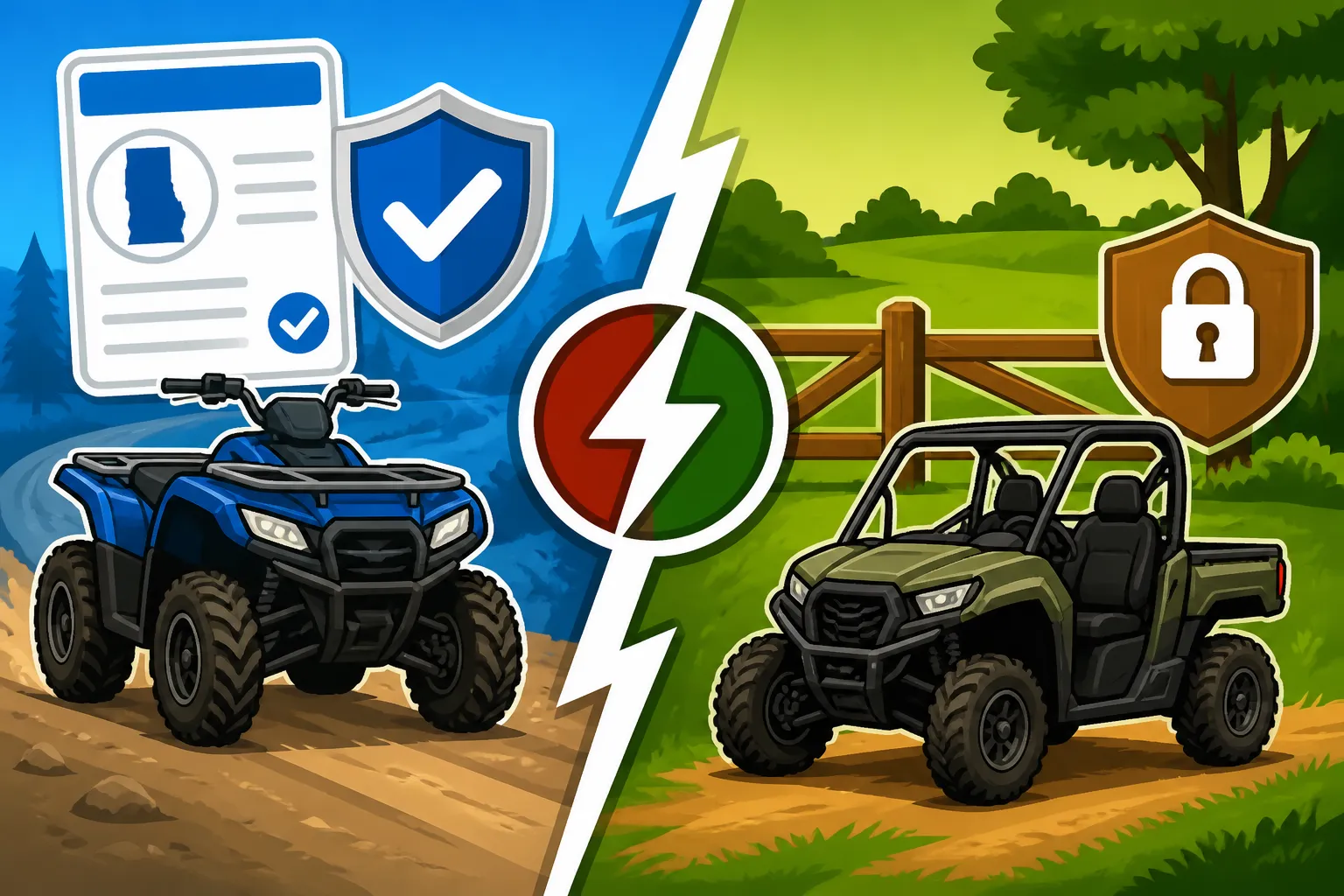
Private Land Use vs. Registered MPOHV Use
To help clarify the differences, here's a quick comparison:
| Feature | Private Land Use (Unregistered) | Registered MPOHV Use (County Roads) |
|---|---|---|
| Registration Required | No | Yes |
| License Plate | No | Yes |
| Legal Road Access | None (except private roads/trails) | Limited to designated county roads/crossings |
| Driver's License | Not legally required by state (though advised for safety) | Required (standard Georgia driver's license) |
| Insurance | Not legally required by state (personal property advised) | Minimum liability insurance legally required |
| Equipment Requirements | Generally none (local ordinances may vary) | Specific requirements: headlights, brake lights, mirrors, seat belts, etc. |
| Machine Type | ATVs, UTVs, dirt bikes, etc. | Specific UTVs/side-by-sides meeting 8-point test; no ATVs |
| Helmet Law (Under 18) | Applies if on private land or public land | Applies for all riders under 18 on public roads |
| State Highways/Interstates | Never allowed | Never allowed |
| Sunset Date | N/A | July 1, 2027 (for road access) |
Ultimately, the choice to register your ATV or UTV in Georgia hinges on your intended use. If your machine stays strictly on private property, then the MPOHV registration is a voluntary option you can safely skip. However, if you plan to utilize the limited access to county roads for convenience or necessity, understanding and adhering to the stringent registration requirements and ongoing responsibilities is absolutely critical. Be informed, be safe, and ride smart, no matter where your adventures take you.
Disclaimer
This article is for general informational purposes only and does not constitute professional advice. Laws, prices and regulations vary by location and change over time. Consult a qualified professional for guidance on your specific situation.