Yamaha Viking Owners and Georgia Rules
You've got a fantastic machine with a Yamaha Viking, whether it's the versatile Viking VI for the whole crew or a standard two-seater built for tough jobs and weekend fun. But owning such a powerful side-by-side in Georgia often brings a nagging question: can you legally take this beast on the road, even just to get to the next hunting spot or cross a county line? This guide is going to walk you through Georgia's specific rules for registering and operating your Yamaha Viking, making sense of the sometimes confusing MPOHV regulations so you can ride with confidence.
Understanding Your Yamaha Viking's Eligibility for Georgia Registration
Let's face it, nobody wants to go through the hassle of paperwork only to find out their machine doesn't even qualify. The good news for most Yamaha Viking owners is that these utility side-by-sides are generally well-suited for Georgia's Motorized Play Vehicle/Off-Highway Vehicle (MPOHV) registration, which allows limited public road use. However, it's not a blanket approval. You need to meticulously check your specific model against a list of eight key criteria. Many of these points are specifically designed to differentiate true side-by-sides from traditional ATVs or even golf carts.
The Steering Wheel and Non-Straddle Seat Rule
This is one of the biggest hurdles for many off-highway vehicles, but your Yamaha Viking typically sails right through. Georgia law explicitly requires that any machine registered as an MPOHV must have a steering wheel for control, not handlebars. This immediately rules out traditional ATVs and dirt bikes, which require a straddle-type seat and handlebars. Fortunately, the Yamaha Viking, whether it's a two-seater or the larger VI model, comes standard with a steering wheel, just like a car or a small truck.
In addition to the steering mechanism, the law also mandates a non-straddle seat. This means you sit in the vehicle, not on it with one leg on either side. Again, your Yamaha Viking is designed with bench-style or bucket seats, where you sit fully within the machine, much like a conventional vehicle. This design choice is a major reason why side-by-sides like the Viking are even considered for MPOHV registration in the first place, setting them apart from other off-road machines. It's a key distinction that reflects the intent of the law to allow more car-like off-road vehicles onto certain public roads. You can dive deeper into this specific requirement by checking out [Why Georgia's MPOHV Rules Demand a Non-Straddle Seat].
Weight, Width, and Payload Capacity
When it comes to size and capability, Georgia has some very specific boundaries for MPOHV registration. These aren't just arbitrary numbers; they're in place to ensure that machines sharing county roads don't pose undue hazards or take up too much space.
First, your Yamaha Viking must be 80 inches wide or less. This measurement is taken from the widest point of the vehicle, excluding mirrors. Most Yamaha Viking models are designed with a width around 62-64 inches, which comfortably falls within Georgia's [Georgia's 80-Inch Width Limit for Registration]. This is a critical measurement, especially if you've added aftermarket accessories like wider tires or fender flares. Always double-check your specific model's specifications or measure it yourself to be absolutely certain.
Next, there's a gross vehicle weight ceiling. Your machine, fully loaded with passengers, cargo, and fuel, cannot exceed 4,000 pounds. A typical Yamaha Viking weighs in the range of 1,500 to 1,700 pounds dry. Even with a full tank, a few passengers, and some gear, it's highly unlikely that a standard Viking would push past the [Georgia's 4,000-Pound Gross Weight Ceiling]. However, if you've heavily modified your machine with heavy accessories like snow plows, winches, or extensive cages, it's wise to get an accurate weight measurement.
Finally, the law specifies a minimum payload capacity of 350 pounds. This ensures the machine isn't just a toy but has practical utility. Yamaha Vikings are built for work and recreation, often boasting payload capacities of 600 pounds or more, easily meeting [Georgia's 350-Pound Payload Requirement]. This figure covers the weight of passengers and any cargo you might be carrying. These weight and size restrictions are about ensuring safety and compatibility with other road users, so verifying your Viking meets them is non-negotiable.
Speed Requirements and Factory Safety Features
Georgia's MPOHV rules also consider how fast your Yamaha Viking can go and what safety equipment it has. These are crucial for integrating these machines safely onto shared county roads.
Your Viking needs to have a top speed capability between 25 miles per hour and 65 miles per hour. Machines that are too slow could impede traffic, while those designed for extreme high speeds might be deemed too dangerous for general road use. Most Yamaha Viking models have a top speed that typically falls within this range, often around 50-60 mph, making them compliant with [Georgia's 25 to 65 mph Speed Requirement]. This specification is usually easy to find in your owner's manual or on the manufacturer's website. If you've tinkered with your engine or added performance modifications, you'll need to verify its current top speed.
Furthermore, factory-installed seat belts are a must. Your Yamaha Viking, like most modern side-by-sides, comes equipped with seat belts for all designated seating positions. These aren't just for off-road safety; they become a legal requirement when operating on public roads under the MPOHV registration. It's vital that these seat belts are in good working order and that all occupants wear them when operating on a public road. Beyond seat belts, your Viking also needs working headlights, brake lights, and at least one rearview mirror. Most Vikings come standard with these features, though you might need to ensure your mirrors offer adequate visibility for road use. You can read more about this in [Georgia Requires Seat Belts on a Registered Machine].
The All-Important Build Date
There's one more critical factor that can make or break your Yamaha Viking's eligibility: its manufacture date. Georgia law states that to qualify for MPOHV registration, the machine must have been manufactured on or after January 1, 2000. This is a hard cutoff. If your Yamaha Viking was built before this date, it simply won't be eligible for MPOHV registration, regardless of how well it meets all the other criteria.
For most Yamaha Viking owners, this won't be an issue, as the Viking model line itself was introduced well after 2000. However, if you're purchasing a used machine, especially an older model from a different manufacturer that might share similar characteristics, always double-check the vehicle's manufacturing date. This date is typically found on a VIN plate or sticker, often located on the frame, under the hood, or in the glove box. This rule helps ensure that registered machines meet more modern safety and emissions standards. For more information, see [Machines Built Before 2000 and Georgia Registration].
Why Register Your Yamaha Viking in Georgia?
You might be thinking, "My Viking is for the trails and my land, why would I bother with registration?" It's a fair question, and the answer lies squarely in expanding your options for how and where you can use your machine. Georgia's MPOHV registration system is entirely voluntary. No one is going to force you to register your Yamaha Viking. However, there are some very compelling reasons why many owners choose to do so, primarily centered around accessing public roads and ensuring you have proper insurance coverage.
Unlocking County Road Access
The primary motivation for most Yamaha Viking owners to register their machine as an MPOHV is the ability to legally operate it on certain public roads. Without registration, your Viking is strictly limited to private property or designated off-road trails. Imagine being able to ride from your property to a friend's house a few miles down a dirt county road, or using your machine to access different parts of your hunting lease without having to trailer it everywhere. That's the freedom registration offers.
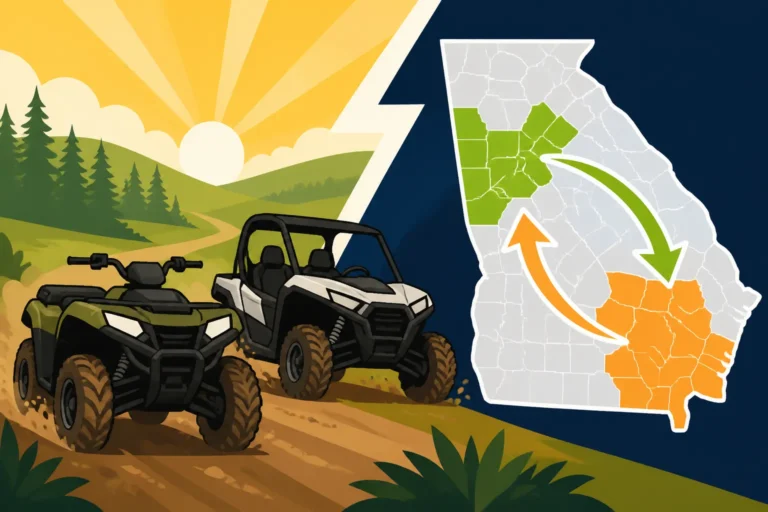
Specifically, a registered Yamaha Viking can be driven on public county roads across Georgia. This does not include state highways, federal routes, or interstates. You might be able to cross a state highway at a designated intersection, but cruising down one is a definite no-go. This ability to use county roads can be incredibly convenient for farmers, hunters, or anyone who lives in a rural area with a network of unpaved or lightly trafficked county roads. It closes that frustrating gap where you're technically "street legal" enough for low-speed county travel but entirely excluded from higher-speed state routes. For detailed rules on where you can ride, check out [Georgia MPOHV Road Rules: County Roads Only]. It's important to remember that this road access isn't permanent; [Georgia's July 2027 Sunset on Road Access] is a critical date for all MPOHV owners to be aware of, as the law allowing this access is set to expire.
The Connection Between Registration and Insurance
Another significant benefit, and often a requirement once you hit public roads, is the tie between MPOHV registration and liability insurance. When you operate any vehicle on a public road in Georgia, you are legally required to carry a minimum amount of liability insurance. Your standard off-road policy for private land use might not cover you when you're on a public thoroughfare. Registering your Yamaha Viking as an MPOHV typically requires you to provide proof of this liability insurance to the Department of Revenue through your county tag office.
This isn't just about avoiding a ticket; it's about protecting yourself financially. Accidents can happen anywhere, and if your Viking is involved in an incident on a county road, having proper liability coverage is paramount. It protects you from the financial fallout if you're found at fault for property damage or injuries to others. Most insurance providers offer specific policies for side-by-sides that can be endorsed for on-road use once registered. Speaking with your insurance agent is crucial to ensure you have the correct coverage for your registered Yamaha Viking. It gives you peace of mind knowing you're protected, whether you're working on the farm, heading to a fishing spot, or just enjoying a casual ride on a country lane. Learn more about this crucial link at [Georgia Liability Insurance Tied to Registration].
Navigating the Georgia MPOHV Registration Process
Okay, you've confirmed your Yamaha Viking meets all the eligibility requirements, and you've decided the benefits of registration are worth it. Now comes the practical part: getting it registered. While it might seem daunting, it's a relatively straightforward process once you know what documents to gather and where to go.
Gathering Your Paperwork: Proof of Ownership and Affidavits
The foundation of any vehicle registration is proving you legitimately own the machine. Since Georgia does not title ATVs or UTVs, the process for proving ownership for an MPOHV is a bit different from a car or truck. You'll primarily rely on a clear chain of ownership documents.
First and foremost, you'll need a bill of sale. If you bought your Yamaha Viking new from a dealer, you should have a detailed dealer invoice or bill of sale. If you purchased it used from a private seller, you need a bill of sale signed by both you and the previous owner, clearly identifying the machine by its Vehicle Identification Number (VIN). This document should outline the purchase price, date of sale, and contact information for both parties. Without a clear bill of sale, establishing ownership can become significantly more complicated. Sometimes, when a machine has changed hands multiple times without proper documentation, it creates a chain of ownership gap that needs to be addressed. You can find templates for a robust bill of sale on platforms like LawDepot, which can help ensure all necessary information is included.
In addition to your bill of sale, you'll need to complete a Georgia Department of Revenue form, specifically Form MV-OHV, which is an affidavit for Motorized Play Vehicles/Off-Highway Vehicles. This form requires you to attest to various facts about your Yamaha Viking, including its characteristics, proof of ownership, and that you meet the eligibility criteria. You'll also need to provide proof of your Georgia residency, typically with a valid Georgia driver's license or state ID. If you're a new resident, there are specific steps to follow. Finally, as mentioned earlier, you must present proof of liability insurance that meets Georgia's minimum requirements for vehicles operated on public roads. This usually comes in the form of an insurance card or a declaration page from your insurer. If you're unsure about what is required, it's always best to contact your county tag office beforehand.
The Role of Your County Tag Office
Once you have all your documents in order, the next step is to visit your local county tag office. This is where the actual registration takes place. The process is handled at the county level, meaning you'll need to go to the tag office in the Georgia county where you reside.
When you arrive, a representative will review your paperwork, including your bill of sale, the completed MV-OHV affidavit, and proof of insurance. They will verify your identity and residency. There will be a registration fee, which is typically a modest amount and must be paid at the time of registration. Remember, the MPOHV registration is a new program, so while staff are becoming more familiar with it, it's always a good idea to be patient and have all your documents clearly organized. You can find detailed steps on what to expect by reading [Georgia County Tag Office Steps for an MPOHV]. They may also perform a visual inspection of your Yamaha Viking, or require a T-22B inspection certificate, to confirm it meets the physical requirements like lights, mirrors, and seat belts. This helps ensure compliance with the law before a plate is issued.
What Happens After Registration
After your application is approved and fees are paid, you'll receive a Georgia MPOHV license plate and a registration decal. The plate must be securely attached to the rear of your Yamaha Viking, clearly visible. The decal, which indicates the year of registration, will be placed on the plate itself.
It's important to understand that this registration needs to be renewed annually. You'll receive a renewal notice, typically by mail, reminding you to update your registration and pay the annual renewal fee. Maintaining continuous insurance coverage is also critical, as any lapse could jeopardize your registration. If you sell your registered Yamaha Viking, you'll need to follow specific procedures to transfer the registration or cancel it, ensuring the next owner can properly register it in their name. This includes providing the buyer with a new bill of sale and possibly a notice of sale to the county. This entire process is designed to bring a level of accountability and safety to side-by-sides operating on public roads, much like any other registered vehicle.
Operating Your Registered Yamaha Viking on Georgia Roads
So, your Yamaha Viking is registered, and you've got your shiny new plate. Fantastic! But registration doesn't mean you can just hit any road you want. There are still very specific rules you need to follow when operating your MPOHV on Georgia's public roadways. Understanding these limitations is key to avoiding fines and staying safe.
Where You Can and Cannot Ride
This is perhaps the most critical point for any registered Yamaha Viking owner in Georgia: your machine is only permitted on county roads. Let me repeat that – county roads only. This means those unpaved backroads, the gravel paths, and even some paved, less-trafficked roads managed by the county government. You cannot, under any circumstances, operate your registered Yamaha Viking on state highways, federal routes, or interstate highways. These are strictly off-limits for MPOHVs.
There's one exception to the "county roads only" rule, and that's when you need to cross a state highway. If your route on a county road requires you to briefly traverse a state highway to get to another county road, you can do so, but it must be at an intersection where it's safe and practical. You cannot drive along a state highway; the crossing must be as direct as possible. This distinction is crucial for many rural riders who might have county roads on either side of a state route. Always be aware of the road signs and markings to determine which jurisdiction a road falls under. Misinterpreting this rule can lead to significant penalties, including fines and potential impoundment of your machine.
Driver Requirements and Safety
Operating a registered Yamaha Viking on Georgia's county roads comes with specific responsibilities for the driver and passengers. First, the operator must possess a valid Georgia driver's license. This isn't a learner's permit or an ATV safety certificate; it's a full-fledged driver's license. This ensures that anyone behind the wheel of a registered MPOHV has met the basic requirements for operating a motor vehicle on public roads.
Beyond the driver's license, safety equipment requirements are paramount. All occupants, including the driver and passengers, must wear seat belts if the MPOHV is equipped with them – which your Yamaha Viking will be. For riders under the age of 18, there is a helmet requirement. This rule applies even if you're riding on a county road. While adults have the option, minors do not. Ensuring all safety gear is used, and that your Yamaha Viking's lights, brakes, and mirrors are in good working order, is not just about compliance, but about preventing accidents. Remember, you're sharing the road with other vehicles, including cars and trucks, and visibility is key, especially when riding after dark.
The Looming Sunset Date
There's one final, very important piece of information that all Georgia MPOHV owners need to be aware of: the law allowing this type of registration and road access has a sunset clause. As it stands, the ability to operate registered MPOHVs on Georgia county roads is set to expire on July 1, 2027.
What does this mean for Yamaha Viking owners? It means that while you can register your machine and enjoy county road access now, this privilege is not permanent. As the sunset date approaches, lawmakers will have to decide whether to renew the law, modify it, or let it expire. It's a critical date because if the law is not renewed, your registered Yamaha Viking would revert to being a strictly off-road vehicle, limited once again to private land and designated trails. Keeping an eye on legislative updates as this date draws closer will be essential for planning your future riding activities. This uncertainty is a reality that current and prospective MPOHV owners in Georgia must consider.
| MPOHV Eligibility Criterion | Yamaha Viking (Typical) | Georgia Requirement | Notes for Owners |
|---|---|---|---|
| Steering Control | Steering Wheel | Steering Wheel | No handlebars permitted. |
| Seating Type | Non-Straddle (Bench/Bucket) | Non-Straddle Seat | Must sit "in," not "on." |
| Overall Width | 62-64 inches | <= 80 inches | Measure with accessories. |
| Gross Vehicle Weight | 1,500-1,700 lbs dry | <= 4,000 lbs | Incl. passengers, cargo, fuel. |
| Payload Capacity | 600+ lbs | >= 350 lbs | Easily met by most models. |
| Minimum Speed | 25-30 mph | >= 25 mph | Avoid impeding traffic. |
| Maximum Speed | 50-60 mph | <= 65 mph | Not designed for highway speeds. |
| Manufacture Date | Post-2000 | >= Jan 1, 2000 | Check VIN plate for date. |
| Seat Belts | Factory installed | Required | For all designated seating positions. |
| Lights & Mirror | Headlights, Brake Lights, Rearview Mirror | Required | Ensure functionality and adequate visibility. |
Disclaimer
This article is for general informational purposes only and does not constitute professional advice. Laws, prices and regulations vary by location and change over time. Consult a qualified professional for guidance on your specific situation.