Headlights, Brake Lights and Mirrors on the Checklist
It's incredibly frustrating when you're trying to do everything right, follow the rules, and get your beloved side-by-side or UTV legally registered for those county road excursions in Georgia, only to feel lost in a sea of requirements. One of the most common sticking points for many riders, and frankly, a place where many machines fall short right out of the box, involves the mandatory safety equipment. This comprehensive guide is here to shed light on precisely what Georgia expects in terms of headlights, brake lights, and mirrors for your Multipurpose Off-Highway Vehicle (MPOHV) to sail through the registration process, saving you headaches and repeat trips to the tag office.
Understanding Georgia's MPOHV Equipment Mandates
Navigating the world of off-highway vehicle (OHV) registration in Georgia can feel like trying to hit a moving target, especially when you consider all the specific criteria your machine needs to meet. It's not just about having a side-by-side; it's about having one that's specifically equipped for the road, even if only for limited county road access. These equipment mandates—headlights, brake lights, and mirrors—aren't arbitrary hoops to jump through. They are fundamental safety requirements designed to protect you and everyone else sharing Georgia's county roads.
Why These Specific Items Matter for Road Use
Think about the dynamics of shared roadways for a moment. Whether you're driving a pickup truck, a sedan, or now, potentially your MPOHV, effective communication and visibility are paramount. Headlights ensure that other drivers can see you, particularly during adverse weather or low-light conditions, and help you illuminate the path ahead. Without them, your UTV becomes practically invisible, a dangerous hazard waiting to happen. Brake lights are your primary means of signaling your intentions to traffic behind you, indicating when you're slowing down or stopping. Imagine the chaos and potential for rear-end collisions if a driver behind you has no warning of your deceleration. Finally, mirrors provide you, the operator, with a critical view of what's happening behind and to the sides of your vehicle, allowing you to make safe lane adjustments or turns.
These items are not just about personal safety; they are about integrating your off-road machine into a system of traffic that relies on these universal visual cues. Georgia's Department of Driver Services (DDS) and county tag offices are tasked with ensuring that any vehicle granted permission to operate on public roads meets a minimum standard for safety and visibility. Overlooking these details isn't just a matter of convenience; it's a matter of public safety.
The MPOHV Checklist: An Overview
When you're preparing to register your side-by-side or UTV as an MPOHV in Georgia, it’s not just a casual glance the county tag office gives it. There's a specific, multi-point eligibility test your machine must pass. While many of the points relate to the physical dimensions and capabilities of the vehicle—such as its speed range, weight limits, and whether it has a non-straddle seat—a significant portion of the inspection focuses on its active safety equipment. [Georgia MPOHV Eligibility: The Eight-Point Test] outlines all the criteria, but the lighting and mirror components are often where standard off-road machines require upgrades.
The state isn't asking for every single feature found on a modern passenger car, but it is demanding the absolute essentials for road safety. This means functional headlights that actually light up the road, bright brake lights that activate when you hit the pedal, and mirrors that allow you to see what’s coming up behind you. Many factory-standard side-by-sides are built primarily for trails and may have rudimentary lighting that doesn't quite meet the brightness or coverage requirements for road use. It's crucial to review your machine's current setup against these standards before you head to the tag office, as failing this equipment check will send you home to make modifications, delaying your registration.
Headlights: Illuminating the Path Forward
When you think about driving any vehicle on a public road, headlights are probably one of the first things that come to mind. They're not just for spotting deer darting across a dirt road at dusk; they're fundamentally about ensuring you're seen by other vehicles and that you can clearly see the road ahead. For your MPOHV in Georgia, the headlight requirement is straightforward but crucial.
Function and Visibility for Day and Night
Georgia's MPOHV rules expect headlights that do more than just glow dimly. They need to provide adequate illumination for the operator to see the roadway clearly for a safe distance, especially if you plan on any [Georgia Night Riding on a County Road]. More importantly for daytime visibility, they serve as a critical "be seen" device. In many states, and certainly with the intent behind Georgia's MPOHV registration, daytime running lights or simply having your headlights on during the day are common safety practices. This is particularly vital for a smaller vehicle like an MPOHV, which can be harder to spot in traffic compared to a full-size truck.
Consider driving conditions beyond just darkness: heavy rain, fog, or even just a gloomy overcast day can significantly reduce visibility for all drivers. Functional, bright headlights cut through these conditions, making your MPOHV's presence undeniable. The goal is not just to comply with a checklist item, but to actively enhance your safety and the safety of others. If your current factory headlights seem a bit weak or are designed more for trail aesthetics than serious illumination, you might need to consider an upgrade to ensure they meet the spirit and letter of the law.
Legal Number, Placement, and Condition
Generally, an MPOHV is expected to have two headlights, mounted symmetrically on the front of the vehicle. These should emit a white or amber light, not blue or red, which are reserved for emergency vehicles. The placement must be secure; you don't want headlights bouncing around on rough terrain or falling out of alignment. Furthermore, the lenses must be intact, clean, and free from cracks or significant discoloration that could impede light output.
The inspector at the county tag office isn't going to pull out a lux meter to measure brightness, but they will certainly perform a visual check for functionality and appropriate placement. They want to see that both headlights light up, are aimed reasonably straight ahead, and are bright enough to be clearly visible. If you've installed aftermarket lights, ensure they are designed for road use and don't create excessive glare for oncoming traffic. A good rule of thumb is that if your headlights would pass inspection on a motorcycle or a car, they should generally be acceptable for your MPOHV. Remember, the entire point of allowing MPOHVs on county roads is conditional on them meeting basic road safety standards, and proper lighting is at the top of that list.
Brake Lights: Signaling Your Intentions
Among the array of safety features on any road-going vehicle, brake lights hold a singularly crucial role: communicating your intent to slow down or stop to anyone behind you. For an MPOHV in Georgia, this isn't just a suggestion; it's a non-negotiable requirement for registration.
Instantaneous and Visible Notification
When you hit the brakes, those red lights at the back of your MPOHV need to light up immediately and with sufficient brightness to be seen clearly by following traffic, even in bright Georgia sunshine. There should be no delay, no flickering, and no guesswork involved. Think about driving down a county road with traffic behind you; every split second counts in preventing a rear-end collision. Your brake lights are the silent, yet most urgent, warning system you have.
Many off-road machines come standard with basic taillights that might glow dimly with your headlights, but true, dedicated brake lights are often an aftermarket addition or an upgrade needed for road legality. The key difference is that brake lights illuminate significantly brighter only when the brakes are applied. If your machine currently only has taillights that are always on or don't noticeably brighten with braking, you'll need to address this before attempting registration. This is one of those items that is almost guaranteed to be a point of failure during a [Georgia T-22B Inspection Certification] if not properly implemented.
Red Light Requirements and System Reliability
Georgia's requirements for brake lights specify a steady red light that activates when the operator engages the braking system. Like headlights, these lights must be securely mounted on the rear of the machine, typically one on each side, though a single, centrally mounted brake light might be acceptable if it meets visibility requirements. The lenses must be red, intact, and free of cracks.
Beyond just their presence, the reliability of your brake light system is paramount. The wiring needs to be robust, protected from the elements, and free of corrosion or loose connections that could cause intermittent failure. Because MPOHVs often traverse rough terrain, their electrical systems can take a beating. It’s a good idea to periodically check your brake lights – ask a friend to observe them while you press the brake pedal – to ensure they are working consistently. If you're building a new machine or significantly modifying an existing one, you might consider using a reputable online resource like LawDepot for creating a bill of sale to document your ownership, and this process might remind you to double-check all your safety features before any legal transactions. The peace of mind that comes from knowing your brake lights are always ready to communicate your actions is priceless on the road.
Mirrors: Seeing What's Behind You
While headlights and brake lights tell others where you're going and what you're doing, mirrors provide you, the operator, with vital information about your surroundings, particularly what's happening behind you. Georgia's MPOHV registration mandates that your machine has at least one rearview mirror, and for good reason.
Ensuring a Clear View of Following Traffic
Imagine trying to merge onto a county road or simply make a left turn without knowing if there's a vehicle hot on your heels. It's not only dangerous but virtually impossible to do safely. A properly positioned and functional rearview mirror (or mirrors) eliminates this blind spot, giving you a clear, unobstructed view of the road behind your machine. This awareness is critical for defensive driving and allows you to react to changing traffic conditions, such as a faster vehicle approaching from the rear.
Many side-by-sides come with a small center mirror, which might be sufficient, but others may only have basic side mirrors (or none at all) designed more for trail navigation than highway visibility. For road use, the expectation is that the mirror allows you to clearly see vehicles approaching from the rear without having to strain or turn your head excessively. While one mirror is the minimum, many experienced MPOHV operators find that having two side mirrors significantly enhances safety and comfort, providing a wider field of view and reducing blind spots.
Placement, Size, and Field of Vision
The mirror must be securely attached to your MPOHV, whether it’s a central rearview mirror mounted on the windshield frame or side mirrors affixed to the roll cage. It should remain stable and not vibrate excessively to the point where the image becomes blurry. The size of the mirror face is also important; it needs to be large enough to provide a useful field of vision, not just a tiny reflection. Inspectors will look for [Rearview Mirrors on the Required List] and confirm they are not cracked, broken, or dislodged.
While Georgia typically requires just one rearview mirror, if your machine is wide, two side mirrors often provide a much more comprehensive view, especially for [Georgia MPOHV Road Rules: County Roads Only] where you might be sharing the lane with faster vehicles. Some riders opt for convex mirrors which offer a wider angle of view, though they do make objects appear farther away than they are, requiring a bit of adjustment for the operator. The key takeaway is that the mirror must actually be functional and allow you to safely monitor traffic to your rear. Don't underestimate this seemingly simple requirement; it's a fundamental component of safe road operation for any MPOHV.
Beyond the Big Three: Other Essential Equipment Considerations
While headlights, brake lights, and mirrors are the primary focus for Georgia's MPOHV registration equipment checklist, thinking strategically about other common road-vehicle components can significantly enhance your safety and the likelihood of a smooth experience once you're on public roads. Even if not explicitly listed as a registration requirement, many of these are essential for practical, safe, and legal road operation.
Turn Signals and Horns: Communicating Intent
It's true that the core MPOHV registration checklist in Georgia doesn't always explicitly call out turn signals as a standalone item for every machine, but imagine trying to navigate a two-lane county road without them. How would you signal a left turn across traffic, or indicate a lane change? Hand signals are an option, but in a side-by-side with a roll cage and often a partial enclosure, they can be difficult for other drivers to see clearly. For this reason, adding a functional set of amber turn signals – front and rear – is highly recommended. Many aftermarket kits integrate seamlessly with existing wiring and switches, providing a crucial layer of safety.
Similarly, a horn, while not always an explicit registration item for MPOHVs, is a fundamental piece of [Georgia Equipment a Road Machine Must Carry] for any vehicle sharing the road. It's your primary auditory warning device, essential for alerting distracted drivers, pedestrians, or even wildlife that might pose a hazard. A simple, loud, and reliable horn can prevent accidents and is often expected by law enforcement as part of general road safety. While LawDepot might help you with the paperwork for buying or selling a machine, it won't install these safety features for you, so make sure they're on your radar.
Windshields, Wipers, and Seatbelts for Road Comfort and Safety
Beyond the signaling and visibility equipment, other features contribute significantly to a safe and comfortable road-going MPOHV. A full windshield, ideally with a wiper, can dramatically improve visibility in rain, mud, or dusty conditions. While not always a strict MPOHV registration requirement in Georgia, it certainly enhances the driver's ability to see clearly and reduces fatigue from wind and debris.
Perhaps one of the most critical safety features, and one that is a mandatory part of the MPOHV registration, is the presence of seatbelts. If your side-by-side or UTV is designed with seats that have seatbelts, those seatbelts must be present and fully functional. [Georgia Requires Seat Belts on a Registered Machine] for registration purposes, which means no frayed straps, no broken buckles, and secure anchor points. This isn't just a nod to safety; it’s a foundational requirement that acknowledges the potential for rollovers or impacts. Ensuring all occupants have properly working seatbelts, along with helmets for those under 18 (and strongly recommended for all), creates a much safer environment on any shared roadway.
The Inspection Process: Verifying Your Machine
You’ve done your homework, reviewed Georgia's MPOHV requirements, and perhaps even upgraded your machine with new headlights, brake lights, and mirrors. Now comes the moment of truth: the inspection and registration process at your local county tag office. Understanding what to expect during this crucial step can make all the difference between a quick approval and a frustrating return trip.
Preparing for the Tag Office Visit
Before you even hitch up your trailer, conduct a thorough self-assessment of your MPOHV. Does every light work? Are the brake lights bright and activating instantly? Can you clearly see behind you in the mirror(s)? It's much easier to fix an issue in your driveway than at the tag office. Gather all your necessary documentation: proof of ownership (like a bill of sale, perhaps created using a reliable template from LawDepot), proof of Georgia residency, and any sales tax receipts. Having a complete [Georgia MPOHV Registration Paperwork Checklist] will prevent common delays.
Remember, the goal of the inspection isn't to be overly punitive but to ensure your MPOHV meets the basic safety standards for public road use. This isn't a deep dive into the engine or suspension; it's a visual verification of key components, and the lights and mirrors are high on that list. If your machine fails any part of the inspection, you'll be given instructions on what needs to be corrected. This might mean adjusting headlight aim, repairing a wiring issue on a brake light, or securely mounting a new mirror. Being prepared means you can often address minor issues on the spot or return quickly once they're resolved.
The T-22B Form and Law Enforcement Verification
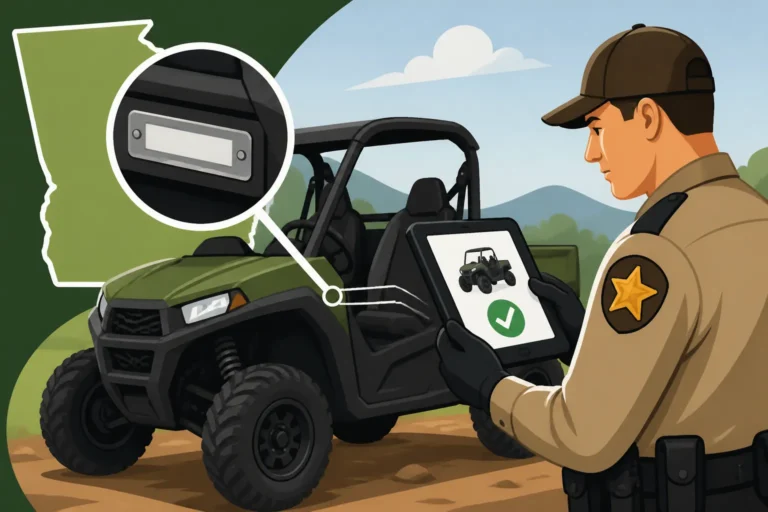
The cornerstone of the MPOHV registration inspection is typically the Georgia Motor Vehicle Division's Form T-22B, titled "Certification of Inspection." This form is a critical document that must be completed and signed by a certified law enforcement officer or another authorized inspector. It's on this form that the inspector will specifically confirm that your MPOHV meets key eligibility criteria, including the functional presence of headlights, brake lights, and mirrors. [T-22B and When You Need It] is a must-read for anyone going through this process.
During this verification, a deputy or other designated personnel will visually check your machine. They will turn on the headlights, press the brake pedal to ensure the brake lights illuminate, and confirm that the mirror(s) provide a clear view to the rear. They'll also verify the machine's VIN, check for any branding, and generally confirm that the machine aligns with Georgia's definition of an MPOHV. It's a straightforward but vital process that bridges the gap between your off-road machine and its legal access to specific county roads. Don't be shy about asking questions if you're unsure about a specific requirement, but ensure your machine is fully compliant before presenting it for this official sign-off.
Disclaimer
This article is for general informational purposes only and does not constitute professional advice. Laws, prices and regulations vary by location and change over time. Consult a qualified professional for guidance on your specific situation.