The January 1, 2000 Build-Date Cutoff
It can be incredibly frustrating to dream of legally riding your beloved off-highway vehicle on Georgia's county roads, only to discover that its age might be the very thing holding it back. Many owners find themselves in a tough spot when they learn about the specific build-date requirements for MPOHV registration. This guide will walk you through Georgia's January 1, 2000, cutoff, explaining exactly what it means for your machine and what options you still have.
Understanding Georgia's Build-Date Cutoff for MPOHVs
Georgia's journey into registering certain off-highway vehicles (OHVs) for limited road use is still relatively new, and with new regulations come specific criteria. One of the most impactful criteria, and often a surprising one for many owners, is the cutoff date for when a machine was manufactured.
Why the Year 2000 Matters to Your Off-Highway Vehicle
The Georgia law establishing the MPOHV (Multipurpose Off-Highway Vehicle) registration system specifically states that a machine must have been "manufactured on or after January 1, 2000." This isn't just an arbitrary date; it's often tied to evolving safety standards, manufacturing processes, and sometimes even emissions regulations that became more prevalent around the turn of the millennium. Legislators often use such dates to ensure that vehicles seeking road access meet at least a baseline of modern design and safety features.
Think about it from the state's perspective: they want to ensure that any machine granted the privilege of sharing public roads, even limited ones, has certain modern engineering considerations. While your older ATV might feel perfectly robust and reliable to you, the state's rule aims for a consistent standard across all registered MPOHVs. It's not about the individual condition of your machine, but its original factory specifications and the year it rolled off the assembly line. This means that if your prized quad was built in 1999, no matter how well-maintained or customized, it simply won't meet this particular requirement for an MPOHV plate.
How to Verify Your Machine's Manufacture Date
Before you get too far down the path of gathering paperwork and heading to your local county tag office, the first crucial step is to verify your machine's exact manufacture date. This information is typically found on a VIN (Vehicle Identification Number) plate or sticker located on the frame of your ATV or side-by-side. Common places to look include:
- The front frame: Often near the handlebars or steering column.
- Under the seat: Sometimes on a cross-member.
- On the left-hand side of the engine casing: Though less common for ATVs/UTVs.
- Owner's manual: The original manual will almost always state the model year and can help confirm the manufacture date.
- Dealer records: If you purchased it from a dealership, they might have records.
The VIN itself contains coded information about the vehicle, including the model year, which often corresponds closely to the manufacture date. If the VIN plate is missing or unreadable, this presents a significant hurdle, as proving the manufacture date becomes nearly impossible. In such cases, you might struggle even with the initial [Georgia T-22B Inspection Certification] process, as the inspector needs clear identification of the machine. Without a clear and verifiable build date of January 1, 2000, or later, your machine will unfortunately not be eligible for MPOHV registration in Georgia.
The Practical Impact of the Cutoff on Your Machine
Discovering that your machine falls on the wrong side of the January 1, 2000, cutoff can be a real letdown, especially if you had plans for road-legal riding. It fundamentally changes how you can use your ATV or side-by-side within Georgia.
Disqualification for Georgia MPOHV Registration
The most immediate and significant impact of owning a machine built before January 1, 2000, is its absolute disqualification from [Georgia MPOHV Registration Explained]. The law is clear and leaves no room for exceptions based on the machine's condition, modifications, or your personal need for road access. This means:
- No plate, no county roads: You will not be able to obtain a distinctive Georgia MPOHV license plate for road use. This directly prevents you from legally operating your machine on designated county roads, even for short distances or to cross a state route at an approved crossing point.
- Failed eligibility: The build date is one of the eight critical points in the [Georgia MPOHV Eligibility: The Eight-Point Test]. Failing this single point means the entire registration process stops there. It doesn't matter if your machine meets the width limit, weight limits, or has all the required safety equipment like seat belts, headlights, and mirrors. The manufacture date acts as a primary gatekeeper.
- Common models affected: Many popular and still widely used older machines fall into this category. For instance, early model Polaris Sportsman 500s, Honda Foreman 400s or 450s, Yamaha Kodiaks, and Suzuki KingQuads from the late 1990s, while excellent machines for trails and private land, simply cannot be registered for road use in Georgia. It’s a bitter pill to swallow for owners who have lovingly maintained these workhorses for years.
What You Can Still Do with an Older Machine in Georgia
While road registration might be off the table for your pre-2000 machine, it doesn't render it useless! There are still plenty of fantastic ways to enjoy your ATV or UTV in Georgia. It just means you'll need to focus your riding on specific environments.
- Private Land Riding: This is, by far, the most common use for any off-highway vehicle, regardless of its age or registration status. If you own land, or have permission from a landowner, you are free to ride your pre-2000 machine to your heart's content. This includes personal property, hunting leases, timber company lands with permission, or any private property where you have explicit consent.
- Designated OHV Parks and Trails: Georgia boasts a number of excellent public and private riding areas specifically designed for off-highway vehicles. Places like [Iron Mountain Resort: Georgia's Biggest Private Park], [Houston Valley OHV Trails in Georgia], and other locations within the [Chattahoochee-Oconee National Forest Riding] offer miles of trails suitable for all skill levels. These parks and trail systems typically only require a park entrance fee or a forest OHV permit, not state road registration, for your machine. Always check the specific park rules for any width or weight restrictions, as these can vary.
- Farm Use Exemptions: If your older machine is strictly used for agricultural purposes on a farm, certain exemptions may apply. Machines used solely for farming, ranching, or other agricultural operations might operate under different rules, but this is highly specific and does not equate to general road legality. It's crucial to understand that "farm use" is a narrow exemption, not a loophole for casual road riding. If your machine is genuinely used for bona fide farm work, you may find the information on [Georgia MPOHV Registration and Farm Use] helpful, though it's important to note the MPOHV registration itself is unlikely to apply due to the build date.
- Off-road events and competitions: Many events, such as mud bogs, obstacle courses, or poker runs, take place on private land or designated event venues, where state road registration is not a factor. You can still participate in these vibrant off-road communities.
Essentially, owning a pre-2000 machine means your adventures will be confined to off-pavement environments. This isn't a total ban, just a clear delineation between recreational/utility use on private or designated lands, and public road access.
Navigating the System with a Pre-2000 Machine
Facing the reality of the January 1, 2000, cutoff can lead to a lot of questions and sometimes, outright frustration. It's important to understand the state's position and how to proceed, whether you're an existing owner or looking to buy.
Common Misconceptions and Frustrations
It's completely understandable to feel a sense of unfairness if your machine is just a year or two too old. Many owners think, "My machine is perfectly safe and runs great! Why can't I get a tag?" This feeling is valid, and it’s a common point of contention among off-road enthusiasts. However, the law isn't designed to evaluate each individual machine's safety on a case-by-case basis. Instead, it relies on broad categories and dates to establish a clear, enforceable standard.
The disappointment of not being able to legally connect trails by riding a short stretch on a county road, or to simply ride down to a neighbor's house without trailering, is a significant hurdle for many. You might hear stories or rumors about exceptions, but when it comes to official MPOHV registration, there simply aren't any for the build-date cutoff. Your local [Where the County Tag Office Fits In] will strictly adhere to the published regulations; they cannot make exceptions or grant waivers based on a machine's condition or owner's plea. The rules are the rules, and for machines built before 2000, that rule means no MPOHV plate.
Preparing for a Sale or Purchase of an Older Machine
Whether you're selling a pre-2000 machine or looking to buy one, understanding this build-date cutoff is absolutely critical for a smooth and honest transaction.
For Sellers:
When it's time to sell your older ATV or side-by-side, transparency is paramount. Be upfront with potential buyers that the machine is not eligible for Georgia MPOHV road registration due to its manufacture date. This helps manage expectations and avoids disputes later on. Highlight its strengths for private land, trail park, or farm use. Ensure you have a clear bill of sale, even for cash transactions, as this protects both parties. Services like LawDepot can help you generate a professional and legally sound bill of sale for private sales, ensuring all necessary details are covered. This is especially important for documentation, as proving ownership without a title can be tricky for any off-highway vehicle. If you are selling a machine that was not registered, you can find more information in [Selling a Registered MPOHV in Georgia].
For Buyers:
If you're in the market for a used ATV or UTV in Georgia, especially one with a lower price point, you'll likely encounter many machines built before the year 2000. It's crucial that you go into the purchase fully aware of the registration limitations. Don't assume that just because a machine runs well or "looks" road-worthy, it can be registered.
Always ask for the manufacture date and physically inspect the VIN plate. A quick check of the VIN on a database can often confirm the year of manufacture. If the seller can't provide clear proof of the build date, or if it's clearly prior to 2000, adjust your expectations and price negotiation accordingly. Understand that this machine will be for off-road recreational use only. You can learn more about what to look for when buying a used machine in [Buying a Used Side-by-Side in Georgia].
Being an informed buyer or seller will save a lot of headaches down the line.
Here's a quick reference table to summarize eligibility based on your machine's manufacture date:
| Feature/Criteria | Machine Built BEFORE January 1, 2000 | Machine Built ON or AFTER January 1, 2000 |
|---|---|---|
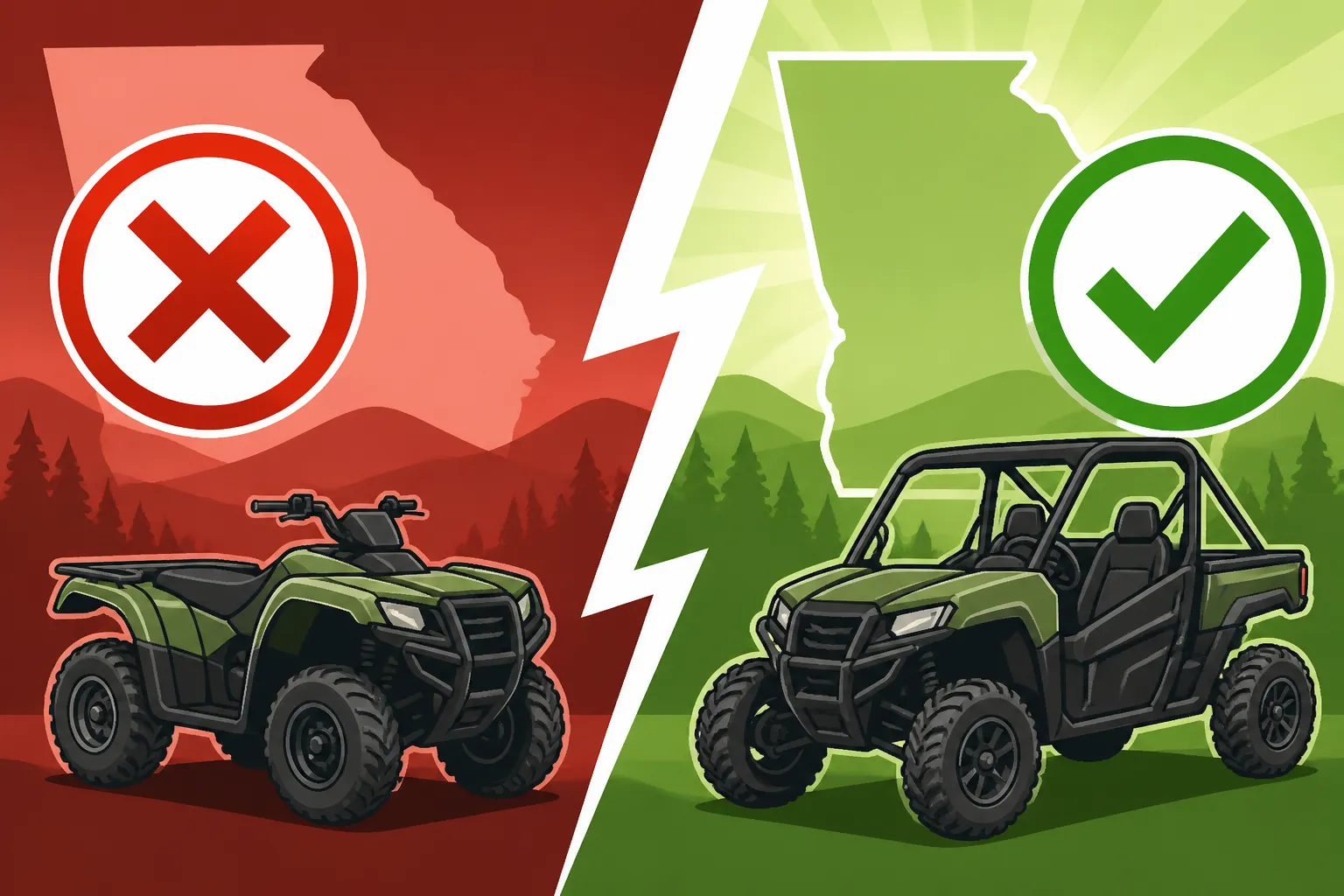
| Georgia MPOHV Road Registration | NOT ELIGIBLE | ELIGIBLE (if other criteria met) |
| Can ride on private land | Yes | Yes |
| Can ride at OHV parks/trails | Yes (check park rules) | Yes (check park rules) |
| Eligibility for county road use | No | Yes (with MPOHV plate) |
| Verification of build date needed | Critical for disqualification | Critical for qualification |
| Impact on resale value for road use | Significantly limits market to off-road buyers | Appeals to both off-road and road-use buyers |
Disclaimer
This article is for general informational purposes only and does not constitute professional advice. Laws, prices and regulations vary by location and change over time. Consult a qualified professional for guidance on your specific situation.