Georgia Rules for a Fourteen-Year-Old Rider
A 14-year-old in Georgia may be able to ride an ATV or UTV in some settings, but age alone does not make every machine or riding area acceptable. The important differences are where the child rides, who supervises, and what the vehicle is built to do. Here’s how to think through private property, trails, parks, helmets, and public roads before planning a ride.
What Georgia’s rules mean for a fourteen-year-old
There is no single age rule that answers every question about a 14-year-old riding an ATV or UTV. The rules can change with the location: private property, a private riding park, public forest trails, wildlife management area roads, and public roads are not interchangeable.
A quad is an ATV, while a side-by-side is a UTV. A UTV’s seats, belts, steering wheel, and larger size may make it look more like a small car, but those features do not automatically give a 14-year-old permission to drive it on public roads. Likewise, a machine’s registration status does not by itself settle whether a young rider may operate it in a particular place.
A useful starting point is to separate three questions:
- May the 14-year-old operate this type and size of machine?
- Is riding allowed in this location, and under what supervision conditions?
- What safety equipment and permissions are required?
The answer to one question does not answer the others. For example, a parent’s permission to ride on private property does not open a closed public trail. A trail permit does not cancel a park’s age restrictions. And a machine that can be registered for a limited road use is not automatically suitable for a child to drive.
Georgia requires helmets for riders under 18 in circumstances that can extend beyond public roads. Review Georgia ATV Helmet Law for Riders Under 18 before treating a yard, farm, or private riding area as an exception. Exemptions may apply to specific work activities, but ordinary recreation should not be assumed to qualify.
Georgia also has rules concerning adult supervision of young riders. The conditions depend on the setting, so a parent should check the relevant rules rather than relying on a general claim that a 14-year-old can ride independently. Georgia Supervision Rules for Minors explains why supervision and location need to be considered together.
ATV and UTV are not the same riding decision
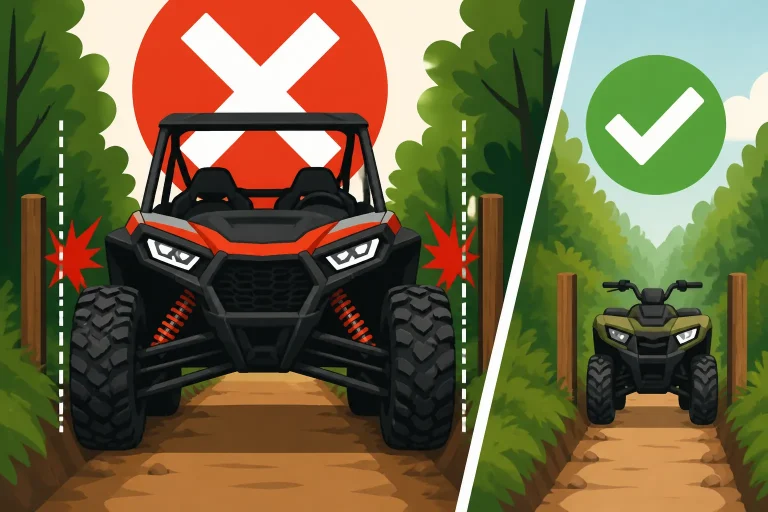
A youth-sized quad may be designed for a younger operator, while an adult ATV can be too powerful, heavy, or tall for a 14-year-old to control comfortably. A side-by-side can carry passengers, but passengers do not make it a child-sized vehicle. Check the manufacturer’s age guidance, operator instructions, passenger capacity, and any restrictions tied to the specific model.
Age recommendations are a useful safety check, not a substitute for legal requirements. A machine may be within a child’s physical reach and still be too powerful for their experience. Conversely, being 14 does not mean a rider is ready to manage a vehicle simply because its controls seem familiar.
Georgia has no state ATV safety course requirement, but training can help a young rider learn braking, turning, terrain judgment, and what to do if the machine becomes unstable. Georgia Has No State ATV Safety Course covers the difference between a legal requirement and voluntary training.
Where a fourteen-year-old may ride
The riding location often matters more than the machine’s registration or the family’s plans. Confirm access and age rules for the exact property or trail system before unloading.
| Riding location | What to check for a 14-year-old |
|---|---|
| Private property | Permission from the landowner, supervision rules, helmet requirements, and whether the machine suits the rider |
| Private off-road park | Minimum operator age, machine-size restrictions, required gear, waiver rules, and supervision policy |
| National forest OHV trail | Whether the route is designated and open, permit requirements, machine restrictions, and rules for young operators |
| Wildlife management area | Whether riding is allowed on that property, which roads may be used, and minimum operator age |
| Public road | Do not assume a quad or side-by-side is allowed; check road-use eligibility, operator age, license, insurance, and local rules |
Private property
Riding on private land is not an unlimited exception to safety and legal rules. The landowner must allow the activity, and the property’s terrain, boundaries, and hazards should be suitable for a young rider. A pasture, farm lane, or large yard can still have steep banks, wire, ditches, traffic, livestock, water, or blind corners.
Parents should set clear limits before the machine starts: where the child may ride, whether a passenger is allowed, how far the rider may go, and what to do if the machine stalls or someone is hurt. A nearby adult who can intervene is more useful than supervision from a distant house or vehicle.
For details about where riding can happen without access to public roads, see Georgia ATV Rules on Private Property. Permission from a landowner is essential, but it does not turn neighboring land, a utility corridor, or a road into an authorized riding area.
Private riding parks
Private parks set their own entry and rider rules in addition to applicable state law. A park may require an adult to remain with a minor, restrict children to certain routes or vehicles, or decline riders below a particular age. Those policies can differ from one facility to another and may depend on whether the child is driving or riding as a passenger.
Call or check the park’s current rules before traveling. Ask specifically whether a 14-year-old may operate the family’s machine, what supervision is required, whether the park limits engine size or vehicle type, and what gear must be worn. Do not rely only on a general statement that the park is “family friendly.” [Georgia Private Park Minimum Ages] is a useful starting point for the questions to ask.
A waiver is not permission to ignore age limits. If a park says the child cannot operate a particular machine or use certain trails, signing a form does not override that rule.
National forest trails and wildlife management areas
Public land has its own access limits, operating hours, trail designations, and permit conditions. A family should confirm that the exact trail or road is open to the machine they plan to bring. A route open to one kind of vehicle may not be open to a wider side-by-side, and a road visible on a map may be gated or closed.
Georgia’s forest OHV permit system and trail rules are separate from the age question. A permit should not be treated as proof that a 14-year-old may operate on every system or without an adult. Check the specific trail system’s rules and the current permit instructions before the trip. Georgia National Forest Trail-Only Rule explains why riders need to stay on designated routes.
Wildlife management areas are especially important to check carefully. Georgia’s WMA rules set a minimum age for operating a machine on WMA roads, so a 14-year-old should not be assumed eligible to drive there. See Georgia WMA Minimum Age of 16 and confirm the particular WMA’s access conditions with the relevant land manager before making plans. A hunting license, adult passenger, or permit should not be assumed to change the minimum age.
Public roads
A quad is not made street legal simply by having headlights, a mirror, or a plate. Georgia’s limited road-access rules for eligible off-highway machines involve specific vehicle and operator conditions. At 14, a child should not drive an ATV or UTV on a public road; do not use a short trip between properties, a dirt surface, or a neighborhood street as a workaround.
Some roads that look quiet or private may still be public roads. Ask the county or relevant local authority if the road’s status is unclear. For a broader explanation of road access and vehicle eligibility, see Georgia MPOHV Road Rules: County Roads Only and Georgia Minimum Age on a Public Road. Registration does not erase age, licensing, insurance, or road restrictions.
Supervision, equipment, and choosing a safe machine
A 14-year-old’s readiness depends on more than reach or confidence. The child needs to understand the controls, follow instructions, recognize hazards, and stop when conditions change. Start with the manufacturer’s guidance and a machine the rider can control at low speed. If the child cannot comfortably reach the controls, operate the brakes, and hold a stable riding position, the machine is not a good fit.
Use a deliberate supervision plan
Before riding, agree on a specific route and boundaries. Keep the child within a range where an adult can respond quickly, and avoid letting a young rider disappear over a hill or into wooded terrain. An adult should be able to see or reliably monitor the riding area, not merely be somewhere on the property.
Set rules that are simple enough to remember:
- One rider at a time on a single-rider ATV.
- No passengers unless the machine is designed and equipped for them.
- No riding near public roads, water, livestock, or other users without a clear plan.
- Stop if visibility, weather, or trail conditions become unsafe.
- Do not ride after alcohol or drugs, or with anyone who is not alert enough to supervise.
A UTV’s passenger seats are only for the number of people the manufacturer allows, with each person seated properly and using the available restraint. A passenger should not ride in a cargo bed or on an improvised seat. More on the distinctions between driver and passenger rules is available in Georgia Rules for Passengers on a Side-by-Side.
Make protective equipment non-negotiable
For a rider under 18, confirm the applicable Georgia helmet requirement before every ride. Choose a properly fitted helmet intended for the activity and replace it if it has suffered a significant impact or is damaged. Eye protection, gloves, long sleeves, long pants, and sturdy over-the-ankle footwear add practical protection from debris, branches, heat, and contact with the machine.
If buying equipment through Amazon or another retailer, check the helmet’s certification, fit guidance, return policy, and intended use rather than choosing by appearance alone. A loose helmet can shift or come off during a crash. The right fit and correct fastening matter as much as the product listing.
For UTVs, check that seat belts and any doors or nets are present and used as intended. A helmet does not replace a seat belt, and a seat belt does not make an unsuitable road or trail legal. Inspect tires, brakes, steering, throttle return, lights, and protective guards before the ride, especially if the machine has been stored or recently repaired.
Match the machine to the rider and conditions
Read the owner’s manual for operating instructions and age guidance. Consider the rider’s size, strength, coordination, and experience—not just whether the engine starts or the seat is reachable. A younger or inexperienced operator may need a smaller, lower-powered machine and a flat, open practice area before approaching hills, mud, or narrow trails.
Do not use a passenger to compensate for an operator who cannot control the vehicle. Added weight can change handling and braking, and a passenger can be injured if the driver makes an abrupt move. A child should also know how to shut off the engine, use the brakes, and get help before riding beyond an adult’s immediate reach.
A practical pre-ride checklist for parents
Rules and park policies can change, and access is not the same at every property. Use this sequence before taking a 14-year-old out:
- Identify the machine. Confirm whether it is an ATV or UTV, how many riders it is designed to carry, and the manufacturer’s age and operating guidance.
- Confirm the location. Determine whether the land is private, a private park, national forest, a WMA, or a public road. Do not infer permission from how a route looks.
- Check the location’s rules. Ask about minimum age, supervision, permitted vehicle types, trail restrictions, operating hours, permits, and required equipment.
- Confirm the child’s eligibility. For WMA roads, pay particular attention to Georgia’s operator-age restriction. For public roads, do not let a 14-year-old operate the machine.
- Prepare the rider and vehicle. Fit the helmet and protective gear, inspect the vehicle, review the route, and explain when the child must stop.
- Keep the plan conservative. Begin on terrain appropriate to the rider’s skill and stop if the child, machine, or conditions are no longer under control.
If any answer is uncertain, pause and contact the park, land manager, county, or other responsible authority. That is safer than relying on a friend’s experience at a different trail or assuming that an adult’s presence overrides every age rule.
The practical bottom line is that a 14-year-old’s safest and most clearly manageable options are limited to places where the child is expressly allowed to ride, with the required supervision and equipment. Do not assume access to WMA roads or public roads, and do not confuse a permit, registration, or parent’s permission with authorization to ride anywhere.
Disclaimer
This article is for general informational purposes only and does not constitute professional advice. Laws, prices and regulations vary by location and change over time. Consult a qualified professional for guidance on your specific situation.