Georgia Supervision Rules for Minors
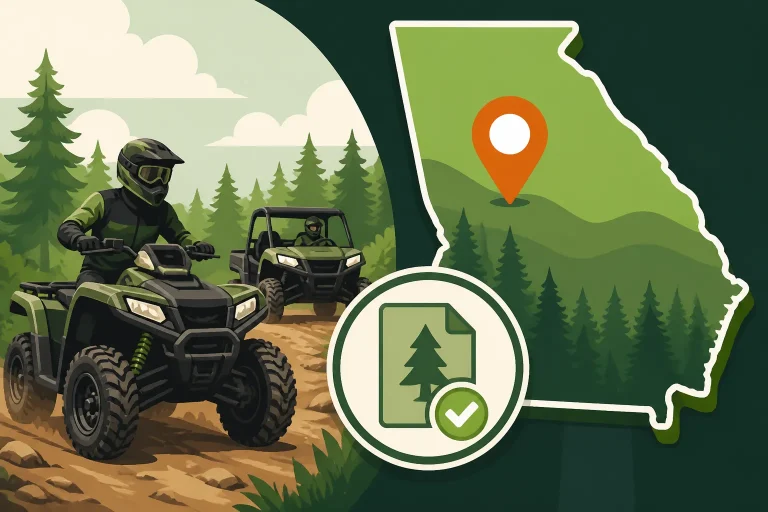
A parent or guardian can be close by and still miss a rule that applies to a particular trail, road, or riding park. Georgia does not have one supervision rule that covers every ATV and UTV setting. The practical answer depends on where the minor rides, what machine they operate, and the land manager’s age and equipment requirements.
Why supervision rules depend on where the machine is ridden
“Supervised” can mean anything from an adult watching on private land to an adult riding alongside a child at a managed trail system. Those situations are not interchangeable. A parent’s presence does not automatically override a minimum age, a permit condition, a road-operator requirement, or a park’s own admission policy.
Start by identifying the riding location and the type of machine. A quad on private property, a side-by-side on a national forest trail, a machine on a wildlife management area road, and a road-registered UTV may all be governed by different requirements. A single answer such as “an adult must be with the child” is not reliable across all of them.
| Where the minor rides | What to check first | What adult supervision does not automatically do |
|---|---|---|
| Private property | Landowner permission, helmet rules, machine fit, and any property or insurance restrictions | It does not make unsafe riding safe or remove applicable safety requirements |
| Private off-road park | Park’s minimum ages, required adult presence, waiver, passenger rules, and machine restrictions | It does not replace the park’s written rules |
| National forest OHV trail | Trail-specific access, vehicle limits, permit requirements, and current closures | It does not authorize riding on a closed or undesignated route |
| Wildlife management area | Whether the road is open to ATV use, age requirements, dates, hours, and any tag rules | It does not make a closed road or non-riding day open to ATVs |
| Public road | Whether the machine and road are eligible for use and what operator requirements apply | It does not substitute for an operator qualification or license |
This is why it helps to ask two separate questions: “May this minor operate this machine here?” and “What supervision does this place require?” A yes to one does not answer the other.
For an overview of riding access and permits, see Georgia OHV Permits: What You Need Before You Ride. Permits address access conditions; they are not a general permission slip for every young rider or every machine.
Rules and checks by riding location
Private property
Private land can feel like the simplest setting, but “it’s our land” should not be treated as a complete safety or legal check. Confirm that the owner has allowed the rider to use the machine and the specific area. A neighbor’s field, hunting lease, timber parcel, utility corridor, or pasture may have its own owner and conditions.
Before riding, make sure the child can reach and use the controls without stretching, can steer and stop the machine reliably, and understands where they may go. Set boundaries that are easy to follow: which trails are open, which gates stay closed, where adults will be, and what to do if the machine stalls or the rider becomes separated.
Helmet rules matter even on private land. Georgia has an under-18 helmet rule for ATV and UTV riders, subject to the applicable details and exceptions. Check [Georgia Helmet Rules for Riders Under 18] and Georgia ATV Rules on Private Property rather than assuming a private driveway or farm exempts a young rider. A parent should also set a stricter personal rule when the legal minimum does not match the riding conditions.
A safe boundary is not necessarily a fence. On a large property, agree on a short, clearly defined route and a turnaround point. Don’t let a young rider follow an adult onto a road, into a wooded area, or across a property line unless that use has been checked and permitted.
Private riding parks
Private parks set their own admission and operating conditions. A park may impose a minimum age, require a parent or guardian to remain on site, limit which machines a child can operate, or set separate rules for passengers. Those conditions can vary from one park to another and may differ by trail difficulty or activity.
Before driving to a park, check its current written rules and call if a requirement is unclear. Ask specifically:
- What is the minimum age to operate a quad or side-by-side?
- Must a parent or guardian accompany the minor, or only sign paperwork?
- Does the adult need to ride with the minor or stay at the park?
- Are there separate minimum ages for passengers?
- What helmet and protective gear are required?
- Are there restrictions on engine size, speed, or machine dimensions?
- Does the park require a waiver or proof of insurance?
A signed waiver is not a substitute for an age requirement. Nor does a child’s ability to ride at home guarantee that a park will allow them on a particular trail. Review Georgia Private Park Minimum Ages and the park’s direct instructions before making plans. Park rules can change, so rely on the location’s current information rather than an old post or a friend’s recollection.
Supervision should be practical, not just nominal. If the park requires an adult to accompany a minor, clarify what “accompany” means. An adult parked at the entrance may not meet a requirement to ride alongside the child. Even when an adult is allowed to supervise from another machine, maintain sight or communication and choose trails that the young rider can manage.
National forest OHV trails
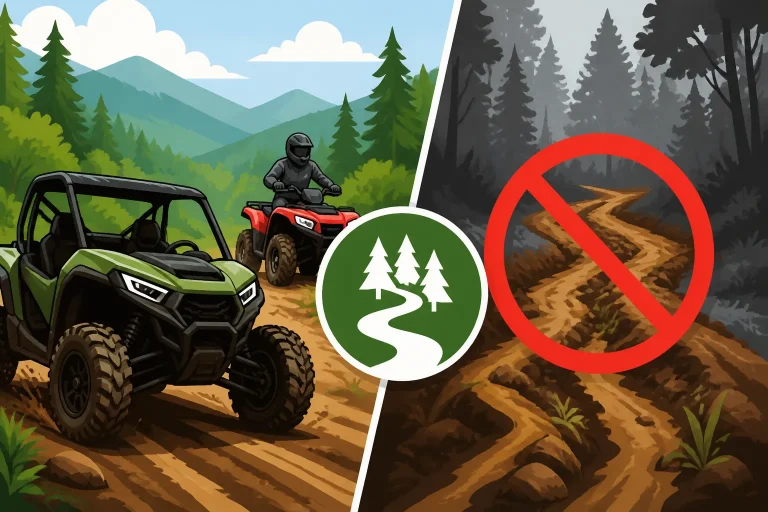
A national forest trail system is not the same as an unrestricted forest road. The route must be open and designated for the machine being used. Trail widths, vehicle types, seasonal closures, permits, and other access conditions may apply. Review Georgia National Forest Trail-Only Rule and check the relevant trail system’s current notices before loading the machines.
An adult riding with a minor does not turn a closed trail into an open one, permit an ATV on a route intended for another vehicle type, or remove a permit requirement. If the system uses operator permits, confirm how they apply to each person who will operate a machine. A permit tied to an operator is not automatically covered by an adult’s permit when the child is driving. See Georgia’s Per-Operator Permit, Not Per Vehicle for the distinction.
Do not assume every forest system uses identical procedures. Check the specific trailhead and managing office for any age-related conditions, permitted machine classes, and supervision requirements. If a minor is too young to meet an operator rule, an adult riding alongside does not necessarily create an exception.
Trail conditions are another reason to supervise actively. Wet clay, steep grades, loose rock, creek crossings, and narrow routes can be difficult for a new rider. Choose a route based on the child’s actual ability and the machine’s capabilities, not on how close the adult can stay. A reasonable plan includes a turnaround point, agreed stopping places, and a clear instruction to wait if the group gets separated.
Wildlife management areas
Wildlife management area access has its own limits. Riding may be restricted to designated roads, particular dates or times, or specific areas. An adult’s presence does not make a road open for riding when it is closed, and a hunting visit does not necessarily mean a child can ride any road on the property.
Georgia WMA rules include age restrictions for ATV operators. Check Georgia WMA Minimum Age of 16 and Georgia WMA Riding Rules Explained before bringing a minor. Also confirm whether the WMA is on forest land and whether a tag or other condition applies there. Rules for one area may not answer the question for another.
Keep the age check separate from the schedule check. A minor may meet the applicable minimum age and still be unable to ride because it is not an allowed day or time, the road is gated, or the intended route is not approved for ATV use. Check the specific property’s current instructions before setting out.
Public roads
A road is not simply a convenient connection between trails. Georgia’s road-access rules depend on whether a machine qualifies for the relevant registration category and whether the road is eligible for that use. Some operator requirements apply to public-road operation; a parent’s supervision does not replace them. See Georgia Driver’s License Rules for MPOHV Operators and Georgia MPOHV Road Rules: County Roads Only before considering any public-road trip.
Registration does not turn every ATV or UTV into a street-legal vehicle, and it does not grant access to every road. An ordinary quad should not be treated like a road machine just because it has lights, a plate, or an adult following behind. For the broader distinction, read Are Side-by-Sides Street Legal in Georgia?.
When a route includes a public road, verify the exact road and machine eligibility before riding. Don’t let a minor follow a vehicle onto a road or cross a roadway without first checking the rule for that location. If the route is not clearly permitted, use a trailer or choose a route that avoids the road.
Choosing a machine and supervising a young rider
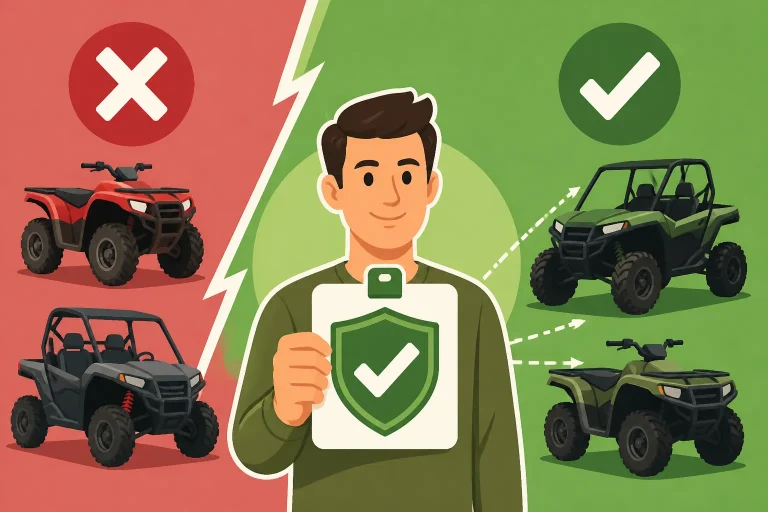
A legal minimum age, where one applies, is only a starting point. It does not mean every rider who has reached that age is ready for every machine or trail. A child should be able to control the specific machine they are using, recognize hazards, and follow instructions consistently.
Match the machine to the rider
A machine that is too large, fast, or heavy can be difficult for a young rider to control. Check whether the rider can sit in the intended position, reach the controls, steer through a turn, and stop smoothly. On a side-by-side, check whether the child can use the seat belt and remain properly positioned. A passenger who cannot be secured as intended should not ride in that seat.
Do not judge readiness only by age, height, or a short ride in a flat yard. Consider the child’s attention, judgment, and response to a sudden stop or change in terrain. A confident rider may still make poor decisions when excited, tired, or riding with friends.
Passengers need their own check. A child who is not operating the machine still needs a suitable seat and restraint, and must follow the vehicle and location’s passenger rules. Review Georgia Rules for Passengers on a Side-by-Side. Never carry more people than the machine is designed to seat, and do not let a passenger ride in a cargo area or another unapproved position.
Set supervision that matches the terrain
Supervision is useful only if the adult can notice problems and respond. For a beginner, that may mean staying close on a separate machine or choosing a short, low-speed route where the rider remains visible. On more demanding terrain, the right choice may be to turn back or leave the child off that ride.
Before starting, explain a small set of rules in plain language:
- Stay on the agreed route and do not pass the adult.
- Stop and wait if the group becomes separated.
- Do not approach roads, gates, water, steep slopes, or other hazards without permission.
- Keep a safe gap from other machines and never follow too closely.
- Stop riding if the machine behaves unexpectedly or the rider feels unsure.
Agree on a signal or a place to stop if verbal communication is difficult. A phone can help with communication, but it is not a substitute for keeping the group together or planning for poor reception.
Make decisions before the ride, not during a disagreement on the trail. Tell the child that the adult can end the ride at any time because of weather, fatigue, unsafe behavior, or changing conditions. If the rider is struggling, do not treat “one more hill” as a test of courage. Stop, reassess, and choose an easier route.
Use protective equipment and clear operating limits
A helmet is an essential part of a minor’s riding setup. Confirm the applicable Georgia rule and any stricter park or landowner requirement. The helmet should fit securely and be appropriate for the activity. Other protective equipment, such as eye protection, gloves, long sleeves, long pants, and over-the-ankle footwear, can help reduce exposure to common trail hazards.
If buying a youth helmet through Amazon or another retailer, check the helmet’s safety certification, sizing guidance, and fit before relying on it. A product listing or a familiar brand name does not prove that a particular helmet fits the child or meets the rule that applies to the ride. Replace damaged gear and make sure the child wears it correctly every time.
Set a speed limit that reflects the terrain, visibility, and rider’s ability. A machine’s maximum speed is not a target. Explain that the rider should slow down before turns, keep enough distance to stop, and avoid riding beyond what they can see. On a group ride, the adult should not leave a young rider to catch up by speeding.
Weather and fatigue affect control. Heat, rain, mud, cold, and poor visibility can make a familiar route harder. Take breaks, carry water, and stop when attention slips. An adult should be alert enough to supervise; riding while distracted or impaired defeats the purpose of accompanying a minor.
A practical pre-ride check for parents and guardians
A few checks before loading the trailer can prevent a wasted trip and reduce avoidable risk. Use this sequence whenever the location or rider changes.
- Identify the exact riding place. Is it private land, a private park, a national forest OHV system, a WMA, or a public road? Don’t rely on a general label such as “the woods” or “the trail.”
- Confirm the minor’s eligibility. Check the current age, operator, passenger, and supervision rules for that location and machine.
- Confirm the route is open to that machine. Check trail designation, width or vehicle restrictions, closures, operating hours, and any seasonal limits.
- Check permits and paperwork. Find out whether the operator, vehicle, or group needs a permit, and whether the minor needs their own. Don’t assume the adult’s paperwork covers a child who is operating.
- Inspect the machine and gear. Check brakes, throttle, tires, steering, lights where required, restraints, and the fit of protective equipment.
- Set the route and boundaries. Point out the turnaround point, hazards, meeting place, and behavior that means the ride ends.
- Reassess on arrival. A trail that looked suitable at home may be muddy, crowded, or closed when you get there.
If a rule is unclear, ask the land manager, park operator, or relevant agency directly. Give them the machine type, the child’s age, whether the child will operate or ride as a passenger, and the exact location. “Can kids ride here?” is too broad to get a dependable answer.
If you are told a child may ride only with an adult, ask what that means in practice: must the adult be on the same machine, ride alongside, remain in the area, or simply be present to sign the forms? Get the answer in writing when possible, particularly for a planned park visit or organized event.
Keep supervision distinct from permission and eligibility. A parent can provide close supervision, but cannot authorize access to someone else’s property, change a trail closure, waive a public-road requirement, or override a park’s minimum age. When in doubt, choose a location with clear rules and a route suited to the child rather than trying to interpret an exception at the trailhead.
Frequently Asked Questions
Is there one Georgia rule requiring an adult to supervise every minor on an ATV?
No single supervision rule should be assumed to apply to every riding setting. Requirements can depend on the land, machine, trail system, and the child’s role as an operator or passenger. Check the specific location’s current rules.
Can a parent’s presence let a child ride where the child does not meet the age requirement?
Do not assume so. An adult’s presence does not automatically override a minimum age or other access condition. Confirm directly with the agency or park that manages the riding area.
Does a child need a helmet on private property?
Georgia has an under-18 helmet rule for ATV and UTV riders, with details and exceptions that should be checked for the situation. Private property is not a reason to assume a helmet is unnecessary. See [Georgia Helmet Rules for Riders Under 18].
Can a minor drive a registered UTV on a Georgia road if an adult follows?
An adult following does not replace applicable operator requirements or make an ineligible machine or road eligible. Check the road-access and operator rules before any public-road use.
Does the adult’s permit cover a minor who is operating?
Permit conditions depend on the riding system. Where a permit is required per operator, don’t assume the adult’s permit covers a minor driving a separate machine. Confirm the rule for that system before the ride.
Disclaimer
This article is for general informational purposes only and does not constitute professional advice. Laws, prices and regulations vary by location and change over time. Consult a qualified professional for guidance on your specific situation.