Georgia Reciprocity Claims Worth Checking
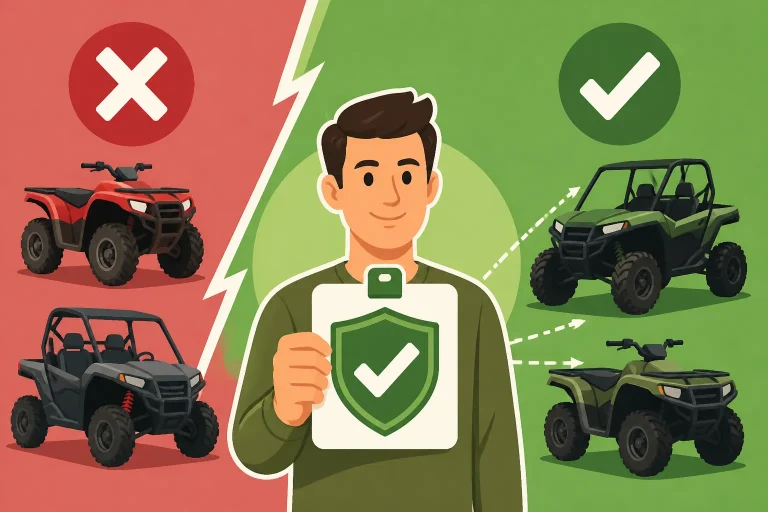
A permit, plate, hunting license, or safety card from another state may look like it should carry over to Georgia. Often it does not. The key is to identify what the document authorizes, who manages the place you plan to ride, and whether Georgia or that land manager accepts it.
What reciprocity means for Georgia riders
Reciprocity is an agreement or rule that lets a credential issued in one place be accepted somewhere else. The word can sound broad, but acceptance is usually limited to a particular credential and activity. A state may recognize another state’s driver’s license, for example, without recognizing its off-highway vehicle permit.
For ATV and UTV riders, several separate kinds of paperwork are easy to mix up:
- An OHV permit may be required by a land manager to use a particular trail system.
- A machine registration or plate may identify a vehicle for a specific legal purpose. It does not automatically grant trail access.
- A hunting license or permit may relate to hunting privileges, but does not necessarily authorize riding an ATV on every wildlife management area.
- A safety card or course certificate may satisfy a requirement in one state or at one private park, but not another.
- A park pass or day-use payment may cover entry to a specific facility, rather than OHV access across a state.
The authority that issued a document matters, but so does the authority responsible for the place where you want to ride. Georgia’s national forest OHV systems, a wildlife management area, a private riding park, and a county road are not interchangeable settings. Each can have its own access rules.
That is why “my home state’s permit is accepted in Georgia” is not a complete answer. Ask: accepted by whom, for what activity, at which location, and for which dates? A credential might help with one part of a trip but leave other requirements unchanged.
For a broader overview of the permits riders may encounter, see Georgia OHV Permits: What You Need Before You Ride. The practical rule is to check the rule set for the exact riding area, rather than treating reciprocity as a statewide pass.
Reciprocity claims that visiting riders should verify
Claims about reciprocity commonly come from a friend, a social media post, an old trip report, or a seller who is used to the rules in another state. Some claims may be partly true but missing a key limitation. Before relying on one, identify the document and the person or agency that supposedly accepts it.
“My other-state forest pass covers Georgia trails”
A pass purchased for a forest, park, or OHV system in another state should not be assumed to cover riding in Georgia. Fees and permits are set by the relevant land manager, and a pass for one jurisdiction does not automatically work at a different one.
For Georgia’s designated national forest OHV systems, check the current permit instructions for those systems. A permit that applies to Georgia’s systems is separate from an out-of-state permit unless the land manager specifically says otherwise. Rules and payment methods can change, so confirm requirements before setting out instead of relying on a pass from a previous trip.
“My home state’s ATV registration means I can ride anywhere”
Registration and trail access answer different questions. A registration or plate from another state may be relevant to identifying the machine or complying with a particular vehicle rule. It does not, by itself, grant permission to ride on national forest trails, private property, or a Georgia WMA.
Likewise, Georgia’s limited registration program for certain machines does not function as a general trail permit. Eligibility for that program is narrow, and a registration does not erase the restrictions imposed by the land manager. The details of plates and road access are covered separately in [Georgia Rules for an Out-of-State Plate].
“Georgia accepts my safety card”
Do not assume a course card from another state replaces a land manager’s permit or a private park’s own training, age, waiver, or supervision rules. A safety course can be useful, and a venue may choose to accept a particular certificate. But that does not establish that every Georgia riding area must accept it.
Ask the facility or agency what it requires. If a private park says it accepts an out-of-state card, confirm which course or card qualifies and whether other requirements still apply. For public-land riding, check the land manager’s current rules rather than relying on an unrelated safety credential.
“My hunting license gives me WMA riding access”
A hunting license does not necessarily provide general ATV access to a WMA. Riding rules can depend on the specific area, whether it is a hunt day, the purpose of the visit, designated roads or routes, and other local restrictions. Some areas may limit vehicle use to particular circumstances; others may not allow the riding activity you have in mind.
An out-of-state hunting credential should not be treated as permission to ride. Check the rules for the specific WMA and confirm whether your hunting status, the date, and the route meet those rules. Start with Georgia WMA Rules for ATV Riders, then verify the details for the particular area before unloading.
“My plate makes my UTV street legal in Georgia”
A plate from another state does not automatically make a UTV lawful on every Georgia road. Road access depends on Georgia law, the road’s classification, the machine and its equipment, and any local restrictions that apply. Rules for road use are separate from trail permits and private-park entry.
Even where a road-use rule allows access, it does not mean the machine may leave the authorized route and continue onto a trail or another road. Check the current road rules before riding between locations; a registration document alone is not a route map or permission slip.
“The private park takes my permit, so it works on public land too”
A private riding park controls access to its own property. It may accept a particular pass, require a waiver, or set its own admission and safety rules. Those choices do not bind a national forest or a state-managed area.
The reverse is also true: a public-land permit does not necessarily cover admission to a private park. Confirm requirements with each destination. Georgia Private Park Waivers and Rules explains why a park’s own conditions can remain separate from public-land requirements.
How to check a reciprocity claim before traveling
A short check before departure can prevent a wasted drive, an access problem at the trailhead, or a citation. Use this process whenever someone says a permit or registration “works in Georgia.”
- Write down the exact credential. Note its official name, issuing agency, expiration date, and whether it belongs to the rider or the machine. “My pass” is too vague to verify.
- Name the exact place you plan to ride. Identify the trail system, WMA, private park, road, or other property. If your trip includes multiple locations, check each one separately.
- Identify the land manager or operator. The entity that manages the destination is the one to ask about its access requirements. A county office, park operator, or land agency may have different answers because it controls a different place or activity.
- Ask whether the credential is accepted for that purpose. Be specific: “Does this out-of-state OHV permit satisfy the permit requirement for riding this system?” Do not ask only whether Georgia has reciprocity.
- Ask what it does not cover. Even if a credential is accepted, you may still need a separate entry payment, operator permit, insurance, waiver, registration, or proof of ownership.
- Check dates and operating conditions. A valid permit does not mean the area is open. Seasonal closures, weather closures, event restrictions, and trail-specific limits can still apply.
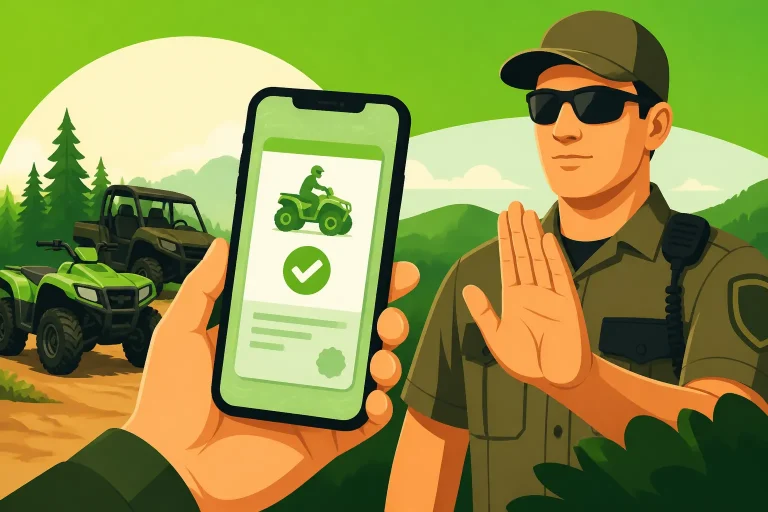
- Save the confirmation and bring the required proof. Keep the permit or receipt accessible, along with any other documents the manager requires. A phone image may be convenient, but confirm whether a digital copy is acceptable or whether a printed copy is needed.
- Recheck close to the trip. Do this especially after a long gap, a change in ownership, or a change in plans. An old post or a prior visit may not reflect current rules.
When contacting an agency or park, give the staff member enough detail to answer accurately. Include the machine type, the credential’s issuing state or agency, the destination, your planned riding date, and whether you are asking about a rider permit, vehicle registration, trail access, or road use.
If you are bringing multiple operators, ask whether each person needs a separate permit. For Georgia national forest OHV permits, the distinction between an operator permit and a vehicle permit matters; see Georgia National Forest Permits Are Per Operator. A group’s paperwork should be checked rider by rider, not assumed to transfer between people because they are sharing one machine.
Which credential covers which situation?
Use this table as a starting point. It is not a substitute for the current rules of the location you intend to visit.
| Credential or claim | What it may relate to | What it does not automatically establish | What to verify |
|---|---|---|---|
| Out-of-state OHV or forest permit | Access to the issuing jurisdiction’s designated areas | Permission to ride Georgia trails | Whether the Georgia land manager accepts it |
| Georgia forest OHV permit | Access under the permit’s stated terms | Permission to ride private property or every public road | Covered systems, dates, operator requirements, and closures |
| Out-of-state ATV or UTV registration | Registration status under the issuing state’s rules | Georgia trail access or unrestricted road use | Georgia’s rules for that machine and the specific route |
| Hunting license | Eligibility for hunting under applicable rules | General ATV access to every WMA | Area-specific access, dates, routes, and hunting conditions |
| Safety-course card | Completion of a course or satisfaction of a stated training rule | A permit, park entry, or universal age-rule exemption | Whether the particular agency or park accepts that course |
| Private-park pass or waiver | Entry or participation at the named facility | Access to public land or another private venue | Park-specific conditions, dates, and machine limits |
| Bill of sale or ownership record | Evidence related to possession or ownership | Permission to use a trail or road | Whether the destination requires proof of ownership |
A good way to use the table is to ask what problem the document actually solves. If the question is “May this rider enter the trail system?”, a vehicle registration may be beside the point. If the question is “May this machine use this road?”, a forest permit is not the answer. Keep each document in its own lane.
This distinction also helps when a machine carries a plate but the operator lacks a required trail permit, or when a rider has a valid permit but the trail is closed. Having one correct document does not make unrelated requirements disappear.
Common mistakes that turn a small assumption into a trip problem
The most frequent issue is treating all “permits” as if they were the same thing. They are not. A pass may be tied to one person, one vehicle, one property, or one activity. Read the stated terms rather than inferring them from the word printed on the document.
Another common mistake is confusing acceptance of a credential with full compliance. A land manager might accept an out-of-state safety card for one requirement while still requiring a separate permit, waiver, age minimum, or equipment standard. Ask whether acceptance is partial or whether it satisfies the specific requirement you have in mind.
It is also easy to rely on a previous trip. Rules might have changed, or the earlier ride may have taken place at a different site with a different operator. Even two trail systems within the same broad public-land area can have different restrictions, operating periods, or access arrangements. Confirm the named system, not just the region.
Do not assume that a permit issued to one operator covers everyone in the group. Some permits are attached to the person operating the machine; others may be structured differently. If a passenger will take a turn driving, or if several machines are involved, clarify the requirement for each operator. The overview at Do Visiting Riders Need a Georgia Forest Permit? is useful for out-of-state riders checking that point.
Finally, do not treat a verbal claim from a seller or fellow rider as official confirmation. The person may be describing a different year, a different location, or an exception that does not apply to your trip. When the consequence is being turned away or cited, direct confirmation from the land manager or facility is more reliable than a general statement that “they honor it.”
A practical checklist for visiting riders
Before leaving home, make a simple list for every place on your itinerary. Record the destination, who manages it, what credential is required, who must hold it, and where to verify closures. Keep a separate note for road travel if the route to the riding area includes public roads.
For each operator, confirm:
- Whether a Georgia-specific permit is required.
- Whether the permit is issued to the rider or the machine.
- Whether a visiting rider’s credential is accepted for any part of the requirement.
- Whether a passenger who may operate needs a separate credential.
- Whether proof of age, ownership, insurance, or registration is required.
- Whether the destination has a waiver, equipment rule, or machine-size limit.
- Whether current closures or weather conditions affect access.
For the machine, check that its identification information is readable and matches any paperwork you plan to carry. If the machine is registered out of state, do not assume that fact settles trail access or road legality. If you are unsure about a plate or the route, check [Georgia Rules for an Out-of-State Plate] and the rules for the road itself.
For the itinerary, verify each stop separately. A public trail system, a private park, and a WMA may all require different documents, even when they are close together. Keep receipts and permits available during the ride, and make sure the person operating can show the proof if asked.
If the trip involves a forest trail system, review the permit’s coverage rather than simply buying or carrying a pass that sounds similar. Georgia’s annual forest permit coverage and the distinction between annual and other permit types are addressed in Georgia Annual Permits Valid at All Six Systems. Confirm current terms with the issuing agency before relying on a pass.
Frequently Asked Questions
Does an out-of-state OHV permit automatically work in Georgia?
No. Do not assume a permit from another state covers Georgia riding areas. Check with the manager of the specific trail system and ask whether it accepts that exact credential.
Does an out-of-state plate give a UTV trail access in Georgia?
No. A plate or registration and permission to ride a trail are separate matters. Verify the trail’s access rules and Georgia’s requirements for any public-road use.
Does a Georgia forest permit cover private riding parks?
Not automatically. A public-land permit does not necessarily include access to private property. Check the park’s own entry, waiver, and operating requirements.
Can an out-of-state hunting license authorize ATV use on a Georgia WMA?
Do not rely on the hunting license alone. WMA vehicle rules can depend on the specific area, date, route, and activity. Confirm the current rules for that WMA before riding.
Disclaimer
This article is for general informational purposes only and does not constitute professional advice. Laws, prices and regulations vary by location and change over time. Consult a qualified professional for guidance on your specific situation.