Georgia Private Park Waivers and Rules
A private off-road park can look like a simple place to unload and ride, but admission often comes with a waiver, machine requirements, age limits and rules that differ from one property to another. This guide explains what Georgia riders should check before signing, how to prepare your group and what to do if the park’s rules or a riding incident become an issue.
What a private park waiver does and does not do
A waiver is a document you are asked to accept in connection with using a riding property or taking part in an activity there. It may describe the risks of off-road riding and set out how the park expects visitors to behave. It may also ask you to acknowledge that you understand those risks and accept certain responsibilities.
The exact wording matters. One form might apply to a trail ride, another to a rental, and another to camping or an organized event. A waiver may cover the rider, passengers, a vehicle owner, a parent or guardian, or some combination. Don’t assume that one person’s signature automatically covers everyone in your group.
A waiver is not the same as a riding permit or a confirmation that your machine meets every requirement. Nor should you treat it as permission to ignore posted instructions, ride a closed trail or operate in a way that puts others at risk. You still need to follow the park’s rules and any applicable laws.
Understand the risks the form describes
Off-road riding involves risks that can’t be fully removed by signs, equipment or careful riding. A waiver may refer to uneven ground, steep slopes, mud, rocks, water, trees, other riders, mechanical failures or changing conditions. It may also discuss the possibility of injury, damage to property or an emergency response far from a paved road.
Read the whole form, including the text above the signature line. Look for:
- Which property, activity or event the form covers
- Whether it applies for one visit or a broader period
- Which people are included
- Whether passengers must complete a separate form
- How the form treats rental machines and personal machines
- What conduct can lead to removal from the property
- Any statements about damage, medical care or emergency contact
- Whether there are separate rules for camping, events or other activities
If a sentence is unclear, ask a park representative to explain the park’s procedure before you sign. If you are uncomfortable with what the document says, pause rather than relying on a quick explanation at the gate. A waiver can have legal consequences, and how a particular provision applies depends on the document and the circumstances. For advice about a specific dispute, consult a qualified attorney.
A signature is not a substitute for reading
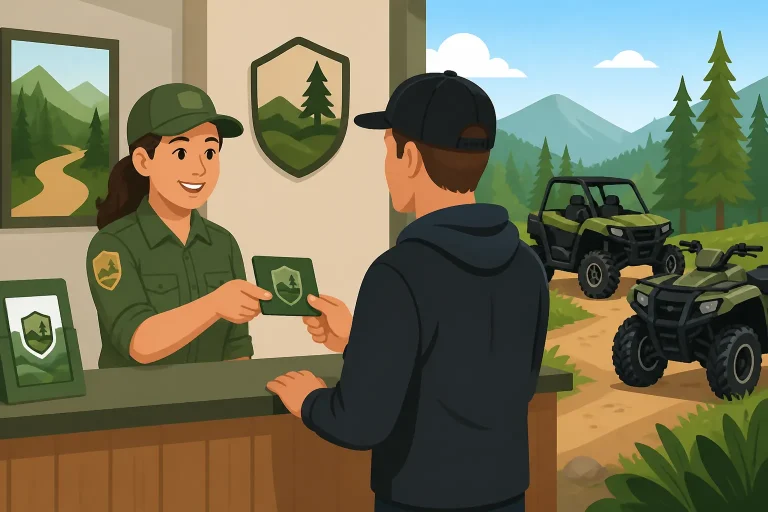
Gate check-in can feel hurried, especially when friends are waiting or the unloading area is busy. That is exactly when it helps to slow down. If a form is available online, review it before driving to the property. If it is only presented at arrival, allow time to read it and ask questions.
Do not sign on behalf of another adult unless you have the authority to do so. For a child, confirm who the park requires to complete the paperwork and how the park handles the child’s participation. Rules about minors and the effect of a parent’s signature can involve legal questions, so don’t assume that every form works the same way.
Keep a copy or a clear photo of the version you signed if the park allows it. Save any accompanying rules, rider acknowledgments or event instructions as well. If there is an incident later, knowing what you were given at check-in can help you describe the circumstances accurately.
Check the park’s rules before you make the trip
Private properties set their own admission and operating rules. Requirements can vary by park, event, trail system and activity. A rule that applies to a rented machine may not apply in the same way to a machine you bring from home. Likewise, one park’s age policy is not proof of another park’s policy.
Start with the property’s official information, then call or message the park if anything is unclear. Social media comments and old ride reports can be useful clues, but they can be out of date. Confirm the details that could prevent your group from riding or change what you need to bring.
| What to verify | Why it matters | What to ask |
|---|---|---|
| Waiver and check-in process | Each rider or participant may need to complete separate paperwork | Can forms be completed before arrival, and does every rider need an individual form? |
| Minimum ages | Age rules may vary by machine, trail, passenger position or activity | What are the age limits for operators and passengers on each machine type? |
| Machine eligibility | Width, passenger capacity or equipment may limit where you can ride | Are side-by-sides allowed, and are there machine dimensions or equipment requirements? |
| Safety gear | A park may require protective equipment beyond what you usually wear | What helmets, eye protection or other gear are required? |
| Rental conditions | Rentals can have separate training, deposit, damage and passenger rules | What does the rental agreement cover, and what is the procedure for a breakdown or damage? |
| Trail access | Not every trail may be open to every machine or rider | Which routes match your machine and experience level? |
| Operating hours | Arrival time, daylight and closing procedures affect your ride plan | When does riding end, and when must visitors be off the trails? |
| Camping and events | Overnight stays and organized rides may have separate terms | Are reservations, additional forms or separate rules required? |
A useful internal starting point is Georgia Private Off-Road Parks Compared, but use a park’s own current instructions to confirm its policies. If you are selecting a riding area for a particular machine, also check Georgia ATV Trails That Allow Side-by-Sides. A property’s general description may not tell you whether every trail is suitable for every vehicle.
Ask about the specific machine, not just the category
When calling a park, describe the machine you actually plan to bring. “UTV” or “four-wheeler” may not be enough. Mention whether it is a quad, side-by-side, youth machine or another type; how many seats it has; and whether it has been modified in a way that affects width, noise or safety equipment.
Ask which routes are open to that machine and whether there are restrictions on passenger count, tires, lighting or other equipment. If the park has a trail-width limit, measure the machine as the park instructs rather than relying on the manufacturer’s general model description. Added wheels, accessories or other modifications may affect the overall measurement.
Check whether your machine has to be registered, insured or accompanied by proof of ownership to enter the property. Requirements can differ, and a private park’s admission policy is not the same question as whether a vehicle is registered for public-road use. For the broader distinction between private riding and public access, see Georgia ATV Trails: Where You Can Legally Ride.
Rules that affect your ride once you enter
The waiver is only one part of the visit. Parks may post operating rules at the entrance, trail junctions, riding areas and camping facilities. Read them even if you have been to the property before. A closed section, a changed route or an event-specific restriction can make an old ride plan unsafe or unsuitable.
Trail choice and riding conduct
Choose a trail that matches both your machine and your actual skill level. A route marked difficult can be challenging even for an experienced rider when conditions change. Rain, loose soil, fallen branches, erosion and water crossings can alter a trail after the description was written.
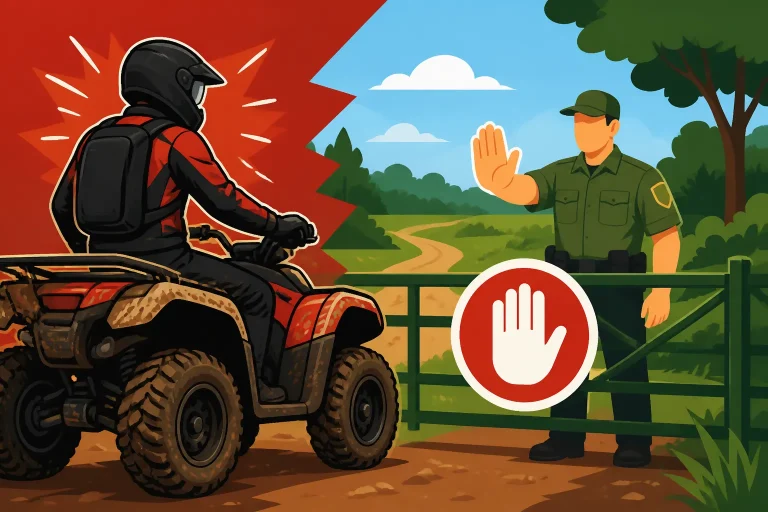
Before leaving the staging area, ask where beginners should ride, which routes are one-way and how the park marks closures. Find out what to do if you encounter a blocked route or a machine that cannot continue. Do not go around a closed gate or bypass a closure marker because the route looks passable. A closure may reflect a hazard, maintenance work or a property-access restriction that is not obvious from the trail.
Use a pace that gives you room to stop if another rider appears around a blind corner. Keep a safe following distance, avoid crowding the vehicle ahead and don’t assume the person in front knows you are there. On a group ride, agree on a regrouping point so that a slower rider is not pressured to keep up.
Parks can restrict wheelies, racing, excessive speed, reckless riding, trail cutting, riding outside marked routes and operating while impaired. Even where a particular behavior is not listed on a sign, it can still violate a general safety rule or create a risk to others. Ask staff what the park expects if you are unsure.
Equipment and protective gear
A park may require a helmet, eye protection or other protective equipment. It can also impose rules for passengers, seat belts, doors, lights, sound levels or mechanical condition. Do not assume that the gear you use on private land elsewhere will meet the requirements at a particular property.
Wear equipment that fits and stays in place while you ride. A loose helmet or fogged-up eye protection can be a distraction when you need clear vision. If you are shopping for gear on Amazon, compare the actual product specifications and sizing information rather than choosing by appearance alone. Check whether the park recognizes the type of helmet or equipment you plan to use, and make sure it fits the rider who will wear it.
For a longer gear checklist, What Every Rider Carries on a Georgia OHV Trail can help you think beyond the minimum admission requirement. A park’s rules still take priority for that visit.
Passengers and machine capacity
A side-by-side’s number of seats does not automatically answer whether every person in your group may ride. The park may have age, restraint or passenger-position rules. Follow the machine manufacturer’s seating and capacity guidance, and do not carry someone in a position that was not designed for a passenger.
If children will ride, ask exactly where they may sit, what restraints are required and whether there are separate rules for youth machines. Never assume that an adult’s permission or a waiver makes an unsafe seating arrangement acceptable.
Alcohol, pets, camping and other property rules
Some rules cover more than the trail. A park may regulate alcohol, smoking, pets, generators, fires, quiet hours, washing machines, parking, fuel storage or where trailers can be left. These conditions may be on a separate form or posted at the campground rather than at the riding entrance.
Ask whether a pet is allowed in the staging area, trails or campground, and whether it must be leashed or kept away from riding routes. If you plan to camp, confirm whether you need a separate reservation or must follow different check-in and quiet-hour procedures. Relevant guides include Georgia Private Park Camping Rules and Georgia Private Park Pet Rules.
Bringing children or a mixed-age group
A family ride takes more preparation than a solo visit because each person may face different requirements. A park can set its own age limits, supervision expectations and passenger rules. Those rules may differ for an operator, a passenger, a rental rider or a participant on a youth-sized machine.
Before making plans, get the park’s age policy in writing or confirm it directly. Ask whether the age limit changes by machine type or trail difficulty. If the park allows a younger rider on a designated route, find out whether an adult must ride alongside, follow behind or remain in a specified area. Don’t interpret “family friendly” as a guarantee that every child can ride every machine.
For more on park-specific minimum-age policies, see Georgia Private Park Minimum Ages. For helmet requirements at private riding properties, consult Georgia Private Park Helmet Rules. Treat those topics as planning guides, then verify the rules for the particular park you intend to visit.
Complete paperwork for every person as required
Bring accurate information for each participant, including children. Parks may request emergency contact details, a parent or guardian’s acknowledgment, rental paperwork or an individual rider form. If the group includes adults who are not a child’s parent or guardian, ask the park in advance what it accepts and whether the responsible adult needs additional authorization.
Do not sign a form for a child without reading the provisions about the child’s participation. If a child is not comfortable with the riding environment, don’t let the pressure of a paid admission or a group schedule push them into riding. The safest choice may be to stay in the staging area or skip that activity.
Match the route to the least experienced rider
A group should choose a route that suits its least experienced operator, not just the most confident rider. Keep the group together at trail junctions, agree on a simple stop signal and decide what to do if someone wants to turn back. A beginner may need more time to steer, brake or handle an obstacle, especially in mud or on a slope.
If the park offers a beginner area, ask whether it is suitable for the age and machine involved. Do not use another rider’s successful trip as proof that a child or first-time operator is ready for the same route. Conditions and skill levels vary.
Rentals and personal machines have different responsibilities
A rental may simplify transportation, but it does not remove the need to understand the rules. The rental provider may require a separate agreement in addition to the park’s waiver. Those documents can address operation, passenger limits, damage, fuel, late return, breakdowns and what the renter must do after a collision.
Before accepting a rental, inspect the machine with the staff member and ask how existing damage is recorded. Take clear photos or video of visible damage if the provider permits it. Confirm how to report a mechanical problem and whether you should stop riding immediately if a warning light, belt smell, steering issue or unusual noise appears.
Find out what happens if the machine becomes stuck or cannot be driven back. Ask whether the park has a recovery process, whether you need to stay with the machine and how to reach staff from the trail. Do not try an improvised tow or recovery that could injure someone or damage the vehicle.
For a fuller overview, see Georgia Rental Requirements at a Park. The rental agreement and the park’s waiver may be separate documents, and each can have a different purpose. Read both.
If you bring your own machine
You are responsible for arriving with a machine that meets the park’s entry rules and is in sound operating condition. Before loading, check the brakes, tires, steering, throttle return, restraints, lights and fluid levels. Secure loose gear and make sure the machine is suitable for the routes you plan to ride.
Ask whether the park requires liability coverage, proof of insurance or proof that you own or may use the machine. Do not assume that your ordinary auto policy covers off-road use. Coverage can depend on the policy language, the machine, the activity and where the incident occurs. If insurance is required, contact your insurer and the park before the trip.
If you need insurance guidance for admission, Georgia Private Park Insurance Requirements offers a useful topic to review. Ask the insurer how the actual policy applies instead of relying on a general description or an online forum.
A practical comparison
| Visit type | Paperwork to check | Main preparation issue |
|---|---|---|
| Personal machine, adult rider | Park waiver, admission rules and any insurance or ownership requirements | Confirm machine eligibility, trail access and required gear |
| Personal machine, child rider | Waiver process, age and supervision rules, passenger limits | Confirm who must complete the child’s forms and which machine or route is allowed |
| Park rental | Park waiver plus rental agreement and safety instructions | Understand damage reporting, breakdown response and passenger restrictions |
| Organized ride or event | General park terms plus event-specific forms or instructions | Confirm schedule, route, group procedures and any additional requirements |
| Overnight visit | Riding paperwork plus campground rules or reservation terms | Check quiet hours, fires, pets, parking and separate camping conditions |
This table is a planning aid, not a statement that every park uses these exact forms. The park may combine documents or add requirements for a particular event.
What to do if there is an incident or disagreement
If someone is hurt, stop riding and get help. Follow the park’s emergency procedure and give staff a clear location. If it is safe to do so, keep other riders away from the incident area and avoid moving an injured person unless there is an immediate danger or emergency responders instruct you to do so.
After an incident, focus first on safety and medical care. Then write down what happened while the details are fresh. Record the time, trail or area, machine involved, weather and surface conditions, who was present and what staff told you. Preserve photos or videos and keep copies of the documents you received. If another person was involved, exchange contact information without making assumptions about fault.
Report a collision, injury or significant machine damage through the park’s stated process. Ask for the name of the person receiving the report and how to obtain a copy or confirmation. If a rental is involved, follow its reporting procedure too. Don’t leave a serious incident unreported because the group wants to get back on the trail.
If you disagree with a rule or a staff decision
Ask for a calm explanation of the rule and where it is posted or included in the paperwork. If staff say a machine cannot use a trail, do not ride it there while trying to resolve the disagreement. Request the park’s manager or designated contact and save the response.
If you believe the park misrepresented an important condition, preserve the advertisement, message or booking information you relied on. Be specific about what was said and what happened. A written, factual account is more useful than an angry public post.
For a serious injury, substantial loss or dispute about what a waiver means, talk to a qualified attorney. Do not rely on a general article or a quick interpretation from another rider to decide whether you have a legal claim or obligation. The document, the facts and applicable law all matter.
A before-you-go checklist
A little preparation at home can prevent a long drive from ending at the gate. Use this list for each visit, even if you have ridden at the property before.
- Confirm the property and the date. Check that the park is open, the trails you want are available and there is no event or closure affecting your visit.
- Read the waiver and rules. Review the current versions and ask about unclear language or check-in steps.
- Confirm ages and passengers. Give the park the actual ages of riders and passengers, and describe the machines they will use.
- Describe your machine accurately. Ask about width, seating, equipment, insurance and route restrictions that apply to that vehicle.
- Choose suitable trails. Match difficulty to the least experienced rider and check whether conditions have changed.
- Prepare protective equipment. Bring gear that fits, and confirm the park’s specific requirements.
- Check the machine. Inspect basic controls, brakes, tires, restraints and fluid levels before loading.
- Plan for a breakdown. Save the park’s contact information and ask how to reach staff from the trail.
- Review non-riding rules. Check policies for pets, alcohol, camping, fires, trailers and quiet hours if relevant.
- Keep the paperwork accessible. Save the waiver, rental terms, reservation details and emergency contacts where you can reach them.
- Tell the group the plan. Agree on meeting points, a turnaround plan and what to do if someone becomes separated.
- Recheck before departure. If weather or trail conditions have changed, contact the park and adjust the plan.
If you are comparing parks, look beyond the waiver. Consider whether the trail options fit your machine, whether the property has routes for the group’s experience level, and whether its policies are clear enough for you to plan confidently. A well-run check-in is helpful, but it cannot replace good judgment on the trail.
Amazon can be one place to compare basic items such as eye protection or a small first-aid kit, but confirm product details and fit rather than buying solely from a photo or review. Keep the park’s stated gear rules as your checklist. Amazon listings may change, and a product’s availability does not establish that it meets a park’s requirements.
Private park waivers and rules are best handled before the trip, not at the signing table. Read the documents, confirm the details that apply to your riders and machine, and ask direct questions when a condition is unclear. That preparation makes check-in smoother and helps your group spend more time riding within the park’s rules.
Disclaimer
This article is for general informational purposes only and does not constitute professional advice. Laws, prices and regulations vary by location and change over time. Consult a qualified professional for guidance on your specific situation.