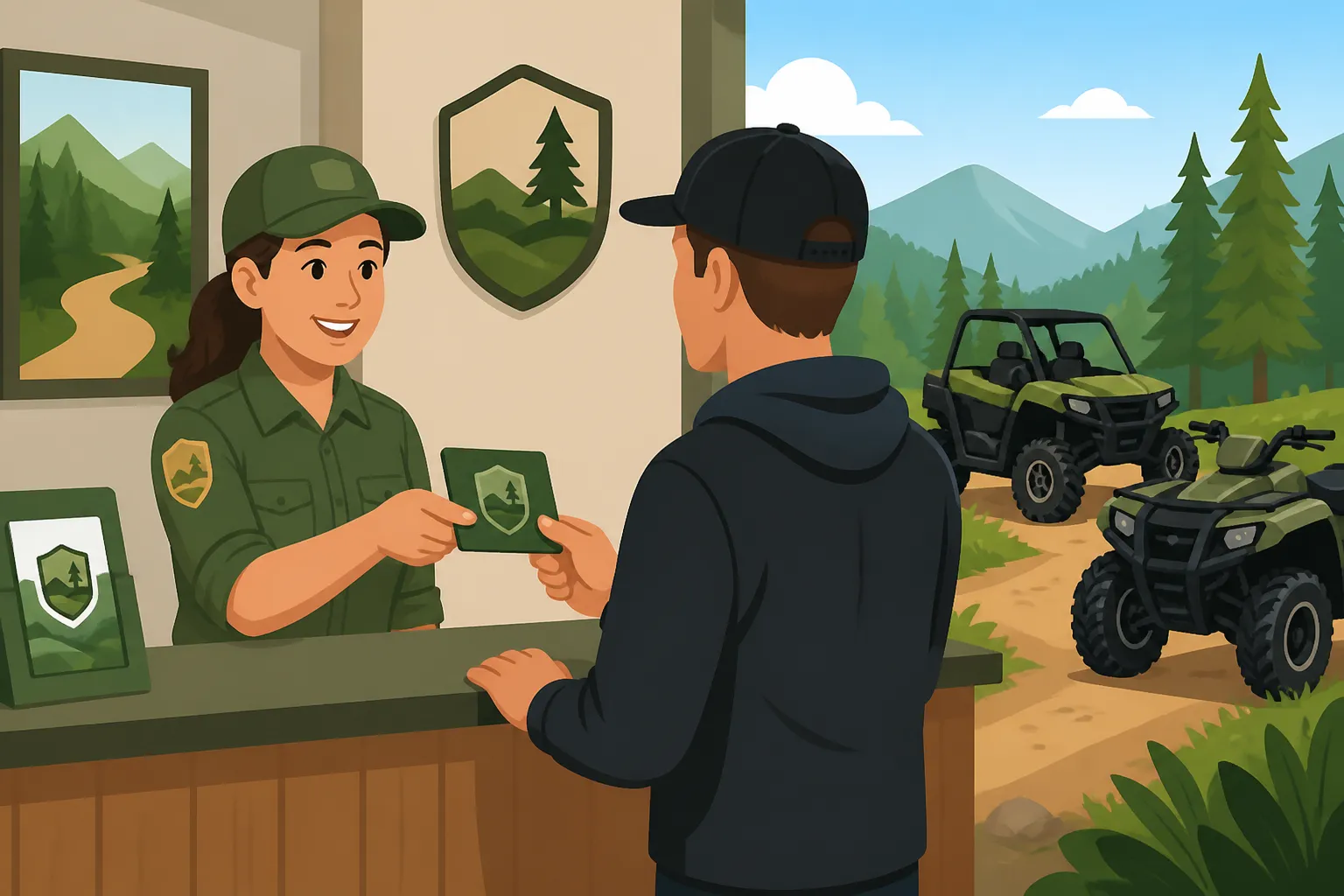
Buying a Permit at a Ranger District Counter
Buying a Georgia Forest OHV permit at a ranger district counter can be convenient, especially if you want to ask questions before heading to a trail. The main catch is that a counter visit is not the same as a guaranteed permit sale: hours, availability and payment options can vary. Here’s how to prepare, what to ask, and what the permit does—and does not—allow.
What a Ranger District Counter Can Do
Ranger district offices are one way to buy a permit for riding designated off-highway vehicle systems in Georgia’s national forests. A counter visit can be useful if you need help choosing between a day permit and an annual permit, want to confirm which riding areas the permit covers, or need to ask about trail conditions and closures.
A permit bought at an office is still a Forest Service OHV permit. It is not a Georgia vehicle registration, a street-use plate, or a general pass for every public or private trail. Georgia’s forest permit program applies to the designated OHV systems covered by the program. The permit does not replace a park’s own admission, waiver, age, equipment or safety requirements.
Before traveling, confirm that the office you plan to visit sells permits and is open when you expect to arrive. An office may have different public service hours from the hours you might assume from a trailhead or recreation area. Staff availability, payment methods and permit processing can also differ. A quick call or check of the office’s current official information can prevent an unnecessary detour.
For a broader overview of the permit rules and what riders should have before they go, see Georgia OHV Permits: What You Need Before You Ride. To compare buying options, Where Georgia Riders Buy a Forest Permit explains the available channels, while Georgia Ranger District Offices That Sell Permits focuses on district offices.
What to confirm before leaving home
Ask the office the practical questions that affect your trip:
- Does this office currently sell Georgia Forest OHV permits at the counter?
- What are its public counter hours, and does it close during lunch or on particular days?
- Which payment methods can it accept?
- Can you buy the permit you need there, or should you purchase it through the official online channel?
- Is the trail system you plan to ride open, and are there any temporary closures or access restrictions?
- What proof of purchase should you carry: a paper copy, an electronic copy, or either?
- Are there current permit terms you should know before paying?
These questions matter because a permit purchase and a riding-area status check are separate tasks. Having a valid permit does not mean a particular trail is open that day. Weather, maintenance, seasonal restrictions and other management decisions may affect access.
Know which permit program you are asking about
Georgia riders may encounter several different kinds of access rules. A Forest Service OHV permit applies to designated national forest riding systems included in that program. A private off-road park can set its own admission and operating rules. A Wildlife Management Area may have separate access restrictions. A machine’s state registration or road-use status is another issue altogether.
When you call or speak with counter staff, use the phrase “Georgia Forest OHV permit” and name the riding system you plan to visit. That helps avoid confusion with a state vehicle registration, campground pass, general recreation pass or a different area’s permit.
Choose the Right Permit Before You Reach the Counter
The Forest OHV permit program offers day and annual options. The right choice depends mainly on how often you expect to ride covered systems and whether the permit will be used by one operator or several. The permit follows the operator rather than the machine, so each person who operates needs to consider their own permit requirement.
The annual permit is valid across all six Georgia OHV systems covered by the program. That can be convenient for riders who visit more than one system or make repeated trips. A day permit may be a better fit for an occasional outing. Since prices and terms can change, check the official permit source or ask the ranger district for current figures before paying.
| Your situation | Option to ask about | What to keep in mind |
|---|---|---|
| One planned riding day | Day permit | Check that it covers the riding date and system you intend to use |
| Several rides during the permit period | Annual permit | Confirm the current validity period and covered systems |
| Two people may take turns operating | A permit for each operator | The permit is tied to the person operating, not just the vehicle |
| You are only a passenger | Ask whether you will operate at any point | A passenger who later drives should have the required operator permit |
| You plan to ride a private park | The park’s own admission and rules | A Forest OHV permit does not replace a private park’s requirements |
| You are visiting a WMA or other public land | The site-specific rules | A Forest OHV permit does not automatically authorize riding there |
For the operator-based rule, read Georgia National Forest Permits Are Per Operator. The annual option’s coverage is discussed in Georgia Annual Permits Valid at All Six Systems, and the day-versus-annual choice is covered in Georgia Day and Annual Forest OHV Permits.
Count operators, not machines
A common planning mistake is to count vehicles instead of people. If one rider operates two machines during a visit, the permit rule is based on that rider, not on having a separate permit for each machine. If two people take turns driving one side-by-side, both people should check the permit requirement for operating.
This distinction also matters for groups. One person buying permits for a group should know who will actually operate and make sure the purchase matches the permit program’s terms. Do not assume that a single permit covers everyone in a family, a group, or a vehicle with multiple seats.
If you are unsure whether a passenger needs a permit in a particular situation, ask the office before buying. A passenger who remains a passenger is not the same as someone who takes a turn driving. The safest approach is to describe the planned use clearly rather than rely on a general assumption.
Compare the permit period with your actual riding plan
Think about how many visits you expect, which systems you want to use, and whether each trip is likely to fall within the permit’s valid period. An annual permit may be more practical for frequent riders, but it is not automatically the right purchase for everyone. An occasional visitor may prefer a day permit, especially if the visit is uncertain.
Do not choose solely by looking at the listed price. Consider whether the permit is refundable or transferable, whether the planned trip dates are firm, and whether the intended riding areas are covered. Confirm current terms before paying, particularly if weather or a possible closure could change your plans.
Prepare for the Counter Visit
A ranger district counter purchase is usually a straightforward transaction, but preparation helps you avoid delays and incomplete plans. You do not need to bring vehicle-registration paperwork simply because you are buying a forest OHV permit. The permit is an operator access requirement, not a title or registration process.
Still, it helps to have your riding details ready. Know which system you want to visit, the date or expected dates, the number of people who may operate, and whether you are considering a day or annual permit. If you are buying for another person, confirm whether the permit must be issued or recorded in the operator’s name and what information the office needs.
A practical preparation checklist
Before setting out, make sure you can answer these questions:
- Which riding system are you visiting? Use the system’s exact name, and confirm that it is one of the covered Georgia OHV systems.
- When do you plan to ride? A specific date helps staff explain the appropriate permit and any current access restrictions.
- Who will operate? Count every person who may drive, including someone who may switch from passenger to operator during the day.
- Which permit period fits? Decide whether you are asking about a day permit or an annual permit, while staying open to confirming the current terms.
- How will you pay? Ask which payment methods the office accepts rather than assuming it takes a particular card or cash.
- How will you show the permit? Confirm whether a paper copy, digital copy or another form of proof is accepted at the riding area.
- Have you checked the trail status? Ask about closures, weather-related issues and any restrictions that apply to your planned visit.
You may also want to bring a phone so you can save an electronic receipt or official permit record if the program provides one. If you prefer paper, ask whether the counter prints the permit or whether you need to print it yourself. Keep the purchase confirmation accessible rather than buried in an email account you may not be able to reach at the trailhead.
Information that may be useful but is not a substitute for the permit
Your vehicle details can help when asking about trail suitability, but they do not determine who needs an operator permit. For example, a side-by-side’s width and equipment can affect whether it fits a particular trail, but those characteristics do not turn an operator-based permit into a vehicle pass.
If you are unsure whether a vehicle can use a particular system, ask about the trail’s restrictions separately. Georgia’s Forest OHV systems may have different trail characteristics, and a machine that is appropriate for one route may not be allowed or suitable on another. The permit authorizes access under the program’s terms; it does not guarantee that every trail accommodates every ATV or UTV.
What Happens at the Counter
The exact interaction can vary by office, but it helps to expect a short conversation about the permit type, the operator and the intended riding system. A counter purchase is a chance to clarify the rules, not just to hand over payment. If an important detail is unclear, ask before completing the transaction.
A useful sequence is:
- State what you need. Explain that you want a Georgia Forest OHV permit and identify the system and planned date.
- Tell staff who will operate. If more than one person may drive, say so before buying.
- Choose the permit period. Ask about day and annual options and confirm their current terms.
- Verify the total and payment methods. The cost can change, so rely on the current official information rather than an old receipt or online discussion.
- Check the permit details before leaving. Confirm the operator information, validity and proof-of-purchase instructions.
- Ask about access status. Find out whether the intended system has closures or restrictions that could affect the trip.
- Keep the permit accessible. Carry or display it in the form the program requires, and retain the receipt or confirmation where you can retrieve it.
Read the details on the permit or receipt before walking away. If the operator name, permit period or other information does not match what you intended to purchase, ask the staff member to resolve it immediately. This is easier to address at the counter than after you have driven to a trailhead.
If the office cannot sell you a permit that day
An office may be closed, unable to process the sale, or unable to provide the option you need. Do not assume you can ride first and sort out the permit afterward. Ask staff how to purchase through the official alternative channel and whether you can complete the transaction before entering the riding area.
If you buy online instead, check that the transaction is complete and save the confirmation in a form you can access without a reliable signal. Georgia Permits on Recreation.gov covers the online option. A screenshot or downloaded copy can be a useful backup if accepted, but confirm the program’s proof requirements rather than treating any saved screen as automatically sufficient.
The permit terms are generally described as non-refundable and non-transferable. That makes it important to verify the operator, dates and permit type before purchase. If a trip is uncertain, ask about the terms before paying; do not count on being able to return the permit or pass it to someone else.
What the Permit Does Not Cover
Buying a permit at a ranger district counter does not settle every question about riding in Georgia. The permit is one part of trip preparation. Operators still need to follow the rules for the specific riding system, comply with applicable equipment and safety requirements, and respect closures and posted restrictions.
It also does not create road access. A Forest OHV permit is not permission to ride a machine on a public road or to travel between trail systems on roads that are not open to that use. Georgia’s county-road rules are a separate subject; see Georgia MPOHV Road Rules: County Roads Only if you are trying to understand road use.
The permit also does not replace:
- A private park’s admission fee, waiver or operating rules
- A separate permit or access rule for a WMA or other public area
- Any applicable requirements for a minor rider
- Vehicle-specific restrictions on a particular trail
- A trail closure, seasonal restriction or temporary safety closure
- Rules governing where a machine may be unloaded, parked or operated
For a clear explanation of the limits, see What an Operator Permit Does Not Cover. If you are choosing between a Forest Service area and a privately operated park, check each site’s rules directly. A permit for one does not automatically cover the other.
Check the destination again on riding day
Conditions can change after you purchase a permit. Rain can affect trail surfaces, maintenance can close a route, and seasonal management can restrict access. Check the relevant official information before traveling and again before unloading. If a system is closed, a valid permit does not override the closure.
Likewise, a permit does not guarantee that a machine fits every trail. Confirm any width or vehicle restrictions for the routes you want to ride. A UTV may be too wide for a trail system or route that is suitable for a smaller ATV. When there is uncertainty, ask the managing office rather than relying on a general description of the trail network.
Carry proof in a usable form
The best way to carry your permit depends on the program’s current instructions. If you receive a paper permit, protect it from water and damage and keep it with you as required. If the permit is digital, make sure the confirmation is saved where you can open it even if cell service is weak.
A paper backup can be useful when a phone battery runs low or a screen is difficult to read outdoors. But a backup does not replace the official permit, and riders should follow the program’s current instructions for how proof must be presented. Carrying a Permit on the Trail explains practical ways to keep the permit available during a ride.
Frequently Asked Questions
Can I buy a Georgia Forest OHV permit at any ranger district office?
Not necessarily. Confirm with the specific office that it sells permits at the counter, check its public hours and ask about payment methods before traveling. If that office cannot process your purchase, ask how to use the official online option.
Does one permit cover every rider in my group?
No. The permit follows the operator, not the vehicle or group. Each person who operates should check the permit requirement for themselves. A passenger who later takes the controls should not assume another person’s permit covers them.
Does a ranger district permit let me ride any Georgia trail?
No. It applies to covered Forest Service OHV systems, subject to their rules and closures. Private parks, WMAs, other public areas and public roads can have separate requirements.
Should I buy the permit before checking trail conditions?
Check the riding system’s status before you go and confirm the permit terms before purchase. Since permit terms may restrict refunds or transfers, do not assume you can recover the cost if a closure or schedule change disrupts your plan.
Disclaimer
This article is for general informational purposes only and does not constitute professional advice. Laws, prices and regulations vary by location and change over time. Consult a qualified professional for guidance on your specific situation.