Machines Too Wide for a Trail System
A machine that fits Georgia’s registration rules may still be too wide for the trail you want to ride. The key is to check the trail’s vehicle limit, not assume a plate or permit guarantees access. Here’s how to measure your machine, compare trail restrictions and choose a ride that fits.
Why registration width and trail width are different
A common source of confusion is that Georgia’s maximum width for registering a multipurpose off-highway vehicle (MPOHV) is not the same as the width limit at many off-highway trails.
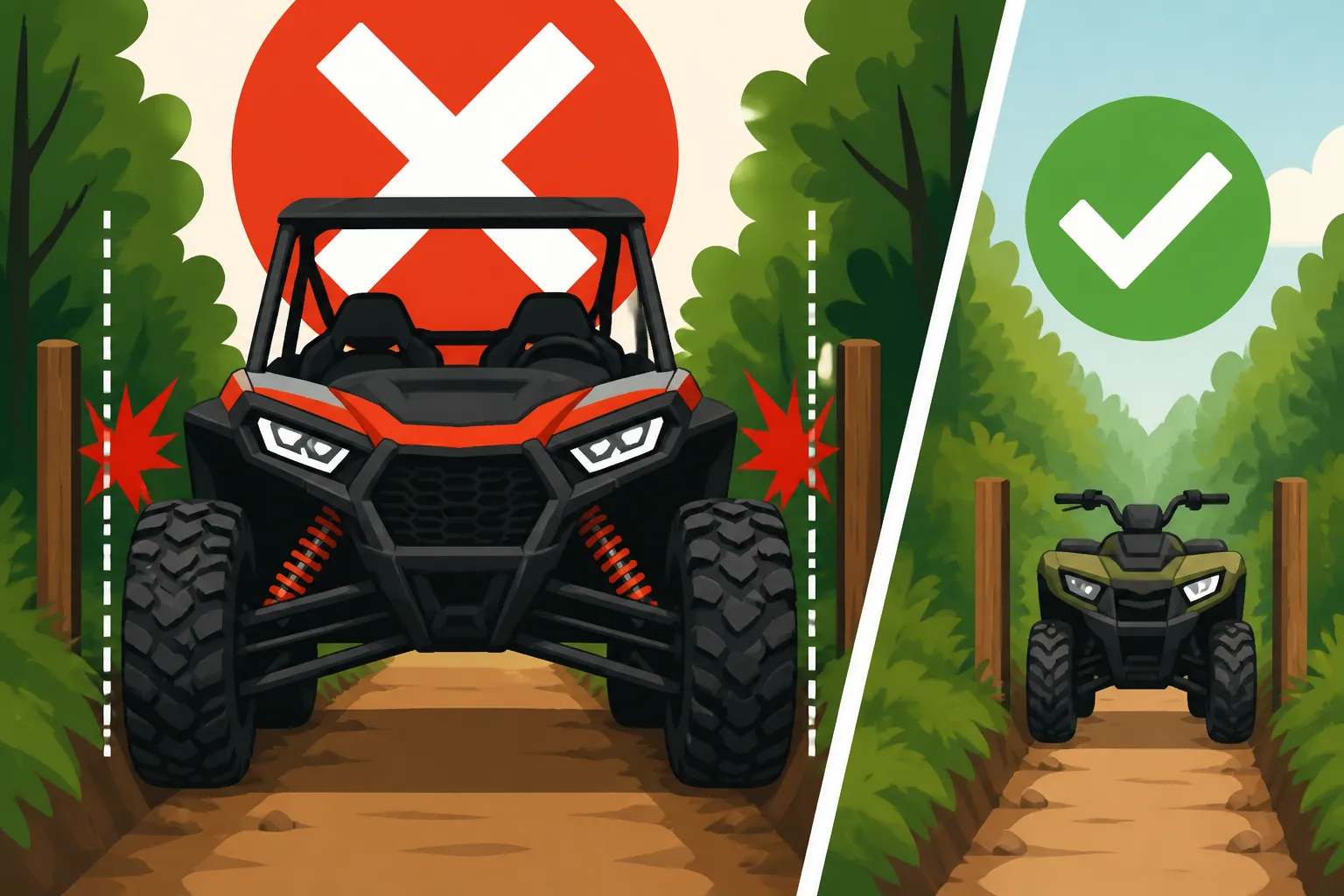
According to the Department of Revenue, a qualifying MPOHV must be no wider than 80 inches to meet its registration requirement. The Forest Service, however, restricts trail use to vehicles less than 50 inches wide unless a trail is specifically designated for full-size vehicles. Some trails have their own, narrower limits.
Those rules answer different questions:
- Registration width: Does the vehicle meet Georgia’s MPOHV registration criteria?
- Trail width: Is the vehicle allowed on a particular trail?
- Road access: Is the vehicle allowed on the road or forest road leading to a trailhead?
A vehicle can meet the state’s registration width rule and still be barred from a narrow Forest Service trail. Registration does not change a trail’s width limit, and an OHV permit does not make an oversized machine fit.
The Department of Revenue’s width rule is only one part of MPOHV eligibility. Its other requirements include a steering wheel, a nonstraddle seat, a minimum cargo capacity of 350 pounds, and a gross vehicle weight under 4,000 pounds. A qualifying machine must also have at least four wheels and be capable of operating between 25 and 65 miles per hour. These are registration standards, not a promise that every trail accepts the machine.
For more about the distinction between vehicle eligibility and state paperwork, see Georgia’s 80-Inch Width Limit for Registration and Georgia MPOHV Registration Explained. For the trail-side measurement, Measuring Width Against the 80-Inch Limit helps explain why the number used for a state application should not be confused with the smaller limits posted at trail systems.
How to check whether your machine will fit
Start with the trail’s own rules, then measure your machine in a way that reflects its actual width. A manufacturer’s listed width is useful, but accessories and modifications can change the measurement.
Check the specification plate or owner’s manual for the vehicle’s factory width. Then look for anything that extends beyond the body, such as wider tires, wheel spacers, fender flares, mirrors, or other add-ons. If the trail’s rule is close to your machine’s measured width, contact the managing ranger district before setting out rather than relying on a catalog figure.
For a home measurement, park on level ground and measure across the widest points from side to side. Keep the tape straight and include the parts that extend furthest outward. A long tape measure is usually easier to handle than trying to estimate width from tire-to-tire spacing; you can use one you already own or pick one up from a hardware store or Amazon. Record the measurement somewhere you can check it when comparing trail rules.
Use these steps as a practical check:
- Find the specific trail system and identify the rule for the route you intend to ride.
- Confirm whether the stated limit applies to the whole system, a particular loop, or a specific trail.
- Measure the widest part of your machine, including modifications.
- Check the current map and trail notices for closures or changes before traveling.
- If the posted rule does not clearly cover your vehicle, ask the managing Forest Service office.
Pay attention to how the limit is written. “Less than 50 inches” is not the same as “50 inches or less.” According to the Forest Service, Houston Valley restricts vehicles to 50 inches in width, while the Beasley Knob trails allow vehicles including ATVs up to 50 inches wide. The Forest Service also says Oakey Mountain accommodates OHVs with less than a 48-inch axle width. Check the exact wording for your destination and machine rather than treating every limit as interchangeable.
A useful comparison is:
| Trail or rule | Width restriction | What it means for a wider machine |
|---|---|---|
| General Forest Service trail rule | According to the Forest Service, vehicles must be less than 50 inches wide unless a trail is specifically designated for full-size vehicles. | Do not assume a full-size vehicle is allowed without confirming the trail designation. |
| Houston Valley | According to the Forest Service, vehicles using the trails are subject to a 50-inch width restriction. | Check your machine against the system’s stated limit before hauling it there. |
| Beasley Knob | According to the Forest Service, the trails allow vehicles up to 50 inches wide. | A machine wider than the stated limit does not meet the trail requirement. |
| Oakey Mountain | According to the Forest Service, the trails accommodate OHVs with less than a 48-inch axle width. | A machine near or above that limit needs careful measurement and confirmation. |
These examples show why there is no single width rule that answers every trail question. The Georgia ATV Trails That Allow Side-by-Sides and Georgia ATV Trails That Ban Side-by-Sides pages can help narrow down options, but always confirm the specific route’s restrictions before you go.
What to do if your machine is too wide
If your vehicle exceeds the trail’s limit, the straightforward answer is to choose a different route or trail system that permits its size. Do not try to squeeze through a narrow section, ride around a gate, or use an unmarked bypass. The Forest Service says motorized riding on the Chattahoochee-Oconee National Forest is limited to trails designated for off-road motorized use, and using a motor vehicle inconsistently with designated maps is prohibited.
Look for a trail system that explicitly allows full-size vehicles, rather than relying on the fact that it has wide-looking roads or open areas. Trail descriptions may distinguish between motorcycles, ATVs, and full-size vehicles, and a system can have separate rules for different loops. For example, the Forest Service identifies the Davenport Mountain OHV trails as suitable for motorcycles and ATVs; that description is not an assurance that a side-by-side or wider utility vehicle is allowed.
The Forest Service also says that motorized vehicles such as motorcycles, ATVs, and unlicensed OHVs are restricted to designated trails on the forest. Forest roads are a separate category: according to the Forest Service, ATVs and MPOHVs are prohibited on Forest Service roads. A machine that cannot use a particular trail should not be rerouted onto a forest road as a workaround.
Before making a trip, check the applicable map and the latest conditions. Motor Vehicle Use Maps identify roads, trails, and areas designated for motor vehicle use, according to the US Forest Service. Trail conditions matter too: the Forest Service closes national forest OHV trails during wet conditions to help prevent trail damage and erosion. Georgia’s Six National Forest OHV Systems and Georgia Trail Conditions Before You Drive are useful starting points for choosing a destination and checking for closures.
If the machine does fit the trail, remember that access still comes with separate requirements. According to the Forest Service, OHV permits are issued per person rather than per vehicle, and each operator needs a permit to be in compliance at systems where one is required. A permit covers the operator requirement; it does not override the vehicle-width rule. For that distinction, see Georgia’s Per-Operator Permit, Not Per Vehicle.
It can also help to call the ranger district responsible for the trail before loading up, especially if your machine is close to the limit or has aftermarket wheels or tires. Ask whether the posted measurement is based on overall vehicle width, axle width, or another stated measurement, and whether the trail has a separate designation for wider vehicles. The Forest Service identifies the Gainesville Supervisor’s Office contact number as (770) 297-3000 for inquiries. For trail-specific status, use the appropriate district contact and current map rather than assuming one office’s answer applies to every system. How to Check Georgia Forest Trail Status offers a practical next step.
A simple decision before you haul
Treat vehicle size, trail access, and road access as separate checks. That keeps a registration document or permit from creating false confidence about where your machine can go.
Before leaving home, confirm:
- Your actual vehicle width: Measure the widest point, including accessories.
- The exact trail limit: Check whether the rule is “less than” a width or “up to” that width.
- The route designation: Confirm the machine type is allowed on the particular trail or loop.
- Road restrictions: Do not assume you can use a Forest Service road to reach or bypass a trail.
- Current conditions: Check for closures, including wet-weather closures.
- Operator requirements: Confirm the permit and driver requirements that apply to your trip.
If your machine meets Georgia’s MPOHV registration standards but exceeds a trail’s width limit, that is not a contradiction. It simply means the vehicle may qualify for state registration while remaining ineligible for that narrower route. Match the machine to the trail, and verify the rules for the exact place you plan to ride.
Sources
- Department of Revenue — Registering a Multipurpose Off-Highway Vehicle | Department of Revenue (checked November 3, 2026)
- Forest Service — Chattahoochee-Oconee National Forest | Frequently Asked Questions about Motorized Use on the National Forest | Forest Service (checked November 3, 2026)
- Forest Service — Chattahoochee-Oconee National Forest | Off-Highway Vehicles (OHV) | Forest Service (checked November 3, 2026)
- Georgia Department of Revenue – Motor Vehicle Division — download (checked November 3, 2026)
- USDA Forest Service — Chattahoochee-Oconee National Forest | ATV and OHV – Call Before You Haul | Forest Service (checked November 3, 2026)
- Forest Service — Chattahoochee-Oconee National Forest | Beasley Knob OHV Trail System | Forest Service (checked November 3, 2026)
- USDA Forest Service — Chattahoochee-Oconee National Forest | Davenport Mountain OHV Trails | Forest Service (checked November 3, 2026)
- USDA Forest Service — Chattahoochee-Oconee National Forest | Houston Valley OHV Trails | Forest Service (checked November 3, 2026)
- USDA Forest Service — Chattahoochee-Oconee National Forest | Locust Stake OHV Trail System | Forest Service (checked November 3, 2026)
- Forest Service — Chattahoochee-Oconee National Forest | Oakey Mountain OHV Trails | Forest Service (checked November 3, 2026)
- USDA Forest Service — Chattahoochee-Oconee National Forest | Rock Creek ORV Trail | Forest Service (checked November 3, 2026)
- USDA Forest Service — Chattahoochee-Oconee National Forest | Tatum Lead ORV Trail | Forest Service (checked November 3, 2026)
- USDA Forest Service — Chattahoochee-Oconee National Forest | Town Creek OHV Trails | Forest Service (checked November 3, 2026)
- USDA Forest Service — Chattahoochee-Oconee National Forest | Whissenhunt OHV Trails | Forest Service (checked November 3, 2026)
- USDA Forest Service — Chattahoochee-Oconee National Forest | Windy Gap, Milma Creek, and Tibbs OHV Trails | Forest Service (checked November 3, 2026)
Disclaimer
This article is for general informational purposes only and does not constitute professional advice. Laws, prices and regulations vary by location and change over time. Consult a qualified professional for guidance on your specific situation.