Why the Permit Follows the Rider
A Georgia Forest Service OHV permit can be confusing if you expect it to work like a vehicle registration sticker. The key distinction is simple: the trail permit is issued to the person operating, not to the ATV or UTV. But a permit alone does not make every machine eligible for every trail, so check both operator and vehicle rules before heading out.
What “the permit follows the rider” means
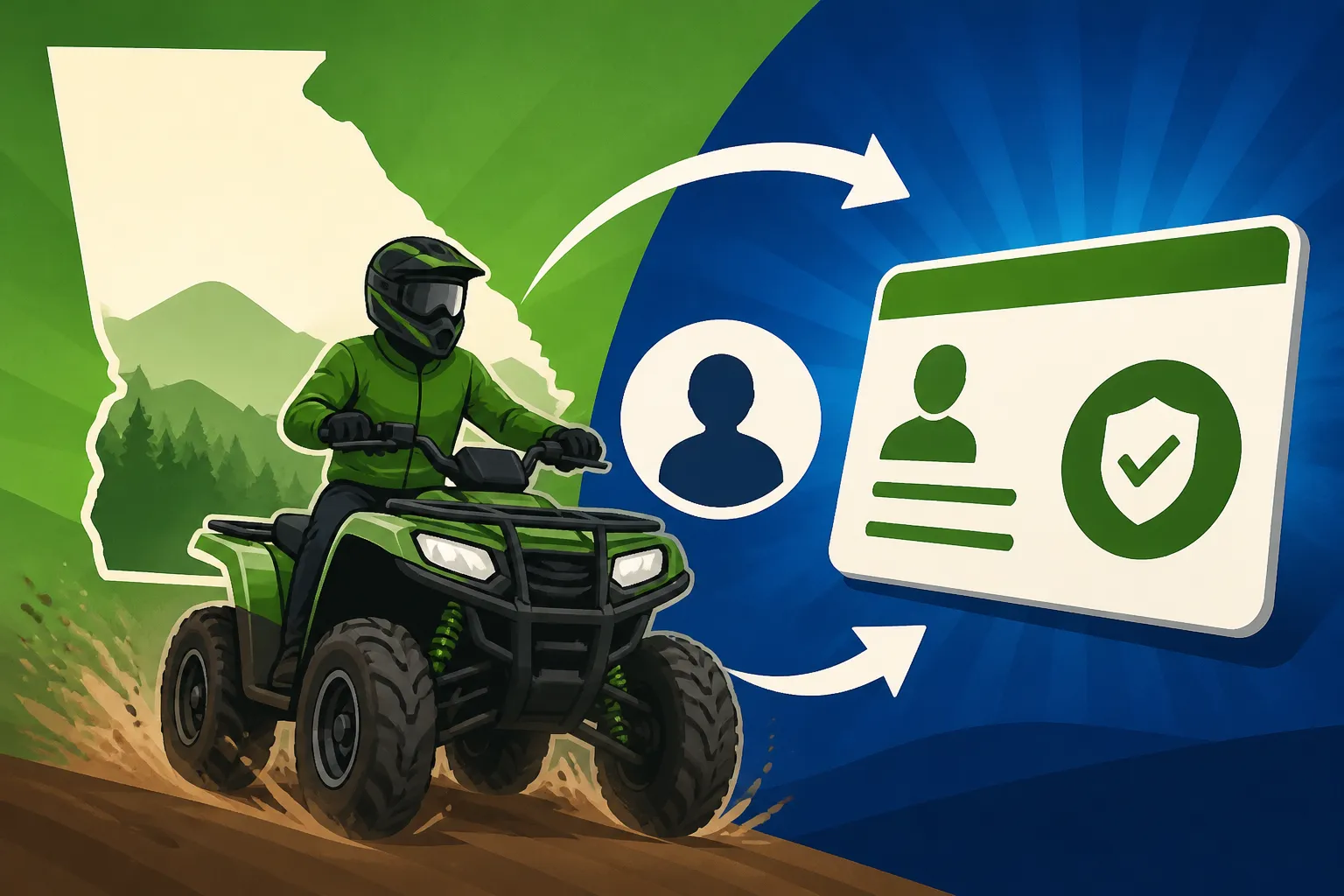
The Forest Service issues OHV permits per person rather than per vehicle. According to the Forest Service, each operator needs a permit to be in compliance on the trails covered by the permit. In practice, that means a permit is tied to the person who will operate the machine—not to a particular ATV, UTV, or tow vehicle.
If two people plan to take turns driving one machine, each operator needs a permit. If one person brings more than one machine, the permit requirement still concerns that operator. A passenger who does not operate is not automatically an operator; check the rules for the specific trail system if your group’s plans or roles are unclear. For more on the distinction, see Georgia National Forest Permits Are Per Operator and Does a Passenger Need Their Own Georgia Forest Permit?.
| Situation | How the permit rule applies |
|---|---|
| One operator uses one machine | The operator needs a permit for the applicable trail system. |
| Two people take turns operating one machine | Each operator needs a permit, according to the Forest Service. |
| One person operates more than one machine | The permit requirement is based on the operator, not the number of machines. |
| A passenger rides but does not drive | The operator-permit rule applies to the person operating; confirm any other trail-specific requirements. |
| A permitted operator arrives with a machine that does not fit the trail rules | The permit does not override vehicle restrictions or make that machine eligible. |
According to the Forest Service, an annual OHV permit is valid at Houston Valley, Whissenhunt, Beasley Knob, Town Creek, Oakey Mountain, and Davenport OHV Trails. A pass that covers those named systems is useful for someone who rides more than one of them, but it does not mean every type of vehicle can ride every trail within those systems. The operator still has to follow the rules posted for the particular trail and machine. See One Annual Permit Covers All Six Georgia OHV Systems for more on the annual pass.
The Forest Service lists a one-day permit at $5 per operator per day and an annual pass at $50 per operator per year, as of November 2026. Those are operator-based costs, not fees charged for each vehicle. Check the Forest Service’s current information before setting out, since fees and local arrangements can change.
The distinction is different from vehicle registration. Georgia’s Department of Revenue describes multipurpose off-highway vehicle registration as voluntary, and a registered machine does not thereby receive a Forest Service trail permit. Registration and trail access answer different questions: registration concerns a qualifying vehicle’s registration status, while an OHV permit concerns the operator’s authorization for applicable Forest Service trail use. For the registration side, see Georgia MPOHV Registration Explained and Georgia’s Day and Annual Forest OHV Permits.
A permit does not decide whether your machine can use a trail
The fact that an operator has a valid permit does not guarantee that a particular ATV or UTV may ride on a particular trail. Forest Service access rules depend on the designated trail, vehicle type, width, and other restrictions. A permit is not permission to ride on an undesignated road or trail, and it does not cancel a closure.
For example, the Forest Service restricts trail use to vehicles less than 50 inches wide unless a trail is specifically designated for full-size vehicles. Some systems have narrower limits or are managed for particular types of off-highway vehicles. A machine that fits a general description of an OHV may still be too wide for the trail you planned to ride. See Georgia’s 50-Inch Width Cap at Houston Valley and Georgia ATV Trails That Allow Side-by-Sides before choosing a destination.
Machine type matters, too. The Forest Service states that the Davenport Mountain OHV Trail is suitable for motorcycles and ATVs, while the Town Creek system does not allow side-by-sides or other UTV-type vehicles. The Forest Service also identifies some loops and systems with separate vehicle rules. A permit covering a trail system does not erase those differences between trails or loops.
Use this sequence to avoid a wasted trip:
- Identify the exact trail system and trail or loop you intend to ride.
- Check whether that trail allows your machine type, including side-by-sides if applicable.
- Confirm the machine’s width against the trail’s stated limit.
- Check current closures, wet-weather restrictions, and other operating conditions.
- Make sure each person who will operate has the required permit.
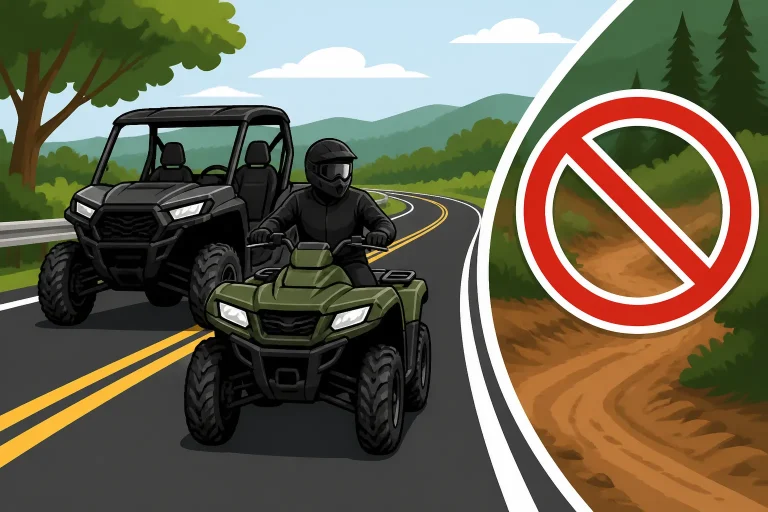
A trail’s name alone is not enough to determine whether a UTV can ride there. The Forest Service says motorized riding is limited to trails designated for off-road motorized use, and use inconsistent with designated maps is prohibited. Some National Forest roads are open only to registered vehicles and mopeds under state law; the Forest Service says ATVs and multipurpose off-highway vehicles are prohibited on Forest Service roads. Off-highway vehicles that are not licensed for public-road use must stay on designated OHV trails. A trail permit does not grant access to a Forest Service road or a route that is closed to your machine.
Georgia vehicle registration is another separate issue. Department of Revenue rules define a qualifying multipurpose off-highway vehicle by features such as a steering wheel and nonstraddle seat, along with equipment and capability requirements. The agency also requires applicants to submit an ownership affidavit and provide required identification, ownership evidence, and insurance documentation. Those registration steps do not substitute for a trail permit or trail-specific permission. For help deciding whether a machine fits the state category, see Georgia MPOHV Eligibility: The Eight-Point Test.
Registration, trail permits, and road access are separate
It is easy to hear “registered” and assume a machine can go anywhere a registered vehicle can go. That assumption can lead to the wrong route. Georgia registration, insurance, a Forest Service OHV permit, and permission to use a particular road or trail are not interchangeable.
The Department of Revenue says Georgia MPOHV registration is voluntary. The registration process requires an MV-OHV Multipurpose Off-Highway Vehicle Inspection and Ownership Affidavit, and the affidavit must be submitted to the tag office in the owner’s county of residence. The Department of Revenue also says applicants need a valid Georgia driver’s license or ID card for identification. Those requirements relate to the state registration process—not to the operator permit for a Forest Service trail.
The Forest Service’s access rules are more specific to where you ride. It says riding on the Chattahoochee-Oconee National Forest is restricted to trails designated for off-road motorized use. It also says all-terrain vehicles and multipurpose off-highway vehicles are prohibited on Forest Service roads. So even if a vehicle has state registration, insurance, and an operator holding a Forest Service permit, those facts do not authorize riding it on a road or trail where that vehicle is prohibited.
It is also important to distinguish an ATV from an MPOHV. Georgia government defines an ATV as an off-road vehicle used on private dirt roads and designated trails, not on public dirt roads, paved roads, or highways. It defines an MPOHV as a four-wheeled utility vehicle designed for both on-road and off-road features. State requirements for these categories differ, but neither category’s state status replaces Forest Service trail restrictions. For broader riding rules, see Georgia ATV Registration Requirements and Georgia ATV Trails That Ban Side-by-Sides.
A useful way to think about the requirements is to ask three separate questions:
- Does the operator have the required Forest Service permit? The permit follows the person operating.
- Is the machine allowed on the selected trail? Check type, width, and any restrictions for the specific loop.
- Is the route open and designated for that kind of riding? Confirm maps, current conditions, and closures.
A “yes” to the first question does not automatically answer the other two. In particular, do not treat a permit as a pass for the full National Forest road network. The Forest Service says off-highway vehicles not licensed for public-road use must remain on designated OHV trails, and use contrary to the designated motor vehicle maps is prohibited.
Check the details before leaving home
Trail rules and operating conditions can change what is possible on the day of a ride. The Forest Service closes motorized trails when conditions are wet to prevent damage and erosion. It also warns that vehicles must comply with noise restrictions: according to the Forest Service, a vehicle traveling at 35 miles per hour or less must not exceed 86 decibels at 50 feet, while a vehicle traveling faster than 35 miles per hour must not exceed 90 decibels at 50 feet. Check the current trail status rather than relying on a past visit or an old trip plan.
Driver qualifications matter as well. The Forest Service says motor vehicles may be operated on designated OHV trails only by an operator of legal age to obtain a state driver’s license or someone accompanied by a legally licensed driver. Georgia government states that MPOHV operators must be 16 years old and have a valid driver’s license and proof of insurance. Those rules are not a substitute for checking requirements that apply to your specific machine and trail.
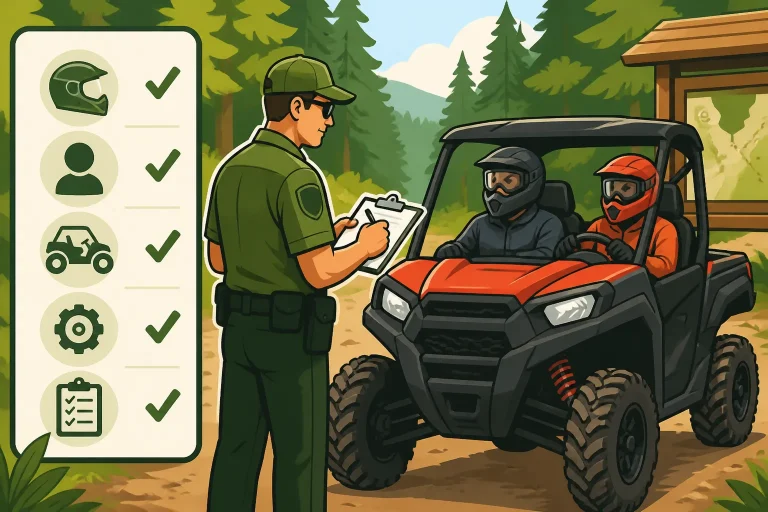
Before the trip, confirm the following:
- Your permit: Each person who will operate should have the required permit. Check whether a day or annual option fits your plans and verify current purchase and display instructions.
- Your trail: Confirm that it is open, designated for motorized riding, and included in the permit’s coverage.
- Your machine: Check whether the trail allows your vehicle type and whether it meets the trail’s width limit.
- Your group: Make sure each operator meets the applicable age and licensing rules. Do not assume a passenger may operate simply because the machine is permitted.
- Conditions: Check for wet-weather closures and any seasonal or local restrictions.
- Your route: Use the relevant Motor Vehicle Use Map and remain on routes designated for your vehicle.
For a concise overview of permit basics, see Georgia OHV Permits: What You Need Before You Ride. If you are comparing destinations, Georgia Trail Conditions Before You Drive can help you plan around closures and changing conditions.
The practical takeaway is straightforward: buy or carry the permit for each operator, then separately verify that the machine and route are allowed. That approach prevents the common mistake of assuming that a permit attached to a vehicle—or a permit in one rider’s name—covers every person and every trail.
Sources
- Forest Service — Chattahoochee-Oconee National Forest | Frequently Asked Questions about Motorized Use on the National Forest | Forest Service (checked November 3, 2026)
- Georgia government — download (checked November 3, 2026)
- USDA Forest Service — Chattahoochee-Oconee National Forest | Roberts Bike Camp OHV Trails | Forest Service (checked November 3, 2026)
- Forest Service — Chattahoochee-Oconee National Forest | Beasley Knob OHV Trail System | Forest Service (checked November 3, 2026)
- USDA Forest Service — Chattahoochee-Oconee National Forest | Davenport Mountain OHV Trails | Forest Service (checked November 3, 2026)
- USDA Forest Service — Chattahoochee-Oconee National Forest | Houston Valley OHV Trails | Forest Service (checked November 3, 2026)
- USDA Forest Service — Chattahoochee-Oconee National Forest | Locust Stake OHV Trail System | Forest Service (checked November 3, 2026)
- Forest Service — Chattahoochee-Oconee National Forest | Oakey Mountain OHV Trails | Forest Service (checked November 3, 2026)
- USDA Forest Service — Chattahoochee-Oconee National Forest | Rock Creek ORV Trail | Forest Service (checked November 3, 2026)
- USDA Forest Service — Chattahoochee-Oconee National Forest | Tatum Lead ORV Trail | Forest Service (checked November 3, 2026)
- USDA Forest Service — Chattahoochee-Oconee National Forest | Town Creek OHV Trails | Forest Service (checked November 3, 2026)
- USDA Forest Service — Chattahoochee-Oconee National Forest | Whissenhunt OHV Trails | Forest Service (checked November 3, 2026)
- USDA Forest Service — Chattahoochee-Oconee National Forest | Windy Gap, Milma Creek, and Tibbs OHV Trails | Forest Service (checked November 3, 2026)
Disclaimer
This article is for general informational purposes only and does not constitute professional advice. Laws, prices and regulations vary by location and change over time. Consult a qualified professional for guidance on your specific situation.