Georgia ATV Registration Requirements
It can feel incredibly frustrating when you're just trying to do the right thing and get your off-road machine legal for those quick trips down a county road, only to be met with a labyrinth of confusing rules. Georgia's approach to registering ATVs and UTVs isn't like registering a car, and it often leaves owners scratching their heads. This guide is here to untangle the specific requirements for getting your side-by-side or utility vehicle properly registered in the Peach State, helping you understand exactly what you need to do and why.
Understanding Georgia's Unique Approach to ATV & UTV Registration
For years, if you owned an ATV or UTV in Georgia, you pretty much just rode it on private land or designated trails. There was no real mechanism to make these machines road-legal, even for a short hop. This created a lot of confusion and a fair bit of frustration for owners who wanted to use their UTVs for quick errands or to connect hunting lands via county roads. Georgia's system is different from many other states, and understanding this core difference is the first step toward successful registration.
Why Standard Titling Doesn't Apply
One of the biggest head-scratchers for many Georgia residents is why their beloved ATV or UTV doesn't have a traditional title, like their car or truck. The truth is, Georgia law traditionally hasn't classified these machines as "motor vehicles" in the same way it does cars, trucks, or motorcycles. This means they don't go through the standard titling process with the Department of Revenue. Without a title, proving ownership historically relied on a bill of sale, a manufacturer's certificate of origin, or an affidavit. This non-titled status has significant implications, particularly when it comes to things like sales tax and proof of ownership. You can find more detail on this in [Why Georgia Does Not Title an ATV].
This lack of a formal title can make transactions feel a bit less secure compared to buying a car. When you purchase a used machine from a private seller, for instance, you're relying heavily on a solid bill of sale to prove your ownership. If that paperwork is flimsy or nonexistent, you could face real headaches down the line if you ever need to demonstrate that the machine is truly yours. This is where creating robust ownership documentation, perhaps even using templates from services like LawDepot for a comprehensive bill of sale, becomes incredibly important. This also ties into how you go about [Proving You Own an ATV in Georgia Without a Title].
The Rise of the MPOHV Registration
Recognizing the growing popularity of side-by-sides and utility vehicles, and the desire among owners for limited road access, Georgia introduced a new category in recent years: the Multi-Purpose Off-Highway Vehicle, or MPOHV. This is Georgia's unique answer to the conundrum of how to allow certain off-road machines onto specific public roads. It's not a full "street legal" designation like you'd get for a car, but it opens doors that were previously shut tight.
The MPOHV registration process officially [Georgia MPOHV Registration Started December 2023], giving owners a pathway to legally operate their eligible machines on certain county roads. What makes this system particularly interesting, and sometimes a source of confusion, is that it's entirely [Georgia MPOHV Registration Is Voluntary]. You're not required to register your UTV as an MPOHV if you only ever ride it on private land or within designated off-road parks. However, if you plan to touch any public road, even briefly, this registration becomes essential. Understanding [What MPOHV Actually Stands For] is key to navigating these new regulations.
Key Eligibility Requirements for a Georgia MPOHV Plate
So, you're ready to get your machine registered as an MPOHV? That's great! But before you head to your local county tag office, it's crucial to understand that not every ATV or UTV qualifies. Georgia has a very specific set of criteria that your machine must meet to be deemed an MPOHV and receive that coveted license plate. These rules are designed to differentiate true utility and recreational vehicles from dirt bikes, quads, and other machines that simply aren't built for even limited road use.
Machine-Specific Criteria
Georgia's MPOHV definition is quite precise. It's not enough to just call your machine a "side-by-side" or a "UTV." The Department of Revenue has an eight-point test that your vehicle must pass. First off, there are size and weight limitations. Your machine must not exceed [Georgia's 80-Inch Width Limit for Registration], which means some of the wider, more aggressive sport UTVs might be out of luck. It also needs to have a [Georgia's 350-Pound Payload Requirement] and stay under a [Georgia's 4,000-Pound Gross Weight Ceiling]. These specifications immediately exclude many traditional ATVs, as well as exceptionally large or heavy commercial UTVs.
Beyond size and weight, the design of your machine matters. It must have a steering wheel, not handlebars. This immediately disqualifies most traditional quads and dirt bikes, making it clear [Why Handlebars Disqualify a Machine]. Furthermore, it needs a non-straddle seat. This is another crucial point for [Why a Straddle Seat Disqualifies a Machine], ruling out conventional ATVs where the rider sits astride the machine like a horse. The machine also needs to be capable of speeds between [Georgia's 25 to 65 mph Speed Requirement]. If your machine is too slow or too fast, it won't qualify. Machines like regular dirt bikes, three-wheelers, dune buggies, and golf carts are explicitly [Georgia Dirt Bikes and Three-Wheelers Are Excluded] and [Georgia Dune Buggies and Golf Carts Are Excluded] from MPOHV registration. Lastly, there's a manufacturing date cutoff: machines built [Machines Built Before 2000 and Georgia Registration] are generally not eligible, regardless of other criteria.
Required Safety Equipment
Meeting the physical and design requirements is just part of the equation; your machine also needs to be properly equipped with safety features commonly found on road-going vehicles. This is where Georgia emphasizes its commitment to safety for anyone operating these machines on public roads. Think of it as a bare minimum for visibility and control.
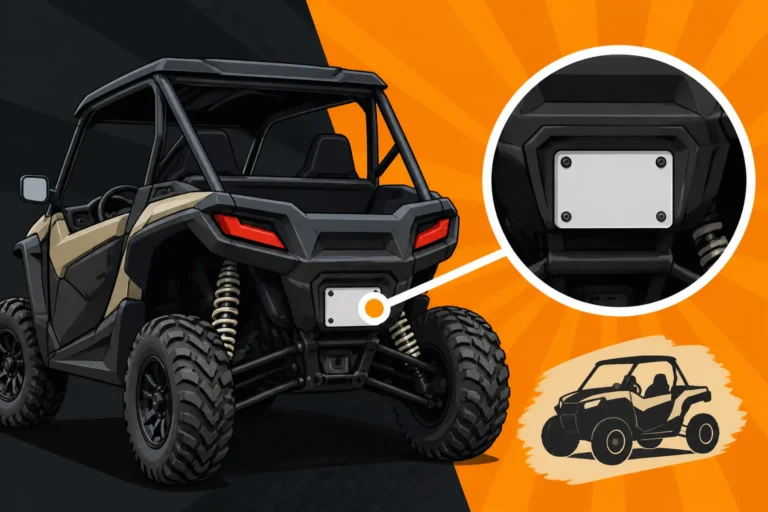
Specifically, your MPOHV must have working headlights, brake lights, and at least one rearview mirror. These aren't just suggestions; they are explicit requirements to ensure you can see and be seen by other traffic. The brake lights, in particular, must be fully functional. Perhaps most critically, your machine must be equipped with factory-installed seat belts, and they must be in working order. This is a non-negotiable item, highlighting [Georgia Requires Seat Belts on a Registered Machine]. If your UTV doesn't have these items, or if they're damaged or non-functional, you'll need to address them before applying for registration. The full list of these items can be seen in [Headlights, Brake Lights and Mirrors on the Checklist].
The Registration Process: What You Need to Bring to the Tag Office
Once you've confirmed your machine meets all the eligibility criteria, the next step is gathering your paperwork and heading to your local county tag office. This can be an intimidating process if you're not prepared, but having all your ducks in a row will make it much smoother. The tag office staff are dealing with these applications daily, so presenting a complete and accurate set of documents is vital.
Essential Documentation Checklist
The most critical items you'll need to bring are proof of ownership and proof of Georgia residency. Since ATVs and UTVs don't have traditional titles, proof of ownership usually comes in the form of a manufacturer's certificate of origin (MCO) for new machines, or a clear, detailed bill of sale for used ones. If you've bought a used machine and the previous owner didn't have much in the way of paperwork, you might need to complete a [Georgia Ownership Affidavit for an MPOHV]. You can often find reliable templates for such legal documents through services like LawDepot, which can help ensure all necessary information is included for the county tag office.
In addition to ownership proof, you'll need to demonstrate you've paid Georgia sales tax on the machine. This is a crucial step that must happen [Georgia Sales Tax Paid Before Registration] and is usually paid at the time of purchase from a dealer, or directly to the county if buying privately. Another non-negotiable item is proof of liability insurance specific to the MPOHV, showing [Georgia Liability Insurance Tied to Registration]. You'll need an active policy from an authorized insurer. Finally, depending on the circumstances, such as if your machine has been significantly rebuilt or if the VIN is questionable, you might need a [T-22B Inspection Certification] from a law enforcement officer. Always call ahead to your local [Georgia County Tag Office Steps for an MPOHV] to confirm their specific requirements and any forms they might need you to fill out beforehand, especially if your situation is unique, like registering [Georgia MPOHV Registration Without a Bill of Sale].
Understanding Branded Certificates and Their Implications
During the registration process, particularly if you're bringing in a used machine, you might encounter the concept of a "branded certificate of registration." This is Georgia's way of flagging certain machines that have a history that could impact their value or safety. It's essentially a warning system for future buyers, and it's something you absolutely need to pay attention to.
A branded certificate means that your MPOHV has been declared salvaged, rebuilt, flood-damaged, or has some other significant designation. It's important to read [What a Branded Registration Warns You About] very carefully. These brands stay with the machine and will be noted on your certificate of registration, essentially telling anyone who looks at the paperwork that the machine has a story. If your machine is eligible for a branded plate, you'll likely need a physical inspection by [Georgia Law Enforcement Inspection for a Branded Plate]. This inspection verifies the vehicle's identity and ensures it meets safety standards after its previous damage or history. While getting a branded registration allows you to operate your MPOHV, it does impact the resale value and perception of the machine. It's wise to consider using a service like LawDepot to generate a comprehensive bill of sale that clearly outlines any existing brands when you eventually sell the machine, ensuring full transparency.
Life After Registration: Road Rules and Annual Renewal
Congratulations, you've navigated the paperwork, met all the eligibility criteria, and now have a shiny new MPOHV plate on your side-by-side! This is a big step, but registration isn't just a one-and-done deal. It comes with responsibilities, both in terms of where and how you can ride, and ongoing administrative duties to keep your machine legal. Understanding these rules is critical to avoid fines and maintain your road access.
Where You Can Legally Ride Your Registered MPOHV
Having an MPOHV plate means you now have limited access to public roads, but it's crucial to understand what "limited" truly means in Georgia. Your registered MPOHV is generally permitted on [Georgia County Road Systems and Where They Run]. This specifically means county roads, which are typically dirt or paved roads maintained by local county governments. This is fantastic for connecting trails, reaching hunting spots, or running quick errands in rural areas.
However, this access does not extend to state highways or interstate highways. It's a common misconception that once registered, you can go anywhere. This is simply not true. Your MPOHV is explicitly restricted from [Why Georgia State Highways Stay Off Limits] and any federal highways. While you may be able to briefly cross a state highway at a designated intersection, riding on them is strictly prohibited. For a detailed breakdown, you can read [Georgia MPOHV Road Rules: County Roads Only]. It's also vital to remember that Georgia has put a [Georgia's ATV Road Access Law Sunsets in July 2027], which means these rules could change in the future, so staying informed is always a good idea. In short, while your side-by-side might technically be capable of higher speeds, its legal operating zones are quite specific, and it's not truly [Are Side-by-Sides Street Legal in Georgia?] in the same way a car is.
Maintaining Your MPOHV Registration
Registration isn't a permanent thing; it's an annual commitment. Just like with your car, you'll need to renew your MPOHV registration each year to maintain its legal status for road use. The process for [Georgia MPOHV Renewal Each Year] is generally straightforward, but it requires continuous compliance with certain rules, especially regarding insurance.
You will pay an annual [Georgia MPOHV Renewal Fee], which is typically a modest amount, but it's important to budget for it. The most critical aspect of renewal, however, is maintaining continuous liability insurance. Your tag office will verify that you have active insurance coverage on your MPOHV before allowing you to renew. A lapse in insurance can lead to penalties or even the cancellation of your registration, so it's vital to ensure your policy stays active. For details on how insurance ties into the renewal, check out [Continuous Insurance and Renewal Time]. Keep an eye out for renewal notices from your county tag office, but ultimately, it's your responsibility to ensure your registration is current.
Georgia MPOHV Eligibility Checklist
To help you quickly determine if your off-highway vehicle qualifies for registration in Georgia, here's a handy checklist. Remember, all criteria must be met.
| Requirement | Description | Status (Yes/No) |
|---|---|---|
| Width | No more than 80 inches wide | |
| Weight | Gross Vehicle Weight Rating (GVWR) of 4,000 lbs or less | |
| Payload | Payload capacity of 350 lbs or more | |
| Speed | Capable of 25-65 mph (inclusive) | |
| Steering | Equipped with a steering wheel (not handlebars) | |
| Seating | Equipped with a non-straddle seat | |
| Age | Manufactured on or after January 1, 2000 | |
| Headlights | Functional headlights | |
| Brake Lights | Functional brake lights | |
| Mirrors | At least one rearview mirror | |
| Seat Belts | Factory-installed seat belts for all seating positions | |
| Exclusions | Not a dirt bike, three-wheeler, dune buggy, or golf cart |
This article is for general informational purposes only and does not constitute professional advice. Laws, prices and regulations vary by location and change over time. Consult a qualified professional for guidance on your specific situation.