How to Register a UTV in Georgia
Trying to figure out how to get your UTV registered in Georgia can feel like navigating a maze, especially with all the new rules and acronyms floating around. For years, side-by-sides and other off-road machines were largely relegated to private land, but now there's a pathway for limited road use. This guide is here to cut through the confusion and give you a clear, step-by-step breakdown of how to register your UTV as a Motorized Off-Road Vehicle (MPOHV) in Georgia, getting you ready for those county road adventures.
The New Era of UTV Registration in Georgia: What You Need to Know
For a long time, if you owned a UTV in Georgia, your options for riding legally were pretty much limited to private property or dedicated off-road parks. Trying to take your side-by-side on public roads, even just a short hop to a neighbor's house or down a dirt county road, was a legal gray area at best and often outright illegal. This created a lot of frustration for owners who wanted more flexibility, especially those living in rural areas or needing their UTV for legitimate work on properties connected by county roads.
Understanding Georgia's MPOHV Program
That all changed with the introduction of the MPOHV registration program. MPOHV stands for "Motorized Off-Road Vehicle," and it's a specific designation created by Georgia law to allow certain UTVs and similar machines to be registered for limited use on county roads. It’s important to understand that this isn't making your UTV "street legal" in the same way a car or truck is. Instead, it carves out a specific exception for county road access, and only if your machine meets a strict set of criteria. This program started in December 2023, and it's been a game-changer for many UTV owners across the state. We’ve covered this in more detail in our article [Georgia MPOHV Registration Explained].
The key takeaway here is that this is a voluntary registration. Nobody is forcing you to register your UTV if you only plan to use it on your own land or at private parks. However, if you envision any use on Georgia's county roads – even just crossing a state route at a designated point – then obtaining an MPOHV registration is absolutely essential. Without it, you could face penalties for operating an unregistered vehicle on public thoroughfares, which nobody wants.
Why Register Your UTV for County Road Access?
So, why go through the hassle? The primary reason is legal access to county roads. Imagine you live on a large property that's split by a quiet county road, or you need to get from your hunting club's main gate to a back pasture without trailering your machine. The MPOHV registration opens up these possibilities. It also provides a layer of legitimacy and identification for your UTV, which can be helpful in cases of theft or recovery.
Beyond the practical aspects, registration also ties into insurance requirements. If you're going to be operating your UTV on public roads, even limited ones, having proper liability insurance isn't just a good idea – it's often a legal requirement once registered. This protects you and others in case of an accident. Furthermore, having a plate means your machine is recognized by the state, which can simplify things if you ever sell it or need to prove ownership.
Does Your UTV Meet Georgia's MPOHV Eligibility Standards?
This is where many UTV owners hit a snag. Georgia didn't just open the floodgates for any off-road machine to get a tag. There's a very specific, eight-point test that your UTV must pass to qualify for MPOHV registration. It’s critical to review each of these points carefully because failing just one can prevent you from getting a plate. This eligibility checklist is designed to ensure that only machines deemed "suitable" for limited road use are registered, focusing on safety and function.
The Eight-Point Eligibility Test for UTVs
Before you gather any paperwork or head to the county tag office, pull out your UTV's owner's manual or specification sheet and go through this list. We also have a dedicated article that dives deeper into each point: [Georgia MPOHV Eligibility: The Eight-Point Test].
- Steering Wheel, Not Handlebars: This is a big one. If your UTV has handlebars, it’s automatically out. This disqualifies virtually all traditional ATVs, which we discuss in [Why Georgia Will Not Register an Ordinary Quad]. UTVs, by their nature, almost always have a steering wheel, so most side-by-side owners will pass this point easily.
- Non-Straddle Seat: Your UTV must have a seat that is not designed to be straddled. Again, this points away from ATVs and dirt bikes. UTVs typically feature bench or bucket seats where you sit in them, not on them.
- Four or More Wheels: Most UTVs easily meet this. Three-wheelers, which are less common, are explicitly excluded.
- Minimum Weight of 900 Pounds: This ensures a certain level of stability. Check your UTV's dry weight specification. Most full-size side-by-sides will meet this without an issue.
- Maximum Gross Vehicle Weight Rating (GVWR) of 4,000 Pounds: The GVWR is the maximum loaded weight of your UTV, including passengers, cargo, and fuel. Your machine's manufacturer should list this. If your UTV, fully loaded, exceeds this, it won't qualify. You can read more about this in [Georgia's 4,000-Pound Gross Weight Ceiling].
- Minimum Payload Capacity of 350 Pounds: This refers to the maximum weight your UTV can carry, including passengers and cargo. Again, check your manufacturer's specs. Most UTVs designed for utility or multiple passengers will easily exceed this. [Georgia's 350-Pound Payload Requirement] has more details.
- Maximum Overall Width of 80 Inches: Measure your UTV from its widest points, typically across the tires or fender flares. Many aftermarket accessories like wider wheels or fender extensions could push a UTV over this limit. Be precise here! See [Georgia's 80-Inch Width Limit for Registration].
- Equipped with Seat Belts: Your UTV must come from the factory with seat belts for all designated seating positions. This is a crucial safety feature. [Georgia Requires Seat Belts on a Registered Machine] offers further information.
If your UTV clears all these hurdles, congratulations! You're past the toughest part. Now, you can move on to gathering the necessary documentation.
Gathering Your Documents: The Essential Checklist for Registration
Once you've confirmed your UTV meets Georgia's MPOHV eligibility, the next step is to assemble all the required paperwork. This is often the most time-consuming part, as missing a single document can send you home from the tag office empty-handed. Be thorough and organized.
Proof of Ownership: Bills of Sale and Affidavits
Unlike cars and trucks, UTVs in Georgia are not titled. This means proving ownership can sometimes be a bit more nuanced. The county tag office needs clear documentation to establish that you are the legal owner.
- Manufacturer’s Certificate of Origin (MCO/MSO): If your UTV is brand new, the dealer will provide you with this. It's the birth certificate for your machine.
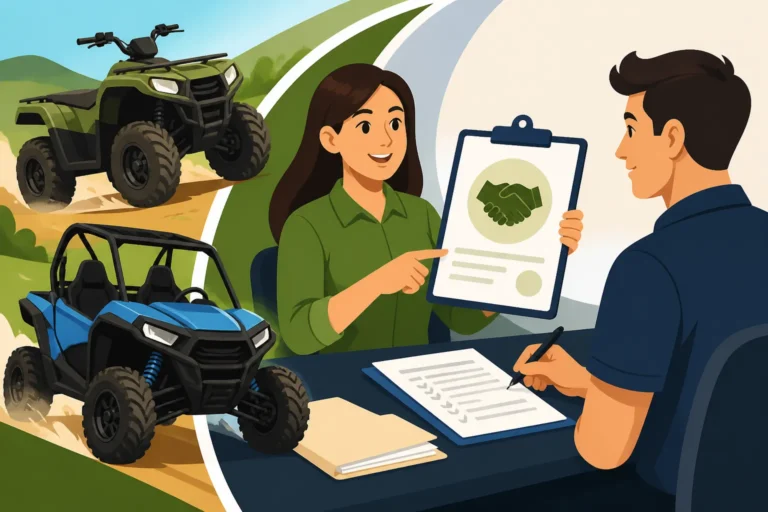
- Bill of Sale: For both new and used UTVs, a comprehensive bill of sale is crucial. If you bought from a dealer, they'll provide one. If you purchased from a private seller, you’ll need a detailed bill of sale signed by both you and the seller. It should include the UTV's Vehicle Identification Number (VIN), make, model, year, purchase price, date of sale, and contact information for both parties. Generic templates can be found online, and resources like LawDepot can help you create a legally sound bill of sale.
- Ownership Affidavit: In some cases, especially with older UTVs or machines where previous paperwork has been lost, you might need to complete a [Georgia Ownership Affidavit for an MPOHV]. This sworn statement attests to your ownership and how you acquired the machine. Using a reputable service like LawDepot can help ensure such affidavits are properly formatted and legally compliant.
Remember, a clear chain of ownership is vital. If there are gaps in the paperwork, it can complicate the process immensely.
Insurance and Sales Tax Proof
Operating any vehicle on public roads in Georgia requires liability insurance, and your MPOHV is no exception. Before you even think about registering, you need to secure a policy. The county tag office will require proof of this insurance. Your insurance provider can give you an insurance card or a binder letter. For more details, see [Georgia Liability Insurance Tied to Registration].
Sales tax is another critical component. Georgia requires that applicable sales tax be paid on the UTV before it can be registered. If you bought your UTV from a licensed dealer, they typically collect the sales tax at the time of purchase and remit it to the state. Your bill of sale should reflect this. If you purchased it from a private seller, you will likely need to pay the sales tax directly to the county tag office when you register. Be prepared for this additional cost. We discuss this further in [Georgia Sales Tax Paid Before Registration]. There are specific rules for machines owned before June 30, 2024, so if your UTV falls into that category, make sure to bring proof of ownership from that period to demonstrate sales tax was presumably paid.
Completing Georgia Form MV-OHV
This is the state's specific application for MPOHV registration. You can usually download it from the Georgia Department of Revenue's (DOR) website or pick one up at your local county tag office. You'll need to fill this out completely and accurately. The form asks for detailed information about your UTV, your personal information, and an affirmation that your machine meets all eligibility requirements. We have a detailed walkthrough on [Georgia Form MV-OHV and What It Asks]. If you're using forms for other legal documents, services like LawDepot can also provide insights into proper form completion.
Sometimes, especially if you've recently purchased the machine or there's any question about its condition, the county tag office might require a T-22B Vehicle Inspection Form. This form verifies the VIN and other identifying features of your UTV. It's typically completed by a law enforcement officer or a licensed dealer. This isn't always required, but it's good to be aware of the possibility.
Making it Official: Your Trip to the County Tag Office
With all your documents in hand and your UTV meeting the eligibility criteria, it’s time to head to your local county tag office. This is where the magic happens, and you walk out with a plate for your side-by-side. Remember, patience is a virtue, especially during peak hours.
What to Expect at the County Tag Office
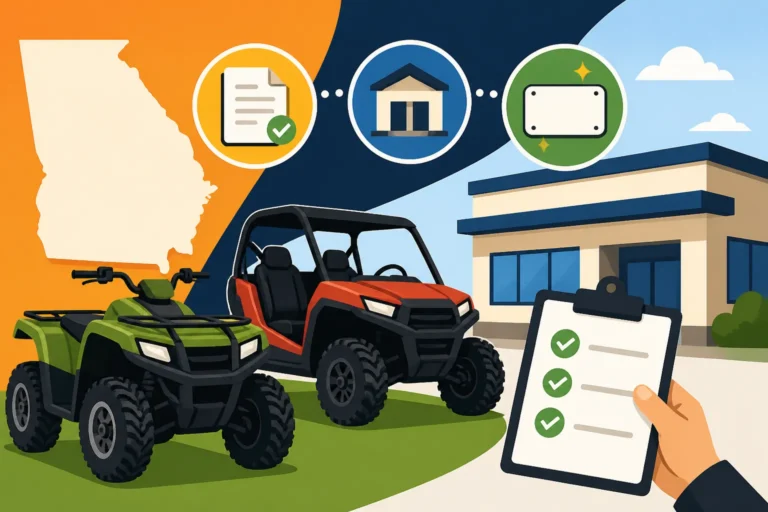
When you arrive at the county tag office, you'll generally take a number and wait for your turn. When called, you'll present all your compiled documents to the clerk. They will meticulously review everything: your proof of ownership, insurance, sales tax payment (or payment due), and your completed MV-OHV form. They may also ask clarifying questions about your UTV or its intended use.
Be prepared for the registration fees. While I can't give you exact current figures, there will be an annual registration fee and potentially other administrative charges. These costs are typically much less than what you’d pay for a car but are still something to budget for. For information on these fees, check out [Georgia MPOHV Registration Cost].
Receiving Your Plate and Decal
If all your paperwork is in order and your UTV qualifies, the clerk will process your registration. You’ll then receive your MPOHV license plate and a registration decal. The plate is specifically designed for these types of vehicles and is distinct from a standard car plate. You must prominently display this plate on the rear of your UTV, as detailed in [Georgia Plate Placement on a Side-by-Side].
The decal, which shows the current registration year, will need to be affixed to the plate. Once you have these in hand, your UTV is officially registered for limited use on Georgia's county roads! This process will need to be renewed each year, so mark your calendar. For details on how to handle renewals, read [Georgia MPOHV Renewal Each Year].
Common Pitfalls to Avoid
- Incomplete Paperwork: This is the most common reason for delays. Double-check everything before you leave your house.
- Missing VIN: Ensure your bill of sale and MV-OHV form clearly state the correct VIN. A mismatch can cause significant problems.
- Not Meeting Eligibility: Don't assume your UTV qualifies. Go through the eight-point test rigorously. Trying to register a machine that doesn't meet the criteria is a waste of time.
- Sales Tax Issues: Be clear on whether sales tax was paid at the dealer or if it's due at the tag office. Have proof of payment or be ready to pay on the spot.
- Outdated Information: Always check the Georgia Department of Revenue website or call your local county tag office for the most current forms and requirements. While this guide provides comprehensive information, regulations can change.
By carefully following these steps and ensuring all your ducks are in a row, you'll find that registering your UTV in Georgia is a manageable process, opening up new avenues for enjoying your machine responsibly and legally.
Disclaimer
This article is for general informational purposes only and does not constitute professional advice. Laws, prices and regulations vary by location and change over time. Consult a qualified professional for guidance on your specific situation.