The $5 Per-Operator Day Rate
Georgia’s $5 OHV day rate can look like a vehicle fee, but the Forest Service charges it per operator. That difference matters when several people take turns driving, and paying does not make every machine or trail eligible. Here’s how to understand the fee, where it applies, and what to check before you load up.
What the $5 day rate covers
The Forest Service charges a $5 day-use permit per operator per day at designated OHV trail systems, as of November 2026. It is a charge for the person operating the machine, not a single fee that covers every driver in a group.
That distinction is easy to miss when you arrive with a vehicle, a passenger, and a plan to switch drivers. If two people will operate, each operator needs their own permit to comply with the Forest Service rule. One permit does not cover multiple people simply because they use the same ATV.
The fee also has a defined scope: it applies at designated OHV trails, not automatically throughout Georgia or on every Forest Service road. Georgia’s national forest OHV systems include Houston Valley, Whissenhunt, Beasley Knob, Town Creek, Oakey Mountain, and Davenport. Annual OHV permits are valid at those six systems, according to the Forest Service. The individual trail’s fee and access rules still matter, so check the current information for your intended destination before setting out.
| Question | Practical answer |
|---|---|
| Who is the permit for? | The operator, under the Forest Service’s per-person permit rule. |
| Does one permit cover a whole machine? | No. Each operator needs a permit. |
| Is the fee a general forest entrance charge? | No. It applies to designated OHV trail systems, not all forest roads or land. |
| What if I ride often? | The Forest Service lists an annual OHV pass as an option for its covered trail systems. |
| Does paying guarantee I can use any trail? | No. Trail designations, vehicle limits, weather closures, and local rules still apply. |
For the broader distinction between daily and annual options, see Georgia’s Day and Annual Forest OHV Permits. If you want to understand why a permit follows the person rather than the vehicle, Georgia’s Per-Operator Permit, Not Per Vehicle covers that point in more detail.
Who needs a permit and how to plan for payment
If you will operate on a trail where the Forest Service requires an OHV permit, plan on each operator obtaining one. That includes a group sharing one machine if more than one person will take the controls. Paying for the machine or bringing its registration paperwork does not replace the operator permit.
The Forest Service allows day-use fees to be paid online through Recreation.gov at designated sites. The agency also lists digital purchase options for some individual trail systems. Check the chosen trail’s official page before leaving: payment methods and instructions can differ by location, and a phone signal or a working screen is not something to assume at a remote trailhead.
A useful pre-ride routine is:
- Decide who will actually operate. If someone is only riding as a passenger, do not assume that person needs an operator permit; the requirement is described as applying to operators. Confirm with the Forest Service if your situation is unclear.
- Check the destination’s current fee and purchase instructions. Do not rely on a receipt or pass intended for a different recreation site.
- Save or print proof of payment in the format the trail system accepts. The Forest Service advises annual pass holders at Davenport to purchase and print the pass ahead of time and display it in the tow vehicle.
- Confirm that the trail is open and that your machine is allowed there before you drive to the trailhead.
The Forest Service lists a $50 annual OHV pass per operator per year as an alternative for riders using the covered systems, as of November 2026. Its annual pass is valid at Houston Valley, Whissenhunt, Beasley Knob, Town Creek, Oakey Mountain, and Davenport OHV Trails. That can suit people who ride repeatedly, but it does not override a particular trail’s restrictions or cover every recreation area. See One Annual Permit Covers All Six Georgia OHV Systems for the covered locations and Buying a Day Permit the Morning You Ride for day-use planning.
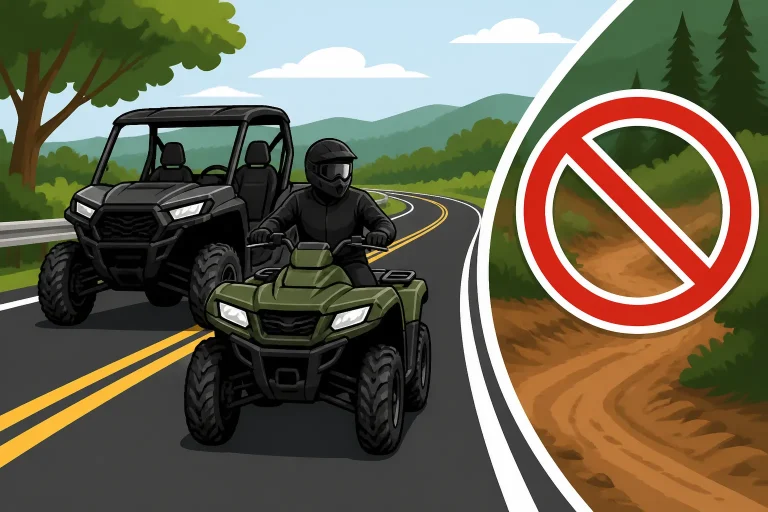
A fee and a permit are not the same as permission to operate anywhere nearby. Forest Service roads and OHV trails have different rules. Forest Service roads are open to registered vehicles and mopeds in accordance with state law, while ATVs and multipurpose off-highway vehicles are prohibited on Forest Service roads. Off-highway vehicles that are not licensed for public-road use must stay on designated OHV trails, according to the Forest Service. For a closer look at that distinction, read Georgia National Forest Trail-Only Rule.
Trail access and vehicle limits still decide where you can ride
A day permit does not make a trail suitable for every ATV or UTV. The Forest Service sets access by trail, and a machine that fits one system may be too wide or otherwise prohibited at another. Look up the vehicle rules for the exact trail rather than treating a permit as an all-access pass.
Width is a frequent dividing line. The Forest Service restricts trail use to vehicles less than 50 inches wide unless a trail is specifically designated for full-size vehicles. Some systems have tighter limits: Oakey Mountain accommodates OHVs with less than a 48-inch axle width, and Houston Valley has a 50-inch vehicle-width restriction. Measure your machine according to the trail’s stated method and limits; a model name or the seller’s description is not a substitute for checking the actual width.
Vehicle type matters just as much. Town Creek’s rules allow ATVs and four-wheelers on Loop B, but prohibit Jeeps, side-by-sides, and other UTV-type vehicles from its trails. Roberts Bike Camp, part of the Town Creek system, has Loop A restricted to two-wheeled vehicles only, and ATVs and other motor vehicles are prohibited there. A permit cannot make a UTV eligible for a trail that does not allow it. If you are choosing a destination for a side-by-side, Georgia ATV Trails That Allow Side-by-Sides can help narrow down what to investigate.
The rule also differs between ATVs and multipurpose off-highway vehicles. The Forest Service says Georgia House Bill 121 prohibits multipurpose off-highway vehicles, low-speed vehicles, and motorized carts from being driven on Forest Service Roads in the Chattahoochee-Oconee National Forest. A qualifying Georgia MPOHV registration does not cancel that restriction or grant access to forest roads.
Georgia registration is a separate process from a Forest Service OHV permit. The Department of Revenue describes MPOHV registration as voluntary and says registered multipurpose off-highway vehicles do not receive titles. Registration eligibility has its own requirements, such as vehicle equipment and design criteria; the permit fee does not establish that a machine qualifies. For background, see Georgia MPOHV Registration Explained and Are Side-by-Sides Street Legal in Georgia?.
Age and licensing rules also remain relevant. The Forest Service allows motor vehicles on designated OHV trails only when the operator is of legal age to obtain a state driver’s license or is accompanied by a legally licensed driver. That trail rule is not a replacement for Georgia’s separate requirements for particular vehicle types. Before taking a young or inexperienced rider, confirm both the trail’s conditions and the applicable state rules.
Checks that can save a wasted trip
Trail status can change with conditions. The Forest Service closes OHV trails when wet conditions risk damage and erosion; that means a trail shown as generally available may still be closed after rain or during other unsuitable conditions. Check for current closures before you leave and again if conditions change during your trip. Georgia Trail Conditions Before You Drive offers more on checking status and planning around closures.
Hours and seasons can also limit a ride. Some Forest Service OHV areas operate only from sunrise to sunset, and some close seasonally for resource protection. Those details are location-specific, so do not assume one trail’s hours or season apply to another. Confirm the intended trail’s current operating information alongside its fee.
Sound and safe operation are part of access, too. The Forest Service specifies that vehicles must not exceed 86 decibels at 50 feet when traveling at 35 miles per hour or less, and the limit is 90 decibels at 50 feet when traveling over 35 miles per hour. Those limits do not change the day rate, but they are among the operating requirements to check before riding.
The Forest Service also warns that violating OHV restrictions can lead to fines of up to $5,000 and/or up to six months in prison. A permit payment is not protection from enforcement if you ride outside a designated area, ignore a closure, or use a vehicle on a prohibited trail. Keep your permit proof available, stay on signed routes, and follow posted rules.
Before loading the machine, confirm these items:
- The destination is a designated OHV trail, rather than a Forest Service road or an undesignated route.
- Every person who will operate has the required permit.
- The specific trail allows your vehicle type and width.
- The trail is open, and its hours and seasonal restrictions work for your plan.
- You have followed the trail’s payment and proof-of-permit instructions.
- You have checked weather-related closures and any posted restrictions.
The simplest way to think about the $5 rate is as a per-operator trail-use permit, not a machine registration, statewide pass, or blanket authorization. Start with the person who will drive, then confirm the selected trail accepts the vehicle and is open. That small check helps prevent paying for access you cannot use.
Sources
- Forest Service — Chattahoochee-Oconee National Forest | Frequently Asked Questions about Motorized Use on the National Forest | Forest Service (checked November 3, 2026)
- Forest Service — Chattahoochee-Oconee National Forest | Off-Highway Vehicles (OHV) | Forest Service (checked November 3, 2026)
- USDA Forest Service — Chattahoochee-Oconee National Forest | Roberts Bike Camp OHV Trails | Forest Service (checked November 3, 2026)
- Forest Service — Chattahoochee-Oconee National Forest | Beasley Knob OHV Trail System | Forest Service (checked November 3, 2026)
- USDA Forest Service — Chattahoochee-Oconee National Forest | Davenport Mountain OHV Trails | Forest Service (checked November 3, 2026)
- USDA Forest Service — Chattahoochee-Oconee National Forest | Houston Valley OHV Trails | Forest Service (checked November 3, 2026)
- USDA Forest Service — Chattahoochee-Oconee National Forest | Locust Stake OHV Trail System | Forest Service (checked November 3, 2026)
- Forest Service — Chattahoochee-Oconee National Forest | Oakey Mountain OHV Trails | Forest Service (checked November 3, 2026)
- USDA Forest Service — Chattahoochee-Oconee National Forest | Rock Creek ORV Trail | Forest Service (checked November 3, 2026)
- USDA Forest Service — Chattahoochee-Oconee National Forest | Tatum Lead ORV Trail | Forest Service (checked November 3, 2026)
- USDA Forest Service — Chattahoochee-Oconee National Forest | Town Creek OHV Trails | Forest Service (checked November 3, 2026)
- USDA Forest Service — Chattahoochee-Oconee National Forest | Whissenhunt OHV Trails | Forest Service (checked November 3, 2026)
- USDA Forest Service — Chattahoochee-Oconee National Forest | Windy Gap, Milma Creek, and Tibbs OHV Trails | Forest Service (checked November 3, 2026)
Disclaimer
This article is for general informational purposes only and does not constitute professional advice. Laws, prices and regulations vary by location and change over time. Consult a qualified professional for guidance on your specific situation.