Georgia Hunting License and Quad Access
A Georgia hunting license can let you hunt where you’re authorized, but it does not automatically give you permission to ride a quad there. The rules depend on whether you’re on a Wildlife Management Area, national forest land, private property or another public site. Knowing which rules apply can help you avoid a closed road, a restricted riding time or a citation.
What a Hunting License Does and Does Not Allow
A hunting license and permission to ride an ATV or quad are separate things. Your license relates to hunting eligibility; it is not a general vehicle permit, a pass for every public property or proof that a particular road is open to ATVs.
On a Wildlife Management Area (WMA), riding is usually governed by the area’s access rules and current hunting regulations. A license may be relevant to whether you can hunt during a particular season, but it does not, by itself, make every WMA road available to you. Restrictions may apply to the days you can ride, the hours of access, the roads you can use and who may operate a machine.
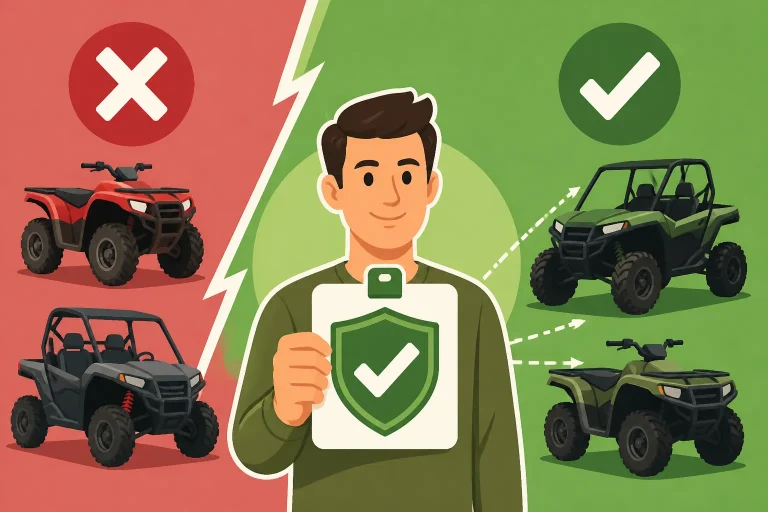
A useful way to think about it is to check four separate questions:
- May you hunt there? Confirm the license, season, species and any required WMA access or hunt permit.
- May you bring a quad onto the property? Check whether the property allows ATV use at all.
- May you ride on this road today and at this time? Look for seasonal closures, hunt-day restrictions, time limits and gates.
- May you operate the machine? Check age and supervision rules, as well as any equipment or safety requirements.
These questions matter because permission to hunt and permission to drive are not interchangeable. A hunter might be legally eligible to hunt but still be unable to ride a quad on the chosen property. Likewise, being allowed to ride a road does not necessarily mean you may hunt there.
The rules can also differ between properties managed by different agencies. A WMA may have its own access restrictions, while a national forest road may be subject to a separate vehicle designation or closure. A public road near hunting land may be governed by yet another set of rules. Start by identifying who manages the land and check that manager’s current rules before unloading your machine.
If your plan depends on riding a WMA road, review Georgia WMA Rules for ATV Riders and Georgia’s WMA Vehicle Rule in Plain English. Those topics help separate the general idea of riding for hunting access from the limits that apply on a specific property. For more on the hunting side, see Georgia Hunting Access by ATV.
| Question | What to verify | Why it matters |
|---|---|---|
| Is your hunting license valid for the hunt? | Species, season, license type and any required hunt authorization | A general license may not cover every hunt or property requirement |
| Is ATV use allowed? | The property’s current access rules | Some places restrict ATVs or allow them only for limited purposes |
| Is the route open? | Road designation, gate status and posted closures | A road visible on a map may be closed to motor vehicles |
| Is riding allowed today and now? | Hunt dates, seasonal dates and time restrictions | Access can change by day and time |
| Can you operate the quad? | Age, supervision and vehicle rules | Property-specific operator requirements may apply |
Riding a Quad on a Wildlife Management Area
A WMA is not a general ATV trail system. Where quad use is allowed, the permission is often narrow: it may be limited to designated roads, specific periods or people engaged in an authorized activity. Do not assume that a WMA road is open just because it looks drivable or because other hunters use it.
Georgia WMA rules can tie vehicle access to hunting activity and timing. Restrictions may include riding only on designated roads, access limited to hunt days or the day before a hunt, and a permitted window around sunrise and sunset. Some properties may have additional restrictions or no ATV access at all. Treat these as property rules to verify rather than as a blanket entitlement attached to a hunting license.
When checking the rules, find the specific WMA’s entry in the current Georgia hunting regulations and look for language about motor vehicles, ATV use, access roads, open dates and operator age. Also check signs at the property entrance and along the route. A sign or closed gate can make a map route unusable, and a temporary closure may not be obvious from an older printed map.
For a practical check, use this sequence:
- Identify the exact property. Confirm its name and land manager. A nearby forest, WMA or recreation area may have a different rule set.
- Read the current property listing. Check for ATV restrictions, open dates, hunt dates and special access conditions.
- Confirm the route. Use only roads identified as open to the vehicle you are riding. Do not treat foot trails, firebreaks, timber roads or closed roads as quad routes.
- Check the time window. If access is tied to a period around sunrise or sunset, plan travel to stay within it. Do not assume the hunting license changes the hours.
- Check the entrance and gates in person. Follow posted signs and do not ride around a closed gate or barrier.
- Keep proof of your hunting and access authorization. Carry the documents or records required for the hunt and property, and be ready to show them if asked.
A license also does not necessarily replace a WMA permit, check-in requirement, quota-hunt authorization or other property-specific condition. The required paperwork depends on the activity and location. Review Georgia WMA Tags and When They Are Needed and Asking a DNR Office About a Specific WMA if you are unsure whether a particular area requires an additional step.
Age rules deserve separate attention. The minimum age for operating an ATV on a WMA may differ from the minimum age for hunting or riding on private land. A young person’s hunting eligibility does not automatically establish that they can operate a quad on a WMA. Check the operator rule for that property and do not assume that an adult riding nearby makes an otherwise prohibited trip acceptable. The general topic is covered in Georgia WMA Minimum Age of 16.
Hunting Access Is Not the Same as Trail Riding
Hunters often use a quad to reach a stand, carry equipment or retrieve game. That practical purpose does not turn all nearby land into an authorized riding area. WMA access rules may permit limited travel to support a hunt while still prohibiting recreational riding, off-road travel or shortcuts through closed areas.
Stay on the roads specifically open to your machine. Do not ride across fields, through woods, down a closed spur or around a gate to get closer to a hunting location. Even if the route seems harmless, off-road travel can damage soil and vegetation, disturb wildlife or conflict with the property’s access rules. A quad should not be used to create a new route because the approved road is inconvenient.
Also distinguish a road open to ordinary traffic from a road open to ATVs. A county road passing through or beside public land may have its own restrictions. Conversely, an internal management road may be open only during certain activities or dates. The property boundary does not automatically determine who controls the road or which vehicles can use it.
If your route crosses national forest land, check the rules for that part of the trip separately. A WMA may sit within or beside national forest land, but the WMA’s access conditions and the forest’s motor-vehicle designations are not necessarily the same. You may need to follow a designated-road or trail rule even when you are traveling to a hunt. See Georgia National Forest Trail-Only Rule for the distinction between road access and designated OHV riding.
Do not confuse public hunting access with permission to ride on private land. If the quad route leaves a public property and enters private land, you need the landowner’s permission unless a legal public right of way applies. Hunting permission may not include permission to drive a vehicle across the property. Ask specifically before riding, and respect gates, posted notices and requests to leave.
There are also practical reasons to keep hunting access and recreation separate. A route that is legal during a scheduled hunt may be closed to riding at another time. A road that is open to a hunter traveling to an authorized location may not be open for a recreational loop. If your main goal is trail riding rather than reaching a hunt, choose a designated riding area and check its own requirements. Georgia ATV Trails: Where You Can Legally Ride can help distinguish public-land hunting access from trail systems intended for OHV use.
A Pre-Trip Checklist for Hunters Using a Quad
Before leaving home, confirm the rules for both the hunt and the machine. Do not rely on a friend’s recollection, a past season’s schedule or an old map. Access rules can change, and a property may have temporary closures or conditions that apply only to certain hunts.
Use this checklist:
- Confirm the hunt is authorized. Check the current season, species, license requirements and any special hunt authorization.
- Check the exact WMA or property rules. Verify whether ATVs are allowed and whether the rules limit the purpose of the ride.
- Confirm open dates and times. Make sure your travel falls within the property’s access window, including any restrictions around sunrise or sunset.
- Identify approved roads. Use a current map or property information and follow signs at the site. Do not use an unmarked route as an alternative.
- Check operator age and supervision rules. A hunting license, hunting age or passenger status does not necessarily settle the ATV operator question.
- Check for permits, check-in or tags. These may be separate from the hunting license and may vary by property.
- Carry the documents the property requires. Have your license and any required hunt or access authorization available.
- Plan for closures. If a gate is closed or a sign conflicts with your planned route, stop and confirm the rule rather than riding around it.
- Ask about uncertainty before you go. Contact the managing agency using the property’s current listing if the rule is unclear.
A helpful planning habit is to record the property name, the specific road you intend to use, the allowed dates and the relevant time window. That makes it easier to notice when a trip plan depends on a rule that applies only to another WMA or another kind of hunt.
If you are using the quad to retrieve game, check the property’s rules on vehicle use for that purpose as well. Rules for retrieving a harvested animal may not be the same as rules for traveling to a stand, and not every road or route will be open. Do not assume that a successful hunt creates permission to drive off-road or through a closed area.
The safest takeaway is simple: a Georgia hunting license may be necessary for the hunt, but it is not a general ATV pass. Confirm the hunting authorization, the property’s vehicle rules, the open route and the allowed time separately. When the rules do not clearly authorize the ride, ask the land manager before you unload the quad.
Disclaimer
This article is for general informational purposes only and does not constitute professional advice. Laws, prices and regulations vary by location and change over time. Consult a qualified professional for guidance on your specific situation.