Georgia Hunting Access by ATV
Hunting with an ATV in Georgia can save a long walk to a stand, but a hunting license or a vehicle permit does not automatically make every road or trail open to you. Access depends on who manages the land, whether the route is open, and what the property’s current rules allow. This guide explains how to check those details before you load your machine.
Start with the land manager, not the ATV
There is no single Georgia rule that grants ATV access to all hunting land. The first question is who manages the property. A Wildlife Management Area, national forest, private hunting lease, and private off-road park can each have different access rules. Permission to hunt does not necessarily include permission to drive an ATV.
For each trip, identify the specific property and the specific route you plan to use. A road that appears on a map may be closed to vehicles, limited to certain seasons, or reserved for administrative use. A trail open to recreational riders may not lead to a legal hunting area. A gate, sign, or current closure notice can change what you may do, even if you rode the route on an earlier visit.
Keep these questions separate:
- May you hunt there? Check the land’s hunting rules, season dates, access requirements, and any license or permit requirements.
- May you operate an ATV there? Check the property’s motor-vehicle rules, open routes, permitted times, and any vehicle restrictions.
- May you use the ATV for your particular purpose? Some rules distinguish travel to an authorized hunting location from recreational riding or general transportation.
This distinction matters because an ATV permit is not a universal land-access pass. A Georgia Forest OHV permit, for example, applies to designated off-highway vehicle systems. It does not grant permission to ride on every national forest road or to use a Wildlife Management Area road for hunting. For a broader explanation of permits and what they cover, see Georgia OHV Permits: What You Need Before You Ride.
The same is true of a hunting license. It may satisfy a hunting requirement, but it does not override a road closure or authorize riding off a designated route. Before each trip, check current property-specific information from the agency or landowner responsible for the area. If a boundary or route is unclear, ask the manager rather than assuming that a trail, timber road, or utility cut is open.
Using an ATV on a Georgia WMA
Wildlife Management Areas are not general-purpose ATV parks. Where vehicle access is allowed, it is typically limited to approved roads and particular conditions. The details can vary by property and by hunting opportunity, so read the rules for the exact WMA you plan to visit. The general overview at Georgia WMA Rules for ATV Riders is a useful starting point, but it does not replace the current rules for an individual area.
A practical way to think about WMA riding is: use an ATV only when the property’s rules permit it, stay on routes open to motor vehicles, and ride only during the allowed period. Do not assume that an open gate means a road is open to public ATV traffic. Some roads may be open to other users, closed to vehicles, or subject to a temporary restriction. Follow signs and barriers, and do not go around a closed gate.
Check the allowed time and hunting purpose
WMA vehicle rules can tie riding to hunting activity and specific time windows. Some access rules refer to a period beginning two hours before sunrise. That does not mean a rider has permission to travel at any hour or on any road. Confirm the applicable time window and any restrictions on the property’s current regulations. For more on the timing issue, see Two Hours Before Sunrise: Georgia WMA Riding Hours.
Also check whether riding is allowed only on hunt days or during another defined period. A day that feels like part of the same hunting trip may not count as an authorized access day under the property’s rules. Do not use a hunting-related exception as a reason to take a casual recreational ride when the exception does not apply.
If the rules require you to be actively hunting or otherwise participating in an authorized activity, make sure your trip fits that requirement. Riding to explore, socialize, or take a scenic loop is not automatically the same as traveling for a hunt. When the rule’s wording leaves room for doubt, ask the managing agency to explain how it applies to your planned trip.
Confirm operator and road restrictions
Georgia WMA rules can include minimum age requirements for ATV operators. The reference guidance for WMA riding identifies age 16 as a minimum in applicable situations, but always verify the current rule for the property. A parent riding nearby does not necessarily make an underage operator eligible. A passenger’s age and ability to ride safely also matter; check any passenger restrictions before carrying someone.
On a WMA, a route being physically passable is not proof that it is legally open. Stay on the designated or otherwise authorized roads. Do not cut across fields, woods, food plots, firebreaks, or stream crossings to shorten the route. If the route ends at a legal parking area, continue on foot rather than creating a new path.
Some WMAs have additional vehicle requirements, such as a permit, tag, or other access condition. Requirements may differ between a WMA managed by the state and one associated with national forest land. Do not assume that one permit covers both situations. Georgia WMA Tags and When They Are Needed explains why it is important to check the property’s specific tag rules.
National forests, OHV trails, and hunting access are different
A national forest can contain roads, designated OHV trails, hunting areas, and closed or restricted land. These are not interchangeable. A trail open to ATVs for recreation is not automatically a hunting access route, and a forest road is not automatically open to ATV use. Check the route’s designation and current status before you ride.
Georgia’s designated Forest OHV systems have their own permit rules. These permits are for riding on the authorized OHV systems, subject to each system’s restrictions and closures. They do not grant general access to roads or trails outside those systems, and they do not replace hunting permits or land-use rules. A detailed overview is available in Georgia’s Day and Annual Forest OHV Permits.
Be especially careful around Wildlife Management Areas located on or near national forest land. The land’s location does not tell you which set of rules applies. Check the managing agency, the WMA regulations, and any forest road or OHV restrictions that apply to the particular route. If one set of rules allows an activity but another closes the route, do not assume that the more permissive rule wins. Ask the responsible offices which requirements apply.
Roads and trails are not the same thing
A road is generally intended for travel between places; an OHV trail is a designated route for recreational riding. Their legal status can differ. A road that is open to passenger vehicles may still have limits on ATV use. A trail that is open for OHV riding may have limits on machine width, season, direction, or operating hours. Look for signs at the trailhead and review current closures before leaving home.
Do not rely only on a navigation app, an old paper map, a social media post, or a route someone remembers using. Those sources can help you orient yourself, but they may not show a new gate, seasonal closure, storm damage, or changed designation. Use current information from the land manager for the final decision. The guide Georgia National Forest Trail-Only Rule explains why being on forest land does not mean you can ride wherever you find a path.
If you reach a closed road or trail, turn around. Do not unload or ride around a barrier, even if the route beyond it looks usable. Closures can protect wildlife, reduce erosion, allow maintenance, or respond to safety problems. Riding around a closure can also make it harder for the manager to reopen the route later.
Check permits, licenses, and out-of-state rules separately
A successful hunting trip may involve several different approvals. Think of them as separate pieces of paperwork rather than one general permission.
| What you need to confirm | What it applies to | What it does not automatically authorize |
|---|---|---|
| Hunting license or hunting authorization | Whether you may hunt under the applicable rules | ATV travel on closed or unauthorized roads |
| WMA access rules | Entry and permitted activities on that specific area | Riding on a different WMA or forest road |
| ATV or OHV permit | Use of the routes or system covered by that permit | Hunting, access to unrelated roads, or entry onto private land |
| Landowner permission | Use of the private property and any agreed routes | Access to neighboring land or public trails |
| Current closure information | Whether a route is open at the time of your visit | Permission to ignore signs or gates |
If you are traveling from another state, do not assume that your home-state hunting license, OHV registration, or trail permit is accepted as a substitute for Georgia requirements. Reciprocity depends on the specific program and activity. Check Georgia’s current hunting and land-access rules and confirm whether an out-of-state document is recognized. For a visitor-focused overview, see Georgia Visitors From Other States.
A forest permit may be required for each operator rather than for each vehicle. That distinction matters if two people plan to take turns driving one machine or if a group arrives with several ATVs. Read the permit conditions instead of assuming that one permit covers everyone in a party. Also make sure you understand where the permit must be carried or displayed and what to do if you cannot show it at a trailhead.
Carry the paperwork or digital records the applicable rules require. A phone screenshot can be useful, but do not count on cell service at a remote trailhead. Save or print the details before you leave, and keep a backup of important confirmations. A paper copy is particularly helpful if a phone battery dies or a group member needs to verify a route.
Match the machine and the trip to the route
Before loading the ATV, make sure it is suitable for the approved route and the intended use. Public access rules may apply to the operator, passengers, machine, and road. A registration or tag does not itself make an ATV road-legal, and a road-legal status does not grant access to a closed forest or WMA route. If your planned trip involves a Georgia county road, review Georgia MPOHV Road Rules: County Roads Only rather than assuming that hunting access rules apply there.
Check the following before departure:
- Machine width and type: A route may have width limits or exclude some machine types. Measure the machine as it will be ridden, including accessories that make it wider.
- Passenger capacity: Carry only the number of people the machine is designed to carry, in designated seats. Do not improvise a passenger position on a cargo rack.
- Lights and controls: Make sure the machine is maintained and that brakes, lights, steering, and tires work as intended.
- Load and towing: Secure firearms, bows, stands, and other equipment. Keep cargo within the machine’s capacity and avoid blocking lights or visibility.
- Noise and spark protection: Follow applicable land-manager requirements for sound and spark arrestors. Do not assume that a machine accepted at one riding area will meet another area’s rules.
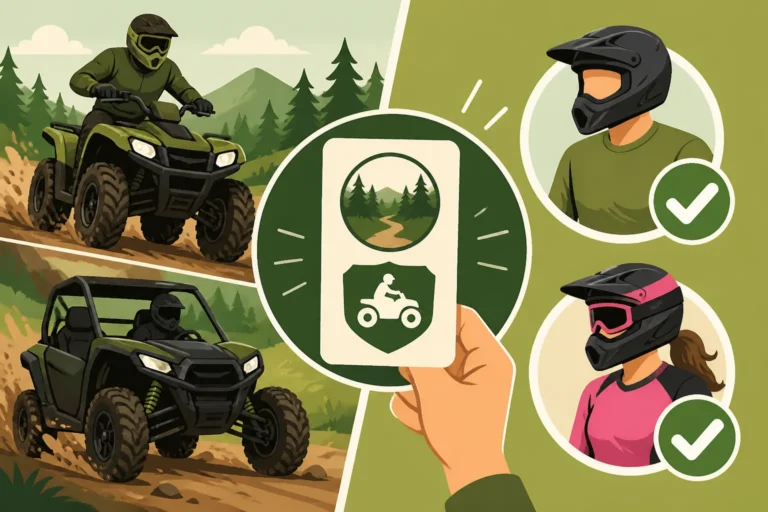
- Safety equipment: Wear a helmet and protective gear appropriate to the machine and conditions. Confirm any age-specific requirements that apply to the operator or passengers.
Hunting gear can make an ATV unstable when it is packed high, unevenly, or beyond capacity. Put heavier items low and secure them so they cannot shift on rough ground. A loaded cargo rack changes handling, especially when braking or traversing a slope. If you are unsure whether the load is safe, make two trips or carry part of it on foot.
A winch can help recover a stuck machine, but it is not permission to travel into mud, steep terrain, or closed routes. Recovery itself can cause injury or damage when the anchor point, cable, or machine is poorly positioned. Carry a basic tool kit, first-aid supplies, water, and a way to contact someone if your group is delayed. Tell a person who is not on the trip where you plan to ride and when you expect to return.
For small safety items such as tie-downs, reflective gear, or a compact first-aid kit, Amazon can be one place to compare options. Check product dimensions and ratings carefully, and make sure any gear you buy actually fits your machine and the conditions you expect.
Plan the route before hunting day
A little preparation can prevent a wasted drive or an avoidable violation. Start with the exact property name, then find the current regulations and map from the agency or landowner responsible for it. Confirm your planned entrance, parking area, route, and destination. If there are multiple access points, do not assume they share the same rules.
Use this process:
- Identify the property and manager. Determine whether you are visiting a WMA, national forest, private lease, or another type of land.
- Read the current rules for that property. Look for ATV access, road designations, permitted days, time limits, age rules, and any required tags or permits.
- Check for temporary closures. Weather, road work, fire risk, wildlife management, and seasonal conditions may change access.
- Trace the route. Make sure each road or trail between the entrance and your destination is authorized for your machine and purpose.
- Confirm your documents. Check the hunting authorization, operator permits, and any vehicle paperwork relevant to the trip.
- Plan a legal backup. If a road is closed or the route is unsuitable, know where you can park and continue on foot—or choose another area.
- Tell someone your plan. Share the property, expected route, group members, and return time with a person who is not riding with you.
Download or print the map and rules before leaving. On many rural properties, mobile coverage is unreliable. A map on your phone is useful, but keep a backup and make sure everyone in the group understands the route. Mark the legal parking area and the route back, not just the hunting location.
If you are unsure about an access rule, ask a specific question. “Can I ride here?” may be too broad to get a useful answer. Instead, provide the WMA or forest name, the road or trail, your machine type, the date, and whether you are traveling to hunt or riding recreationally. Ask whether an ATV is allowed on that route, during that time, for that purpose, and whether a permit or tag is required.
When preparing equipment, avoid treating online shopping as a substitute for the land manager’s requirements. Amazon may help you find items such as a map case or cargo straps, but check that a product is suitable for the load and machine. A strap that is convenient for light luggage may not be appropriate for securing heavy hunting equipment on rough roads.
Common mistakes that cause trouble
Treating a hunting license as vehicle permission
A hunting license does not open a closed road. Likewise, permission to ride does not automatically authorize hunting. Confirm both activities independently.
Assuming every WMA has the same ATV rules
WMA rules can differ, and a rule that applies to one property may not apply to another. Check the specific area and current season information every time. A remembered rule from last year is not a reliable substitute for a current check.
Riding off the road to get closer
Taking a shortcut through woods, fields, or a food plot can damage habitat and violate access restrictions. Park where vehicle use is permitted and continue on foot if necessary. Do not make a new trail because the legal route feels inconvenient.
Confusing an OHV system with the surrounding forest
A signed OHV trail system is a designated recreation area, not a blanket authorization to ride elsewhere in the forest. Stay on the authorized system and check its closures and requirements. The same principle applies in the other direction: being in a forest does not automatically authorize a ride on a WMA road.
Assuming a gate is open because it is not locked
A gate can be open for land-management work, wildlife operations, or another authorized user. Signs and official route designations matter more than whether a gate happens to be open when you arrive.
Taking a passenger or child without checking the rule
Passenger capacity and minimum operator age are different questions. A young passenger may be allowed under one set of conditions but not another, and an adult’s presence does not necessarily waive an operator-age requirement. Check both the property rules and the machine manufacturer’s seating instructions.
Relying on old maps and posts
An old route description can omit current restrictions. Confirm the route with current property information, especially after storms, during hunting seasons, or when a road has recently been gated or repaired.
Assuming out-of-state paperwork transfers automatically
A registration, permit, or hunting document from another state may not satisfy a Georgia requirement. Verify reciprocity for the exact activity rather than inferring it from similar rules elsewhere.
If an official rule is unclear, pause before unloading. Contact the managing office or landowner and describe the route and planned use. If you cannot get a clear answer, choose a route whose status is confirmed. That is less frustrating than discovering the restriction after you have ridden in.
A practical pre-trip checklist
Use this checklist the night before a hunt, then recheck for closures before you leave:
- I know who manages the property.
- I have read the current rules for the exact WMA, forest area, or private property.
- I have confirmed that ATV use is allowed for my planned purpose.
- I know which roads or trails are open and where I am allowed to park.
- I have checked the permitted days and operating hours.
- I have confirmed operator age, passenger rules, and any machine restrictions.
- I know which hunting documents, permits, or tags are required.
- I have checked whether my out-of-state documents are recognized, if relevant.
- I have reviewed current closures, weather concerns, and access notices.
- My machine is maintained, properly loaded, and suitable for the route.
- I have a map or saved route and a backup if cell service is unavailable.
- Someone outside the group knows where we are going and when we expect to return.
The safest rule of thumb is simple: hunt only where you are authorized, ride only where the machine is authorized, and do not assume that one permission includes the other. Georgia offers several kinds of hunting and riding access, but the details are tied to the land and route. Verify them before the trip, follow signs on the ground, and be prepared to park and walk when an ATV route is not open.
Disclaimer
This article is for general informational purposes only and does not constitute professional advice. Laws, prices and regulations vary by location and change over time. Consult a qualified professional for guidance on your specific situation.