Georgia WMA Roads Closed by a Gate
A closed gate on a Georgia Wildlife Management Area road can turn a planned ride into a confusing judgment call. The safest approach is simple: do not pass a closed gate or ride around it unless the land manager clearly authorizes access. Here’s how to check what the closure means, what to do instead, and how WMA riding rules fit in.
What a Closed Gate Means for ATV and UTV Riders
A gate is a physical signal that vehicle access is restricted at that point. It may be closed for a seasonal restriction, road work, wet conditions, wildlife or habitat protection, a hunting-related rule, or another management reason. The gate may not explain the reason, and its presence alone may not tell you when access will resume.
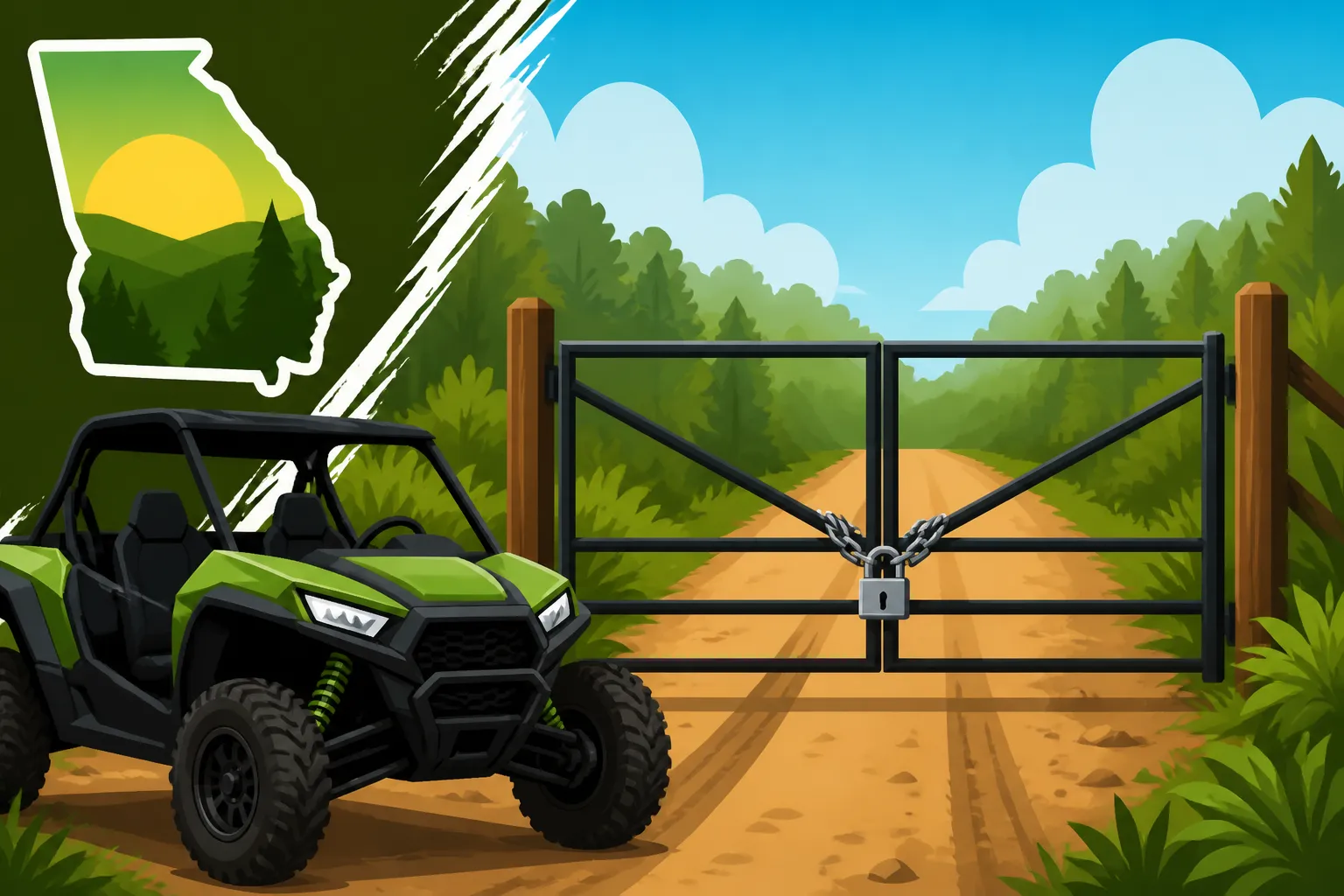
For a rider, the practical answer is the same: don’t take an ATV, UTV, or other vehicle past a closed gate unless the responsible land manager has specifically confirmed that access is allowed. That includes squeezing beside the gate, going around its end, using a nearby opening, or following tire tracks through an alternate route. A visible path around a barrier is not proof that the route is open to public vehicle use.
This matters because a WMA road is not automatically an ATV trail. Georgia WMA riding is generally limited to roads where vehicle use is allowed under the rules for that area and time. The route, access hours, hunting activity, and local restrictions can all matter. Georgia WMA Rules for ATV Riders explains the broader framework, while Georgia WMA Riding Only on Roads focuses on the road-use limitation.
A closed gate can also mark a boundary that is easy to miss on the ground. The road beyond it might look maintained and passable, but appearance does not establish permission. Likewise, a gate that is open does not necessarily mean every vehicle may use the road at every time. Check the current rules for the specific WMA before riding.
| What you see | Safest practical response |
|---|---|
| Gate closed across the road | Stop and do not pass or go around it |
| Gate open, but a sign lists restrictions | Follow the sign and confirm the WMA rules |
| Gate open with no readable sign | Check the WMA’s current access information before proceeding |
| Gate closed with no explanation | Treat vehicle access as closed until the land manager confirms otherwise |
| Tire tracks or an open-looking bypass beside the gate | Do not assume the bypass is authorized |
| A closure notice that appears outdated or unclear | Contact the responsible office before riding |
A closed gate is not an invitation to decide for yourself that the road is safe or that the closure no longer applies. If the notice is missing, damaged, or hard to interpret, use another authorized route and ask the appropriate office for clarification.
How to Check Whether the Road Is Open
Before unloading, identify the exact WMA and the road or access point you plan to use. “The WMA is open” is not enough to confirm that a particular road is open to vehicles. A property may have different rules for different roads, trails, dates, or activities.
Use this process:
- Identify the specific WMA and entrance. Check the name on your route information, signs, or map. If you are unsure which property or access point you are looking at, do not guess.
- Look for posted signs at the entrance and along the road. Pay attention to closure notices, seasonal restrictions, vehicle limits, and any instruction that applies only to a particular route.
- Check current access information from the responsible agency. A map can help you plan, but a map that shows a road does not necessarily prove that it is open to vehicle use today.
- Confirm the road-use and timing rules. WMA vehicle access may depend on the location, time, date, hunting activity, and other restrictions. Two Hours Before Sunrise: Georgia WMA Riding Hours and Hunt Days and the Day Before cover timing issues that can affect a ride.
- Ask an agency office when the information conflicts or is incomplete. Share the WMA name, the entrance or road location, and what the gate or sign says. Asking a DNR Office About a Specific WMA offers more detail on getting an answer for a particular area.
Do not rely only on an old social media post, a riding app, a paper map, or another rider’s account. Those can be useful clues, but they may not reflect a current closure. If an official notice and an older map disagree, use the more current official information and ask for clarification when needed.
It is also worth checking the rules on the day of your ride. A road that was open on a previous visit may be closed for a temporary reason, or access may change with hunting activity or conditions. A phone call before driving a long distance can prevent a wasted trip—and a citation or conflict with land managers.
If a gate is closed and you cannot verify that access is allowed, turn around. Do not treat a lack of signage as permission to pass through.
WMA Roads, Hunting Activity, and Other Restrictions
WMA vehicle access is not simply a matter of whether a gate is open. The rules can include where you may ride, when vehicles may be used, and whether a particular activity is taking place. Read the rules for the specific WMA rather than assuming that access conditions are identical across Georgia.
A road shown on a map may be intended for authorized vehicles, land management, or another permitted use, not general ATV or UTV travel. A gate may be one part of how access is controlled, but restrictions can also be posted at an entrance or described in the area’s rules. Georgia WMA Vehicle Rule in Plain English and Georgia WMA Access for a Quad are useful starting points for understanding those limits.
Hunting can affect access as well. Some WMA riding rules are tied to hunt days and the period around sunrise, and requirements may differ depending on whether a rider is actively hunting or simply riding. Check the rules before carrying hunting equipment or planning a ride during a season. Being an Active Hunter in the Area explains why that distinction can matter. If tags or other area-specific requirements may apply, verify them rather than assuming they are unnecessary; see Georgia WMA Tags and When They Are Needed.
A gate may also be closed because a road is unsuitable for vehicle travel at that time. Mud, erosion, storm damage, or maintenance can make a route hazardous or cause further damage if riders continue through. Even if the road looks passable, don’t use that as a reason to cross the barrier. Stay on an authorized road and follow any posted closure.
Keep in mind that WMA rules and access notices are separate from rules for Georgia’s national forest OHV trails or private riding parks. A permit or permission that applies somewhere else does not automatically authorize riding on a closed WMA road. For example, Georgia WMA National Forest Trail-Only Rule addresses a different access setting and should not be read as permission to ride past a gate on a WMA road.
What to Do When You Reach a Closed Gate
When you encounter a closed gate, stop before the barrier and avoid blocking the road or entrance. Read any posted notice from a safe location. If the closure applies to vehicles, turn around without moving the barrier or entering a bypass.
If you are unsure whether the gate is closed temporarily or whether there is another authorized route, do not try to resolve the question by driving through. Call the agency or office responsible for the WMA. Ask whether the road is open to ATV or UTV use, whether the restriction applies on that date, and whether there is another approved access point. Be specific about the entrance or road, because a general question about the WMA may not resolve a road-level restriction.
If the closure is not posted or the sign is unreadable, take a photo from a safe and lawful location if useful, note the road or entrance, and ask the responsible office. A photo can help explain what you encountered, but it does not replace confirmation that the route is open.
Plan for a backup destination before leaving home. That could mean another verified road or riding area where your machine is permitted, rather than an improvised detour around the gate. Check that the alternative is suitable for your vehicle and that its own access rules allow riding that day. If the only route you intended to use is closed, the responsible choice may be to leave and reschedule.
A few habits make these trips easier:
- Save the WMA name and agency contact information before setting out.
- Check current notices close to the ride date, not only when planning weeks ahead.
- Carry a map or offline route information, but treat it as a planning aid rather than proof of access.
- Follow the most restrictive applicable sign or rule until an agency confirms otherwise.
- Do not move, damage, or bypass a gate.
- Keep the machine on routes where vehicle use is explicitly allowed.
A closed gate is a clear reason to pause, not a challenge to find another way through. Confirm access first, stay on authorized roads, and choose a different route when you cannot get a reliable answer.
Disclaimer
This article is for general informational purposes only and does not constitute professional advice. Laws, prices and regulations vary by location and change over time. Consult a qualified professional for guidance on your specific situation.