Waivers Minors Cannot Sign Themselves
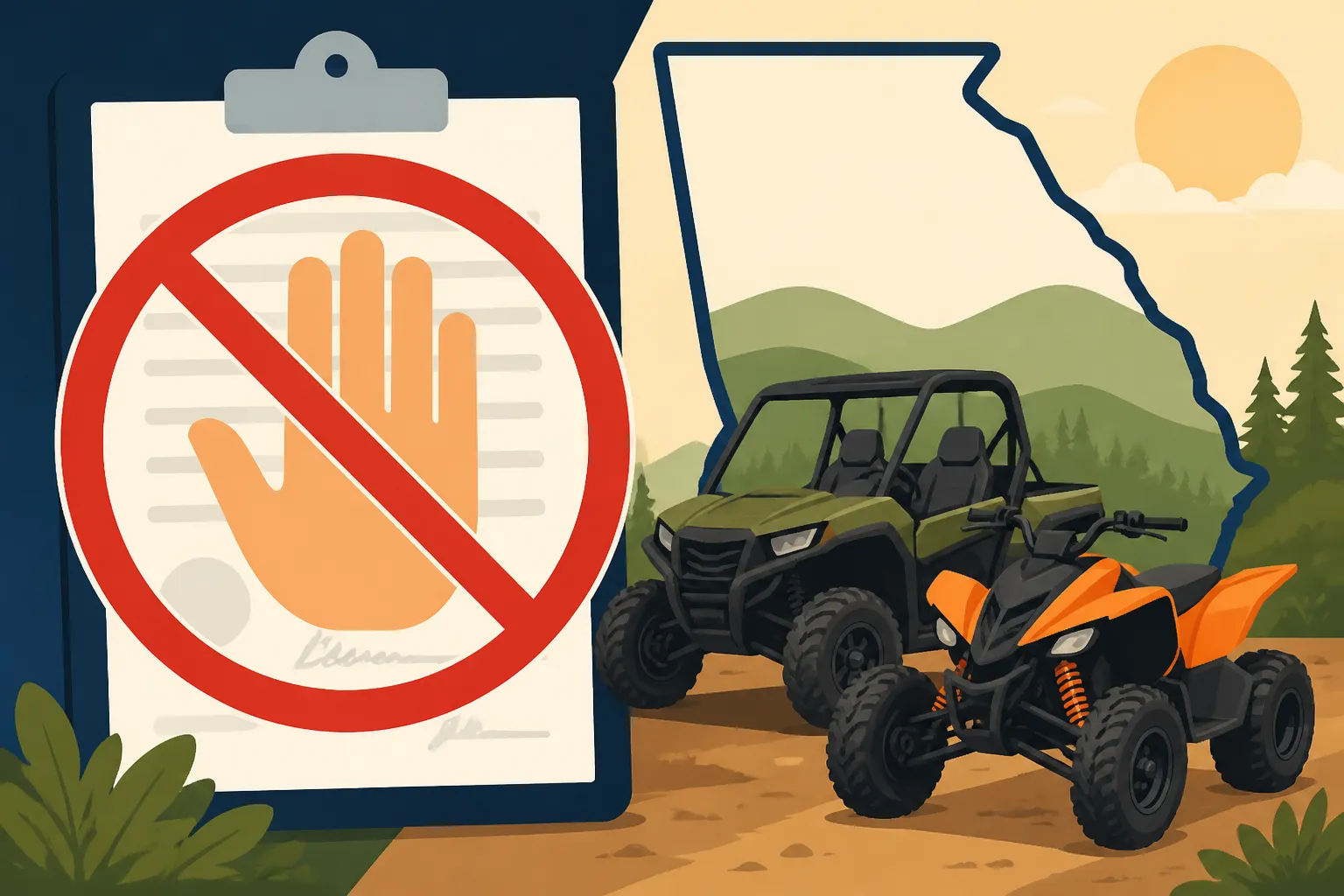
A family can arrive at a Georgia ATV or UTV park only to find that a child cannot sign the required waiver. The practical rule is simple: a minor should not be expected to release their own legal claims, and a parent or authorized guardian may need to complete the paperwork. But an adult’s signature does not automatically settle every legal question about a child’s injury.
Why a minor’s signature usually is not enough
A park waiver is more than a sign-in sheet. It may ask a rider to acknowledge risks, agree to follow park rules, or release the park from certain claims. Because a minor generally cannot make the same binding legal agreements as an adult, a park may reject a child’s signature and require an adult to sign instead.
That does not mean every document called a “waiver” works the same way. A form might include several different agreements: permission to participate, confirmation that the family understands the risks, an emergency contact, and language intended to limit legal responsibility. Whether a particular clause is enforceable can depend on the wording and circumstances.
In Georgia, a parent’s signature should not be treated as a guarantee that the child has lost every right to bring a claim after an injury. Signing for a minor may satisfy a park’s entry process or show that a parent authorized participation, but it does not automatically make every release of the child’s future claims enforceable. The adult might also be releasing claims that belong to the adult personally. Those are separate legal issues.
The useful distinction is between permission to participate and a legally effective release of liability. A park may require the first as a condition of entry. The second is more complicated and cannot be assumed from the signature alone.
| What the form may cover | Who may be asked to complete it | What the signature does not automatically establish |
|---|---|---|
| Permission for a minor to ride | Parent or authorized guardian | That every claim belonging to the child has been waived |
| Acknowledgment of riding risks and park rules | Adult and sometimes the minor as an acknowledgment | That the park is excused from every kind of negligence |
| Emergency contact or medical information | Parent, guardian, or responsible adult | That the adult is legally authorized to make every medical decision |
| Release of an adult’s own claims | The adult signing for themselves | That the adult can release the child’s separate rights |
| Indemnity or payment obligations | The adult named in the document | That every financial obligation is valid or unlimited |
A park can still set check-in rules and decline to let a minor ride if the required adult is not present or the paperwork is incomplete. That is a practical access issue, separate from whether a waiver would hold up in court after an accident.
If you want to see the kinds of documents a riding facility may request, review Georgia Private Park Waiver Forms. Read the actual form before signing instead of relying on a brief description at the gate.
What the adult signing should check
Before signing, identify every person and activity the document covers. A family may be asked to sign one form for a child riding an ATV, another for a passenger riding in a side-by-side, or a separate release for a rental. Do not assume that one adult signature covers every child, machine, or activity unless the form clearly says so.
Confirm who can sign
Parks commonly ask a parent or legal guardian to sign for a minor. If an aunt, grandparent, family friend, or group leader is bringing the child, ask the park in advance whether that adult can complete the paperwork and what proof of authority it needs. A park may have its own policy, and a signed note from a parent may not satisfy it.
Do not sign another person’s name or describe yourself as a guardian if you are not one. If the parent will not be at the park, ask the facility what documentation it accepts and whether the parent must complete the form online or in person. Getting a clear answer before travel is much easier than trying to resolve the issue at the check-in counter.
For broader age and supervision questions, see Georgia Supervision Rules for Minors. A waiver does not replace the park’s age rules, operator requirements, or supervision policy. Check those separately, including the facility’s Georgia Private Park Minimum Ages information.
Read the release, not just the title
Look for the exact wording about risks, claims, injury, property damage, rental equipment, and responsibility for a minor. Pay attention to whether the adult is signing:
- Only to give permission for the child to participate.
- For the adult’s own claims as well as the child’s participation.
- To accept financial responsibility for damage or charges.
- To agree to indemnity language, which may ask the signer to cover certain losses or claims.
- For one named child or for multiple children.
A heading such as “assumption of risk” or “release” does not tell you the full effect of the document. Read the clauses themselves. If a provision is unclear or appears to create a substantial financial obligation, ask the park to explain what it means before signing. For advice about a specific dispute or legal effect, consult a Georgia attorney.
Do not treat the child’s signature as a substitute
A park may ask a minor to initial or sign a section confirming that the rules were explained. That can be part of the park’s process, but it does not make the child’s signature a substitute for the required adult signature. If the form has both signature lines, complete them as instructed rather than assuming one is optional.
The child should understand the rules in plain language: where riding is allowed, how to signal for help, what to do if separated, and why the park’s speed and passenger rules matter. A child’s understanding is important for safety even when the parent or guardian handles the legal paperwork.
A waiver is not a permit, safety check, or riding authorization
Families sometimes mix up park paperwork with government permits. They serve different purposes. A private park waiver is a facility’s document for entry and participation. A permit for a public riding area, where one is required, is a separate authorization with its own conditions.
For example, a permit for a Georgia national forest OHV system does not replace a private park’s waiver, and a private park waiver does not give a rider permission to use a national forest trail. Forest permits are generally tied to the operator rather than simply to the machine; see Georgia’s Per-Operator Permit, Not Per Vehicle. Permit requirements and park policies should be checked independently.
A parent’s signature also does not make an otherwise ineligible child an authorized operator. Before the trip, confirm the park’s minimum age, supervision rules, machine-specific requirements, passenger policy, and any required safety equipment. State rules and facility rules may address different situations. For instance, Georgia Helmet Rules for Riders Under 18 concerns a separate safety requirement; signing a waiver does not cancel applicable helmet rules.
The same separation matters for out-of-state visitors. A permit, registration, or other document from another jurisdiction may not satisfy a Georgia facility’s check-in requirements. Ask the park what it accepts rather than assuming that another state’s paperwork carries over. If the ride is on public land, verify the relevant land manager’s permit rules as well.
Before leaving home, contact the park and ask these questions:
- Does a parent or legal guardian have to be physically present?
- If the parent cannot attend, what authorization or documentation will the park accept?
- Does each minor need a separate form?
- Are separate forms required for riders, passengers, rentals, or particular activities?
- What are the age, supervision, and passenger rules for the machines the family plans to use?
- Is there a separate permit or access document for the riding area?
- Can the adult review the waiver before arrival?
Write down the answer or keep the park’s written instructions. Policies can differ among private facilities, and one park’s process is not proof of another park’s requirements. More information about facility policies is available under Georgia Private Park Waiver Forms and Georgia Private Park Minimum Ages.
If the park refuses the form or an accident happens
If a minor arrives without the required adult or paperwork, do not try to solve the problem by having the child sign anyway or by changing a form. Ask the park whether the adult can complete the document remotely, whether the child can wait while a parent comes, or whether the visit needs to be rescheduled. The park may still refuse access under its policy.
If the wording is confusing, ask staff to identify which part is permission to participate, which part releases claims, and whether the adult is accepting any financial responsibility. Staff can explain the facility’s process, but they may not be able to give legal advice about whether a clause is enforceable. If the answer affects a major decision, pause before signing and seek qualified legal guidance.
After an accident, focus first on getting appropriate medical help and reporting the incident to park staff. Keep a copy or clear photograph of the signed paperwork, rental documents, receipts, and any written report. Record the date, location, machine involved, names of witnesses, and a factual description of what happened. Preserve relevant photographs and messages. Avoid making assumptions about fault or signing additional statements you do not understand.
A waiver is one part of the situation, not a substitute for documenting an injury or getting advice. The terms of the form, the facts of the incident, the child’s age, the adult’s role, and applicable law may all matter. If someone is injured or a substantial claim is raised, speak with a qualified attorney rather than relying on the park’s general explanation of its waiver.
For planning purposes, the safest approach is straightforward: have the parent or authorized guardian review and complete the paperwork, confirm the park’s rules before traveling, and keep waiver requirements separate from permits and riding eligibility. That avoids a preventable check-in problem without assuming that a signature settles every legal question.
Disclaimer
This article is for general informational purposes only and does not constitute professional advice. Laws, prices and regulations vary by location and change over time. Consult a qualified professional for guidance on your specific situation.