Does Georgia Require Eye Protection on a Quad?
A ride can feel harmless until dust, insects, gravel, or low branches hit your face. If you ride a quad in Georgia, it helps to separate state law from trail and park rules: Georgia may not impose one eye-protection rule for every off-road ride, but a specific riding area can set its own requirements.
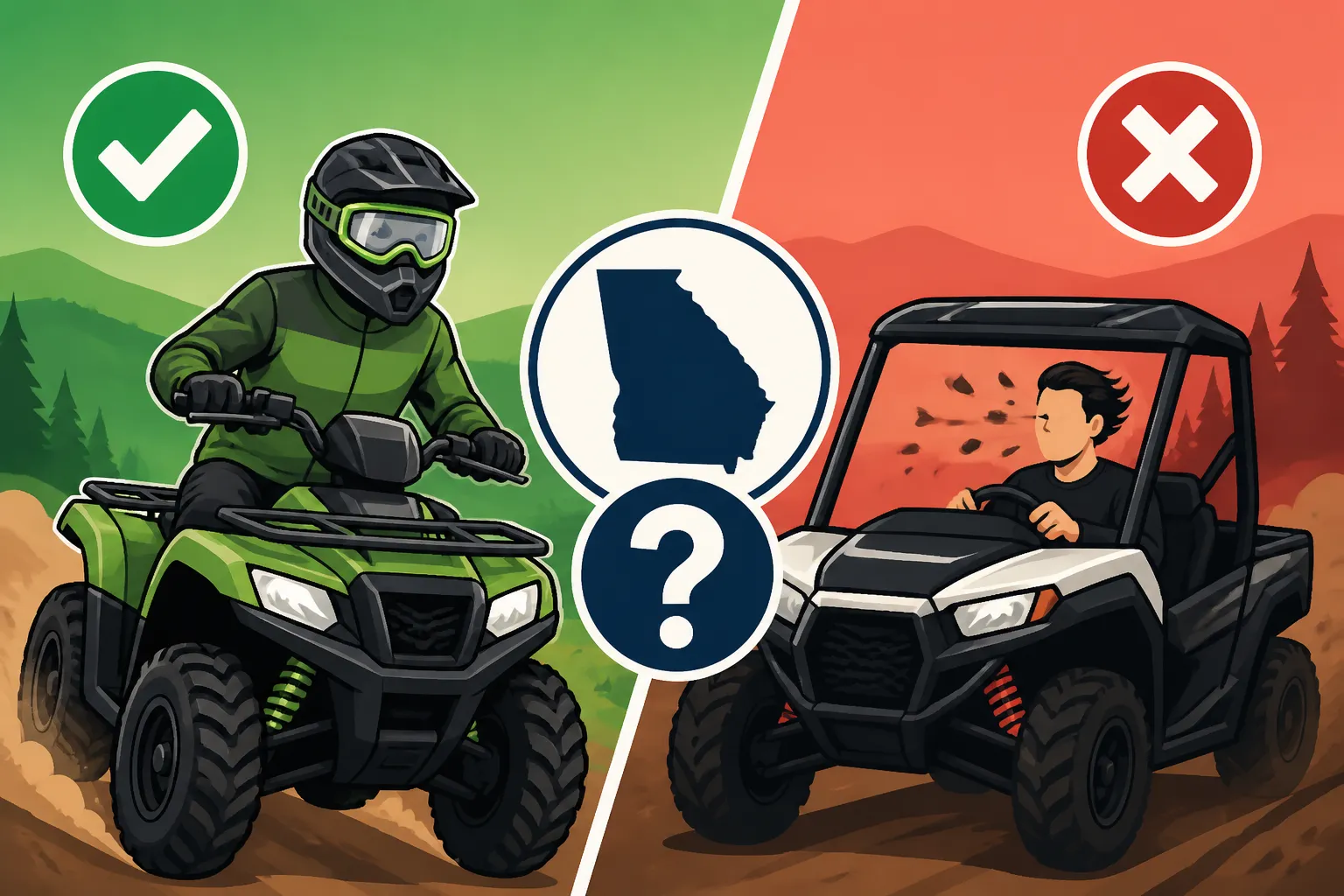
Does Georgia law require eye protection on a quad?
For ordinary off-road quad riding, Georgia does not appear to have a blanket statewide rule requiring every operator and passenger to wear eye protection. That is different from saying goggles are never required. Rules can depend on where you ride, what kind of machine you operate, and whether you are on public land, at a private park, or using a road.
It is also easy to mix up ATV rules with rules for motorcycles. A law or safety requirement that applies to a motorcycle does not automatically apply to every off-road quad. Likewise, a machine’s registration or permit does not necessarily make road use legal or settle which safety rules apply. Georgia has a specific registration category for some off-highway machines, but that category has its own conditions and does not turn every ATV into a road-legal vehicle. See Georgia ATV Registration Requirements and Are Side-by-Sides Street Legal in Georgia? for the distinctions.
Helmet requirements are a separate issue. Georgia has rules for riders under 18, and those should not be mistaken for a general eye-protection requirement. Check Georgia ATV Helmet Law for Riders Under 18 for the helmet rule and Georgia Helmet Rule on Your Own Land for how the setting can matter. A helmet requirement does not, by itself, tell you whether goggles are mandatory.
A practical way to read the rules is:
- State law: The general off-road ATV rules do not appear to require eye protection for every quad ride.
- Riding-area rules: A forest trail system, private park, event, or rental operator may require or strongly recommend it.
- Your own risk: Dust, grit, branches, and weather can make eye protection sensible even when it is not legally required.
- Road use: Do not assume a quad is permitted on a public road just because it has equipment, a registration, or protective eyewear.
If you are unsure about a particular ride, check the rules for that specific place before leaving home. A broad answer about Georgia law cannot override a trailhead notice or a private park’s posted conditions.
When a trail or park can require goggles
Public riding areas and private parks may set conditions for access that are more specific than the general statewide rule. A park can require helmets, eye protection, or other equipment as part of its visitor policies or waiver process. Forest land may also have rules that differ from those at a private riding facility. Before you go, look for the current rules from the land manager or operator rather than relying on an old social post or another rider’s recollection.
This matters for visitors from outside Georgia, too. An out-of-state permit or license does not necessarily satisfy a Georgia riding area’s equipment rules. Permits usually address permission to use a place or system, not every item a rider must wear. Review Georgia OHV Permits: What You Need Before You Ride and Georgia Visitors From Other States if your ride involves a Georgia public-land trail system.
| Riding situation | What to check | Sensible approach |
|---|---|---|
| Private off-road park | Posted rules, waiver, rental conditions, and age restrictions | Contact the park or review its current visitor information before traveling |
| National forest OHV system | Current land-manager rules, trail notices, and access conditions | Check the specific system and carry required safety gear |
| Organized ride or event | Event instructions, entry conditions, and any gear list | Treat the event’s rules as separate from the general state rule |
| Private property | The landowner’s conditions and any applicable law | Get permission and agree on safety expectations before riding |
| Public road or crossing | Whether the machine may use that road and which road rules apply | Do not assume off-road rules or equipment settle road legality |
On a private property ride, the owner can set conditions for guests, such as wearing goggles in a dusty riding area. A private park can also deny access to a rider who does not follow its rules. For more on park-specific conditions, see Georgia Private Park Helmet Rules and Georgia Private Park Waivers and Rules. Even where those rules focus on helmets, the same principle applies: read the operator’s full requirements rather than assuming the statewide minimum is the whole story.
Forest-system access is another situation where it pays to check before driving out. Trail status, closures, permitted machine types, and safety expectations can vary by location. A permit is not a substitute for checking those details. Georgia National Forest Trail-Only Rule explains why access is limited to designated routes in the relevant setting.
If you cannot find an answer online, contact the park or land manager directly. Ask whether eye protection is required for operators and passengers, whether ordinary glasses count, and whether the rule changes for children or rental machines. That short check can prevent a wasted trip and avoid a disagreement at the gate.
Choosing eye protection that works on a quad
Whether or not a rule requires it, eye protection is useful because a quad rider is exposed to flying debris and changing conditions. Dust from the machine ahead can reduce visibility quickly. Twigs, bugs, mud, and small stones can also strike the face. Regular glasses may help with wind and larger particles, but they often leave gaps around the sides and may not stay secure on rough terrain.
For off-road riding, properly fitted goggles are often the more practical choice. Look for a secure fit with the helmet you plan to wear, clear vision, and a lens suited to the light. A strap helps keep goggles in place over bumps. A lens that fogs or becomes heavily scratched can make riding less safe, so fit and maintenance matter as much as the label on the package.
| Option | Potential benefit | Trade-off to consider |
|---|---|---|
| Riding goggles | Wraparound coverage and a strap that can hold them in place | Fit may vary with helmet shape; lenses can fog or get scratched |
| Safety glasses | Lightweight and easy to carry as a spare | Usually leave more room around the sides for dust and debris |
| Prescription riding eyewear | Can provide vision correction with a secure riding fit | Fit, lens options, and compatibility need to be checked carefully |
| Ordinary sunglasses | Reduce glare in bright conditions | Often offer limited impact and side protection; may not stay secure |
| Face shield or windshield | Can deflect some wind and debris depending on design | Does not necessarily protect against debris entering from the sides or around the opening |
Do not treat a windshield as a guaranteed replacement for eyewear. Its coverage depends on its design, the rider’s position, wind direction, and the machine. A passenger may also be exposed differently from the operator. If a riding area specifically requires goggles or another form of eye protection, ask whether a windshield or face shield meets that rule rather than guessing.
When shopping, match the product to the way you ride and the helmet you use. If comparing options on Amazon or elsewhere, check the fit information, lens type, and whether the eyewear is intended for impact protection; do not assume that a “sport” or “dust” label alone proves it meets a park’s requirement. If you wear prescription glasses, confirm that the goggles fit over them or consider purpose-made prescription riding eyewear.
A few simple habits help keep eyewear useful:
- Carry a clean spare lens or a backup pair if the ride is long.
- Clean lenses with products intended for their material, since rough wiping can scratch them.
- Keep goggles secured when they are not being worn so they do not get covered in grit.
- Replace eyewear if it is cracked, badly scratched, or no longer fits securely.
- Avoid riding with a fogged or dirty lens that blocks your view. Stop somewhere safe and clear it first.
A quick check before you ride
The best answer for a particular ride comes from checking the relevant rule and preparing for the conditions. Use this short process:
- Identify the riding area. Confirm whether you are going to private land, a private park, or a public-land trail system.
- Read the current access rules. Check the operator or land manager’s equipment requirements, including rules for passengers, minors, and rentals.
- Confirm permit and access details separately. A permit may allow use of an area without answering whether goggles are required. Use What Every Rider Carries on a Georgia OHV Trail as a reminder to prepare for more than just paperwork.
- Wear suitable protection for the conditions. Dusty trails, groups riding close together, branches, and changing weather all make secure eye protection a sensible precaution.
- Recheck if the plan changes. Moving from a private park to a forest system, joining an event, or riding a different machine can mean different requirements.
If you are riding with children, do not treat the absence of an eye-protection mandate as a reason to skip protective gear. Explain when to keep goggles on, how to handle fogging safely, and why riders should not remove eyewear while moving. For passengers, make sure the gear fits them rather than assuming the operator’s spare will work.
The practical takeaway is straightforward: Georgia does not appear to require eye protection for every off-road quad ride, but a specific park or riding area may set its own rule. Check that rule before you go, and consider goggles even when they are optional. That approach is more reliable than treating a statewide legal minimum as a complete safety checklist.
Disclaimer
This article is for general informational purposes only and does not constitute professional advice. Laws, prices and regulations vary by location and change over time. Consult a qualified professional for guidance on your specific situation.