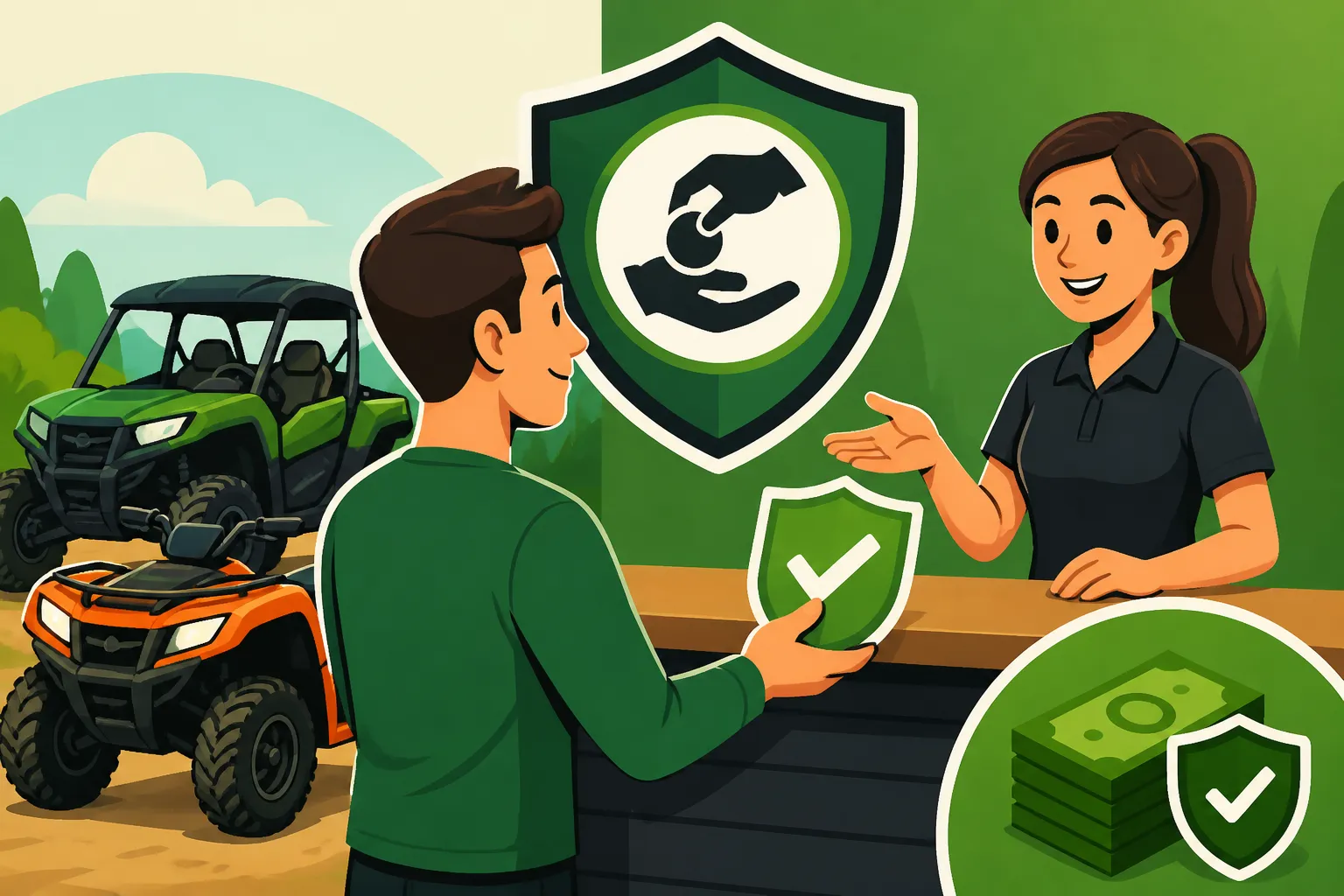
Damage Deposits at a Rental Counter
A rental deposit can feel like a second rental charge, especially when the counter asks for a card before you have seen the machine. In Georgia, the amount and release process depend on the rental operator’s terms. Know what the deposit covers, inspect the ATV or UTV before riding, and document its return so a damage claim is easier to understand.
What a rental deposit does and does not cover
A damage deposit is money or a payment-card authorization the rental business holds to help cover costs if the machine is returned damaged, incomplete, unusually dirty, or late. The rental agreement should explain what the operator may deduct and how the remaining deposit is returned.
The exact process varies by park and rental company. A card authorization may reduce the amount available to spend without appearing as a completed charge. A business might instead collect a deposit and refund the unused balance later. Ask which method applies, when the hold or refund is expected to clear, and who to contact if it does not.
Do not assume the deposit is a cap on what you could owe. The contract may allow charges beyond the deposit if repair or other covered costs exceed the held amount. It may also describe damage exclusions, deductibles, or circumstances where a waiver does not apply. Read those terms before signing rather than relying on a verbal summary.
| Counter question | Why it matters | What to confirm |
|---|---|---|
| Is this a card hold or a completed charge? | The transaction may affect available funds differently. | How it will appear and when the hold or refund is expected to clear |
| What can be deducted? | A deposit may cover more than visible damage. | The contract’s rules for damage, missing equipment, cleaning, and late return |
| Can I owe more than the deposit? | The deposit may not limit your financial responsibility. | Whether the agreement allows additional charges |
| Is a damage waiver available? | A waiver may have conditions and exclusions. | What it covers, what it excludes, and whether it changes the deposit |
| How is the return assessed? | A later inspection can lead to disagreement. | Whether staff inspect the machine with you and how damage is recorded |
A damage deposit is also different from a trail permit, park admission, or proof of insurance. Paying one does not automatically provide permission to ride, and a permit does not automatically protect you from a damage claim. For the distinction between access requirements and what a permit covers, see Georgia OHV Permits: What You Need Before You Ride and What an Operator Permit Does Not Cover.
Rental businesses may have their own insurance requirements or offer optional coverage, but neither the word “insurance” nor “waiver” tells you enough by itself. Ask for the written terms and find out whether the agreement makes you responsible for damage to the machine, injury or damage involving other people, or both. Georgia Private Park Insurance Requirements explains why park requirements and a renter’s own protection should not be treated as the same thing.
Before you accept the machine
The best time to prevent a deposit dispute is before the machine leaves the rental area. Take a few minutes to review the agreement, inspect the ATV or UTV, and make sure the condition record matches what you see. If the rental counter is busy, do not let the queue rush you into accepting a machine without a proper check.
Read the contract before paying
Look for the sections covering the deposit, damage responsibility, return time, fuel, cleaning, towing or recovery, and prohibited use. Confirm whether a charge can be made to the card on file after the rental. Ask how the operator decides what damage is new and whether you will be contacted before an additional charge is processed.
If a staff member explains a term differently from the written agreement, ask for the explanation to be added to the contract or clarified in writing. Keep a copy or clear photo of the signed agreement and any damage-waiver terms. If you are asked to sign a waiver, understand what it does not cover as well as what it may cover. Georgia Private Park Waiver Forms offers useful context for the separate waivers a park may require.
Check that the person signing is the renter named in the agreement and that the approved operator or passenger list is clear. Do not let someone who is not authorized drive simply because they are part of your group. Rental rules about minimum age, supervision, and eligible drivers can be stricter than what you might assume from riding on private property. Review Georgia Private Park Age Minimums and the rental operator’s own rules before the trip.
Inspect and record the condition
Walk around the machine with a staff member if possible. Check the body panels, bumpers, frame, wheels, tires, windshield, lights, seats, belts, mirrors, and any accessories included with the rental. On a quad, pay attention to the plastics, racks, controls, and tires. On a side-by-side, look at the doors, roof, windshield, seat belts, and cargo area.
Photograph or video any existing scratches, cracks, dents, missing parts, warning lights, or other problems. Capture enough of the machine to identify it, then take close-ups of the specific marks. Record the date and time, and ask staff to note the existing condition on the checkout form. If staff will not document a visible issue, consider asking for another machine rather than accepting responsibility for a condition you cannot prove.
Confirm that the checkout form identifies the correct machine, such as by its unit number or serial information, and lists the accessories supplied. Ask whether you are expected to return items such as keys, helmets, a winch remote, or a safety kit. Missing equipment can become a separate deduction even when the vehicle itself is undamaged.
Before leaving, ask staff to show you the basic controls and explain the return location and time. Find out what to do if the machine has a mechanical problem or becomes stuck. A rental agreement may make the renter responsible for recovery costs in some circumstances; do not assume that a breakdown or trail recovery is automatically included.
While riding and if something goes wrong
Use the machine only as the rental agreement allows. A rental operator may limit where you can ride, who can drive, whether passengers are allowed, and which trails are suitable for the machine. Ignoring those conditions could affect how the operator handles damage or a waiver claim.
Follow the park’s safety instructions and use the required protective equipment. Helmet requirements, age limits, and passenger rules can depend on the park and the machine, so confirm them at the counter rather than assuming one rental’s rules apply everywhere. Georgia Private Park Helmet Rules discusses the role of park policies alongside other riding rules.
If you notice a new mechanical issue, stop in a safe place and contact the rental business promptly. Continuing to ride after a warning light, unusual noise, overheating, or steering or braking problem could make a small issue worse and complicate the return inspection. Do not attempt a repair unless the operator authorizes it.
If there is a collision, rollover, or other damage:
- Put people’s safety first and move away from immediate hazards if it is safe to do so.
- Contact park staff or the rental business using the number or procedure provided at checkout.
- Follow the operator’s instructions about stopping use, recovery, and incident reporting.
- Take photos of the machine and the scene when it is safe and appropriate.
- Get the names and contact details of other people involved, and follow any required reporting process.
- Keep copies of messages, forms, and receipts related to the incident.
Do not leave the machine at a trailhead or attempt to conceal damage. Prompt reporting creates a clearer record of what happened and gives the rental company a chance to arrange recovery or inspect the machine. If another person is injured or property is damaged, the incident may involve issues beyond the rental deposit. Georgia Accident Reporting for a UTV Crash provides additional context on incident reporting.
A trail permit or park pass does not replace the rental contract. Nor should you assume that your personal vehicle or recreational policy covers a rented off-road machine. Ask the rental operator what coverage is included, what you may purchase, and what responsibility remains yours. If you have your own policy, contact the insurer before riding and describe the rental use specifically.
Returning the machine and resolving a deposit dispute
Return the vehicle on time, to the location specified in the agreement, and with the required keys and accessories. Follow the stated fuel and cleaning instructions. Do not pay for optional cleaning or damage services without first asking what the charge covers and whether it is required by the contract.
Whenever possible, ask a staff member to inspect the machine with you. Take return photos from the same angles as the checkout photos, including close-ups of any marks noted earlier. Ask for a written return record showing the date and time, machine identification, and any damage or missing equipment the staff member identifies. If there is a disagreement, state it calmly and ask that your account of the condition be recorded.
Before leaving, request an explanation of the deposit release process. A business may release its own authorization promptly while a bank or card issuer takes additional time to update the available balance. If the agreement describes a refund rather than a card hold, ask how it will be issued and what confirmation you should expect. Keep the contract, checkout and return records, photos, and payment documentation until the transaction is fully resolved.
If an unexpected deduction appears, start by comparing it with the agreement and the condition records. Ask the rental business for an itemized explanation and copies of any inspection notes or repair documentation used to support the charge. Share relevant checkout and return photos, and keep communications in writing when possible. If the charge is on a payment card and the business does not resolve the concern, contact the card issuer and ask about its dispute process and timing. Do not assume a card dispute automatically cancels a contractual obligation; explain the facts accurately and retain all records.
Rental deposits are ultimately governed by the rental terms and the details of the transaction. The practical approach is straightforward: know what may be charged, record the machine’s condition at both ends of the rental, and keep written proof of what happened. Also check the park’s access and equipment rules separately. Georgia Private Park Waivers and Rules and Georgia Rental Requirements at a Park can help you prepare for requirements beyond the deposit itself.
Disclaimer
This article is for general informational purposes only and does not constitute professional advice. Laws, prices and regulations vary by location and change over time. Consult a qualified professional for guidance on your specific situation.