Georgia ATV Helmet Law for Riders Under 18
Navigating the rules and regulations for youth ATV and UTV riders in Georgia can feel like trying to solve a complex puzzle, especially when you're a parent trying to keep your kids safe and legal. One of the biggest areas of confusion revolves around helmet laws for riders under the age of 18. This comprehensive guide will break down Georgia's specific requirements, clarify where and when helmets are mandatory, and equip you with the knowledge to make informed decisions for your family's off-road adventures.
Understanding Georgia's Fundamental ATV Helmet Law for Minors
The Peach State takes the safety of its youngest off-road enthusiasts seriously, particularly when they venture onto public thoroughfares. It's a common misconception that all ATV and UTV riding requires a helmet, but Georgia's law is quite specific about where and for whom this mandate applies. Understanding the core legislative intent is the first step to ensuring compliance and, more importantly, rider safety.
The Core Requirement: Public Roads and Rights-of-Way
At the heart of Georgia's helmet law for minors is a clear distinction: it primarily applies to riders under 18 operating an all-terrain vehicle (ATV) on a public road, street, or highway, or on the rights-of-way adjacent to such public ways. This means if your teenager or child is out on their quad or side-by-side and crosses into what's considered public access land, they must have a helmet on. This isn't just a suggestion; it's a legal obligation designed to protect them from serious injury in the event of an accident where they might encounter other vehicles or unexpected hazards.
Think about a 16-year-old operating a side-by-side down a designated county dirt road that connects two pieces of private property. Even if that road is unpaved and seems remote, if it's maintained by the county and accessible to the public, it falls under this rule. The moment those tires touch a public right-of-way, the helmet law for that minor rider kicks in. It's a critical point for parents to understand, as many rural roads can blur the lines between private and public access. For a deeper dive into what constitutes these roads, you might find [What a County Road System Includes] helpful.
Defining an "ATV" in the Context of Helmet Laws
When the law refers to an "ATV," it's often using a broader definition than just the traditional four-wheeler or quad. In Georgia, the helmet law for minors typically encompasses most off-road vehicles that are designed for use off paved roads. This includes traditional single-rider ATVs, utility terrain vehicles (UTVs) often called side-by-sides, and sometimes even dirt bikes and three-wheelers if they meet the general definition of an off-road machine in the statute. The key characteristic is usually their design for off-road use, not necessarily their ability to be registered for limited road access.
It’s important to distinguish these machines from other vehicles that might have different rules, like golf carts or low-speed vehicles (LSVs). While a golf cart might be used in similar recreational settings, its legal classification and, consequently, its helmet requirements often differ significantly from those for an ATV or UTV. The state's intent is to cover machines that pose a higher risk due to their speed, design, and typical operating environments. If your child is riding any vehicle capable of higher speeds and designed for rugged terrain, assume the helmet rule applies if they're on a public road, regardless of whether it's a [Georgia Registration for a Polaris Ranger] or a smaller youth quad.
Where the Under-18 Helmet Rule Applies: Public vs. Private Land
The distinction between public and private land is paramount when discussing Georgia's ATV helmet law for minors. This is where a lot of confusion arises, as the rules can change dramatically depending on where the wheels are turning. Understanding these boundaries is key to ensuring both safety and legal compliance.
Riding on Georgia's County Roads and the Helmet Mandate
Georgia has provisions that allow certain types of off-road vehicles, specifically Modified Off-Highway Vehicles (MPOHVs) like many UTVs or side-by-sides, to be registered for limited use on county roads. However, just because a machine is legally allowed on these roads doesn't negate the helmet requirement for young riders. If a minor, meaning anyone under 18 years of age, is operating or even riding as a passenger on an ATV or UTV that is lawfully on a county road, a helmet is absolutely mandatory. This is a crucial point many parents overlook.
Imagine a family taking their registered side-by-side, perhaps a [Georgia Registration for a Kawasaki Mule], down a gravel county road to access a hunting property. If a 14-year-old is driving, or even if they're just sitting in the passenger seat, they must be wearing a properly fitted and approved helmet. The law prioritizes the vulnerability of minors when they are exposed to the public road system, regardless of whether the machine itself is registered or how carefully it's being driven. This requirement is a cornerstone of [Georgia MPOHV Road Rules: County Roads Only], emphasizing safety even for machines designed for limited road use.
Helmet Requirements on Private Property
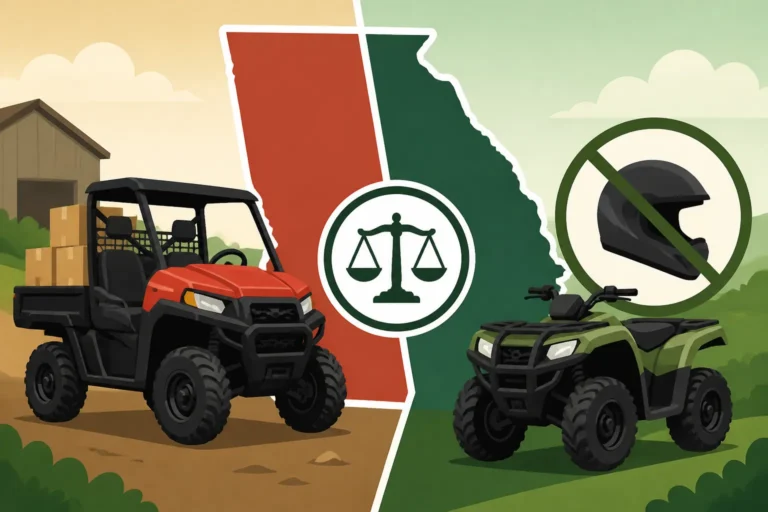
Here's where the primary state law for minors' helmets takes a significant turn: it generally does not apply to riding on private land. If your child is operating an ATV or UTV entirely on your own property, or on private land with the owner's permission, Georgia's statewide statute does not mandate helmet use for those under 18. This is a critical distinction that often brings relief to parents who primarily use their machines for recreation on their own acreage or leased hunting grounds.
However, "not legally mandated" does not mean "not recommended." Many parents, safety advocates, and manufacturers like SuperATV strongly advise helmet use on private land due to the inherent risks of off-road riding. While the law grants flexibility, the laws of physics do not. A fall or collision on private land can be just as devastating as one on a public road. Parents bear a significant moral and often legal responsibility for their children's safety on private property. For more on this, you can look at [Georgia Helmet Rule on Your Own Land] which delves into this specific scenario.
State Parks, National Forests, and Managed Riding Areas
While private land might offer a helmet exemption under state law, publicly managed lands such as state parks, Wildlife Management Areas (WMAs), and national forests often have their own sets of regulations. These rules can be much stricter than the general state statute and frequently require helmets for all ATV and UTV riders, regardless of age, when on designated trails or roads within those managed areas. It’s imperative to check the specific rules of any public riding area before you go.
For example, when you plan a trip to a place like [Houston Valley OHV Trails in Georgia] or any of the other systems within the [Chattahoochee-Oconee National Forest Riding], you will find that a helmet is typically required for everyone operating an off-highway vehicle. These areas are managed for public recreation and safety, and their rules often reflect best practices rather than minimum legal requirements. Always look up the specific park or forest regulations online or call the ranger district office before heading out to avoid surprises and ensure your minor riders are properly geared up.
Exemptions to Georgia's Under-18 Helmet Law
While Georgia's helmet law for minors on public roads is fairly straightforward, like many statutes, it does include specific exemptions designed to accommodate practical realities, primarily related to certain types of work. These carve-outs are important for families who use ATVs and UTVs as tools rather than purely for recreation.
Agricultural and Commercial Use Exemptions
One of the most significant exemptions to Georgia's helmet law for riders under 18 applies to machines being used for agricultural or commercial purposes. If a minor is operating an ATV or UTV while actively engaged in farm work, logging operations, or other legitimate commercial activities, they are generally not required to wear a helmet on public roads or rights-of-way that they might use as part of that work. This exemption recognizes that these machines are often essential equipment for earning a living or managing a farm, and the nature of the work might make helmet use impractical or even less safe in some situations.
It's crucial to understand the "actively engaged" part of this exemption. This isn't a loophole for casual riding. A 17-year-old driving a side-by-side to move feed from one barn to another on a family farm, perhaps crossing a short stretch of county road as part of that duty, would likely fall under this exemption. However, if that same 17-year-old is simply riding the side-by-side for fun, even on farm property but crosses that same county road, the helmet rule would apply. The intent of the machine's use at that specific moment is what matters. You can find more specific details on this in [Georgia Helmet Exemption for Farm Work].
Other Potential Exemptions and Nuances
Beyond agricultural and commercial use, Georgia's helmet law for minors is quite broad, covering both operators and passengers under 18 on public roads. There aren't many other blanket exemptions in the state-level statute. However, it's always wise to consider any potential local ordinances that might exist in specific counties or municipalities. While state law provides a baseline, local jurisdictions can sometimes enact stricter rules, although this is less common for helmet mandates and more for general road access.
It's also worth noting that the law specifically targets "off-road vehicles" (or similar terminology) and their use on "public roads." Therefore, if a particular vehicle does not meet the legal definition of an off-road vehicle or is being operated in a manner that falls outside the "public road" context (like on designated private trails or purely on land not accessible to the public), then the state helmet law for minors typically would not apply. However, exercising common sense and prioritizing safety is always paramount, and voluntary helmet use, regardless of the legal mandate, is a best practice for all riders, especially the young ones.
The Serious Consequences of Non-Compliance
Ignoring Georgia's ATV helmet law for riders under 18 isn't just a minor oversight; it carries significant legal and financial ramifications. For parents or guardians, understanding these potential consequences is critical, not only for legal compliance but also for protecting their children and their family's financial well-being.
Penalties and Fines for Helmet Violations
In Georgia, if a minor is found operating or riding as a passenger on an ATV or UTV on a public road or right-of-way without a helmet, and they are required to wear one, the responsible party (typically the parent or guardian) can face serious penalties. A violation of this helmet law is considered a misdemeanor. This isn't just a simple traffic ticket; a misdemeanor conviction can come with substantial fines, court costs, and potentially even more severe legal repercussions depending on the circumstances and any previous infractions.
Specifically, the financial impact can be quite direct. Georgia law outlines a significant penalty for these types of violations. Parents could be looking at a considerable fine, which quickly adds up when factoring in court fees and administrative costs. This fine is a direct consequence of failing to ensure your child wears the required safety equipment. It’s a clear message from the state that the safety of young riders on public roads is not to be taken lightly. To grasp the specific financial sting, read [Georgia's $500 Helmet Violation Penalty]. This penalty serves as a stark reminder of the importance of compliance.
Insurance Implications and Liability After an Accident
Beyond the immediate legal penalties, operating a UTV or ATV without a helmet when legally required can have devastating long-term consequences, especially if an accident occurs. Insurance companies often scrutinize claims closely, and if it's determined that a minor was riding without a helmet in violation of state law, this could severely impact coverage. An insurer might deny or significantly reduce payouts for medical expenses or property damage, leaving the family responsible for potentially enormous costs.
Furthermore, the liability for parents or guardians dramatically increases in the event of an accident where a minor rider sustains injuries while not wearing a legally mandated helmet. If another party is involved, or even if the accident is single-vehicle, the fact that the child was not in compliance with the helmet law can be used to assign greater negligence to the parents. This could lead to lawsuits, substantial personal liability for medical bills, and prolonged legal battles. Even if you have [Georgia UTV Insurance Minimums], a lapse in legal compliance can weaken your position significantly. The helmet isn't just about avoiding a ticket; it's a critical layer of protection against both physical harm and severe financial ruin.
Essential Safety Gear Beyond the Helmet
While a helmet is undeniably the most critical piece of safety equipment, especially for riders under 18 on Georgia's public roads, it's far from the only item that should be part of every rider's kit. A comprehensive approach to safety gear can dramatically reduce the risk of injury and enhance the overall riding experience for everyone, particularly young, developing riders.
The Importance of Eye Protection, Gloves, and Long Clothing
Beyond the helmet, proper eye protection is non-negotiable. Whether it's goggles or a full-face helmet visor, protecting the eyes from dust, debris, insects, branches, and even sunlight is crucial. A simple splash of mud or a low-hanging branch can impair vision, leading to an accident, or cause direct injury to the eyes. Many off-road specific goggles are designed to integrate seamlessly with helmets, providing maximum protection. Companies like SuperATV offer a wide range of accessories including windshields for UTVs that can help deflect some frontal debris, but dedicated eye protection is still paramount for the operator and passengers.
Gloves are another often-overlooked item. They provide a better grip on the handlebars, absorb vibrations, and, most importantly, protect hands from abrasions, blisters, and impacts during a fall. Hands are often the first thing riders put out in a spill, and well-padded gloves can make a huge difference in preventing serious injury. Likewise, long-sleeved shirts and long pants, made from durable materials like denim or specialized riding fabrics, offer a vital layer of protection against scrapes, cuts, and even sunburn. Short sleeves and shorts might be comfortable on a hot day, but they offer almost no protection in an off-road environment, making them an unsafe choice for any rider.
Proper Footwear and Rider Education
The choice of footwear is just as important as upper body protection. Riders, especially minors, should always wear sturdy, over-the-ankle boots that provide support and protection for the feet and ankles. Sneakers or sandals offer minimal protection against impacts, crushing injuries, or simply keeping feet securely on the footpegs or floorboards, especially when navigating rough terrain. A solid pair of riding boots can prevent many common foot and ankle injuries that occur during off-road excursions.
Finally, while not a piece of gear in the traditional sense, rider education is an essential component of ATV and UTV safety. Georgia does not mandate a state-sponsored ATV safety course, which is highlighted in [Georgia Has No State ATV Safety Course]. However, enrolling young riders in a reputable ATV or UTV safety course is one of the best investments a parent can make. These courses teach critical skills such as proper turning, braking, obstacle avoidance, and understanding terrain, significantly reducing the risk of accidents. Practical experience combined with formal training empowers young riders to make safer decisions and react appropriately in challenging situations, making them more confident and competent on any machine, whether they're installing a new SuperATV lift kit or just enjoying a casual ride.
Age Limits and Supervision for Young Riders in Georgia
Understanding Georgia's helmet law is just one piece of the puzzle when it comes to minor riders. The state also has specific regulations regarding who can operate these machines and under what conditions, particularly when accessing public roads. These rules are distinct from helmet requirements but equally important for safe and legal riding.
Minimum Age for Operation on Public Roads
It’s a common misunderstanding that if a minor has a helmet on and is within the agricultural exemption, they can automatically operate a side-by-side or ATV on a county road. However, Georgia law typically states that any person operating a motor vehicle on a public road must possess a valid driver's license. This applies to registered MPOHVs (Modified Off-Highway Vehicles) when they are being driven on county roads. Therefore, even a 16 or 17-year-old who doesn't yet have a full, unrestricted driver's license (meaning they might only have a learner's permit or provisional license) would generally not be legally permitted to operate an MPOHV on a county road.
This means that while the helmet law might apply to a 16-year-old passenger, the actual operator needs to meet the driver's license requirements. This can be a significant hurdle for many young enthusiasts who are eager to drive but haven't yet reached the age or passed the tests for a full license. Parents should be acutely aware of this, as allowing an unlicensed minor to operate a vehicle on a public road can lead to separate, severe penalties related to unlicensed operation, quite apart from any helmet violations. For comprehensive details on this, refer to [Georgia Driver's License Rules for MPOHV Operators].
Supervision Rules for Minors on Private Land and Designated Trails
While Georgia's state law is less prescriptive about supervision on private land, common sense and parental responsibility dictate that minors should always be supervised while operating ATVs or UTVs. Many private off-road parks and public managed areas, like WMAs or national forests, will have their own specific age and supervision rules. For instance, some designated riding areas within Georgia's Wildlife Management Areas have a [Georgia WMA Minimum Age of 16] for operators on WMA roads, irrespective of whether they have a driver's license.
These rules often specify that younger riders must be accompanied by an adult, sometimes directly on the same machine, or on a separate machine within eyesight. Parents and guardians should always check the specific rules of any private park or public land before visiting. Even on private family land, close supervision is crucial. Young riders are still developing their judgment, coordination, and understanding of risk. An experienced adult's presence can provide immediate guidance, identify potential hazards, and intervene quickly in an emergency, ensuring a much safer and more enjoyable experience for everyone involved.
Choosing the Right Helmet: What Parents Need to Know
Selecting the right helmet for a minor ATV or UTV rider is about more than just finding one that looks cool. It's a critical safety decision that requires careful consideration of certification, fit, and ongoing maintenance. A helmet can only provide maximum protection if it meets certain standards and fits the rider correctly.
DOT Certification and Proper Fit
When choosing a helmet for a child or teenager, the absolute first thing to look for is a DOT certification. This signifies that the helmet meets the minimum safety standards set by the U.S. Department of Transportation. While other certifications like Snell or ECE offer even higher levels of protection, DOT is the baseline legal requirement for any helmet used on public roads where one is mandated. Never purchase a helmet that doesn't clearly display the DOT sticker on the back.
Equally important, if not more so, is ensuring a proper fit. A helmet that is too loose can shift during an impact, failing to protect the head effectively, or even fly off. One that is too tight will be uncomfortable and could distract the rider. A properly fitting helmet should feel snug all around the head, with no pressure points. It shouldn't move side-to-side or front-to-back when the chin strap is fastened, and the skin on the rider's forehead should move with the helmet as it's rotated. Many youth-specific helmets are available, designed to fit smaller heads and often lighter in weight, which is crucial for comfort and neck strain for younger riders. Always try a helmet on before buying and refer to sizing charts, and if possible, have a professional assist with the fit.
Helmet Maintenance and Replacement
A helmet's protective capabilities aren't indefinite. Proper maintenance and knowing when to replace a helmet are vital. Helmets should be cleaned regularly according with the manufacturer's instructions, using mild soap and water for the shell and removing padding for washing. Avoid harsh chemicals or solvents that can degrade the helmet materials. Store helmets in a cool, dry place away from direct sunlight and extreme temperatures, which can also compromise their integrity over time.
Crucially, a helmet must be replaced after any significant impact, even if there's no visible damage to the exterior. The protective foam inside is designed to crush and absorb energy during a crash, and once it has done its job, it won't be as effective a second time. It’s a one-and-done item in a serious accident. Furthermore, helmets have a lifespan, typically around five years, regardless of whether they've been involved in a crash. Over time, materials degrade due to UV exposure, sweat, and general wear and tear, reducing their ability to protect. Always check the helmet's manufacture date, often found under the comfort liner, and replace it periodically to ensure your child is always wearing the best possible protection.
Safety Gear Table: Key Items and Their Purpose
To help visualize the full scope of essential safety gear, here’s a quick overview of what riders, especially minors, should wear and why.
| Gear Item | Purpose | When/Where Mandatory (for minors in GA) | Recommendation |
|---|---|---|---|
| Helmet | Protects head from impact, brain injury. | On public roads/rights-of-way. | DOT-certified, proper fit, full-face preferred, replaced after impact/5 years. |
| Eye Protection | Shields eyes from debris, dust, sun, branches. | Not explicitly mandated by GA helmet law, but critical for safety. | Goggles or full-face visor, anti-fog preferred. |
| Gloves | Protects hands from abrasions, blisters, impacts; improves grip. | Not legally mandated. | Full-fingered, padded gloves, suitable for off-road riding. |
| Long-Sleeved Shirt | Protects arms from scrapes, cuts, sun. | Not legally mandated. | Durable material (e.g., jersey, denim); specialized riding gear is best. |
| Long Pants | Protects legs from scrapes, cuts, impacts, engine heat. | Not legally mandated. | Durable material (e.g., denim, specialized riding pants). |
| Over-the-Ankle Boots | Protects feet and ankles from impacts, crushing injuries, provides grip. | Not legally mandated. | Sturdy, rigid sole, good ankle support; off-road boots are ideal. |
| Chest Protector | Protects torso from impact with handlebars, flying debris, branches. | Not legally mandated. | Recommended for more aggressive riding or inexperienced minors. |
| Rider Education | Teaches safe operation, hazard avoidance, proper riding techniques. | Not legally mandated by GA, but highly recommended. | Certified ATV/UTV safety course for all ages, especially beginners. |
Disclaimer
This article is for general informational purposes only and does not constitute professional advice. Laws, prices and regulations vary by location and change over time. Consult a qualified professional for guidance on your specific situation.