Who Is Liable When a Minor Crashes in Georgia?
A minor crashes an ATV or UTV in Georgia, and the first question is often whether the parents are automatically responsible. Usually, the answer depends on more than the rider’s age: who owned the machine, who allowed the ride, how the crash happened, where it occurred, and what insurance covers. Here’s how to sort through those issues and what to do next.
Who may be liable after a minor’s ATV or UTV crash
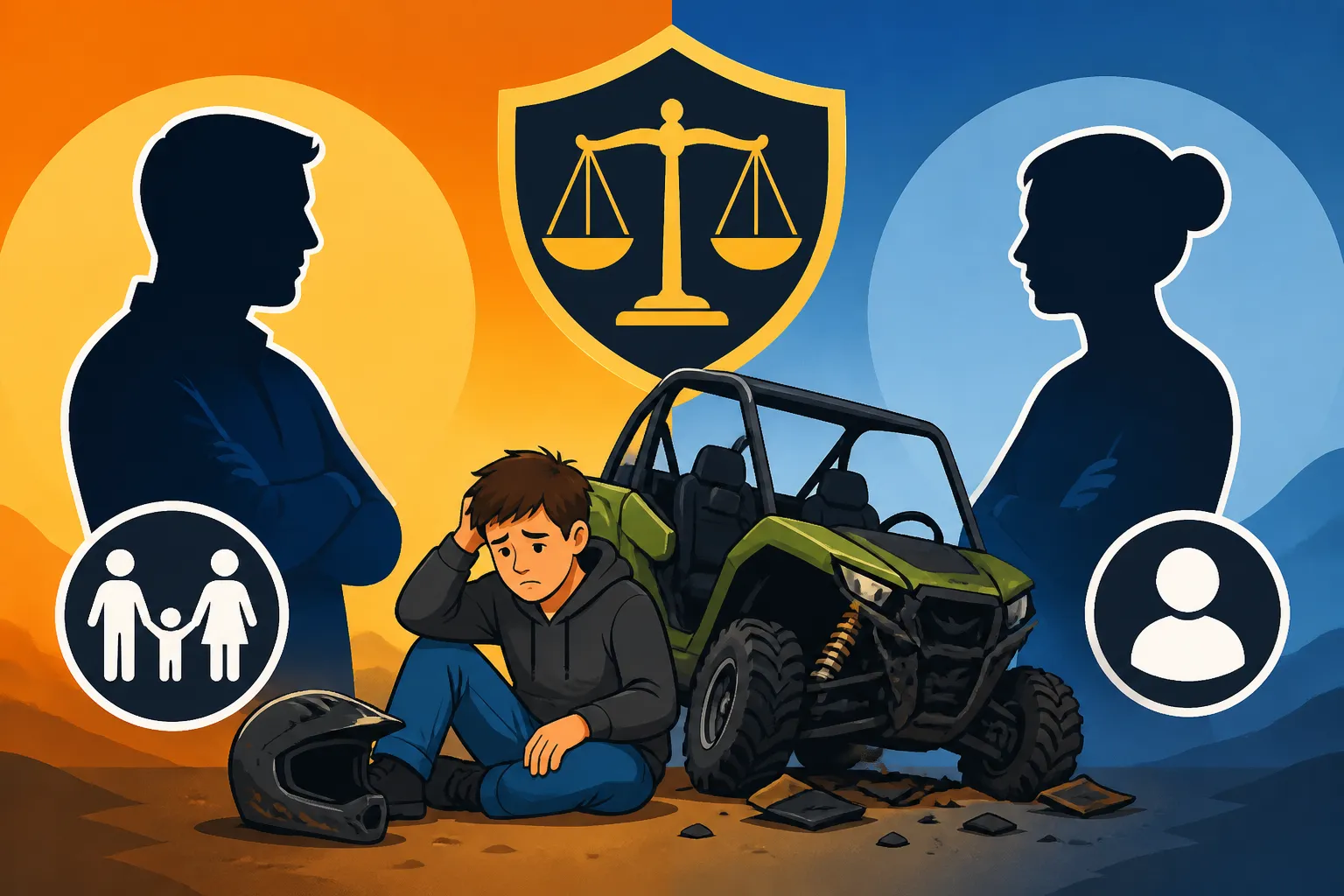
Liability is not automatically assigned to a child’s parent just because the rider is under 18. A claim may instead involve the minor, the vehicle’s owner, an adult who allowed the ride, another rider or driver, or a property owner. More than one person may share responsibility, depending on the facts.
| Person or party | How they could be involved | What matters |
|---|---|---|
| The minor operating the machine | The rider’s actions may have contributed to the crash or injuries | Age, ability, conduct, supervision, and the circumstances |
| The owner | The owner may have negligently allowed someone to use the machine | Permission, the rider’s experience, known risks, and how the machine was maintained |
| A parent or guardian | A parent may have personally contributed to the risk or may be responsible under a specific legal rule | Their own actions, ownership, supervision, and the facts of the incident |
| Another rider or driver | Their conduct may have caused or contributed to the collision | Right of way, speed, visibility, and each person’s actions |
| A property owner or operator | A dangerous condition or negligent operation of a riding area may be relevant | The location, the owner’s role, notice of a hazard, and applicable law |
The minor’s conduct can matter
A minor’s age does not by itself settle whether the rider was at fault. Investigators and insurers may consider what happened immediately before the crash: whether the rider was traveling too fast for the terrain, ignored instructions, carried a passenger improperly, or used a machine beyond their ability.
A child’s age and experience may matter when evaluating their conduct. That does not mean every crash involving a young rider results in a claim against the child or family. The circumstances, applicable law, and available insurance all matter. If the rider was operating someone else’s machine, the owner’s decision to provide access may also come under scrutiny.
Parents are not automatically responsible for every accident
A parent may be involved in a claim because of their own actions, such as providing a machine to a rider they knew was not ready to operate it, or failing to address a risk they were responsible for managing. Georgia law also has rules that can impose parental responsibility in specific situations involving a minor’s conduct. Whether a particular rule applies depends on the facts and should not be assumed from the child’s age alone.
It helps to separate two questions: Who caused or contributed to the crash? and What insurance or legal responsibility may apply? A parent may not have caused the crash but could still be drawn into an insurance or legal dispute because they own the machine, insured it, or allowed the child to ride. Conversely, being a parent does not automatically make someone liable for every injury their child causes.
The owner may face a separate question
An adult who owns the ATV or UTV can face scrutiny if they allowed a minor to ride without considering the child’s experience, the machine’s size and power, or the riding conditions. This is sometimes discussed as negligent entrustment. Whether that theory fits depends on what the owner knew and did, not merely on the fact that the rider was young.
The owner’s responsibility may also be affected by maintenance. A mechanical failure, missing safety equipment, or a known defect could raise questions separate from the rider’s conduct. Keep records of service and repairs, and don’t alter or dispose of damaged parts before documenting them.
For a child riding at a private park, the park’s rules, supervision arrangements, and signed paperwork may be relevant. A waiver is not a universal answer to every claim, and its effect can depend on its wording and the circumstances. See Georgia Private Park Waiver Forms and Georgia Private Park Insurance Requirements for related considerations.
Why the location, supervision, and insurance matter
A crash on a private trail, farm, public road, or organized riding area can raise different questions. The location does not automatically determine who is at fault, but it can affect which rules apply, who controlled the area, and what documentation may be useful.
On private property, a landowner is not automatically liable just because an injury occurred there. Relevant issues may include who invited or allowed the riders onto the property, whether the owner knew of a dangerous condition, and what steps were taken to address it. A riding park may have its own operating rules and safety procedures. An injury claim can also turn on the rider’s actions, even if the property was privately owned. Georgia ATV Rules on Private Property explains why permission to ride and permission to use a particular route are separate practical questions.
On a public road, the rider’s eligibility and the machine’s legal status are distinct from crash liability. A registration, permit, or out-of-state plate does not, by itself, establish that a minor was allowed to ride in that place or that the machine was covered by insurance. If a side-by-side is being used on a road, review the applicable operating rules rather than treating registration as permission for every road. Georgia Driver’s License Rules for MPOHV Operators and Georgia Rules for Passengers on a Side-by-Side cover related operating issues.
Supervision can be important evidence. Consider whether the adult knew the child’s skill level, gave instructions, selected a suitable machine, and remained in a position to intervene. There is no single supervision arrangement that guarantees safety or eliminates liability. The circumstances matter, including the machine, terrain, other riders, and the minor’s experience. Georgia Supervision Rules for Minors provides more on the supervision side of riding.
Insurance may cover some claims, but check the policy
An insurance policy may cover injuries or property damage arising from an ATV or UTV crash, but coverage depends on the policy’s wording and the facts. Don’t assume that a homeowners policy, auto policy, recreational-vehicle policy, or registration-related insurance requirement covers every machine, rider, location, or use.
Check the policy for:
- Which machines are listed or included
- Whether the minor is an insured or permitted operator
- Whether coverage changes when the machine is used on a public road, at a park, or for work
- Exclusions involving racing, business use, unapproved riders, or certain vehicle types
- Liability limits, deductibles, and any conditions for reporting a crash
Ask the insurer to explain the coverage for the specific machine and the specific use. Give accurate information about the rider, location, and events. Avoid guessing or changing details to make a claim fit a policy.
A forest permit or registration should not be treated as liability insurance. A permit may address access to a riding area, while insurance addresses financial coverage under the policy. If you are preparing for a ride, Georgia OHV Permits: What You Need Before You Ride can help distinguish access requirements from other responsibilities.
Safety rules matter, too, but following one requirement does not automatically resolve fault. For example, Georgia has a helmet rule for riders under 18 in specified circumstances; the exact applicability depends on where and how the machine is being used. Georgia Helmet Rules for Riders Under 18 explains that issue.
What to do after a minor is involved in a crash
First, get medical help when needed and make the scene safe without putting anyone else at risk. Don’t delay urgent care while trying to settle questions about fault or insurance. Once immediate safety is addressed, careful documentation can help preserve an accurate account.
- Record the basic facts. Note the date, time, location, machines involved, names of riders and witnesses, and a clear description of what happened. If you do not know an answer, mark it as unknown rather than filling in a guess.
- Photograph the scene and equipment. If it is safe, take pictures of the machine, damage, terrain, signs, road conditions, and any apparent hazard. Photograph the scene before equipment is moved or repairs are made where practical.
- Keep the machine and records available. Preserve maintenance records, purchase paperwork, operating instructions, messages about permission to ride, and any relevant park or landowner rules. Do not repair or discard damaged parts before documenting them.
- Notify the appropriate insurer. Report the incident promptly and follow the policy’s instructions. Provide accurate information, keep copies of communications, and ask what additional documentation the insurer needs.
- Write down what each person remembers. Do this separately and as soon as reasonably possible. Avoid coaching the child or witnesses, and do not post assumptions or accusations about the crash online.
- Check whether an official report is needed. Reporting requirements can depend on the location and details of the incident. For a public-road crash, contact the appropriate law enforcement agency or local authority to ask what reporting steps apply. Georgia Accident Reporting for a UTV Crash covers related reporting considerations.
- Get legal advice if the injuries or dispute are serious. A lawyer can assess how Georgia law applies to the specific facts, including questions about a minor’s conduct, parental responsibility, ownership, landowner duties, and insurance coverage.
Avoid quick blame decisions
People at the scene may feel pressure to decide immediately who is responsible. A minor may be upset or embarrassed, and adults may try to settle the matter before anyone has a complete picture. Keep the conversation factual. Do not promise payment, sign a release, or make a definitive statement about fault before understanding the injuries, the damage, and the available coverage.
A crash can involve several contributing factors. A rider’s decision, an adult’s decision to allow the ride, another person’s actions, the machine’s condition, or a hazardous location may all be relevant. The fact that a child was riding does not prove that the parent caused the crash. Likewise, the fact that an adult owns the machine does not automatically establish that the owner was negligent.
If someone is seriously injured, there is significant property damage, or the insurer disputes coverage, get advice based on the actual evidence. Keep copies of reports, photographs, medical records, policy documents, and correspondence. These records can help clarify what happened and who may have responsibility without relying on memory alone.
Disclaimer
This article is for general informational purposes only and does not constitute professional advice. Laws, prices and regulations vary by location and change over time. Consult a qualified professional for guidance on your specific situation.