Georgia Minimum Age on a Public Road
One of the biggest head-scratchers for folks in Georgia who own an ATV or UTV is figuring out who can actually drive these machines on a public road, and more importantly, how old they need to be. It's not just a simple matter of getting behind the wheel; Georgia has specific rules that can be confusing, especially when you factor in different types of vehicles and various road classifications. This guide will walk you through the nitty-gritty of Georgia's minimum age requirements for operating your side-by-side or utility vehicle on those designated county roads.
The Core Rule: Operators Must Be Licensed Drivers
Let's get straight to the point: if you want to legally operate a Georgia-registered Multi-purpose Off-Highway Vehicle (MPOHV) on a county road in Georgia, the driver must hold a valid driver's license. This isn't just a suggestion; it's a fundamental requirement that underpins all other age considerations for MPOHVs. This can be a real shocker for some, especially those accustomed to a more relaxed approach on private land.
Why a Driver's License is Non-Negotiable
The state of Georgia categorizes registered MPOHVs, which primarily include UTVs and larger side-by-sides, as vehicles that are allowed limited access to county roads. Because these machines are interacting with public infrastructure and potentially other road-going vehicles, the state mandates that their operators possess the same level of proven driving competence as someone operating a car or truck. This means passing all the tests, vision screenings, and age requirements typically associated with obtaining a Class C driver's license. It's all about ensuring that anyone behind the wheel on a public thoroughfare understands traffic laws, has the necessary motor skills, and can react responsibly to unpredictable situations. Without that license, you're not just breaking a minor rule; you're operating a vehicle on a public road without the state's official stamp of approval for your driving abilities, which carries significant legal implications.
When you think about it, the logic holds. Imagine a busy county road, perhaps one that winds through a rural area near a popular trail system or hunting spot. A driver of an MPOHV needs to be able to signal turns, understand right-of-way, respond to stop signs, and generally navigate traffic safely. These are all skills that the driver's license process is designed to verify. Without that baseline, you're creating a potentially hazardous situation for everyone on the road, including yourself and any passengers. The state isn't just trying to be difficult; it's trying to maintain a semblance of order and safety on public roadways. This is a key part of understanding [Georgia Driver's License Rules for MPOHV Operators].
This requirement can be particularly frustrating for families where older teenagers are perfectly capable of handling a UTV off-road and might even use it for farm work or assisting around a large property. They might be skilled operators in a field or on a trail, but that experience doesn't translate to a public road without the official driver's license. It’s a point of contention for many, but the law is quite clear: a valid license is the entry ticket for county road access. This isn't to say their skills aren't valuable or impressive, but the public road environment demands a different, state-sanctioned certification of ability.
Comparing to Car Driving Ages
For most folks in Georgia, the minimum age to obtain a Class C driver's license is 16, after having held a learner's permit for a certain period and completing driver's education. This effectively means that the absolute youngest someone can legally drive a registered MPOHV on a county road is 16 years old. This aligns the MPOHV with other motor vehicles on public roads, drawing a clear line in the sand. You can't just jump from riding around the pasture to cruising down the county road without meeting the same basic age and licensing criteria as someone driving a sedan.
Think about the graduated licensing system for young drivers. It starts with a learner's permit, moves to an intermediate license with restrictions, and then to a full Class C license. This entire process is designed to gradually introduce new drivers to the complexities of road use. When it comes to MPOHVs, the state isn't offering a separate, easier path for these vehicles. If you're driving an MPOHV on a county road, you're expected to have completed that same rigorous journey to obtain a full driver's license. There's no "MPOHV learner's permit" loophole here.
This strict alignment means that if your child is 14 or 15 and has a learner's permit, they are still not legally allowed to drive a registered MPOHV on a county road, even with a licensed adult in the passenger seat. The learner's permit is for cars and trucks under direct supervision, not MPOHVs. The full Class C license is the benchmark. This can be a hard pill to swallow for eager young riders and their parents, but it's crucial for staying on the right side of the law and avoiding serious penalties. It emphasizes that while MPOHVs are distinct from cars, their operation on public roads requires the same foundational legal capabilities.
Exceptions and Misconceptions
While the driver's license rule is pretty ironclad for MPOHVs on county roads, there are always nuances and common misconceptions. One frequent misunderstanding is the belief that if you're just crossing a state highway, or if the county road is particularly rural and quiet, the rules might be relaxed. This simply isn't true. Any operation on a public road that is not private property, regardless of its traffic volume, falls under the state's requirements. Another misconception is that farm use or hunting activities grant some kind of blanket exemption to the age and licensing rules. While there might be specific, limited exemptions for very direct agricultural use on certain types of roads, they generally do not supersede the driver's license requirement for general public road use. Always check the specifics of [Georgia MPOHV Road Rules: County Roads Only].
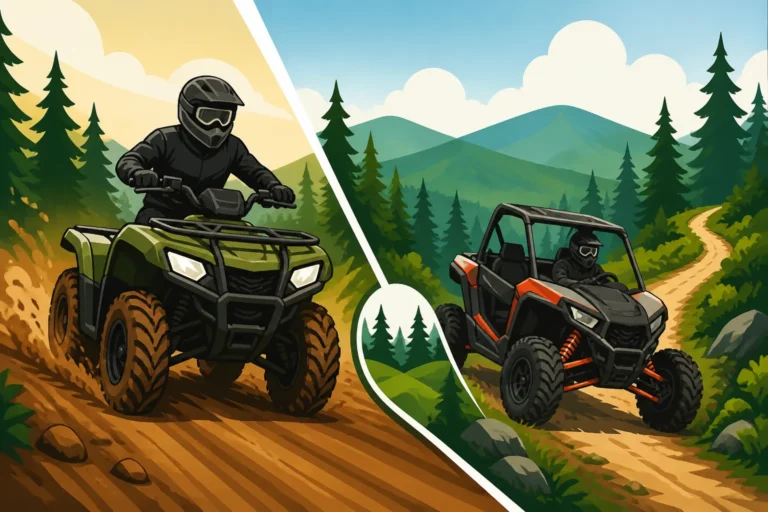
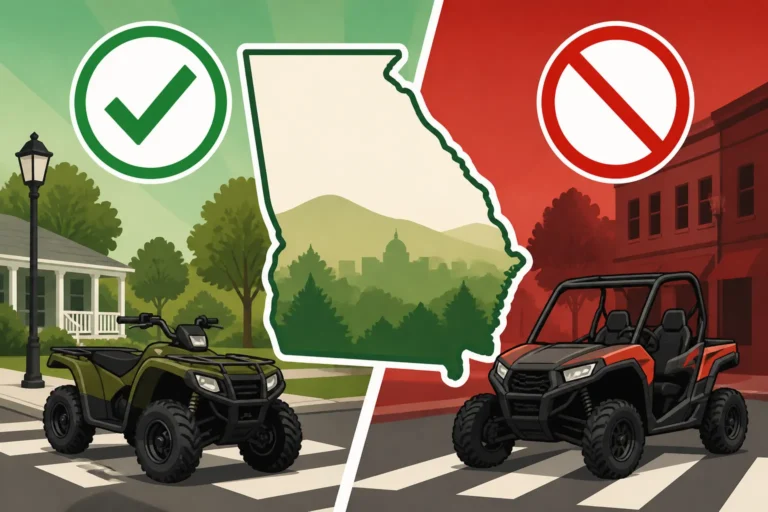
It's also important to distinguish MPOHVs from other types of off-road vehicles that have different rules. For instance, ordinary ATVs (the straddle-seat, handlebar machines) are generally not permitted on any public roads in Georgia, regardless of the operator's age or license status. They simply don't fit the definition of a registerable MPOHV, which has specific design requirements like a steering wheel, non-straddle seating, and seat belts. So, even if you have a full driver's license, you cannot legally ride a traditional quad down a county road. The vehicle itself must meet the state's criteria for MPOHV registration before any driver age rules even come into play.
Another area of confusion can arise from the voluntary nature of MPOHV registration itself. Some might think, "If it's voluntary, maybe the rules aren't as strict?" However, if you choose to register your MPOHV to gain the privilege of county road access, then you must adhere to all the associated rules, including driver licensing. It's an all-or-nothing proposition: either you meet the requirements and gain limited road access, or you don't and keep your machine strictly on private land. There isn't a middle ground where you can pick and choose which rules to follow once you've opted for registration.
Georgia's Specific Age Requirements for MPOHV Operators
When we talk about the minimum age for driving an MPOHV on a public road in Georgia, we're essentially talking about the age at which one can obtain a full, unrestricted Georgia driver's license. There aren't separate, lower age limits specifically for MPOHVs. The state views these registered machines, when on county roads, in much the same way it views any other licensed vehicle.
The "Minimum Age 16" for Licensed Drivers
As discussed, because operating a registered MPOHV on Georgia county roads requires a valid driver's license, the de facto minimum age is 16. This is the age at which most individuals in Georgia, after completing the graduated licensing program, can obtain an unrestricted Class C driver's license. This means that if you're a parent with a 15-year-old who is an excellent rider and proficient with your side-by-side, they still cannot legally take it out on the county road, even if they're just driving a short distance to a friend's house or a local fishing spot. The law is quite explicit here.
This can feel restrictive, especially in rural communities where UTVs are incredibly useful tools for daily tasks beyond just recreation. Many teenagers grow up driving these machines on family land, becoming quite skilled at a young age. However, the step from private property to public roadway introduces a new layer of responsibility and liability that the state has chosen to regulate through the existing driver's licensing framework. It's not about doubting a teenager's ability to drive the machine itself, but rather their certified comprehension of traffic laws and their maturity to navigate shared public spaces.
Therefore, for any MPOHV owner planning to use their machine on the limited public roads available to them, ensuring the operator is at least 16 years old and holds a current, valid driver's license is paramount. Any deviation from this rule could result in citations, fines, and even more serious legal consequences if an accident were to occur. It's a critical safety and legal checkpoint that cannot be overlooked. Even if the journey is only 100 yards, the rule applies.
No Learner's Permit for County Road Riding
A common question that arises is whether a teenager with a Georgia learner's permit can operate an MPOHV on a county road if a fully licensed adult is present. The answer is a resounding no. A learner's permit, or Class CP license, specifically authorizes the permit holder to operate a Class C vehicle (a regular passenger car or truck) when accompanied by a licensed driver who is at least 21 years old and occupying the front passenger seat. MPOHVs, while motor vehicles, are not considered "Class C vehicles" in this context for the purpose of learner's permit operation on public roads. Their specific classification for road use means they don't fall under this particular learner's permit provision.
This distinction is important because it clarifies that the MPOHV road access program is not an extension of standard passenger vehicle licensing. It's a separate, albeit related, privilege that hinges on already possessing a full, unrestricted driver's license. This prevents younger, less experienced drivers, even under adult supervision, from operating these specialized machines on public roads where they might encounter cars, trucks, and other hazards that demand the full attention and experience of a certified driver. It highlights the state's intent to keep the roads as safe as possible by not allowing a "training wheels" phase for MPOHVs on public asphalt or dirt.
So, if your 15-year-old has their learner's permit and can legally drive your car with you supervising, that permission does not extend to your side-by-side on a county road. They must wait until they are 16 and have successfully completed the steps to earn their full Class C license. This might seem like an overly strict interpretation, especially given that many MPOHVs are arguably easier to control at lower speeds than a full-sized pickup truck, but the letter of the law is quite clear and leaves little room for interpretation on this point.
The Role of Parental Supervision
While parental supervision is absolutely essential for teaching young riders how to safely operate ATVs and UTVs on private property, it does not act as a substitute for the state's licensing requirements on public roads. For an MPOHV on a Georgia county road, the driver must be licensed, full stop. A parent's presence or guidance, no matter how experienced or responsible the parent, cannot override the legal requirement for the operator to possess their own valid driver's license. This means a parent cannot simply ride alongside a younger, unlicensed operator on another machine, or even sit as a passenger, and consider the operation legal.
On private land, the rules are entirely different. There, parents typically set the rules, teaching their children how to ride responsibly and safely, often with the use of appropriate safety gear and age-appropriate machines. This is where most of the learning and recreational riding for younger individuals occurs. However, the moment the tires touch a public county road, even for a brief crossing, Georgia's laws kick in, and parental discretion alone is no longer the governing factor. This is a critical distinction for parents to understand to avoid legal trouble.
This can be a tough conversation to have with children who are eager to use the family side-by-side for more than just off-road adventures. It requires emphasizing that the legal framework for public roads is much more stringent than for private property, and that respecting these laws is a part of responsible ownership. While supervision is always beneficial for safe riding, on Georgia's public roads, it's the operator's legal certification that matters most, not just who is watching them.
What About Golf Carts and PTVs? A Different Set of Rules
It's really easy to get confused between the rules for MPOHVs (like your UTV) and those for golf carts or Personal Transportation Vehicles (PTVs) because both can sometimes be seen on public roads. However, Georgia law makes a pretty clear distinction, especially when it comes to who can drive them and at what age. What applies to your side-by-side often doesn't apply to a golf cart, and vice-versa.
Age Rules for Personal Transportation Vehicles (PTVs)
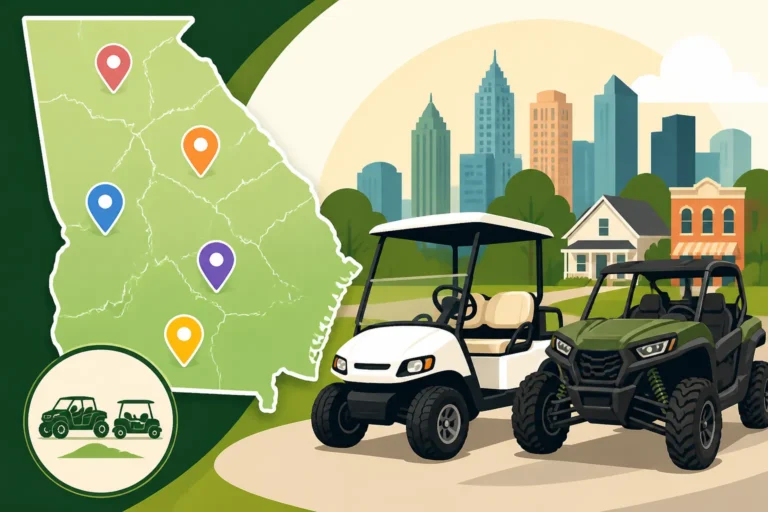
Georgia law has specific provisions for Personal Transportation Vehicles (PTVs), which include most golf carts. These vehicles are often allowed on designated local streets or paths within certain jurisdictions, but their age requirements are typically much more flexible than for MPOHVs. For instance, many local ordinances allow individuals as young as 12 or 15 to operate PTVs on specified paths or streets, often with certain restrictions like needing to be accompanied by a licensed adult or only during daylight hours. This is a far cry from the strict 16+ with a full license rule for MPOHVs. [Georgia Golf Cart Laws and PTV Ordinances] lays out the differences.
The reasoning behind this difference is often tied to the perceived capabilities and speed of the vehicle, as well as the specific types of roads or paths they are allowed on. Golf carts, by their nature, are generally slower, smaller, and less powerful than most MPOHVs. They are also usually restricted to very specific low-speed streets or dedicated cart paths, which are designed for different types of traffic and have different safety considerations than broader county roads. This means that a local municipality might feel comfortable allowing a 15-year-old with a learner's permit, or even a younger child under adult supervision, to drive a golf cart on a path, while never permitting them to operate a more robust MPOHV on a shared county road.
It's vital for MPOHV owners not to confuse these two sets of rules. Just because a 14-year-old can legally drive a golf cart on a path in Peachtree City (with certain conditions) does not mean they can operate your Polaris Ranger on a county road. The vehicle type, its capabilities, and the specific legal classification all contribute to very different age and licensing requirements. Always check the local ordinances where you plan to ride, as PTV rules can vary significantly from one city or county to another.
Peachtree City's Unique Approach
Peachtree City in Georgia is famous for its extensive network of golf cart paths, spanning over 100 miles. It's almost a way of life there, and they have very specific rules regarding who can drive a golf cart on these paths. Generally, anyone 15 years old with a learner's permit, or 16 and older with a valid driver's license, can operate a golf cart in Peachtree City. Children between the ages of 12 and 14 are often allowed to operate a golf cart on the paths if accompanied by a licensed driver 18 years or older, who is seated beside them. Children under 12 are typically not allowed to drive a golf cart. [Peachtree City Cart Registration Fees in Georgia] might even be a concern for non-residents.
This tiered age structure for golf cart operation in Peachtree City illustrates how local municipalities can enact ordinances that differ significantly from state-level MPOHV rules. These local rules are tailored to the specific environment of cart paths, which are segregated from high-speed vehicular traffic for the most part, creating a safer, lower-speed environment. This allows for more flexibility in operator age, recognizing that the risks involved are different from those on a standard public road.
However, and this cannot be stressed enough, these Peachtree City rules are for golf carts on golf cart paths within Peachtree City. They have absolutely no bearing on the minimum age for operating an MPOHV on a county road anywhere else in Georgia. You cannot take the rules from Peachtree City's golf cart paths and apply them to your side-by-side on a county road in rural Habersham County. It's a completely different legal framework for a different type of vehicle and different infrastructure. Understanding this distinction is crucial to avoiding confusion and potential legal issues.
Why the Distinction Matters
The distinction between MPOHVs and PTVs (golf carts) matters immensely because it determines everything from registration requirements to permissible roadways and, most critically for this discussion, the minimum age of operators. MPOHVs, under Georgia law, are defined by specific characteristics that make them more robust and capable than a typical golf cart—things like a steering wheel (not handlebars), seat belts, and typically a higher top speed and payload capacity. These features contribute to their classification as a vehicle that needs a licensed driver when operating on public roads.
Ignoring this distinction can lead to significant legal repercussions. If you allow an underage or unlicensed driver to operate your MPOHV on a county road, citing golf cart rules as your justification, you will likely find yourself in trouble. Law enforcement officers are trained to understand these differences and will enforce the applicable laws based on the specific type of vehicle. You could face fines, have your machine impounded, or even be held liable in the event of an accident if the operator was not legally permitted to drive. This is why brands like SuperATV, which offer robust aftermarket parts for UTVs, often emphasize compliance with all local and state regulations for safety and legality.
In essence, Georgia has created specific legal categories for different types of recreational and utility vehicles that sometimes touch public roads. These categories have unique requirements. Your MPOHV falls under one set of rules (licensed driver, 16+ for road use), while a golf cart falls under another, generally more lenient set for designated local paths or streets. Understanding which category your machine fits into and what rules apply to that category is the first step toward responsible and legal operation.
Helmet Laws and Under-18 Riders on Georgia Roads
Beyond just who can drive, there's another crucial safety and legal consideration for younger riders: helmets. Georgia has a clear helmet law that applies specifically to individuals under the age of 18 when operating or riding an ATV or UTV, even on private land. When you bring these machines onto public roads, those rules become even more stringent and visible to law enforcement.
The Mandate for Minors on Public Roads
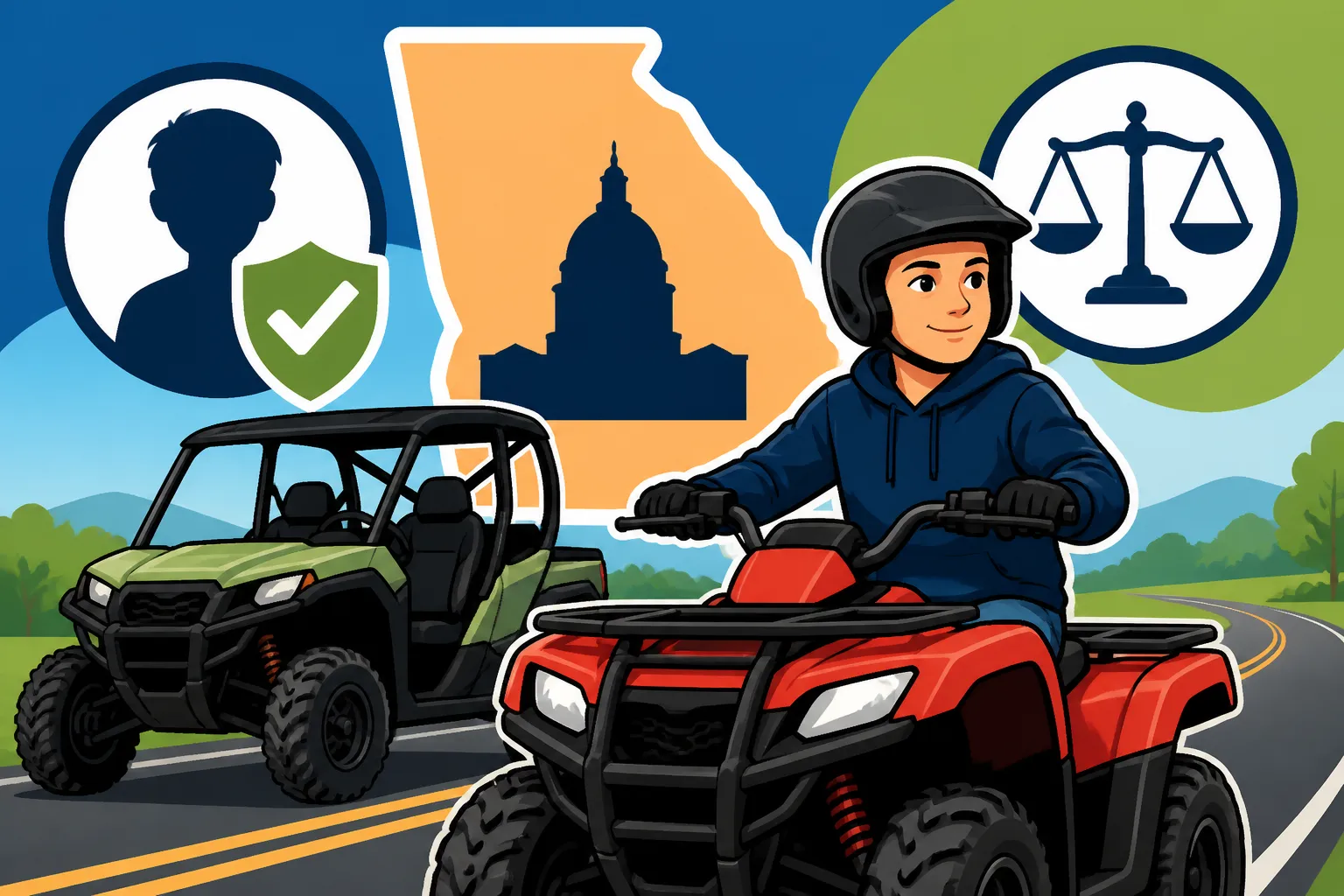
Georgia law mandates that any person under 18 years of age operating or riding as a passenger on an all-terrain vehicle (ATV) or utility terrain vehicle (UTV) must wear a protective helmet. This rule applies universally, whether the machine is on private land or, if legally allowed, on a public road. However, when an MPOHV is on a county road, this rule takes on added significance. Public roads are where law enforcement has direct jurisdiction and visibility, making helmet compliance a critical check point for any under-18 operator or passenger. This is an important part of [Georgia ATV Helmet Law for Riders Under 18].
For an MPOHV registered for county road use, if a 16- or 17-year-old is the licensed driver, they are legally required to wear a helmet. The same goes for any passengers under 18. This isn't just about personal safety; it's a legal obligation. The helmet must be properly fitted and fastened. It’s not enough to just have it in the machine; it must be on the head and secured. This simple piece of gear can dramatically reduce the risk of serious head injuries in the event of a rollover or collision, which is why the state takes it so seriously, especially for minors.
Ignoring this helmet mandate on a public road, even if the driver is licensed and otherwise legal, can lead to a citation for the operator and potentially for the parents or guardians of the minor. It underscores the state's dual focus on operator competence (via licensing) and fundamental safety equipment (via helmets) for vulnerable age groups. Equipping your younger riders with the right safety gear, like helmets and eye protection, is just as important as ensuring they meet the age and licensing requirements.
Private Land vs. Public Road Helmet Rules
The interesting thing about Georgia's helmet law for minors on ATVs and UTVs is that it applies whether you're on your own sprawling property or, if permitted, on a county road. So, in theory, the rule doesn't change based on the type of land. However, the enforcement and the visibility of that enforcement change dramatically when you move from private land to public roads. On private property, enforcement typically only occurs if there's an incident reported, or if law enforcement has reason to be on the property. On a public road, law enforcement is actively patrolling and can observe violations in real-time.
This means that while some might take a more relaxed approach to helmet use on their own private land (though not advised, given the risks), that leniency completely disappears when you venture onto a county road. Any deputy or state patrol officer who observes a minor operating or riding in an MPOHV on a public road without a helmet is well within their rights to stop the vehicle and issue a citation. The visibility of public roads makes non-compliance far more risky from a legal standpoint. This is particularly relevant when thinking about [Georgia Under-18 Helmet Rule on Private Land].
Furthermore, the public nature of county roads often means higher speeds and interactions with other vehicles, which can amplify the consequences of an accident. While a helmet is crucial for any riding scenario, its importance is arguably magnified when operating in a shared public space where the actions of others are beyond your control. Thus, while the rule itself is consistent, the stakes and likelihood of enforcement are significantly higher on public roads than on private land.
Penalties for Non-Compliance
Operating an MPOHV on a Georgia county road with an underage, unlicensed driver, or with minors not wearing helmets, can lead to serious penalties. For the operator, especially an unlicensed one, this could range from significant fines to a court appearance, and potentially even charges for operating a vehicle without a license, which can have long-term impacts on their ability to obtain a license in the future. For the owner of the machine, or the parent/guardian who allowed the operation, there could be charges of negligent entrustment or contributing to the delinquency of a minor. This is why understanding [Georgia's $500 Helmet Violation Penalty] is so important.
The penalties for helmet non-compliance for minors can include a fine, and it's not a small one. More importantly, in the event of an accident, if a minor was not wearing a helmet as required, the liability implications can be catastrophic. Insurance companies may deny claims, and personal injury lawsuits could be significantly complicated by the violation of a state safety law. This financial and legal burden far outweighs the perceived inconvenience of wearing a helmet or waiting until a child is old enough to legally drive.
Ultimately, adhering to these age and helmet laws isn't just about avoiding a ticket; it's about safeguarding lives and protecting yourself from immense legal and financial risk. The rules are designed to promote safety, and while they might seem restrictive at times, they are in place for very good reasons. Responsible MPOHV ownership on public roads in Georgia means understanding and strictly following every one of these regulations.
Broader Road Rules and What Else You Need to Know
Understanding the minimum age for MPOHV operators on Georgia county roads is a huge first step, but it's part of a larger tapestry of regulations you need to be aware of. The age requirement doesn't exist in a vacuum; it's intertwined with other rules about vehicle registration, insurance, and where you can actually ride.
Insurance and Registration Requirements
For your MPOHV to even be considered for county road access in Georgia, it must first be properly registered with the state, which typically happens at your local county tag office. This registration is what grants the limited privilege of county road use. Along with registration comes the mandatory requirement for liability insurance. Just like a car, if your MPOHV is going to operate on a public road, you must carry the state-mandated minimum liability coverage. Without current registration and proof of insurance, even a fully licensed adult operating an MPOHV is breaking the law on a county road. This becomes particularly important when you consider [Liability Coverage a Deputy Will Ask About].
The state's reasoning here is straightforward: if you're involved in an accident on a public road, there needs to be a mechanism to cover damages and injuries to others. Liability insurance provides that crucial financial protection. A deputy checking your registration and insurance paperwork is a common occurrence on county roads, and non-compliance can lead to citations, fines, and even the impoundment of your machine. It’s a foundational requirement that supports the entire system of road access for MPOHVs.
This also means you need to budget for these annual costs. Beyond the initial purchase and any accessories you might add from a brand like SuperATV, there's the yearly registration fee and the ongoing insurance premiums. Neglecting these can turn a fun ride into a legal nightmare. Think of it as the cost of doing business if you want to enjoy the privilege of limited road access for your UTV.
Where You Can Actually Ride
Even with a licensed driver, proper registration, and insurance, MPOHVs in Georgia are only permitted on county roads. They are strictly prohibited from state highways, interstates, and municipal streets (unless a specific local ordinance for PTVs applies, which, as we discussed, is usually for golf carts, not MPOHVs). This limitation is crucial to understand. You cannot simply take your registered side-by-side onto any public paved surface. Stick to those county roads and know [What a County Road System Includes].
County roads are generally lower-speed roads, often unpaved or lightly paved, and they are typically maintained by the county government. They are distinct from state routes (like GA-15 or US-129) which are higher speed, often multi-lane, and maintained by the Georgia Department of Transportation. Crossing a state highway is generally permitted only at an intersection, and sometimes only at a designated crossing point, but continuous travel along a state highway is a definite no-go. Ignoring these restrictions is not just unsafe; it's a surefire way to get pulled over and ticketed.
Many MPOHV owners utilize county roads to connect private properties, reach trailheads, or access hunting leases. This is precisely the kind of use the registration program aims to facilitate. However, it requires a clear understanding of your local road network and an honest assessment of whether your planned route will stay entirely within the bounds of permissible county roads. Using GPS maps that differentiate between state routes and county roads is an excellent way to ensure you're staying legal.
The Sunset Clause and Future Changes
It's important to remember that Georgia's law allowing MPOHV access to county roads has a "sunset clause." This means the law is currently set to expire on July 1, 2027. Unless the Georgia General Assembly takes action to renew, extend, or modify this law before that date, the privilege of operating MPOHVs on county roads will cease. This is a critical piece of information for all MPOHV owners who rely on this road access, and it's detailed in articles like [The July 1, 2027 Expiration Date].
This sunset clause adds an element of uncertainty to the long-term planning for MPOHV use on public roads. While the current rules regarding minimum age, licensing, and other requirements are firm, the entire framework could change in a few years. This makes it even more important for owners and operators to stay informed about legislative developments in Georgia regarding off-highway vehicles. Membership in local riding clubs or staying connected with advocacy groups can be valuable for keeping up-to-date.
For now, operate under the current rules, knowing that they could be subject to review and change. This potential future change underscores why it's so important to adhere to the existing regulations strictly. Demonstrating responsible operation and compliance now could be influential in future legislative decisions regarding MPOHV road access.
Summary of Age Requirements for Road Use in Georgia
To help clarify the differences we've discussed, here's a quick reference table outlining the general age requirements for operating MPOHVs versus Golf Carts/PTVs on public roads or designated paths in Georgia. Remember, local ordinances can always add more specific rules, especially for PTVs.
| Feature | Multi-purpose Off-Highway Vehicles (MPOHVs) | Golf Carts / Personal Transportation Vehicles (PTVs) |
|---|---|---|
| Minimum Age | 16 years old | Varies by local ordinance (e.g., 12, 15, or 16) |
| License Required | Yes, full Class C Driver's License | Varies by local ordinance (often none, or learner's permit with adult) |
| Learner's Permit | No, not for MPOHV road operation | Varies by local ordinance (sometimes permitted with adult) |
| Road Access | Limited to County Roads only | Limited to designated local streets or cart paths |
| Helmet Under 18 | Yes, mandatory | Varies by local ordinance; generally not required by state for PTVs |
| Registration | Yes, mandatory for road use | Varies by local ordinance (some cities require registration) |
| Insurance | Yes, mandatory for road use | Varies by local ordinance (often recommended, sometimes required) |
Getting your head around Georgia's rules for ATVs and UTVs on public roads can feel like a maze, especially when you're trying to figure out who can drive and how old they need to be. But by breaking it down, it's clear that for MPOHVs on county roads, the rules are quite strict: you need to be at least 16 and hold a full driver's license. There's no shortcut for learner's permits or younger drivers, and specific safety gear like helmets for minors is non-negotiable. Golf carts and PTVs have different, often more flexible rules, but those don't apply to your side-by-side. Staying informed and adhering to these regulations isn't just about avoiding a ticket; it's about ensuring everyone's safety and enjoying the privilege of limited road access responsibly.
Disclaimer
This article is for general informational purposes only and does not constitute professional advice. Laws, prices and regulations vary by location and change over time. Consult a qualified professional for guidance on your specific situation.