Designated ATV Trails on Forest Land
Finding a legal place to ride an ATV on Georgia forest land is not as simple as spotting an open dirt road. Forest Service rules distinguish designated OHV trails from forest roads, and each trail system can have its own vehicle limits and closures. The safest plan is to check the current map, confirm your machine fits the trail, and sort out permits before you leave.
Where riding is allowed on national forest land
On the Chattahoochee-Oconee National Forest, motorized off-road riding is restricted to trails designated for that use. The Forest Service says unlicensed off-highway vehicles must stay on designated OHV trails, and using or possessing a motor vehicle in a way that conflicts with the designated map is prohibited.
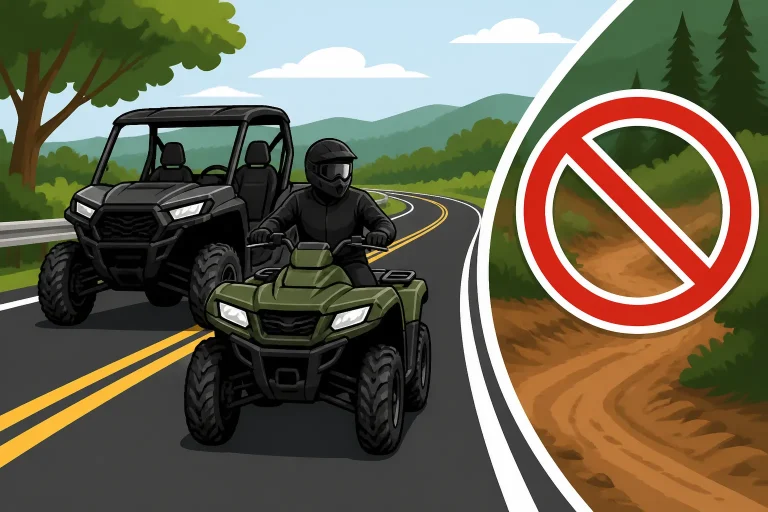
That distinction matters because a forest road can look like a trail without being one. Forest roads are open to registered vehicles and mopeds under state law, but the Forest Service prohibits ATVs and multipurpose off-highway vehicles on Forest Service roads. A state registration, license plate, or ability to drive on some public roads does not automatically make a machine eligible for a forest road or OHV trail. Before riding, check Georgia ATV Registration Requirements and Georgia MPOHV Road Rules: County Roads Only to understand what state registration and road access do—and do not—allow.
Motor Vehicle Use Maps, often called MVUMs, identify roads, trails, and areas designated for motor vehicle use. Use the map for the specific ranger district and follow its designations rather than relying on a general recreation map, an old screenshot, or a route shared by another rider. The US Forest Service explains that use or possession inconsistent with designated maps is prohibited. For map resources, see Georgia ATV Trail Map Downloads.
A trail map is not permission to ride everywhere shown as a route. It may distinguish between routes open to particular vehicle types, and the trailhead may have additional restrictions. Forest Service rules also restrict trail use to vehicles less than 50 inches wide unless a trail is specifically designated for full-size vehicles. Individual trail systems may set a narrower maximum or allow only certain vehicle types, so the most restrictive applicable direction is the one to follow.
Another important limit is that many machines commonly called four-wheelers are not road vehicles. Georgia government describes ATVs as off-road machines intended for off-road use, private dirt roads, and designated trails—not public dirt roads or paved roads. An ATV plate or a nearby county road does not turn an ATV route into an approved forest trail.
Do not assume that a registered multipurpose off-highway vehicle (MPOHV) can use forest roads just because it may qualify for certain state road use. The Forest Service says MPOHVs are prohibited on Forest Service roads. For registration questions, Georgia MPOHV Registration Is Voluntary explains the separate state process; forest access still depends on Forest Service designations and rules.
Choose a trail that fits your machine
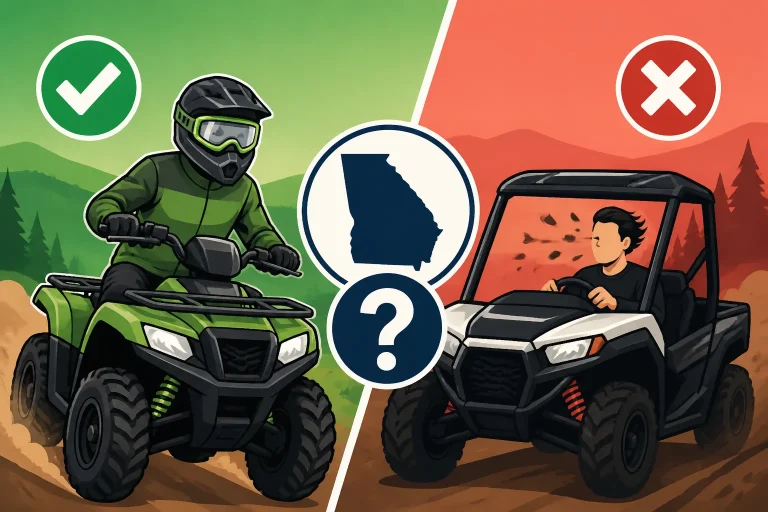
Trail access is machine-specific. Width is an obvious concern, but the permitted vehicle category matters too: a trail open to ATVs may not allow a side-by-side, four-wheel-drive truck, or other full-size vehicle. Check the current map and trail information before loading your machine. Georgia Trail Widths and What Fits covers why measuring before a trip can prevent a wasted drive.
| Trail system | What to check before riding |
|---|---|
| Davenport Mountain | The Forest Service describes Davenport Mountain as a 5.9-mile trail suitable for motorcycles and ATVs. Check the current trail information for any vehicle-specific restrictions before going. |
| Houston Valley | The USDA Forest Service describes a 25-mile system with a 50-inch width restriction; pickups and four-wheel-drive vehicles are not allowed on the OHV trails. |
| Whissenhunt | The Forest Service describes 11.2 miles of one-way trails suitable for motorcycles and ATVs less than 50 inches wide. Riders must stay on signed trails. |
| Beasley Knob | The Forest Service describes approximately 13.4 miles open to four-wheel-drive vehicles, motorcycles, and ATVs. Check current conditions and posted restrictions before riding. |
| Town Creek | The USDA Forest Service describes 15 miles in two loops: Loop A is for two-wheeled vehicles, while Loop B is designated for ATVs and four-wheelers. Jeeps, side-by-sides, and other UTV-type vehicles are not allowed. |
| Oakey Mountain | The Forest Service says the trails are managed for ATVs and dirt bikes with less than 48 inches of axle width. Jeeps, Hummers, and other four-wheel-drive vehicles are prohibited. |
The table is a starting point, not a substitute for the latest official map or trail alert. A trail system can contain routes with different rules, and conditions can change access. For example, the Town Creek information distinguishes its loops by vehicle type; an ATV rider should not treat Loop A as an ATV route simply because the larger system includes an ATV loop. At Roberts Bike Camp, part of the Town Creek system, the USDA Forest Service also identifies Loop A as restricted to two-wheeled vehicles.
The same caution applies to width. A machine that fits one trail may be too wide for another, and the quoted maximum may refer to vehicle width or axle width depending on the trail system’s instructions. Check the exact wording for the trail you intend to ride. Do not rely only on a model’s advertised dimensions; accessories, tires, and other changes may affect the machine’s actual width.
If you ride a side-by-side, confirm that the particular route expressly allows it. The general rule allowing full-size vehicles on trails specifically designated for them is not blanket permission to take a UTV onto any forest OHV trail. For a broader trail-by-trail comparison, see Georgia ATV Trails That Allow Side-by-Sides.
Permits, operators, and trail conditions
An OHV permit is separate from state vehicle registration. The Forest Service issues OHV permits per person rather than per vehicle, and each operator needs a permit to be in compliance. In practical terms, one permit should not be treated as covering everyone who takes a turn driving the same machine. The distinction is explained further in Georgia’s Per-Operator Permit, Not Per Vehicle.
The Forest Service says annual OHV permits are valid at Houston Valley, Whissenhunt, Beasley Knob, Town Creek, Oakey Mountain, and Davenport OHV Trails. The Forest Service lists a one-day pass at $5 per operator per day and an annual pass at $50 per operator per year, as of November 2026. Check the Forest Service’s current information for purchase instructions, accepted pass types, and any trail-specific directions before heading out.
A permit does not override a closure, authorize riding outside a designated route, or make an otherwise ineligible machine suitable for a trail. Check for alerts before leaving and again if conditions are changing. The Forest Service closes OHV trails during wet conditions to prevent damage and erosion, including erosion into streams. Some trail areas also have seasonal closures for resource protection. See Georgia Trails That Close After Rain for more on why a trail can be unavailable even when the route is normally open.
Trail operating hours and rules also vary by site. Several systems are day-use areas with operation from sunrise to sunset, while a particular trailhead may have separate seasonal or hunting-related restrictions. Do not assume the hours or open season at one forest trail apply to another. Read the current site information and signs when you arrive.
The Forest Service allows motor vehicle operation on designated OHV trails only when the operator is of legal age to obtain a state driver’s license or is accompanied by a legally licensed driver. Georgia government separately describes age and license requirements for ATVs and MPOHVs. Check the specific rule that applies to your machine and situation; do not treat a passenger’s license or a permit as a substitute for an operator meeting the applicable requirement.
Noise limits are another potential reason a machine may not comply. The Forest Service specifies limits measured at 50 feet, with the permitted level depending on the machine’s speed. If your exhaust has been modified, check the current Forest Service requirements and make sure the machine meets them before visiting. A trail permit does not waive equipment requirements.
A practical pre-ride check
A few checks before loading can prevent an avoidable turn-around at the trailhead.
- Identify the exact trail system and route. Use the current Motor Vehicle Use Map for the relevant ranger district, not a general road map. Confirm that the route is designated for motorized OHV use and for your type of machine.
- Confirm the machine fits. Check the system’s width limit and vehicle categories. Do not assume that a trail open to ATVs also allows UTVs, Jeeps, or other four-wheel-drive vehicles.
- Arrange a permit for each operator. The Forest Service requires each OHV operator to have a permit. If more than one person will drive, check that each operator is covered.
- Check weather and closure alerts. Wet-weather closures protect trail surfaces and nearby resources. A route that was open recently may be closed after rain or other damaging conditions.
- Read the trailhead signs. Confirm route direction, permitted vehicle type, hours, and any additional restrictions before unloading.
- Stay on the signed route. Cross-country riding and riding on a main road instead of the designated trail are not substitutes for a closed or unsuitable route. The Forest Service warns that use inconsistent with designated maps is prohibited.
If you cannot confirm that a route allows your machine, do not ride it based on appearance alone. Contact the ranger district responsible for the area or choose a trail with clear, current vehicle information. The Chattahoochee-Oconee National Forest spans multiple districts, and local trail details can differ. Georgia’s Six National Forest OHV Systems provides a useful overview when you are deciding where to start.
The key distinction is simple: forest roads and designated OHV trails are not interchangeable. Stay on a route designated for your machine, meet the permit and operator requirements, and check closures before travelling. That approach helps protect the trail and reduces the risk of a citation or a trip that ends at the gate.
Sources
- Forest Service — Chattahoochee-Oconee National Forest | Frequently Asked Questions about Motorized Use on the National Forest | Forest Service (checked November 3, 2026)
- Georgia government — download (checked November 3, 2026)
- Forest Service — Chattahoochee-Oconee National Forest | Off-Highway Vehicles (OHV) | Forest Service (checked November 3, 2026)
- USDA Forest Service — Chattahoochee-Oconee National Forest | Roberts Bike Camp OHV Trails | Forest Service (checked November 3, 2026)
- Forest Service — Chattahoochee-Oconee National Forest | Beasley Knob OHV Trail System | Forest Service (checked November 3, 2026)
- USDA Forest Service — Chattahoochee-Oconee National Forest | Davenport Mountain OHV Trails | Forest Service (checked November 3, 2026)
- USDA Forest Service — Chattahoochee-Oconee National Forest | Houston Valley OHV Trails | Forest Service (checked November 3, 2026)
- USDA Forest Service — Chattahoochee-Oconee National Forest | Locust Stake OHV Trail System | Forest Service (checked November 3, 2026)
- Forest Service — Chattahoochee-Oconee National Forest | Oakey Mountain OHV Trails | Forest Service (checked November 3, 2026)
- USDA Forest Service — Chattahoochee-Oconee National Forest | Rock Creek ORV Trail | Forest Service (checked November 3, 2026)
- USDA Forest Service — Chattahoochee-Oconee National Forest | Tatum Lead ORV Trail | Forest Service (checked November 3, 2026)
- USDA Forest Service — Chattahoochee-Oconee National Forest | Town Creek OHV Trails | Forest Service (checked November 3, 2026)
- USDA Forest Service — Chattahoochee-Oconee National Forest | Whissenhunt OHV Trails | Forest Service (checked November 3, 2026)
- USDA Forest Service — Chattahoochee-Oconee National Forest | Windy Gap, Milma Creek, and Tibbs OHV Trails | Forest Service (checked November 3, 2026)
Disclaimer
This article is for general informational purposes only and does not constitute professional advice. Laws, prices and regulations vary by location and change over time. Consult a qualified professional for guidance on your specific situation.