Georgia Trail Widths and What Fits
Choosing an ATV or UTV for Georgia trails can be frustrating: a machine that fits your garage, trailer, and budget may still be too wide for the route you want to ride. This guide explains how width limits work, how to measure your machine, and how to match it to Georgia’s public and private riding areas before you make the drive.
Why width matters on Georgia trails
A trail’s width limit is not the same as its visible width
When a trail system sets a maximum vehicle width, that limit is an access rule—not a promise that every section of trail will be as wide as your machine. A route may open onto a broad forest road, then narrow between trees, rocks, or deeply cut banks. A vehicle that meets the posted limit can still require careful maneuvering.
This distinction matters especially in North Georgia, where rocky terrain, roots, and tight turns can make a trail feel narrower than it looks on a map. In the southern part of the state, sandy or muddy ground can create a different challenge: the machine may fit between the trees but need extra room to turn or recover from a rut.
Treat an access limit and the physical trail as two separate checks. First, confirm that your machine is allowed. Then consider whether its width, turning radius, tires, and accessories make the actual route manageable for your riding experience.
Width limits can determine which machines are allowed
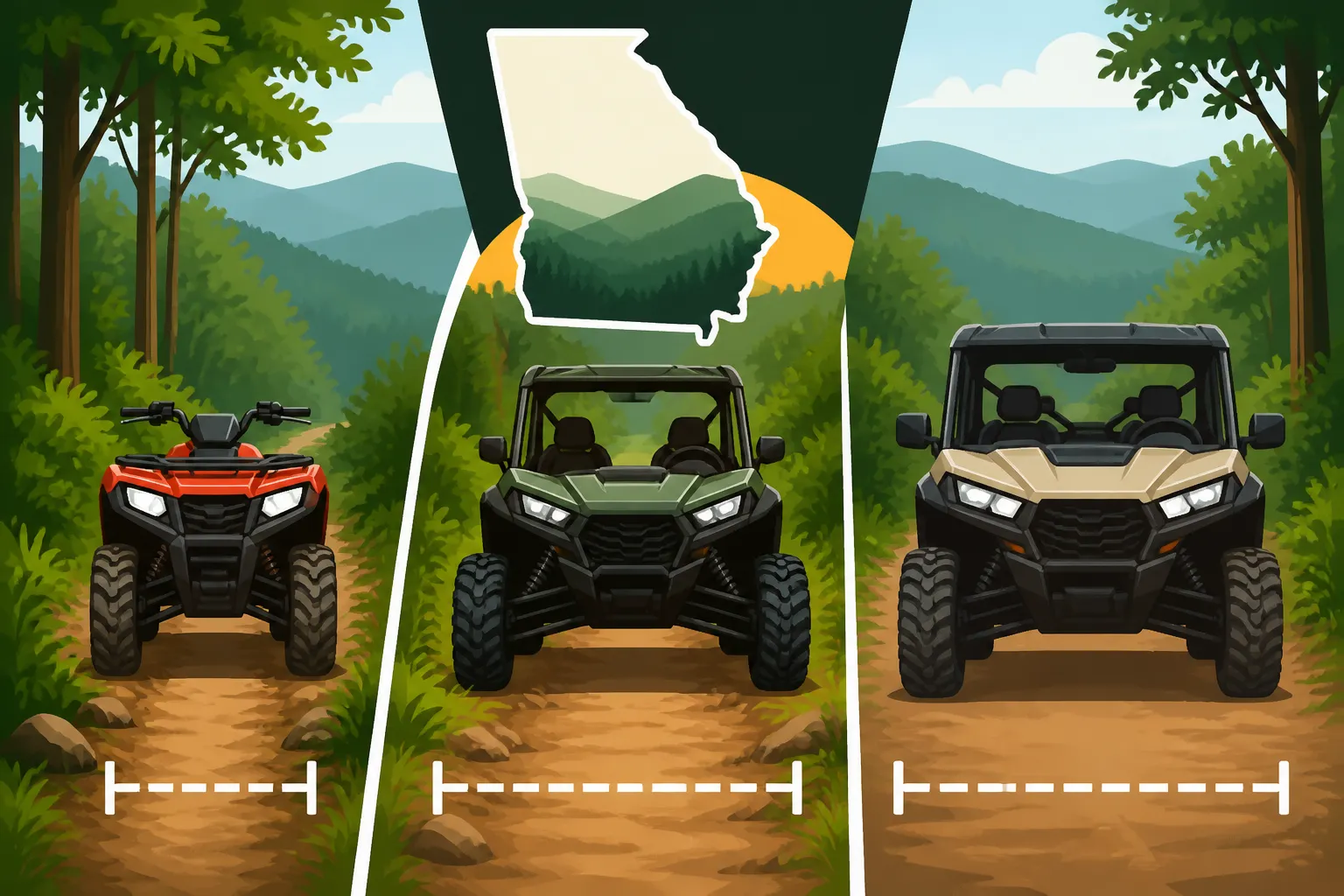
Many Georgia Forest Service OHV routes are intended for motorcycles and ATVs rather than full-size side-by-sides. Some trail areas have specific width restrictions; others prohibit side-by-sides or do not provide an appropriate route for them. A machine’s four-wheel-drive capability does not change its width classification.
Houston Valley is a useful example to research because its routes have a 50-inch width restriction. That kind of limit can rule out many utility side-by-sides, even if they look compact beside larger recreational vehicles. Before you plan a trip, read the system’s current rules rather than assuming that a posted ATV trail is open to every four-wheeled machine.
For a broader overview, start with Georgia's Six National Forest OHV Systems and then check the page for the specific system you plan to visit. The label “OHV area” describes a general type of recreation, not a blanket invitation for every ATV and UTV.
Georgia has different kinds of riding areas
Georgia’s public OHV trail systems, private off-road parks, county roads, and private land are not interchangeable. A narrow forest trail may be unsuitable or closed to side-by-sides, while a private park may offer wider routes designed for them. Road access rules are a separate subject again; a machine that fits a trail is not automatically allowed on a public road.
This is why a search for “Georgia ATV trails” can lead to confusing results. A route may be listed as an off-road destination, but the listing might refer to a motorcycle trail, an ATV trail, or a private park with several types of routes. Always identify the type of riding area before using its width information to plan a trip.
The guide Georgia ATV Trails: Where You Can Legally Ride can help separate the main types of places to ride. Once you know whether a destination is a public forest system or private park, check its own machine restrictions and trail descriptions.
How to measure your ATV or UTV correctly
Measure the widest point, not just the body panels
A manufacturer’s listed width is a useful starting point, but it may not represent the machine exactly as you ride it. Measure the widest point from the outer edge of one side to the outer edge of the other. Depending on the machine and its setup, the tires, wheels, fenders, or other fixed components may define that point.
Park on level ground, keep the steering straight, and use a tape measure across the widest point. If you have a helper, one person can hold each end of the tape at the outside edges while the other checks the measurement. Write down the result and keep it with your vehicle paperwork or trip notes.
If the machine is close to a stated limit, do not round down or rely on a catalog number. A small measurement difference can determine whether the vehicle meets a system’s restriction. The practical guide Measuring Your Machine Before You Tow is a useful companion when you are checking dimensions for both trail access and trailer fit.
Include changes that affect the machine’s overall width
Aftermarket wheels and tires can make a machine wider than its stock specification. Wheel spacers, offset wheels, wider tires, fender extensions, and some bolt-on accessories may also affect the measurement. A machine bought used may not have the same setup it had when it left the factory.
Mirrors and other projecting accessories can complicate a measurement. A posted rule or park operator may define how width is assessed, so ask directly if the measurement is near the limit or if your setup has unusual projections. Do not assume that a removable accessory is irrelevant; the destination’s rule is what matters.
Keep two measurements if useful: the machine’s width as currently equipped, and the manufacturer’s published width for reference. If you remove an accessory before riding, recheck what remains and confirm that the area accepts that interpretation. A careful measurement at home is much less aggravating than being turned away at a trailhead.
Account for passengers, cargo, and trail behavior
Passengers and cargo do not usually change the vehicle’s measured width, but they affect how confidently you can place the machine on a narrow route. A loaded side-by-side may have a different feel on a side slope, and a passenger can make a quick correction harder. Keep cargo secured and avoid stacking items where they obstruct visibility or interfere with safe handling.
Width also affects turning. A long, wide UTV may technically fit through a gap but need more room to swing around a switchback. A short ATV can often pivot more easily, although a wide stance may still limit access on a narrow trail. Think about the whole route, not only the width of a trailhead gate.
If you are comparing machines, measure the vehicle you actually intend to bring, including its tires and accessories. A claimed “compact” design is not enough. Keep your notes beside the trailer’s usable width and loading setup so you can check the entire trip before leaving.
Matching vehicle width to a Georgia riding area
Narrow public trails are often a better match for ATVs
Many Forest Service OHV routes in Georgia are built around motorcycles and ATVs, not broad utility vehicles. On those routes, a narrower ATV may be a sensible match, provided that the specific trail allows that kind of machine and your vehicle complies with any posted restrictions.
The six National Forest OHV systems in Georgia do not all offer the same experience. Trail width, permitted vehicle types, terrain, operating hours, seasonal closures, and conditions can differ. Do not use one system’s rules as a shortcut for another. A trail that works for your ATV near one town may have a different restriction at another trailhead.
For example, Houston Valley near Dalton is known for its width restriction, while the routes at other systems require their own checks. Look up the particular trail, then verify what is open and allowed before loading. Georgia's 50-Inch Width Cap at Houston Valley explains why riders should treat that limit as a vehicle-access rule rather than a rough estimate of trail size.
Side-by-sides need route-specific confirmation
A side-by-side can be a great choice for passengers, cargo, and longer outings, but it is not a universal Georgia trail vehicle. Some trail systems do not allow side-by-sides, while other places may offer routes suitable for them. Even where a UTV is allowed, its width can restrict which individual trails it can use.
That distinction is especially important if you are traveling with a group that owns different machines. An ATV rider may be able to use a narrow loop that a side-by-side cannot enter. Planning a mixed group ride around the most restrictive vehicle can help avoid splitting up or discovering the mismatch at the gate.
Before booking a cabin, arranging a trailer, or promising the kids a full day on the trails, confirm the rules with the specific destination. Georgia ATV Trails That Allow Side-by-Sides and Georgia ATV Trails That Ban Side-by-Sides are helpful starting points, but always check current system or park information before setting off.
Private parks may offer different options
Private off-road parks can provide a wider range of routes than a narrow public trail system, but that does not mean every route is open to every vehicle. Parks may designate routes by machine type, width, skill level, or conditions. Their access rules can change depending on maintenance, weather, events, or operating policies.
When contacting a park, ask about your exact make, model, width, and tire setup. “It’s a UTV” may not give staff enough information to answer accurately. If the park has route ratings or a map, ask which trails are appropriate for your vehicle and experience level, and whether any sections have gates or width restrictions.
Also ask what the park means by a listed width limit. Is it based on the vehicle’s stated width, the widest point as equipped, or a measurement taken at check-in? Getting a clear answer in advance can spare you a long drive followed by a disappointing conversation at the entrance.
Georgia destinations and what to check
Public forest trail systems require a system-by-system check
Georgia’s Forest Service OHV systems include Houston Valley, Beasley Knob, Whissenhunt, Town Creek, Oakey Mountain, and Davenport Mountain. They offer different settings and trail experiences, so machine fit at one does not establish access at another. Check the route details, vehicle restrictions, operating conditions, and closures for the specific location you want.
North Georgia terrain can add practical challenges even when your machine is permitted. Rocky surfaces and tight turns can make it harder to pass or turn around. A route that seems manageable on a map may feel more demanding when rain has loosened soil or water has moved rocks and debris.
Use a map as a planning aid, not as a substitute for rules at the trailhead. Georgia Trail Conditions Before You Drive is a useful topic to review before heading toward a system, especially if you have a long tow or a narrow window for riding. Check the same day when possible, because a route that was open during your last visit may not be open now.
Houston Valley illustrates why width details matter
Houston Valley, in the Chattahoochee National Forest area near Dalton, is a well-known example of a public riding destination where machine width is a critical part of trip planning. Its 50-inch restriction is not simply advice to bring a nimble machine; it limits which vehicles qualify for the routes covered by the rule.
If your ATV is close to 50 inches, measure it as equipped and verify how the system applies its limit. A change in tire size, wheel offset, or other modifications could matter. Do not assume that a model’s name or trim level tells you whether your individual machine qualifies.
The same caution applies to every destination with a posted threshold. The safest approach is to confirm the restriction with official trail information and ask the managing office if your setup is borderline. If you discover your vehicle is too wide, choose a route or park that accepts its dimensions rather than trying to squeeze through a restriction.
Private parks and local riding areas vary
Private destinations around Georgia may offer trails for different types and sizes of machines, but their rules are not standardized across the state. A park may welcome a broad UTV on some routes while reserving other sections for narrower vehicles. It may also impose route rules based on skill, weather, or maintenance needs.
Before visiting, check the park’s published vehicle requirements, trail map, opening information, and any registration or waiver steps. If the website does not answer a width question, contact the operator with your machine’s measured width. If you are riding with children or passengers, confirm the park’s passenger rules as well.
People often plan around the destination name and forget to confirm the exact machine restriction. That can be an expensive mistake if you have paid for lodging or driven several hours. A quick check of the current route options and policies is part of choosing the right riding area, not an unnecessary extra step.
Choosing the right machine for your riding plans
Pick for the trails you will actually ride
A larger UTV can be comfortable for family outings, hunting tasks, and hauling supplies, but that extra width may close off narrow public trails. A smaller ATV may reach more narrow routes, but it offers less room for passengers and cargo. Neither type is automatically the better choice; the right one depends on where you expect to ride.
Consider how often you will use public forest trails compared with private parks or private land. If narrow public trails are your priority, a compact ATV may suit your plans better. If you mainly want a two- or four-seat vehicle and intend to use parks that accept it, a side-by-side may make more sense.
Be realistic about the places you can access from home. A machine that fits your ideal destination but cannot use the closest trail system may spend more time on a trailer than you expect. Compare the routes you will visit most often, the number of riders, and the transport setup before you settle on a width.
Balance width with comfort, capacity, and handling
A narrower machine can have advantages on tight trails, but width is only one part of the decision. Seating, cargo capacity, suspension, turning radius, ground clearance, and how the vehicle feels to the driver all matter. If you often ride with a passenger, consider whether a single-seat ATV is a realistic long-term fit.
For a family, a UTV’s seats and protective structure may feel more practical. But if the routes you want to ride prohibit side-by-sides, those benefits do not solve the access problem. The reverse is true too: a narrow ATV may fit the trail but may not carry the equipment or passengers your outings require.
Try to make the choice based on your actual riding pattern rather than a single dramatic feature. Write down your regular destinations and the types of outings you expect to take. Then compare those plans against real width limits and permitted vehicle classes, rather than assuming every machine will work everywhere.
Consider transport and storage dimensions too
Trail eligibility is only one measurement problem. Your ATV or UTV must also fit your trailer, garage, shed, and any loading ramps you use. A machine that clears a trail restriction may still be too wide for the trailer’s usable deck or difficult to secure around its tires.
Measure the trailer’s usable width between rails or fenders, not just its advertised overall width. Allow room for safe loading and tie-down access. If the machine is especially wide, check ramp alignment and the space needed to maneuver it into a garage or storage building.
Keep a simple record of the machine’s width, length, height, tire setup, and trailer capacity. This is useful when comparing a replacement vehicle or arranging a rental. A few measurements taken once can prevent repeated guesswork every time a trip comes up.
Planning a ride when width is uncertain
Check the route and machine rules before departure
Start with the exact destination, not a broad search for trails in a region. Identify the trail system or private park, then look for machine-type restrictions and width limits. If the information is unclear, contact the managing office or park directly and describe your vehicle precisely.
A practical pre-trip checklist can keep the details straight:
- Identify the exact trail system or park.
- Confirm that your type of vehicle is allowed.
- Measure the widest point of your machine as equipped.
- Compare the measurement with the destination’s stated limit.
- Check closures, conditions, and operating rules.
- Ask the operator about borderline measurements or unusual accessories.
- Confirm the trail map and permitted routes when you arrive.
Tools such as onX Offroad can help riders review mapped routes and organize trip planning, but a map should not be treated as permission to ride a route. Confirm restrictions and closures through the trail manager or park before relying on a route for access.
Plan for mixed groups and different machine sizes
If your group includes both ATVs and UTVs, choose a destination that accommodates every vehicle or divide the itinerary into suitable routes. A trail that is open to the ATV does not necessarily accept the side-by-side. This can become a real problem when the group has only one vehicle capable of carrying supplies or passengers.
Before the trip, share the actual measurements and vehicle details with the group. Ask each rider to check modifications, especially if a machine has aftermarket wheels or tires. Agree on what the group will do if a route is closed or one vehicle cannot enter.
It also helps to choose a meeting point with room to park and turn around. If one vehicle is denied access, the group may need a safe alternative rather than attempting to reverse through a narrow trail. Good planning keeps a width restriction from turning into a frustrating or risky situation.
Use maps as planning tools, not guarantees
Digital mapping can make it easier to understand where a trail system is located and how routes connect. onX Offroad may help you organize a ride and examine mapped information before leaving home, especially when you are comparing potential destinations in different parts of Georgia.
However, mapped lines do not always communicate a machine’s eligibility, a temporary closure, or how a narrow section feels in person. Treat map information as one part of your planning process. Confirm the official rules, ask about recent conditions, and follow signs at the trailhead.
If your machine is near a width limit, build in extra time to verify access before you tow. You may also want to identify a backup destination that suits the same vehicle. That way, uncertainty about one trail system does not automatically cancel the entire weekend.
Common width-planning mistakes to avoid
Relying only on the factory specification
A published specification can be helpful, but it may describe the vehicle in a stock configuration. If a previous owner changed the wheels, tires, or suspension, the machine’s real width may be different. Measuring the actual setup is the more dependable step when access depends on a specific cutoff.
Another common mistake is measuring only the seat, hood, or body panels. The widest point may be at the tires or wheels. Use a tape measure across the full machine, and take care to keep it level and straight rather than measuring at an angle.
If the measurement is close to the stated limit, ask for clarification instead of trying to interpret the rule in your favor. A gate attendant or ranger may apply the written requirement strictly. Confirming before departure is easier than negotiating after a long drive.
Assuming a trail marked for ATVs accepts UTVs
The words “ATV trail” can be used casually in conversation, but official trail designations and restrictions matter. A four-wheeled side-by-side is not automatically treated like a small ATV. Width limits, vehicle classifications, and local rules can all affect whether a particular machine is allowed.
This misunderstanding is especially common among new owners who have ridden only private land or a large off-road park. Public forest trails may be narrower and more restrictive. For more context, review Georgia ATV Trails That Allow Side-by-Sides and confirm details for each location instead of generalizing from a previous ride.
The reverse assumption can also cause confusion: a route suitable for one side-by-side may not be open to all UTVs. Different models have different widths, and a park may impose its own vehicle or route limits. Always check both the vehicle category and the measured dimension.
Treating a map or old trip report as current permission
A saved map, forum post, or memory from an earlier trip can become outdated. A route may close because of weather, maintenance, seasonal rules, or other management decisions. A trail’s conditions can also change after rain, even if its vehicle limits remain the same.
Use the map to orient yourself, then verify the current rules through the appropriate manager. onX Offroad can be useful for route planning, but it does not replace trailhead signs or official closure information. Keep a backup plan, particularly when traveling a long distance or towing a wide machine.
Finally, do not force access through a narrow gate or ride around a closure because the vehicle seems to fit. Restrictions protect riders, land, and trail infrastructure. If a machine is not permitted, choose a suitable alternative and make the next trip easier by checking the dimensions in advance.
Disclaimer
This article is for general informational purposes only and does not constitute professional advice. Laws, prices and regulations vary by location and change over time. Consult a qualified professional for guidance on your specific situation.