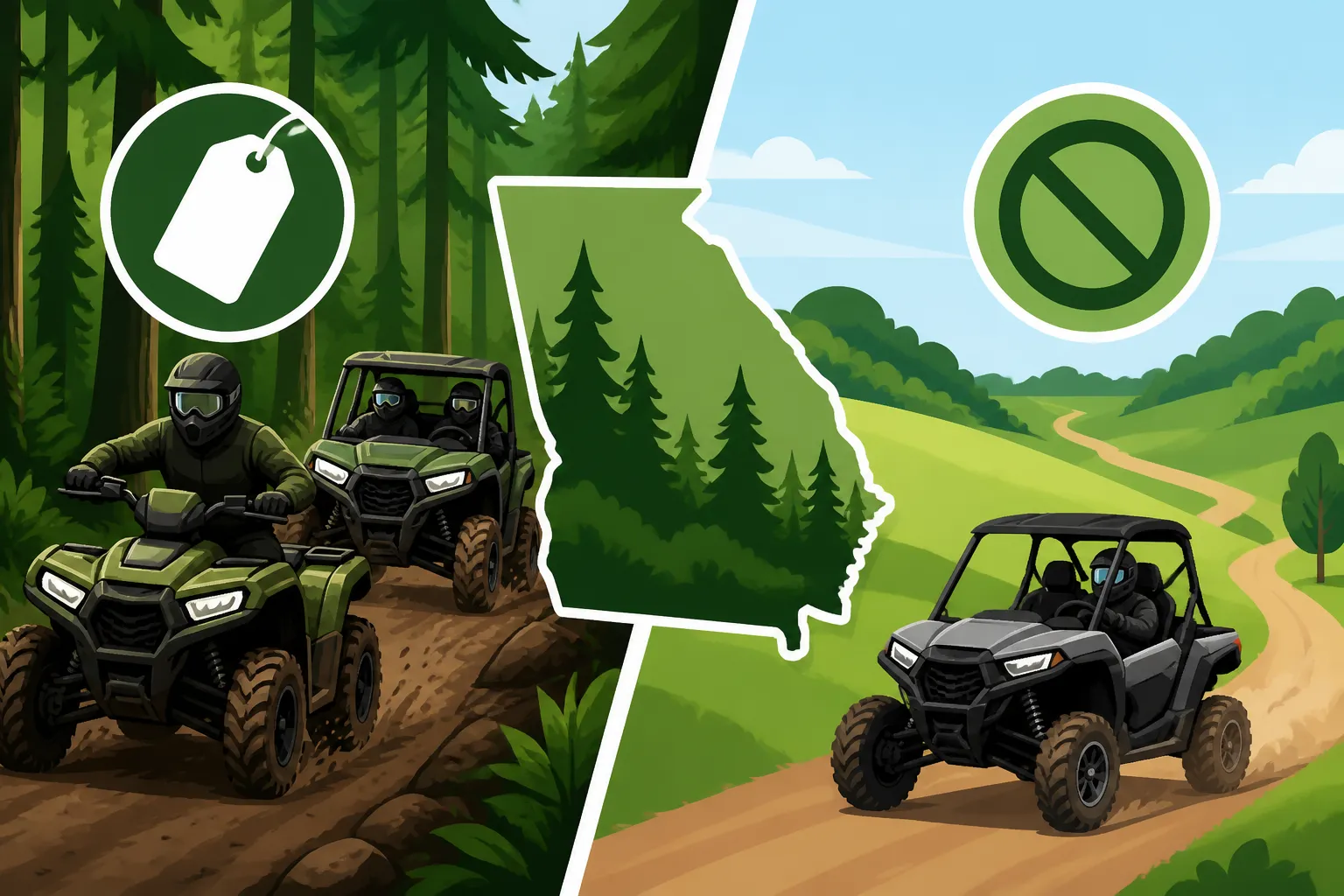
Tags Needed Only on Forest-Owned WMAs
A Georgia WMA visit can involve more than one kind of permit, and the word “tag” can mean different things. The key distinction is where the WMA is located: a vehicle tag requirement may apply on a WMA on national forest land, not automatically on every WMA. Here’s how to separate that requirement from trail permits, machine registration and hunting access rules.
What “tags needed only on forest-owned WMAs” means
A WMA is managed for wildlife and public recreation, but the land under it can have different owners. Some WMAs are on national forest land; others are not. That distinction matters because a vehicle tag or access requirement tied to forest-owned WMAs does not automatically apply statewide to every WMA.
In this context, “tag” means an area-specific requirement for a vehicle using a particular WMA. It is not the same thing as a Georgia license plate, an ATV registration document, or an off-highway vehicle permit for a developed trail system. The exact requirement can depend on the specific area and the activity.
If you are planning to ride a quad or UTV onto a WMA, confirm whether that WMA requires a vehicle tag before you go. Don’t assume that having a tag for one area covers another, or that the tag requirement applies to all WMAs. Check the current area rules with the managing agency and read any instructions about where the tag must be displayed, who needs one, and what roads or dates it covers.
| Requirement | What it generally relates to | Does it replace the others? |
|---|---|---|
| WMA vehicle tag or access requirement | Entry or vehicle use on a particular WMA, including some WMAs on national forest land | No |
| Georgia National Forest OHV permit | Riding a designated national forest OHV trail system | No |
| Hunting license or area authorization | Hunting activity and access conditions | No |
| Georgia MPOHV registration | Registration of an eligible machine for the uses covered by that registration | No |
The practical takeaway is to identify the property first, then check its rules. “WMA” alone is not enough information to decide whether a tag is needed. For background on which roads are available and when, see Georgia WMA Riding Rules Explained and Georgia WMA Riding Only on Roads.
How to tell whether the rule applies to your WMA
Start by confirming the exact name of the WMA and which agency manages the land where you plan to ride. A WMA boundary and an ownership boundary do not always describe the same thing. If the area overlaps federal land, ask whether the specific vehicle-tag rule applies to the part you intend to enter, rather than relying on a map label or a general statement about WMAs.
A useful pre-trip check is:
- Name the WMA and access point. Use the official area name and the road, gate or trailhead you expect to use.
- Confirm the land manager. Find out whether the relevant parcel is national forest land or another type of property.
- Ask about the tag requirement directly. Use a specific question: “Does this vehicle need an access tag to enter this WMA at this access point?”
- Check what the tag authorizes. A tag may address entry or vehicle access without allowing off-road travel or use on closed roads.
- Confirm dates, hours and display instructions. Restrictions can change with seasons, hunts, closures or area conditions.
- Keep separate permits and documents together. A WMA tag does not necessarily satisfy a forest OHV permit, hunting requirement or machine-registration requirement.
If you cannot determine whether a parcel is forest-owned, contact the relevant land manager before hauling your machine. A county road, forest road and designated OHV trail can have different access rules even when they are close together. Georgia WMA Vehicle Rule in Plain English explains why the type of road and the area’s rules matter.
A WMA tag is not a Forest OHV permit or machine registration
Several documents can sound interchangeable because they are all connected to vehicle use. They are not. A WMA access tag, a forest OHV permit and a Georgia machine registration each serve a different purpose.
A Georgia National Forest OHV permit applies to riding on designated OHV trail systems when that system requires the permit. It is not a general pass for every road or every WMA on national forest land. A WMA vehicle tag, where required, is tied to the particular area’s access rules. A machine registration addresses the machine itself and does not grant permission to ride on property where motorized use is closed.
That separation matters even if you already have a valid permit. You may have a forest OHV permit and still need to follow a WMA’s access conditions. You may have a WMA tag and still be prohibited from leaving an authorized road. And an eligible machine’s registration does not turn a closed road or unauthorized route into an open one.
| If you have… | It may help with… | It does not automatically allow… |
|---|---|---|
| A WMA-specific vehicle tag | Access covered by that WMA’s instructions | Riding on closed roads or trails |
| A Georgia Forest OHV permit | Use of designated OHV systems covered by the permit | General access to every national forest road or WMA |
| Georgia MPOHV registration | Registration of an eligible machine for applicable uses | Riding wherever the machine can physically travel |
| Hunting credentials | Hunting activities subject to applicable rules | Unrestricted motorized access |
For a closer look at the permit system, see Georgia’s Day and Annual Forest OHV Permits and Georgia’s Per-Operator Permit, Not Per Vehicle. The forest permit follows the operator under its rules; it is not a tag for the machine and is not a substitute for a WMA-specific access requirement. Read What an Operator Permit Does Not Cover before assuming a permit settles every access question.
Registration is another separate issue. Georgia’s MPOHV program applies only to machines that meet its eligibility rules, and registration does not guarantee road or trail access on public land. Georgia MPOHV Registration Explained describes what registration covers, while Georgia Registration Versus Just Riding Private Land helps distinguish registration from permission to use a particular property.
Check roads, dates and riding limits before you unload
A tag, if the WMA requires one, is only one part of the access check. WMA rules may limit vehicle use to specified roads, particular dates or certain hours. Some areas may have hunting-related access conditions, and gates or temporary closures can change what is available. Do not interpret permission to enter as permission to ride cross-country.
Before leaving home, verify:
- Which roads are open to motorized vehicles. A road visible on a map is not necessarily open to public vehicle use.
- Whether the machine is allowed. Rules may distinguish between a highway-legal vehicle, an ATV, a UTV and other off-highway machines.
- When vehicle use is allowed. Hunting dates, area schedules and seasonal closures can affect access.
- Whether a tag or permit must be displayed or carried. Follow the instructions for that specific property.
- Whether the route crosses into another land unit. A road may pass between WMA, national forest and private land, each with its own rules.
- What to do if a gate is closed. Do not go around it or assume the closure is meant only for full-size vehicles.
Some Georgia WMA rules restrict riding to roads and limit access to a period around sunrise on certain hunt days. Those conditions are not a blanket permission to ride any road at any time; they are area rules to verify for your destination. See Georgia WMA Two-Hour Window Around Sunrise and Georgia WMA Riding Only on Hunt Days for more on those restrictions.
If the goal is trail riding rather than reaching a legal hunting access point, look for a designated OHV trail system and check its separate requirements. Georgia National Forest Trail-Only Rule explains why forest land should not be treated as open riding terrain. For system-specific permit information, see How to Buy a Georgia Forest OHV Permit.
When in doubt, make the call before the trip. Give the agency the WMA name, the planned access point, the machine type and the purpose of the visit. Ask whether a tag is needed, where riding is allowed and whether any current closure affects your route. That is more reliable than borrowing another rider’s tag, relying on an old map or assuming that one permit covers every kind of access.
Disclaimer
This article is for general informational purposes only and does not constitute professional advice. Laws, prices and regulations vary by location and change over time. Consult a qualified professional for guidance on your specific situation.