Non-Transferable and What It Means
A Georgia OHV permit can be easy to misunderstand when several people share a machine, a rider changes vehicles, or you buy a used ATV. The key point is that a non-transferable permit is tied to the operator, not sold along with the vehicle. Knowing what that does—and does not—allow can help you avoid arriving at a trailhead with the wrong permit.
What “non-transferable” means for a Georgia OHV permit
A non-transferable permit is issued for the person who will operate the off-highway vehicle. You cannot pass your permit to another rider for their use, even if you are riding together or using the same machine. The permit is not a transferable vehicle registration, title, or ownership document.
This distinction matters because the words “permit” and “registration” can sound interchangeable. They serve different purposes. A forest OHV permit concerns access to covered riding areas under the applicable rules. Vehicle registration and ownership paperwork concern the machine and may apply to different uses. A permit does not prove that you own the ATV, and proof of ownership does not automatically give you a forest riding permit.
The Georgia system is described as an operator-permit system: the permit follows the rider rather than being attached exclusively to one machine. That means an operator may be able to use the same permit when switching between eligible machines, subject to the permit’s terms and the rules of the particular riding area. It does not mean that the operator can lend the permit to a friend or family member.
For a broader explanation of how the permit system works, see Georgia’s Per-Operator Permit, Not Per Vehicle. To understand which permits may apply across Georgia’s national forest OHV systems, check One Annual Permit Covers All Six Georgia OHV Systems and confirm the current coverage before you ride.
“Non-transferable” also does not necessarily mean that you must stay with one vehicle for the entire day. It means the permit cannot be reassigned to a different person. If you change machines, make sure the permit remains available to you in the format required by the issuing program and that the new machine is allowed on the trail you plan to use.
| Situation | What non-transferability means | What to check |
|---|---|---|
| You ride your own machine | The permit is for you as the operator, not simply for your ATV | Whether the permit covers the riding area and date |
| You borrow a machine | You generally still need a permit for yourself if one is required for operators | Machine eligibility, trail limits, and display rules |
| You share one machine with another operator | Each person who operates may need their own permit | Whether the other person has a valid permit |
| You carry a passenger | A passenger who does not operate is different from a second operator | The system’s passenger and permit rules |
| You sell your machine | Your operator permit does not automatically go to the buyer | How the buyer obtains a permit |
| You cannot ride and want a friend to use your permit | The friend cannot use your permit as their own | Refund, cancellation, or replacement options |
The table summarizes the basic distinction, not every possible condition. Permit products and individual riding areas may have rules about dates, proof, display, machine types, passengers, or where riding is allowed. Read the terms for the specific permit rather than assuming “non-transferable” answers every trail-access question.
What the permit follows—and what it does not
The permit follows the operator in the sense that it is issued for that rider’s use. It does not give the operator unrestricted access to every public or private place in Georgia. It also does not change the machine’s legal status, make a restricted trail suitable for a wider vehicle, or replace another required authorization.
It follows the person, not the ATV
Suppose you purchase a permit and later ride a different eligible ATV. The permit is not automatically invalid just because the machine changed, if the permit is indeed an operator permit and the new machine meets the riding area’s requirements. But the permit still belongs to you. Another person cannot take it and operate under your name.
This can be especially important for a group ride. One person may bring a machine that can carry a passenger, but that does not automatically make one permit sufficient for two people who take turns driving. If the second person operates, that person is an operator too. Review Georgia OHV Permit for a Group Ride and Two Riders and Two Permits on One Machine for the operator-permit distinction in shared-riding situations.
A passenger who never takes control of the machine may be treated differently from an operator. Do not assume that a passenger needs a separate operator permit, or that a passenger is exempt from every other rule. Check Does a Passenger Need Their Own Georgia Forest Permit? and the riding area’s current instructions, especially if a passenger might drive later.
It is not vehicle registration or a road-use permission
A forest OHV permit is not the same as state or county registration. It does not establish that the vehicle meets requirements for public-road use, and it does not make an ATV or UTV street legal. A tag, registration certificate, or other vehicle document also does not necessarily replace an OHV permit required for a trail system.
Likewise, a forest permit does not authorize riding on every road, forest route, or parcel of land. Access depends on the specific trail or road designation and any closures or restrictions in force. For the difference between a riding permit and other Georgia requirements, see What an Operator Permit Does Not Cover. If your question is about using a machine on a county road rather than a designated riding area, Georgia MPOHV Road Rules: County Roads Only addresses a separate set of rules.
It does not transfer with a sale or a handoff
If you sell an ATV, the buyer does not acquire your personal permit just by purchasing the machine. The buyer needs to determine which permit, if any, is required for the planned ride and obtain one under the applicable terms. Similarly, lending your machine to someone does not make your permit theirs.
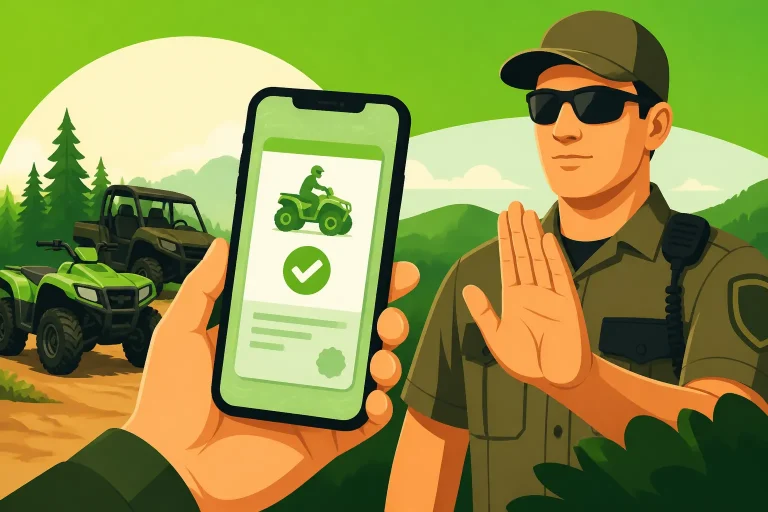
The same principle applies when a friend cannot attend a ride. Giving them your permit details, printed copy, or proof of purchase does not change who the permit was issued to. A ranger or other official may ask for proof that the operator has the required permit. The person riding should be able to show their own valid authorization as directed by the program.
Common situations that cause confusion
The non-transferable rule is straightforward, but shared machines and changing plans can make it less obvious in practice. These examples show where to pause and check the specific permit terms.
Two people take turns driving
If two people operate the same ATV or UTV during a ride, treat them as two operators for permit-planning purposes unless the current program instructions clearly say otherwise. A single machine does not turn two drivers into one permit holder. Each person should confirm whether they need an individual permit before the ride.
This is a common issue for families and groups that plan to swap drivers partway through the day. Arrange permits before leaving rather than expecting to share one at the trailhead. If the second person is only a passenger and never drives, verify the passenger rule separately. The distinction is between operating and riding as a passenger, not simply between owning and not owning the machine.
One operator uses more than one machine
An operator permit is not necessarily limited to one ATV. If you switch machines, the permit may remain yours, but the new machine must still meet that location’s rules. Width limits, machine categories, trail designations, closures, and required equipment can all affect whether it may be used.
For example, a machine that fits one trail system may be too wide for another, or a particular system may not allow the same vehicle type. A permit does not override those restrictions. Check the specific trail’s vehicle rules and current status before changing machines or traveling to another riding area.
A friend borrows your permit
A permit is not a shared household pass unless its terms specifically say it works that way. If a friend operates with your permit, the permit has not become theirs simply because you are nearby, paid for it, or are not using it at that moment.
Do not rely on a photo or a printed copy of another person’s permit as a substitute for your own authorization. The issuing program may allow a particular display method, but that does not change the name or operator associated with the permit. For practical details about showing proof, see Showing a Permit on Your Phone and Printing a Backup Copy.
You bought a used ATV with a permit or paperwork
A seller may hand over documents, decals, or a permit receipt with a used machine. Before assuming any of them can be used, identify what each document is for. Vehicle ownership paperwork may relate to the sale or identity of the machine. A forest OHV permit is tied to its terms and holder; it does not necessarily pass to the buyer.
Ask the seller what the document represents, then verify the answer with the issuing program. Do not treat a permit as proof that the seller owns the ATV, or treat a bill of sale as proof that you have permission to ride a particular forest trail. If there is uncertainty about machine ownership, Georgia Proof of Ownership on the Trail covers a separate but related question.
Your plans change or you cannot attend
Non-transferable does not automatically mean non-refundable, and non-refundable does not mean non-transferable. These are separate conditions. A permit may be impossible to transfer to another rider while also having a separate policy on refunds, cancellation, or replacement. Review the applicable terms before purchasing, and do not assume a friend can use a permit simply because you will not be going.
For a fuller explanation of those terms, see Are Georgia Forest OHV Permits Refundable or Transferable?. If a permit is lost or inaccessible, use the issuing program’s instructions rather than trying to reuse someone else’s permit. Georgia OHV Permit Replacement If Lost addresses that problem.
How to avoid a permit problem before riding
A few checks before a trip can prevent a misunderstanding at the trailhead. The right steps depend on whether you are riding alone, sharing a machine, switching vehicles, or visiting a different system.
- Identify the exact riding area. A permit is useful only for the places and dates covered by its terms. Confirm that the trail or OHV system accepts the permit you plan to use and check for closures.
- Count the operators, not just the machines. If more than one person will drive, check whether each operator needs an individual permit. Do not plan to pass one permit back and forth.
- Check the machine separately. Confirm that the ATV or UTV fits the area’s vehicle requirements. A valid operator permit does not make an oversized or otherwise ineligible machine acceptable.
- Read the permit’s transfer and refund terms. These are distinct questions. If you may change plans, check what the program allows before buying.
- Keep proof available in the required format. Follow instructions for displaying or showing the permit, and make sure the person operating can access their own proof.
- Separate trail access from road legality. Do not assume a forest permit allows you to ride on a public road or that road registration replaces a forest permit.
- Ask the issuing office when the terms are unclear. Be specific: explain who will operate, whether you will switch machines, and which trail system you plan to visit.
For permit purchase details, How to Buy a Georgia Forest OHV Permit can help you understand the process. If your concern is whether the permit is required for a visiting rider, see Do Visiting Riders Need a Georgia Forest Permit?. Check the current official permit information before traveling, because coverage, display instructions, and access conditions can change.
The practical takeaway is simple: a non-transferable Georgia OHV permit belongs to the operator named or otherwise designated by the permit, not to the machine and not to the next person who wants to ride. Plan around the people who will drive, verify the vehicle and trail rules separately, and do not treat a permit as a title, registration, or blanket grant of access.
Disclaimer
This article is for general informational purposes only and does not constitute professional advice. Laws, prices and regulations vary by location and change over time. Consult a qualified professional for guidance on your specific situation.