Quads on a Cart Path
It's a scene many of us have encountered in Georgia: you're driving through a quaint town like Peachtree City, and you see families tooling around on golf carts on dedicated paths, connecting neighborhoods, schools, and shops. If you're an ATV or UTV owner, a thought might pop into your head: "Could I ride my quad here? It sure would be convenient." The short answer, and the reality that often disappoints, is generally no. This comprehensive guide will clear up exactly why your quad or side-by-side isn't meant for Georgia's cart paths and where you can legally and safely enjoy your machine.
Understanding Georgia's Distinct Machine Categories
Before we dive into why certain paths are off-limits, it's crucial to understand how Georgia law categorizes off-road vehicles. Not all recreational machines are created equal in the eyes of the law, and these distinctions directly impact where you can and cannot ride. Trying to apply the rules for one type of vehicle to another is where a lot of confusion, and potential legal trouble, can start.
What Defines a Quad or ATV in Georgia Law?
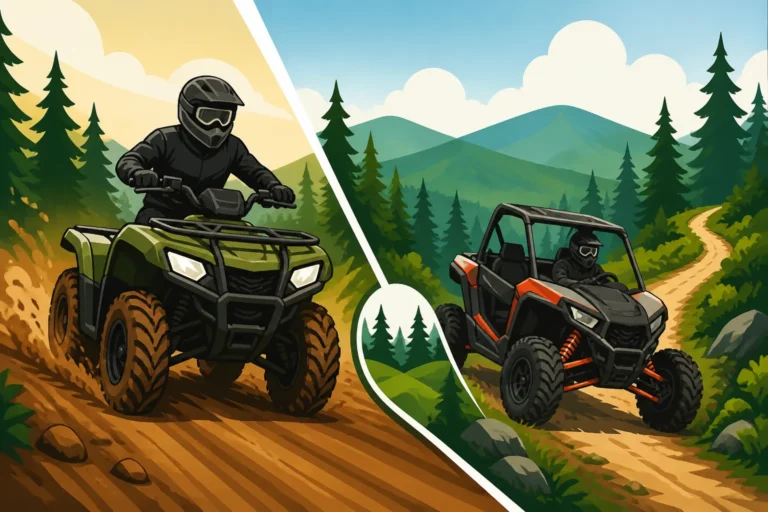
In Georgia, when we talk about a "quad" or an ATV (All-Terrain Vehicle), we're generally referring to a motorized off-highway vehicle designed to travel on four low-pressure tires, with a seat designed to be straddled by the operator, and handlebars for steering control. These machines are built for rugged terrain, for mud, dirt, and challenging trails. They typically have powerful engines and a robust suspension system to handle bumps and jumps. Their entire design philosophy is centered around navigating environments far removed from paved roads or smooth pathways.
It's important to note that these characteristics — the straddle seat and handlebars — are key disqualifiers for road-legal status for many purposes in Georgia, including cart path access. The law very specifically differentiates these features from those found on vehicles intended for public paths or roads. This is also why [Georgia Dirt Bikes and Three-Wheelers Are Excluded] from being considered MPOHVs or for use on cart paths; their design is fundamentally geared towards off-road performance, not public thoroughfares. Even if you've kitted out your quad with a winch or upgraded suspension from a company like SuperATV, it doesn't change its fundamental legal classification or eligibility for cart paths.
The World of Golf Carts and Personal Transportation Vehicles (PTVs)
On the flip side, golf carts and Personal Transportation Vehicles (PTVs) occupy a very different legal and functional niche. These are typically smaller, slower-moving vehicles designed for short-distance travel, often within communities, on golf courses, or on designated pathways. The defining characteristics here are usually a non-straddle seat, a steering wheel, and a design that prioritizes ease of use and safety in low-speed, shared environments. PTVs, while similar to golf carts, might be slightly more robust or have certain features allowing them to operate on public streets where permitted by local ordinance, but they are still worlds apart from an ATV.
Many Georgia cities and counties have enacted specific ordinances to govern the use of golf carts and PTVs, creating networks of paths for them. A prime example is [Peachtree City Golf Cart Rules in Georgia], where an extensive network of cart paths is a fundamental part of the community's infrastructure, allowing residents to travel almost anywhere without a car. These local rules dictate everything from registration to operator age and acceptable speeds. The critical takeaway is that these paths are built for and governed by rules specific to golf carts and PTVs, not the powerful, off-road machines we know as ATVs or UTVs.
Why Quads and Cart Paths Don't Mix
The idea of zipping down a scenic cart path on your ATV might sound appealing, but it quickly hits a wall of legal and practical realities. The fundamental design, intended use, and legal classification of ATVs make them entirely unsuitable for these pathways. This isn't just about semantics; it's about safety, infrastructure, and adhering to the specific laws designed to keep everyone safe.
Legal Definitions and Operational Restrictions
The most straightforward reason quads aren't allowed on cart paths boils down to their legal definition and the restrictions that follow. Cart paths are specifically created and designated for golf carts and PTVs. The ordinances governing these paths explicitly exclude ATVs and UTVs. This means that [Why a Path Network Is Not for ATVs] is clearly laid out in local laws. An ATV, by its very nature, does not fit the legal description of a vehicle permitted on these paths. It’s not just a suggestion; it’s a rule backed by law.
Think about the physical characteristics we discussed earlier. An ATV is designed with handlebars and a straddle seat. These are direct contraindications for operating on a cart path. [Why Handlebars Disqualify a Machine] for such use often relates to the control characteristics and the assumption of off-road agility rather than the precise, stable steering needed in close quarters with other path users. Similarly, [Why a Straddle Seat Disqualifies a Machine] is tied to the operator's posture and control, which differs significantly from the seated, automotive-style control of a golf cart. Even if you argue that your quad is "small enough," its inherent design makes it legally distinct and therefore prohibited.
Safety Concerns and Infrastructure Limitations
Beyond the legal definitions, there are very real safety and infrastructure reasons why ATVs should not be on cart paths. These pathways are often shared by pedestrians, cyclists, and slower-moving golf carts. An ATV's speed, weight, and aggressive handling characteristics pose a significant danger in such an environment. Imagine a powerful quad suddenly encountering a child on a bicycle or an elderly person walking their dog around a blind curve on a cart path. The potential for serious injury is simply too high.
Furthermore, the physical infrastructure of cart paths is not built to withstand the demands of an ATV. These paths are typically narrower than roads, often have tight turns, and may feature smaller bridges or [Tunnels Under a Highway for Carts] that are designed for light-duty, slow-moving traffic. The weight and torque of an ATV could damage the path surface, erode shoulders, or even compromise smaller bridge structures over time. While you might consider upgrading your ATV with heavy-duty components from a company like SuperATV for enhanced off-road performance, those same components and the machine's overall ruggedness make it a poor fit for the delicate ecosystem of a cart path. These paths are meant for leisure and light transportation, not the robust demands of an off-road vehicle, no matter how carefully one might try to operate it.
Where You Can Legally Ride Your Quad in Georgia
So, if cart paths are off-limits, where can you actually ride your ATV or UTV in Georgia without breaking the law or endangering others? Thankfully, Georgia offers a variety of legal and exciting options for off-road enthusiasts. It’s all about knowing the right places and understanding the specific rules for each.
Designated Off-Road Trails and Parks
The best and most exhilarating places to ride your ATV or UTV are on designated off-road trails and at private riding parks. These locations are specifically designed for the challenges and thrills of off-road riding, providing the space and terrain your machine was built for. Georgia boasts several fantastic options, ranging from national forest trails to expansive private resorts. For instance, the [Chattahoochee-Oconee National Forest Riding] areas offer extensive trail networks where you can truly put your machine through its paces. Similarly, private parks like [Iron Mountain Resort: Georgia's Biggest Private Park] provide hundreds of miles of trails, catering to various skill levels with amenities often unavailable on public lands.
When planning a trip to these areas, it's crucial to check specific rules and permit requirements. Many public lands, especially those within national forests, require special permits. Understanding [Georgia OHV Permits: What You Need Before You Ride] is essential before you even load your machine onto the trailer. These permits are typically per-operator and ensure that the funds are used for trail maintenance and management. Always respect trail closures, posted rules, and practice Tread Lightly! principles to preserve these valuable riding areas for everyone. These are the environments where your ATV truly shines and where its capabilities can be safely and legally enjoyed.
County Roads (with a Major Caveat)
Now, this is where it gets a little nuanced, and it's a source of common misunderstanding. While regular ATVs are generally not street legal in Georgia, certain UTVs can be registered as Multi-purpose Off-Highway Vehicles (MPOHVs) and legally operated on county roads. This is a very specific designation with stringent requirements, and it's important not to confuse an MPOHV with a standard ATV or UTV. The state introduced specific legislation to allow these machines limited road access, but only if they meet a detailed checklist of criteria.
To qualify as an MPOHV, a UTV must pass [Georgia MPOHV Eligibility: The Eight-Point Test]. This test covers everything from width and weight limits to speed capabilities, the presence of a steering wheel (not handlebars!), non-straddle seating, seat belts, and proper lighting and mirrors. For instance, a traditional quad with handlebars and a straddle seat will simply not qualify. If you've invested in a UTV and are considering making it road-legal, you might find yourself looking at aftermarket accessories from SuperATV, such as mirrors, turn signal kits, or even specific windshields, to help meet these requirements. However, even if your UTV is registered as an MPOHV, its road use is restricted to county roads only – state highways and interstates remain strictly off-limits, with very few exceptions for crossing. Additionally, remember that [Georgia ATV Helmet Law for Riders Under 18] still applies on public roads, even for MPOHVs. Always check local county ordinances, as some counties may have additional restrictions.
Consequences of Illegal Riding
Ignoring Georgia's rules for ATVs and UTVs, especially when it comes to riding on unauthorized paths like golf cart trails or prohibited public roads, carries significant risks. It's not just about getting a slap on the wrist; the repercussions can be financial, legal, and could even impact your ability to ride in the future. Nobody wants a day of fun to turn into a nightmare of penalties and paperwork.
Penalties and Enforcement
If you're caught riding an ATV or UTV on a cart path, state highway, or any other unauthorized area, you're likely facing a citation. The specific penalties can vary depending on the local jurisdiction and the nature of the violation, but they often include substantial fines. For example, [Georgia Ticket Cost for Illegal Road Riding] can quickly add up, easily costing hundreds of dollars, not including court fees or other administrative costs. Law enforcement agencies, including local police departments and county sheriffs, are increasingly aware of and vigilant about illegal ATV use. You might encounter [Georgia Sheriff Enforcement on County Roads], especially in areas known for recreational vehicle activity.
Beyond fines, there's also the very real possibility of your machine being impounded. [Georgia Impound Rules After a Violation] often mean that your ATV will be towed and stored at your expense, incurring daily storage fees on top of the initial towing charge. Releasing an impounded vehicle can be a costly and time-consuming process, requiring proof of ownership, payment of all outstanding fees, and sometimes even a court order. This can quickly turn an impulsive ride into a massive headache and an unexpected drain on your wallet.
Insurance and Liability Issues
Perhaps one of the most overlooked consequences of illegal riding is the impact on your insurance and personal liability. Most ATV insurance policies are written with the assumption that you will be operating your machine legally and in designated areas. If you're involved in an accident while riding on a cart path or other prohibited area, your insurance company may deny coverage for damages or injuries. This means you could be personally responsible for thousands, or even tens of thousands, of dollars in medical bills, property damage, and legal fees.
Even if you have [Georgia Liability Insurance Tied to Registration] for an MPOHV, that coverage is contingent upon you adhering to the terms of your policy and the law. Operating outside these boundaries can render your policy void. Imagine a scenario where you cause an accident on a cart path, injure a pedestrian, and your insurance refuses to pay because you were operating your ATV illegally. The financial ruin from such a situation could be devastating. Always prioritize legal riding to ensure your coverage is valid and to protect yourself from severe financial and legal repercussions.
Comparison: ATVs/UTVs vs. Golf Carts/PTVs
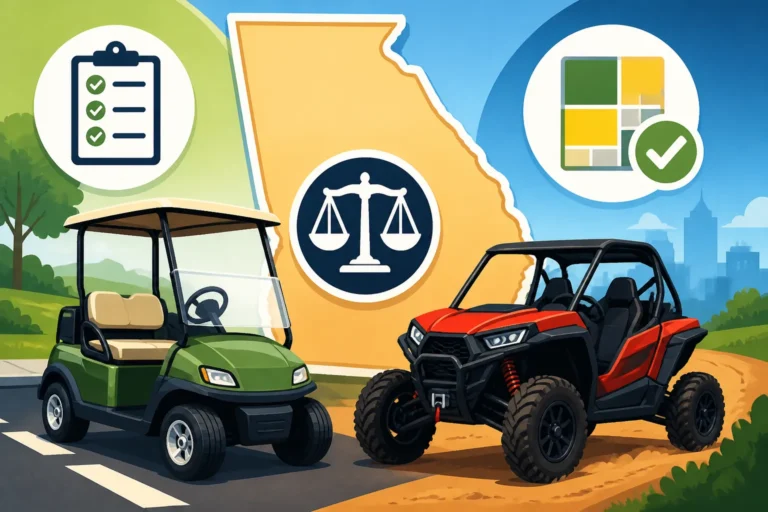
To further clarify why these vehicles have different rules and uses, here's a quick comparison of their key characteristics:
| Feature | ATV/Quad | UTV/Side-by-Side (Non-MPOHV) | Golf Cart/PTV (Standard) | MPOHV (UTV that qualifies) |
|---|---|---|---|---|
| Seating | Straddle seat (like a motorcycle) | Bench or bucket seats (side-by-side) | Bench seats (side-by-side) | Bench or bucket seats (side-by-side) |
| Steering | Handlebars | Steering wheel | Steering wheel | Steering wheel |
| Primary Use | Off-road trails, recreation, utility tasks | Off-road trails, recreation, utility, hunting | Golf courses, community travel, short errands | Limited road use on county roads, off-road trails |
| Speed Range | Varies, often 40-70+ mph | Varies, often 30-75+ mph | Typically 15-25 mph | 25-65 mph (Georgia MPOHV requirement) |
| Road Legal? | No | No (unless registered as MPOHV) | Only on designated paths/local roads by ordinance | Yes, on county roads only, with registration |
| Cart Path Legal? | No | No | Yes, on designated paths | No |
| Registration | Not typically state-registered for road use | MPOHV registration required for limited road use | Local registration/permit often required | Georgia MPOHV registration required |
In conclusion, while the idea of taking your quad onto a peaceful cart path in Georgia might seem appealing for convenience or a change of scenery, it's a firm no across the board. These paths are explicitly designed and legally designated for golf carts and Personal Transportation Vehicles, not the robust and powerful ATVs and UTVs built for off-road adventures. Attempting to ride your quad or UTV on these paths not only puts you at risk of fines, impoundment, and insurance complications but also endangers other path users who expect a certain type of vehicle and speed. Instead, embrace the fantastic off-road opportunities Georgia truly offers, from vast national forest trails to exciting private parks, ensuring your riding is always legal, safe, and truly enjoyable.
Disclaimer
This article is for general informational purposes only and does not constitute professional advice. Laws, prices and regulations vary by location and change over time. Consult a qualified professional for guidance on your specific situation.