Georgia Golf Cart Laws and PTV Ordinances
It's incredibly frustrating trying to figure out where your golf cart or Personal Transportation Vehicle (PTV) can legally go in Georgia, especially when the rules seem to change from one city limit sign to the next. You bought your cart for convenience and fun, not to navigate a maze of confusing local ordinances and state statutes. This guide is here to untangle the complexities of Georgia's golf cart laws and PTV ordinances, helping you understand where you can ride, who can drive, and what you need to do to stay on the right side of the law.
The Head-Scratching Confusion Around Georgia Golf Cart Laws and PTVs
Let's be honest, for years, most people thought of golf carts as, well, golf carts. Something you drove on the links or maybe around a quiet campground. But times have changed, and these handy little machines have evolved, bringing with them a whole new set of questions and legal interpretations. It’s no wonder people feel like they need a legal degree just to take a spin around the block.
Why Golf Carts Aren't "Just" Golf Carts Anymore
The modern golf cart, or PTV as the state often calls them, is far more versatile than its ancestors. People use them for everything from quick trips to the neighborhood pool, running errands in master-planned communities, or even getting around large properties. This expanded use has pushed them out of the purely recreational realm and onto public roads and pathways, creating a need for clearer, albeit often localized, regulations. The idea of "just" a golf cart is a relic of the past, as these machines are now a legitimate form of local transportation for many Georgians.
This shift in use means that what was once an informal understanding is now a matter of statute and local ordinance. Where you live in Georgia dictates a lot about your experience. One town might embrace them as a solution to traffic woes, while the next might view them strictly as off-road vehicles. This patchwork approach is a major source of the confusion and frustration that owners feel, especially if they travel or move. What’s perfectly fine in Peachtree City might get you a ticket in a different county.
The Difference Between a Golf Cart, a PTV, and an LSV
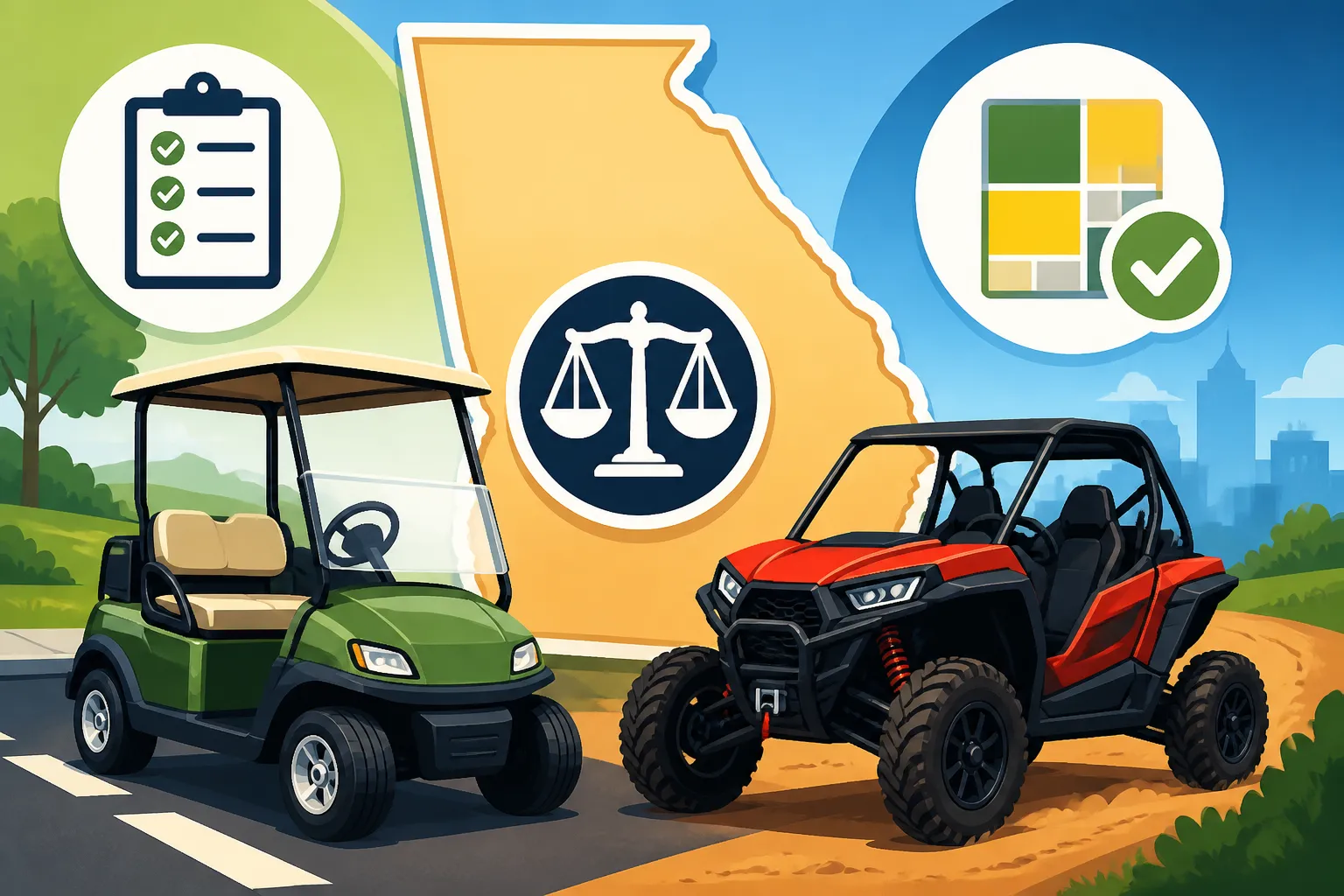
It's easy to lump all small, low-speed vehicles together, but Georgia law, like many states, draws some important distinctions. A "golf cart" generally refers to the traditional machine designed for golf courses. A "Personal Transportation Vehicle" (PTV) is a broader category, often encompassing golf carts that have been modified or purpose-built for use beyond the golf course, including additional safety features. Then there are Low-Speed Vehicles (LSVs), which are a whole other class of street-legal vehicles.
LSVs are a key distinction to understand. They are typically factory-made vehicles that meet federal safety standards for low-speed use, have a maximum speed of 20-25 mph, and come with a Vehicle Identification Number (VIN) that allows them to be titled and registered like a regular car. This means they'll have proper headlamps, turn signals, seatbelts, and a windshield. In Georgia, [Georgia Low-Speed Vehicles Capped at 20 mph] have specific rules, including being limited to roads with speed limits of 35 mph or less. PTVs and golf carts, on the other hand, often operate under different, usually less stringent, state and local regulations, and generally aren't titled in the same way. Knowing these differences is crucial before you even think about hitting the pavement.
Understanding Georgia's PTV Ordinances: What Cities Can Do
Unlike traditional ATVs or even the recently defined Motorized Personal Off-Highway Vehicles (MPOHV) like side-by-sides, golf carts and PTVs primarily fall under the purview of local governments when it comes to road use. This grants cities and counties significant power in deciding if, when, and where these vehicles can operate on their streets. This local control is why you'll find such varied rules across the state.
The Power of Local Control: City and County Ordinances
Georgia state law gives individual cities and counties the authority to pass ordinances regulating the use of golf carts and PTVs on local public roads within their jurisdiction. This means there isn't one universal "Georgia golf cart law" that applies to every corner of the state. Instead, you'll need to check the specific ordinances of your city and county. This local authority extends to things like where carts can be driven, required safety equipment, operating hours, and even age limits for drivers. This system is designed to allow communities to tailor rules to their unique layouts and traffic patterns, but it certainly adds a layer of complexity for cart owners.
Imagine living on one side of a county line where golf carts are perfectly street-legal on secondary roads, only to cross into the next county where they are strictly forbidden except on private property. It's a common scenario that catches many off-guard. These local ordinances are often developed in response to community needs, safety concerns, and the desire to integrate these vehicles into the local transportation fabric. For example, a city might pass an ordinance specifically allowing PTVs on roads to help residents access local businesses or amenities, creating a thriving cart-friendly environment. [Georgia PTV Ordinances Cities Can Pass] delves deeper into how these local laws are crafted.
When a City Says "Yes" and a County Says "No"
One of the most perplexing situations arises when a city within a county has an ordinance permitting golf cart use, but the county itself does not. Generally, a city's ordinance applies within its incorporated limits, superseding conflicting county rules for those specific roads. However, if you venture outside the city limits onto a county road, you're then subject to the county's regulations. This can create confusing boundaries, especially in areas with a mix of municipal and unincorporated land.
For instance, a resident of a town that embraces golf carts might happily use their machine on local streets. But if they try to extend their journey just a mile outside the city line onto a county-maintained road, they could suddenly be in violation. It's a tricky dance that requires cart owners to be acutely aware of their geographical location. Always check both your city's and your county's rules, and if in doubt, stick to designated paths or private property. Some drivers opt for universal accessory kits from companies like SuperATV, adding turn signals, horns, and mirrors, making their cart more visibly "street-ready" even if the local rules are hazy.
Key Elements of a Typical PTV Ordinance
While specific details vary, most Georgia PTV ordinances cover similar ground to ensure safety and order. You can expect to see rules regarding:
- Permitted Roads: Specifying which roads (usually with lower speed limits) are open to carts.
- Required Equipment: Mandating headlights, taillights, brake lights, reflectors, and often a horn or rearview mirror.
- Operating Hours: Sometimes restricting use to daylight hours, or requiring specific lighting for night use.
- Driver Age and Licensing: Setting minimum age requirements and often requiring a valid driver's license or permit.
- Registration/Permit: Some cities require a local registration or permit for carts operating on public streets, sometimes with a small fee.
- Speed Limits: Often capping the speed of carts at 20-25 mph, even if the road's speed limit is higher.
- Signage: Some ordinances require specific signage, like a "slow-moving vehicle" triangle or a "Share the Road" sign, on the back of the PTV.
For instance, the city of Savannah might have one set of rules, while Athens-Clarke County has another. These ordinances are designed to integrate golf carts safely into the existing traffic flow, and understanding these common elements will help you prepare your PTV for legal road use in your area.
Navigating Age and Licensing Requirements for Golf Carts and PTVs
Who can actually get behind the wheel of a golf cart or PTV on public roads in Georgia? This is another area where local ordinances play a huge role, leading to differences depending on where you reside or visit. The state generally defers to local authorities for these rules, so assuming "kids can drive them anywhere" could land you in hot water.
Who Can Drive What: Georgia's Age Rules
State law sets a general framework, but local ordinances typically define the specific age requirements for driving golf carts and PTVs on public roads. It's not uncommon for cities to require drivers to be at least 15 or 16 years old, and in some cases, even older, especially if the cart is operating on shared public roadways. The rationale is simple: public roads present different hazards than a private golf course or an enclosed community, requiring a certain level of maturity and driving knowledge.
However, some communities, particularly those with extensive cart path networks, might have slightly more lenient rules for younger drivers when they are operating solely on those designated paths. For example, [A Learner's Permit at 15 on a Cart] might be sufficient in certain areas under specific conditions. Always consult your local city or county ordinance for the exact age requirements in your area. This is not a situation where it's better to ask for forgiveness than permission; a violation could result in fines or even the impoundment of the vehicle.
Driver's License vs. Learner's Permit: What's Required
Building on the age requirements, many local ordinances specify what kind of license or permit a driver must possess. For golf carts and PTVs operating on public streets, it's often mandated that the operator have a valid Georgia driver's license. A learner's permit might be accepted in some areas, but usually with the caveat that a fully licensed adult must be present as a supervisor in the vehicle.
This requirement ensures that the driver has at least a basic understanding of traffic laws and road etiquette, even if the cart itself isn't a full-fledged automobile. The key here is "valid." An expired license or a suspended license won't cut it. For example, Peachtree City, a pioneer in golf cart use, has specific rules regarding driver's licenses and age, which we'll explore shortly. If you're not sure, check the local ordinance. Don't assume that because your teenager can drive it on private land, they can automatically take it out on the street.
Supervision Rules for Young Drivers
When local ordinances do allow younger drivers (typically those with a learner's permit or under a certain age) to operate a golf cart or PTV on public ways, there are almost always strict supervision requirements. This usually means a licensed adult, often a parent or guardian, must be in the passenger seat and capable of taking control if needed. These rules are in place for obvious safety reasons, acknowledging that while golf carts are fun, they are still vehicles that share the road with cars and trucks.
It's not enough for the adult to simply be "nearby." They generally need to be physically in the cart, actively supervising the young driver. Violations of these supervision rules can lead to citations for both the young driver and the supervising adult. It's a serious responsibility, and authorities want to ensure that proper guidance is provided to minimize risks. Remember, even if your PTV is decked out with cool accessories from SuperATV, safety and adherence to local laws are paramount.
Where Can You Legally Ride Your Golf Cart or PTV in Georgia?
This is perhaps the biggest question for any golf cart owner in Georgia. The answer, unfortunately, is rarely a simple "everywhere" or "nowhere." It's a nuanced landscape, heavily influenced by whether you're on a dedicated path, a local road, or trying to cross a major thoroughfare.
Designated Cart Paths: Your Primary Playgrounds
In communities that have embraced golf carts, designated cart paths are often the safest and most permissible places to ride. These paths are purpose-built for golf carts and similar PTVs, keeping them separate from vehicular traffic. They are designed to connect neighborhoods to shopping centers, schools, parks, and other amenities, creating a vibrant network for alternative transportation. [Georgia Golf Cart Path Access] is a prime example of how these paths become the lifeblood of cart-friendly towns.
Riding on these paths typically comes with its own set of rules, such as speed limits, right-of-way guidelines, and sometimes even specific operating hours. These paths are a fantastic amenity, allowing families to enjoy their carts without the stress of mixing with faster-moving traffic. However, it's important to remember that even on a dedicated cart path, you're not entirely isolated; you'll still encounter pedestrians, cyclists, and potentially other slower-moving vehicles, so vigilance is always necessary.
Public Roads: The "When and Where"
While ATVs are generally [Georgia ATV Road Law Explained] for public road use, golf carts and PTVs have a different, albeit limited, relationship with Georgia's road network. As we've discussed, it's entirely up to local ordinances whether a golf cart can be driven on public roads. When permitted, these ordinances almost universally restrict carts to roads with a speed limit of 35 mph or less. This is a critical distinction; you will not typically find a golf cart legally allowed on a road with a 45 mph or higher speed limit.
Furthermore, even on these lower-speed roads, carts are usually expected to stay to the far right side of the lane, allowing other traffic to pass safely. The logic behind this limitation is safety; golf carts are slower, less robust, and offer less protection than conventional vehicles, making them a hazard on faster roads. If you're considering driving on a public road, confirm your local ordinance, ensure your cart meets all required safety equipment standards, and always be aware of your surroundings. Remember that even with lights and mirrors, a golf cart is not as visible as a car, especially at dawn or dusk.
Crossing State Routes and Interstates: Strict Limits
This is a firm "no" for interstates and a highly conditional "yes" for state routes. Golf carts and PTVs are never permitted on interstate highways in Georgia. Full stop. The speeds are too high, and the vehicles are simply not designed for such environments. Attempting to drive a golf cart on an interstate is not only illegal but extremely dangerous.
Crossing state routes, however, can sometimes be permitted, but only at designated crossings and only where a local ordinance specifically allows it. These crossings are typically marked and are designed to allow a cart to get from one section of a cart path network to another, or to access a specific destination. You cannot just pick a random spot on a state route and decide to cross. Even then, [Georgia's July 2027 Sunset on Road Access] for some types of off-road vehicles might hint at an increasingly cautious approach to mixing slower vehicles with faster traffic. Always yield to vehicular traffic and cross quickly and safely when a crossing is designated and permitted. The idea is to minimize the time the cart is exposed to faster-moving cars.
Registration, Plates, and Insurance: The Paperwork Side of Things
With the growing popularity of golf carts and PTVs on local roads, many owners wonder if they need to register their machines, get a plate, or carry insurance. The answers, once again, depend heavily on local regulations and how you intend to use your cart.
Do You Need to Register Your Golf Cart in Georgia?
Here's where it gets interesting: golf carts and PTVs, unlike the new MPOHV category for side-by-sides, are generally not registered or titled at the state level by the Georgia Department of Revenue (DOR). This means you won't get a state-issued license plate for your golf cart in the same way you would for a car or even a registered UTV. This lack of a state title is one reason [Why Georgia Does Not Title an ATV] and why TAVT typically doesn't apply to these machines.
However, many local cities and counties that permit golf cart use on their roads require a local registration or permit. This might involve obtaining a decal or a small local "plate" from the city hall or local police department. These local registrations help municipalities track the carts operating on their pathways and roads, and often come with a small fee that helps maintain the cart path infrastructure. For example, [Peachtree City Cart Registration Fees in Georgia] are a key part of their system. Always check your local city's rules; don't assume that because the state doesn't require it, your local government won't.
Plates, Decals, and Visible Markings
If a local ordinance requires registration, it will often come with a specific decal or small plate that must be affixed to the golf cart in a visible location. This serves as proof that you've complied with local regulations and helps law enforcement identify carts operating legally. These aren't typically the large, reflective plates you see on cars, but smaller, municipal-issued identifiers.
Beyond official plates or decals, many ordinances also specify other visible markings. A common requirement, especially for golf carts that might be driven on public roads during limited hours or at slower speeds, is a slow-moving vehicle (SMV) triangle. These bright orange triangles are universally recognized warning signs. Ensuring your cart has all the required visible markings, whether from the city or general safety standards, is a good way to avoid unnecessary stops by law enforcement and enhance your overall safety. Installing bright LED tail lights or even a small light bar from SuperATV can significantly improve your visibility, especially if your local rules permit night riding.
Insurance: Protecting Yourself and Others
While Georgia does not require state-level registration for golf carts, and therefore does not mandate insurance in the same way it does for cars, carrying liability insurance for your golf cart or PTV is highly recommended, especially if you plan to operate it on public roads or paths. Accidents can and do happen, and without insurance, you could be personally liable for significant damages or injuries.
Imagine a scenario where your golf cart, even at low speed, collides with a pedestrian or another vehicle. The medical bills or repair costs could be substantial. Many homeowners' insurance policies may offer some limited coverage for golf carts operated on private property, but this often doesn't extend to incidents on public roads. It's wise to contact your insurance provider to inquire about specific golf cart or PTV coverage options. Some companies offer specific endorsements or standalone policies that provide adequate liability coverage, protecting your assets in case of an unfortunate incident. [Georgia UTV Insurance Minimums] might give you a baseline idea of the liability coverage commonly carried for similar recreational vehicles.
Special Case: Peachtree City's Famous Golf Cart Network
When you talk about golf carts and PTVs in Georgia, Peachtree City almost always comes up. This Fayette County city is renowned for its extensive multi-use path system and its deep integration of golf carts into daily life. It's often seen as the gold standard for how communities can embrace these vehicles.
A Model for Cart-Friendly Communities
Peachtree City boasts over 100 miles of paved multi-use paths, specifically designed to accommodate golf carts, cyclists, and pedestrians. These paths crisscross the city, connecting residential areas with schools, shopping centers, restaurants, and recreational facilities. For many residents, the golf cart isn't just a leisure vehicle; it's their primary mode of local transportation. This infrastructure has allowed Peachtree City to develop a unique culture where golf carts are a visible and integral part of the community fabric.
The success of Peachtree City's model has made it a point of reference for other communities in Georgia and beyond that are considering how to integrate PTVs into their own transportation plans. It demonstrates that with careful planning, dedicated infrastructure, and clear regulations, golf carts can enhance a community's quality of life and reduce reliance on automobiles for short trips. The paths are well-maintained, clearly marked, and provide a safe environment away from the main roads.
Peachtree City's Unique Registration and Fee Structure
Because Peachtree City has so thoroughly integrated golf carts into its transportation system, it also has a well-defined local registration and fee structure. While the state doesn't require registration, Peachtree City mandates that all golf carts operated on its path system be registered with the city. This involves obtaining a registration decal, which is typically renewed every few years. The fees collected help fund the maintenance and expansion of their impressive path network.
The city distinguishes between resident and non-resident fees. For example, [Peachtree City Resident Registration at $15] is quite affordable, reflecting the city's commitment to supporting its residents' use of carts. However, visitors or non-residents who wish to use the path system for extended periods might face a higher fee, as detailed in [The $235 Non-Resident Path User Fee]. This structure helps ensure that those who benefit most from the infrastructure contribute to its upkeep, a practical approach to managing a community asset.
Rules for Residents, Visitors, and Underage Drivers
Peachtree City also has clear rules regarding who can drive a golf cart on its paths. Generally, drivers must be at least 12 years old to operate a cart on the multi-use paths, but strict supervision rules apply for those under 16. [Ages 12 to 14 With a Parent in the Seat] is a common requirement, ensuring that younger drivers have an experienced adult present. For public streets within Peachtree City where carts are allowed, a valid driver's license is typically required for any operator.
Visitors also need to be aware of these rules. While you might bring your own cart to enjoy the paths, you'll still need to comply with Peachtree City's registration requirements if you plan to use it for an extended stay. The city even has specific provisions for [Georgia Cart Rules for Visiting Families], acknowledging that many tourists come to experience its unique cart culture. These clear-cut rules are essential for maintaining safety and order on such a popular and extensive path system.
Essential Safety Gear and Operational Rules for PTVs
Operating a golf cart or PTV, especially on shared paths or public roads, comes with responsibilities. Even at low speeds, accidents can happen, and ensuring your machine is properly equipped and operated safely is paramount.
Lights, Brakes, and Mirrors: What Your Cart Needs
When a local ordinance permits golf carts or PTVs on public roads, it almost always specifies minimum safety equipment requirements. These generally include:
- Headlights: For visibility, especially at dawn, dusk, or during inclement weather. Many ordinances require them for any operation outside of clear daylight hours.
- Taillights and Brake Lights: Crucial for signaling your presence and intentions to other drivers and cyclists.
- Turn Signals: While not always universally required on all golf carts by every ordinance, they are a wise addition for any cart on public roads, enhancing safety significantly. You can find universal kits from SuperATV that make adding turn signals, brake lights, and a horn a straightforward process.
- Reflectors: Often required on the sides and rear for passive visibility.
- Rearview Mirror: Essential for seeing traffic approaching from behind, just like in a car. Some ordinances specify a single mirror, others may require both side mirrors.
- Horn: To alert pedestrians, cyclists, or other drivers of your presence.
Failing to have this required equipment can not only lead to a citation but also significantly increases your risk of an accident. Always inspect your cart before heading out, especially if you plan to operate it where these items are mandated.
Passenger Rules and Staying Safe
Golf carts are typically designed to carry a specific number of passengers, and it's important to adhere to these limits. Overloading a golf cart can affect its stability, braking ability, and overall control, making it more prone to tipping or losing traction. Most carts have seats for two, four, or six passengers. It's crucial that all passengers remain seated while the cart is in motion, with arms and legs inside the vehicle.
Children, especially small ones, should be properly secured and supervised. Many PTVs don't have the same robust seatbelt systems as cars, but if they do, use them! Avoiding distractions while driving, maintaining a safe speed, and keeping a watchful eye on your surroundings are all part of responsible operation. Remember that a golf cart, while fun, is not a toy. It's a vehicle, and treating it with respect for its limitations is key to keeping everyone safe. [Georgia Rules for Passengers on a Side-by-Side] might provide a good comparison for passenger safety expectations on similar recreational vehicles.
Night Riding and Visibility Considerations
If your local ordinance permits golf cart operation after dark, visibility becomes an even more critical concern. Even with headlights and taillights, a golf cart is a small vehicle and can be easily overlooked by drivers of larger vehicles. Beyond the minimum required lighting, consider adding extra reflective tape to your cart, or even additional LED lighting, particularly to the sides, to make it more noticeable from all angles.
Wearing light-colored clothing or reflective vests can also enhance your visibility as a driver and passenger. Avoid driving on unlit paths or roads at night if possible, or if you must, proceed with extreme caution and at a reduced speed. Fog, rain, or other adverse weather conditions further complicate night riding, and it might be best to avoid operating your cart in such circumstances. The goal is to be seen and to see, ensuring you have ample time to react to any situation on the path or road.
Enforcement and Penalties: What Happens When You Break the Rules
No one wants to get a ticket, especially when you're just trying to enjoy a leisurely ride. However, golf cart and PTV laws are serious, and law enforcement officers in Georgia are authorized to enforce them. Understanding the potential consequences can help you avoid costly mistakes.
What Law Enforcement Looks For
When a Georgia police officer, sheriff's deputy, or local marshal sees a golf cart or PTV on a public road or path, they're generally looking for a few key things to ensure compliance with local ordinances and state law:
- Driver Eligibility: Is the driver old enough and properly licensed (if required by local ordinance)?
- Vehicle Equipment: Does the cart have the required headlights, taillights, brake lights, reflectors, horn, and rearview mirror?
- Local Registration: Does the cart display any required city or county registration decals or plates?
- Permitted Area of Operation: Is the cart operating on a road or path where it's legally allowed? Is the road speed limit 35 mph or less?
- Safe Operation: Is the cart being operated in a safe manner, not overloaded, and adhering to speed limits?
Officers are not trying to ruin your fun, but they are tasked with ensuring public safety. If any of these elements are out of compliance, it can lead to a stop and potential citation.
Common Violations and Their Consequences
Common violations related to golf cart and PTV operation in Georgia include:
- Underage Driving: Allowing an unlicensed or underaged person to operate the cart where prohibited.
- Operating Without Required Equipment: Missing headlights, brake lights, or other mandated safety features.
- Driving on Prohibited Roads: Operating a cart on a road with a speed limit greater than 35 mph, or on a state route or interstate where not specifically permitted.
- Operating Without Local Registration: If your city requires a permit or decal and you don't have one.
- Reckless Operation: Driving erratically, speeding, or otherwise endangering others.
The consequences for these violations can range from a simple warning to a substantial fine, much like a traffic ticket for a car. In some cases, repeated violations or serious infractions could even lead to the impoundment of your golf cart. [Georgia Ticket Cost for Illegal Road Riding] can give you an idea of how expensive these citations can become, especially when court costs are factored in. It’s always cheaper and less stressful to know and follow the rules than to face the penalties.
Impoundment and Fines: The Cost of Non-Compliance
If a golf cart is found to be operating in serious violation of local ordinances or state law, law enforcement has the authority to issue citations and, in some cases, impound the vehicle. Impoundment is typically reserved for more severe violations, such as driving under the influence (DUI) on a golf cart, repeated offenses, or situations where the vehicle is deemed a significant public safety hazard.
Beyond the initial fines associated with the citation, if your cart is impounded, you'll also be responsible for towing and storage fees, which can quickly add up. Retrieving an impounded vehicle can be a lengthy and expensive process. It's a stark reminder that even though golf carts seem relatively innocent, operating them illegally carries real and significant financial and legal consequences. Make sure your cart is compliant, your driver is qualified, and you know where you're legally allowed to ride.
| Feature | Golf Cart / PTV (Local Ordinances) | Low-Speed Vehicle (LSV) | Registered MPOHV (Side-by-Side) |
|---|---|---|---|
| State Title/Registration | No state title, often local registration/decal | State titled and registered like a car | State Registered (MPOHV Certificate) |
| License Plate | No state plate, often local decal/permit | State license plate required | Branded state MPOHV plate required |
| Max Speed | Generally under 20-25 mph | Capped at 20-25 mph by design | 25-65 mph (registered for road use) |
| Road Access | Local roads (35 mph limit) & cart paths | Roads 35 mph limit or less | County roads (45 mph limit) by local act |
| Driver's License | Varies by ordinance, often required for roads | Required (valid driver's license) | Required (valid driver's license) |
| Insurance | Recommended, often not state-mandated | State-mandated liability insurance | State-mandated liability insurance |
| Federal Standards | Not typically required | Meets federal safety standards for LSVs | Meets some state MPOHV standards |
| Examples | Traditional golf carts, custom PTVs | Polaris GEM, Club Car Villager LSV | Polaris Ranger, Can-Am Defender, etc. |
Disclaimer
This article is for general informational purposes only and does not constitute professional advice. Laws, prices and regulations vary by location and change over time. Consult a qualified professional for guidance on your specific situation.