Night Visibility on a Rural Road
A rural Georgia road can feel empty until a pickup crests a hill or a deer steps out of a pine stand. At night, a UTV’s small profile, dusty lights, and dark surroundings can make it hard for drivers to judge distance. This guide explains how to improve visibility, prepare your machine, and keep lighting separate from road-access rules.
Why night visibility matters on rural Georgia roads
A UTV can be harder to see than you expect
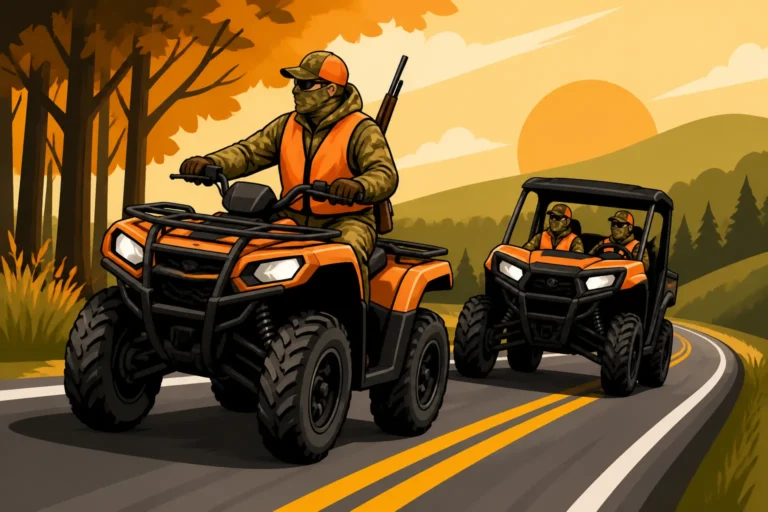
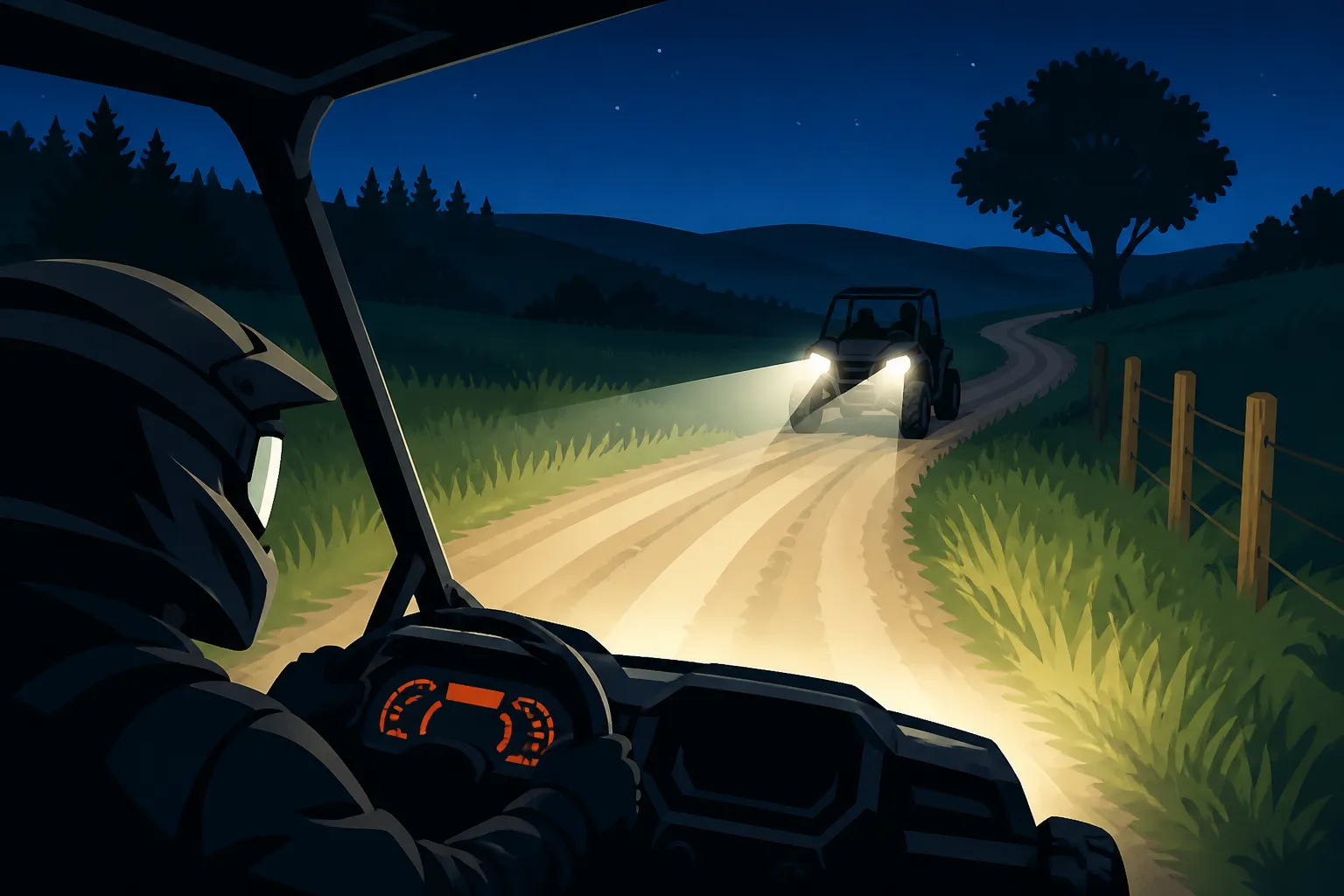
A side-by-side may feel substantial when you are sitting behind its steering wheel, but other road users can read it differently. Its outline is lower and narrower than a passenger vehicle’s, and its lights may sit below the sightline of a driver in a truck. On a dark road, an approaching driver may notice your headlights without immediately recognizing how far away you are or how quickly you are moving.
That problem gets worse on roads lined with trees, where headlights have less open space to illuminate the scene. A curving road in the North Georgia mountains can hide a UTV until the last moment; a flat stretch through pine country may encourage drivers to travel faster than the available visibility allows. Dust kicked up by a vehicle ahead, rain on a windshield, or a dip in the road can further shorten the time everyone has to react.
Being visible is not only about helping other drivers see you. It also helps you spot road edges, potholes, animals, branches, and people walking along the shoulder. If you cannot see far enough to stop safely, slowing down—or postponing the trip—is often the most useful safety choice.
Darkness changes the risks on different roads
“Rural road” can describe several very different settings: a narrow paved county road, a gravel road near a farm, or a state route passing through a small community. Each has its own traffic patterns and hazards. A gravel lane might have loose shoulders and no streetlights, while a paved road may bring faster traffic, hidden driveways, or a sharp bend beyond a stand of trees.
In parts of South Georgia, wildlife and unlit farm entrances may be the main concerns. In the foothills, elevation changes and tight curves can make it difficult to see what is beyond the headlight beam. Near towns such as Dahlonega or Dalton, a route may shift quickly from a dark stretch to a brighter intersection. Your eyes need time to adjust when you move between those conditions.
It is worth planning the route before sunset rather than assuming a familiar daytime road will be equally easy at night. Check whether the road is open to the machine, note sharp turns and crossings, and think about where you could safely pull off if visibility deteriorates. For a broader explanation of access rules, see [Georgia MPOHV Road Rules: County Roads Only] and [Georgia UTV Road Rules by County].
Improve your UTV’s visibility before the ride
Check every light and reflector
Before heading out, switch on the machine and inspect its lighting from several angles. Confirm that the headlights work, the rear lights are visible, and the lenses are not coated in mud, dust, or scratches that scatter the beam. A light can appear bright from the driver’s seat yet look faint from behind or from the side, so ask someone to walk around the machine while the lights are on.
Pay attention to details that are easy to overlook: a loose connector, a cracked lens, a light bar aimed too high, or a rear light partly blocked by a cargo box. Clean reflectors and other reflective surfaces, too. Reflectors can help another vehicle notice the machine when its headlights strike them, but they do not replace working lights or careful riding.
The table below is a practical pre-ride check. It is not a substitute for checking the equipment rules that apply to your machine and route.
| Visibility item | What to check | Why it matters |
|---|---|---|
| Headlights | Both operate, lenses are clean, beams are aimed to illuminate the road without glaring into oncoming traffic | Helps you see the road and gives approaching drivers a clear cue |
| Rear lights | Visible from behind and not blocked by cargo or accessories | Helps following drivers recognize your position |
| Reflectors | Clean, intact, and not covered by dirt or equipment | Can reflect another vehicle’s light back toward the driver |
| Mirrors | Secure, adjusted, and giving a useful view behind | Helps you monitor traffic without turning away from the road for long |
| Wiring and mounts | No loose wires, wobbling brackets, or intermittent connections | Reduces the chance of losing a light during the ride |
| Plate and markings | Not obscured by mud, a spare tire, or a cargo attachment | Keeps required identification visible where applicable |
Georgia’s road-use requirements and a machine’s registration status are separate questions from whether its lights look adequate. A registration does not automatically make every road legal to use, and adding lights does not make an otherwise ineligible vehicle road-ready. Review [Georgia Equipment a Road Machine Must Carry] and [Are Side-by-Sides Street Legal in Georgia?] before relying on a lighting upgrade as a complete solution.
Aim auxiliary lights for useful visibility
Auxiliary lighting can help when the factory beam leaves dark areas, but more brightness is not always better. A beam pointed too high can dazzle an oncoming driver. A very wide beam may light the trees beside the road while leaving distance ahead harder to judge. Think about where the light falls, not just how bright it looks while the machine is parked.
If you are considering additional lighting, confirm that the accessory is made for your specific machine and that the mounting position will not block factory lights, mirrors, or required markings. SuperATV is one brand riders may encounter when looking at UTV accessories; check the product’s fitment details and intended use rather than assuming any light will suit every model. Once installed, test the setup in a safe, controlled area—not by experimenting on a public road.
Use auxiliary lights thoughtfully around traffic. If a light has separate settings, understand how to operate them before you ride and use only the setting appropriate for the conditions. Avoid making sudden changes that could confuse another driver, and never treat a powerful beam as permission to travel faster than you can safely stop.
Ride so other road users can read your intentions
Give drivers time and space to recognize you
Visibility includes your position and behavior, not just your equipment. Keep a predictable line, avoid weaving, and leave enough space to respond if a vehicle ahead slows or turns. A driver approaching from behind may need extra time to recognize that your machine is moving more slowly than a car, especially on a dark, unlit stretch.
When another vehicle approaches, stay in your lane and avoid sudden moves toward the shoulder. A narrow shoulder can hide a ditch, loose gravel, or a culvert edge. If you need to stop, choose a safe place off the travel lane where the machine can be seen; do not pull over at a blind curve or just beyond the crest of a hill if you can avoid it.
Mirrors can help you keep track of traffic, but do not rely on them alone. Check your surroundings before turning or changing position, signal your intention where the machine is equipped to do so, and allow other drivers to respond. For more on visibility details, review [Rearview Mirrors on the Required List] and [Headlights, Brake Lights and Mirrors on the Checklist].
Adjust for weather, dust, and wildlife
A dry, clear night is not guaranteed to stay that way. Rain can make pavement shiny and reduce contrast; fog can scatter light back toward the driver; dust can hang in the air after another vehicle passes. In any of these conditions, reduce speed and leave more distance. If the road ahead disappears into glare or mist, find a safe place to stop rather than continuing by guesswork.
Wildlife is another reason to ride at a speed that leaves room for a reaction. Deer may appear at the roadside, and a sudden swerve can be more dangerous than a controlled slowdown. Scan the road edges as well as the pavement ahead, particularly near wooded areas, fields, and water. Keep both hands ready to steer and avoid staring only into the brightest part of the beam.
A visibility accessory can address only part of the problem. SuperATV and other manufacturers offer products aimed at UTV owners, but installation, aiming, and the riding conditions still matter. After fitting an accessory, take time to check whether it creates glare, shadows, or obstructions before riding in traffic.
Check the route and rules before leaving after dark
Confirm that the road is open to your machine
One of the most frustrating mistakes is preparing a UTV for night riding, then discovering that the route itself is not available to it. Georgia road access depends on the road and the applicable rules; a county road, a state highway, a city street, and a private subdivision road should not be treated as interchangeable. A tag or a set of headlights is not a blanket authorization to ride anywhere.
Before setting out, identify the road type and verify that the machine may use it. Pay particular attention to state routes and highway crossings, where the rules may differ from those for an eligible county road. You can read more in [Georgia County Road Systems and Where They Run], [Georgia State Routes You May Only Cross], and [Georgia Crossings at Designated Points].
If a route includes a road you are unsure about, choose a different route until you have confirmed the rules. This is especially important at night, when signs, road markings, and route boundaries can be harder to see. A short detour is a much better outcome than reaching a prohibited road and trying to improvise.
Use a pre-ride routine that catches small problems
A quick routine can prevent the kind of equipment issue that appears only after you have left home. Start with the machine parked on level ground. Check the lights, clean the lenses and reflectors, inspect mirrors and mounts, and make sure cargo does not block anything. Then walk around the machine and look at it from the perspective of someone approaching from the front, rear, and sides.
Next, test the controls you may need in traffic and confirm that you can reach them without fumbling. Set mirrors before moving, secure loose items, and make sure everyone riding knows the plan. If the route changes or visibility worsens, agree in advance that you will slow down, pull over somewhere safe, or turn back rather than press on because the destination is close.
A simple checklist can keep the departure calm:
- Confirm that the planned roads are open to your machine.
- Clean and test headlights, rear lights, and reflectors.
- Check that mirrors are secure and adjusted.
- Verify that cargo and accessories do not block lights or markings.
- Choose a speed that allows you to stop within the distance you can see.
- Reassess if rain, fog, dust, or glare reduces visibility.
- Stop or turn back if the route no longer feels safe.
SuperATV may be one option to consider when researching accessories for a compatible UTV, but no product replaces route planning, correct installation, and cautious riding. The safest night setup is the one that lets you see the road without making it harder for someone else to see you.
Disclaimer
This article is for general informational purposes only and does not constitute professional advice. Laws, prices and regulations vary by location and change over time. Consult a qualified professional for guidance on your specific situation.