Reflectors Worth Adding to a Machine
A UTV can feel highly visible in the driveway and almost disappear on a shaded Georgia road, especially at dusk, in rain, or against red-clay dust. Adding reflectors can help other drivers recognize your machine’s width and direction sooner. This guide explains which reflectors are useful, where to place them, and how to think about visibility without treating an accessory as proof of road legality.
Why reflectors matter on a Georgia ATV or UTV
Visibility is about being noticed early
A headlight helps a driver see what is ahead, while a reflector helps a machine stand out when another vehicle’s lights shine toward it. That distinction matters on a rural road where a driver may come around a bend, meet a rise, or approach a slower vehicle from behind. Reflectors can make the outline of a UTV easier to read before the driver is close enough to judge its size and position.
Conditions around Georgia can make that extra visibility useful. A machine may be dusty after a trail ride, muddy from a wet field, or parked beside a dark tree line. At twilight, a dark body panel can blend into the background. Reflective material gives approaching headlights something brighter to catch, although it cannot make a machine visible from every angle or through heavy rain, fog, or dust.
Reflectors are a supporting safety measure, not a substitute for using required lighting, signaling, or cautious road behavior. They also do not make an ATV or UTV street legal by themselves. Georgia road access, registration, insurance, and equipment rules involve separate questions. For background on those distinctions, see [Georgia ATV Road Access Law Explained] and [Georgia Equipment a Road Machine Must Carry].
Reflectors do not replace lights or legal requirements
A reflector does not shine on its own. It depends on light from another source, so it cannot replace working headlights, tail lamps, brake lights, or turn signals where those are required. It is also less useful when a vehicle approaches from an angle that does not illuminate it well.
Before adding accessories, confirm what applies to your particular machine and the road you plan to use. A Georgia MPOHV registration, for example, is not a blanket permission to ride on every public road. The route and applicable rules matter, as do insurance and equipment requirements. [Georgia MPOHV Registration and Proof of Insurance] and [Georgia Registration Versus Just Riding Private Land] are useful starting points when sorting out those separate issues.
Think of reflectors as one layer in a broader visibility plan. Clean lamps, a visible plate where applicable, suitable clothing for the operator, and predictable riding all contribute. Reflective tape can be a sensible addition, but it should not be used to disguise damaged lights or to suggest that a machine meets a legal checklist it has not actually met.
Which reflectors are worth considering
Rear red reflectors for approaching traffic
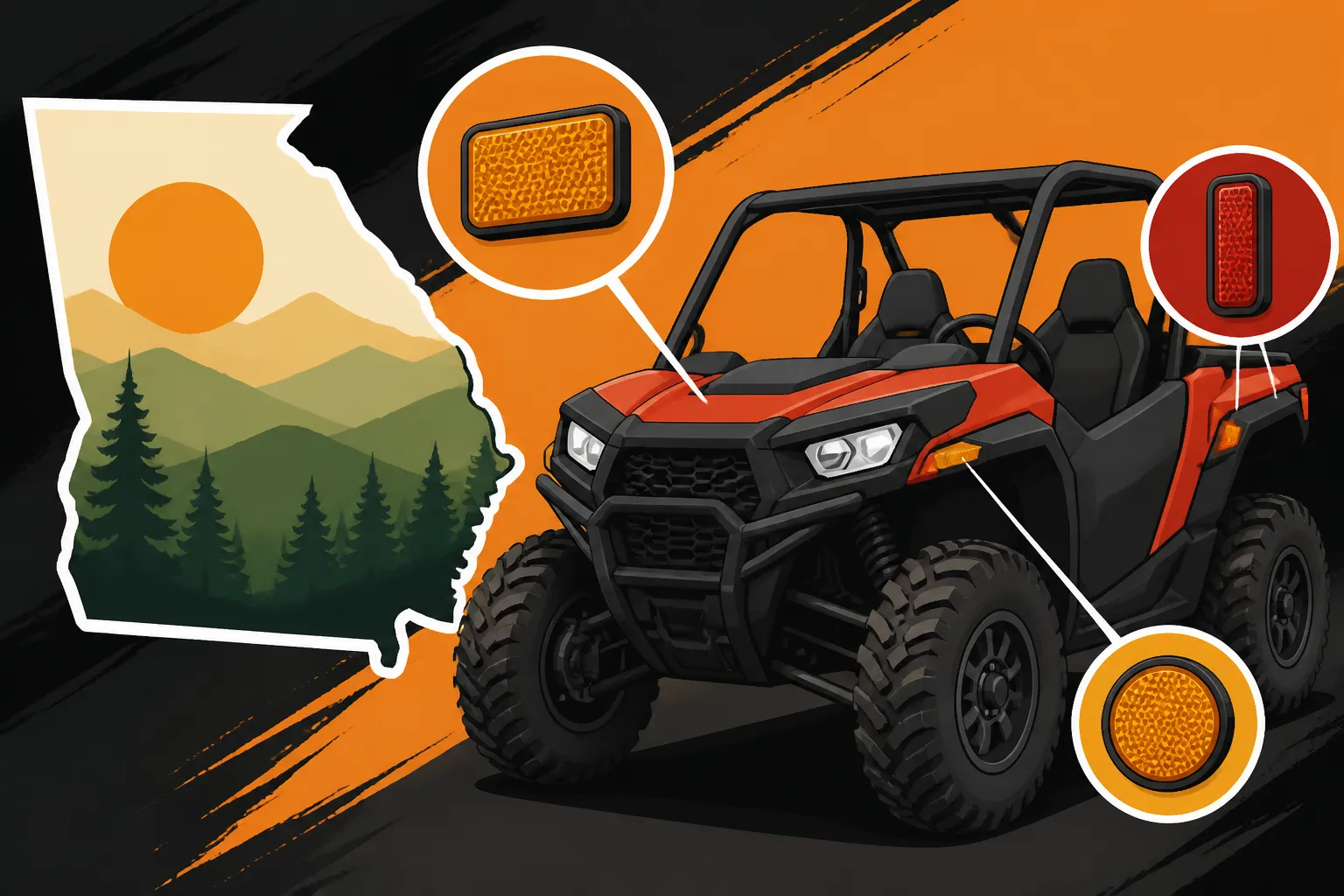
Red reflective material at the rear can help a driver approaching from behind notice the back of the machine. On a side-by-side, the rear bodywork, cargo area, or bumper may offer practical locations, provided the material remains visible when the tailgate, spare tire, cargo, or accessories are in place.
Keep the rear pattern easy to recognize. A pair of reflective areas spaced apart can help show that the machine has width, while a single small sticker tucked behind a spare tire may be difficult to see. Avoid placing reflectors where mud is likely to cover them quickly or where a strap, cooler, hunting gear, or tool bag will block them during ordinary use.
Do not confuse a red reflector with a red lamp. A reflector returns light from another vehicle; it does not glow steadily or illuminate when you press the brake. If you add reflective material, check that it does not cover a taillight, brake light, license plate, or other required item. [Georgia Plates for Off-Highway Vehicles] explains why plate visibility is a separate consideration.
Amber or white material at the front and sides
Reflective material near the front can help make the machine easier to notice as a vehicle approaches. Amber reflective surfaces are commonly used at the sides, while white or amber material may be considered toward the front depending on the product and applicable requirements. Since legal specifications can depend on the machine and use, do not assume that any color of tape satisfies a particular rule.
Side reflectors can be especially helpful on a wide machine. A driver approaching from a side road or driveway may see the side profile before the front or rear. Placing reflective material toward the front and rear portions of each side can help outline the machine’s length. On a four-seater, consider how the doors, fenders, and installed accessories affect what is visible from different angles.
Use a balanced arrangement rather than covering every panel. Too many competing stickers can make it harder to pick out the machine’s outline, and decorative graphics may not be reflective at all. If shopping for accessories from a supplier such as SuperATV, check the product description for whether an item is genuinely reflective, its intended location, and whether it fits your particular bodywork. Don’t infer road compliance from a product listing.
| Location | Reflector option to consider | Practical check |
|---|---|---|
| Rear body or bumper | Red reflective material | Confirm it remains visible with cargo and accessories installed |
| Front-facing bodywork | White or amber reflective material | Keep it clear of lamps and the plate |
| Side panels | Amber material, with rear-side red where appropriate | View the machine from a side road and at an angle |
| Trailer or removable cargo | Separate reflectors where suitable | Check visibility when the machine is loaded |
Reflective tape versus hard reflectors
Reflective tape can work well on flat, clean panels and can be cut to fit a particular shape. It is usually easy to apply, but its usefulness depends on the surface and installation. A panel coated with wax, mud, or oily residue may prevent the adhesive from holding. A rough, curved, or frequently flexing surface can also make tape peel or wrinkle.
Hard reflectors may be preferable where a flat mounting point is available and the machine sees frequent trail use. They can stand slightly proud of the bodywork, though that can expose them to branches, cargo, and impacts. Before drilling or fastening anything, check what is behind the panel and whether the installation could affect wiring, body strength, or a manufacturer’s warranty.
A product such as SuperATV reflective accessory material may be one option to investigate, but compare the actual item’s dimensions, adhesive or mounting method, and visibility from the angles that matter. Whether you choose tape or a hard reflector, the important practical test is whether it stays attached, stays clean enough to work, and remains visible after the machine is loaded for a ride.
Where to place reflectors without creating new problems
Start with a walk-around visibility check
Park the machine on level ground and look at it from the front, rear, and both sides. Then step back and view it from a diagonal angle, roughly as a driver might see it when approaching a driveway or turning onto a road. Note places hidden by tires, a spare wheel, a roof, a cargo box, or a mounted accessory.
For a side-by-side, inspect both sides with the doors shut and open. A reflector that is visible with the door closed may disappear when the door is open, and one placed on a removable panel may not be there after repairs. Also check the machine with the equipment you actually use: a plow, hunting gear, a rear rack, or a loaded cargo bed can change the outline considerably.
If the machine has a plate, make sure reflectors do not cover it or compete with its visibility. Plate location has its own requirements and practical limits; [Georgia Plate Placement on a Side-by-Side] can help you think through that part of the setup. Reflectors should add visibility, not make required markings harder to see.
Choose durable, visible mounting areas
Clean and dry the surface before applying adhesive material, following the product instructions. Avoid placing tape on a panel that is regularly rubbed by a seat, door, tie-down, or strap. A sticker that peels after a few rides is not a dependable visibility aid, and a loose strip can collect dirt or catch on nearby gear.
Think about how the machine is used. A farm UTV that spends its days near equipment may need reflectors positioned away from repeated contact with gates and implements. A trail machine may need a more protected location because brush and mud can quickly damage exposed accessories. A hunting setup may need reflectors that remain visible when a gun case or cooler is secured to the rear rack.
Measure the machine and look at the planned placement from a distance before committing. This is especially sensible on a wide machine, where a small reflector near the center may not reveal the full width. Registration eligibility itself can involve measurements and other standards; reflectors do not alter those criteria. See [Georgia's 80-Inch Width Limit for Registration] for one example of a separate eligibility question.
Keep reflectors clean and inspect them regularly
Dust and dried mud can reduce how much light a reflector returns. After a ride, wipe the reflective surfaces as part of the normal cleanup, particularly if the machine has been on wet clay or dusty roads. Use a cleaning method suitable for the material so you do not scratch or peel it.
Make a quick check before a road trip or a ride that could extend into dusk. Look for missing pieces, cracked housings, peeling edges, and reflectors blocked by newly added cargo. If a reflector is damaged, replace it rather than assuming a small remaining fragment is enough to be seen.
Night riding deserves extra attention. Reflectors may help when a vehicle’s headlights reach them, but they do not guarantee that a driver will see the machine in time. Slow down, use required lighting, avoid sudden movements, and make sure the route is permitted for your vehicle. For more context, read [Georgia Night Riding on a County Road] and [Georgia's July 2027 Sunset on Road Access].
A practical reflector setup checklist
Match the setup to how you ride
A machine used mostly on private land may still benefit from reflectors if it crosses driveways, works around farm vehicles, or is loaded near a road. A machine operated on roads where access is permitted needs a more deliberate inspection, but accessories alone cannot establish that the route is lawful or that the machine meets registration and equipment rules.
Before buying anything, decide what you want the reflectors to accomplish. If the main concern is being seen from behind, prioritize visible rear placement. If you regularly cross at an angle or work near traffic, side visibility may deserve more attention. If cargo often blocks the rear bodywork, plan for a location that remains uncovered when loaded.
SuperATV and other accessory sellers may offer different styles and fitments, but compare each item to your actual machine rather than buying based only on a broad “UTV” label. Make sure it suits the panel shape and expected exposure. A well-placed, durable reflector is more useful than a larger accessory that ends up hidden behind a spare tire.
Use this final inspection before riding
- Confirm that reflectors are visible from the front, rear, and both sides where you need them.
- Check the machine with its usual cargo and accessories installed.
- Make sure reflective material does not cover lights, a plate, or other required equipment.
- Verify that tape is firmly attached and hard reflectors are securely mounted.
- Clean away mud, dust, or residue that could reduce visibility.
- Check the legal status of the machine, route, insurance, and required equipment separately.
If you are unsure whether a particular reflector color, position, or product meets a legal requirement, ask the appropriate Georgia county tag office or law enforcement agency before relying on it. Reflectors are a practical visibility upgrade, but they are not a substitute for confirming road eligibility. For machine-specific registration questions, [Georgia Registration Questions Tag Offices Hear Most] is another useful related topic.
Disclaimer
This article is for general informational purposes only and does not constitute professional advice. Laws, prices and regulations vary by location and change over time. Consult a qualified professional for guidance on your specific situation.