Can You Drive a UTV on the Road in Georgia?
For many UTV owners across Georgia, the dream of taking their machine directly from the hunting camp or the trail to run a quick errand on a nearby public road can often feel like navigating a legal minefield. The truth is, the rules aren't always clear, leading to frustrating questions about what's allowed and what's definitely not. This comprehensive guide aims to unravel the complexities of Georgia's laws regarding UTVs and road use, so you can understand your options and avoid costly mistakes.
The Nuance of "Street Legal" for UTVs in Georgia
When folks talk about a vehicle being "street legal," they usually mean it can operate freely on any public road, much like a car or a truck. However, for UTVs (or side-by-sides as many call them), Georgia's approach is much more nuanced and conditional. It's not a blanket "yes" or "no," but rather a system of specific allowances and strict limitations. It's easy to get this wrong, and the consequences can range from a hefty fine to having your machine impounded, which nobody wants.
Understanding Georgia's MPOHV Classification
The key to understanding UTV road access in Georgia lies in a specific designation: the Multi-purpose Off-Highway Vehicle, or MPOHV. This isn't just a fancy name; it's a legal classification that allows certain types of utility terrain vehicles to be registered for limited road use. It’s important to realize that not all UTVs, and certainly not any ATV, will qualify. The state essentially created this category to differentiate between machines built primarily for recreation or work off-road and those that, with specific features, could safely share certain public roadways. Without this MPOHV designation, your UTV is strictly an off-road machine in Georgia. You can learn more about this classification in our detailed guide on [Georgia MPOHV Registration Explained]. This is a critical first step, because if your machine doesn't meet the MPOHV criteria, any discussion of road use is moot.
The Limited Scope of Road Access: County Roads Only
One of the biggest misconceptions is that once a UTV is registered as an MPOHV, it can go anywhere a car can. This is absolutely not the case. Georgia's law is very clear: MPOHVs are generally restricted to county roads only. This means you cannot legally operate your registered UTV on state highways, interstates, or most municipal (city) streets unless a specific local ordinance in that town explicitly permits it. Many UTV owners living in rural areas find this distinction crucial, as their day-to-day needs might involve traversing short distances on county roads. Trying to cross a busy state route or taking a shortcut through town on an unapproved street can land you in serious trouble with local law enforcement. It's also vital to understand that this limited access often comes with speed restrictions and other rules that differ significantly from regular vehicle laws. For a deeper dive into these specifics, check out [Georgia MPOHV Road Rules: County Roads Only].
Eligibility and Equipment Requirements for Road Use
Before you even think about heading to the tag office, your UTV needs to meet a very specific set of criteria to be eligible for MPOHV registration in Georgia. These aren't suggestions; they are hard requirements designed to ensure a basic level of safety for machines sharing the road with other vehicles. Many UTV owners are surprised by how stringent these requirements are, especially if they've purchased a machine primarily for off-road adventures. Companies like SuperATV offer a wide range of aftermarket accessories, and while some are for performance, others like mirrors or specific harnesses might help you get closer to meeting certain safety criteria.
Key Machine Features Georgia Mandates
Georgia law outlines precise physical characteristics your UTV must possess to be considered an MPOHV. These are designed to ensure the machine is stable enough for road use and doesn't pose an undue hazard. Here’s a breakdown of the critical dimensions and features:
- Width: Your UTV must be 80 inches or less in overall width. This is a common point of disqualification for some wider sport models or those with aftermarket wide-stance kits. Imagine trying to navigate narrow county roads; this limit helps ensure you don't take up too much of the lane. We cover this extensively in [Georgia's 80-Inch Width Limit for Registration].
- Payload Capacity: The machine must have a payload capacity of at least 350 pounds. This generally excludes smaller, lighter utility vehicles that might not be designed to carry much more than a driver. This ensures the UTV can handle a reasonable load without compromising stability. You can find more information on this requirement in [Georgia's 350-Pound Payload Requirement].
- Gross Vehicle Weight: The UTV's gross vehicle weight (GVW) must not exceed 4,000 pounds. This includes the vehicle itself, plus its maximum payload. This limit prevents heavier, truck-like machines from being registered as MPOHVs. For more details on this, see [Georgia's 4,000-Pound Gross Weight Ceiling].
- Steering Mechanism: It must be equipped with a steering wheel, not handlebars. This immediately disqualifies all traditional ATVs, dirt bikes, and three-wheelers, which are built with handlebars and a straddle-style seat. The steering wheel implies a different posture and control mechanism, more akin to a car. Check out [Georgia Requires a Steering Wheel, Not Handlebars] for more insight.
- Speed Capability: The UTV needs to be capable of speeds between 25 miles per hour and 65 miles per hour. Machines that are too slow would impede traffic, while those designed for extremely high speeds might be considered too dangerous for general road use under this classification. This range ensures it can keep up with the flow of traffic on rural county roads without becoming a hazard. We explain this in detail in [Georgia's 25 to 65 mph Speed Requirement].
- Seating: It must have a non-straddle seat, meaning a bench or bucket seat where the operator and passengers sit in the vehicle, not on it like a motorcycle or ATV. This is another key differentiator from traditional ATVs.
- Seat Belts: Factory-installed seat belts are required for all designated seating positions. This is a fundamental safety feature for any vehicle operating on public roads, no matter how limited its access. Without working seat belts for everyone the machine is designed to carry, it simply won't qualify. Our article [Georgia Requires Seat Belts on a Registered Machine] delves into this.
- Brakes and Lights: The UTV must have headlights, taillights, brake lights, and at least one rearview mirror. These are standard safety features that allow the machine to be seen and to signal its intentions to other drivers. While aftermarket lighting or mirror kits from brands like SuperATV can enhance visibility, ensure your machine has the basic factory-equipped necessities.
- Manufacturer Date: There's also a date cutoff: the machine must have been manufactured on or after January 1, 2000. This often catches people off guard, as older, well-maintained UTVs might still be disqualified based purely on their build year.
Required Safety Gear and Driver Qualifications
Beyond the machine itself, there are requirements for the operator and for carrying the right documentation. Simply having a compliant UTV isn't enough; you need to be prepared to operate it safely and legally.
- Driver's License: Any person operating a registered MPOHV on a public road in Georgia must possess a valid driver's license. This isn't a leisure activity that anyone can jump into; it's driving a motor vehicle on a public thoroughfare, and the state expects a licensed driver at the wheel. There are no special "MPOHV licenses" – a standard Class C driver's license is required.
- Insurance: Liability insurance is mandatory for any MPOHV registered for road use. Just like with your car, this protects you and others in the event of an accident. You will need to provide proof of insurance when registering your machine and maintain continuous coverage. A lapse in insurance can lead to registration suspension. We break down these requirements in [Georgia Liability Insurance Tied to Registration].
- Helmet Law (for minors): While adults are generally not required to wear helmets when operating a registered MPOHV on a county road, anyone under the age of 18 must wear a DOT-approved helmet. This applies even on county roads. It’s a critical safety measure for younger riders.
- Plate Placement: Once registered, you’ll receive a distinctive MPOHV license plate. This plate must be displayed on the rear of the machine, clearly visible. Failure to properly display the plate can result in a citation.
Navigating the Registration Process
So, your UTV meets all the physical and operational requirements – that's a huge hurdle cleared! Now comes the administrative part: getting it officially registered. This involves a trip to your local county tag office and ensuring you have all the necessary paperwork in order. It can feel a bit daunting, but understanding the steps makes it much smoother.
Steps at Your Georgia County Tag Office
The process for MPOHV registration is handled at your local county tag office, just like registering a car. It's not an online-only process, and you'll need to be prepared with specific documents.
-
Gather Your Paperwork: Before you leave home, make sure you have all the essential documents:
- Proof of Ownership: This is typically a Manufacturer's Certificate of Origin (MCO/MSO) for a new machine, or a bill of sale if you purchased it used. For used machines without an MCO, Georgia has specific rules, sometimes requiring an affidavit of ownership. Check out [Proving You Own an ATV in Georgia Without a Title] for more details on ownership proof.
- Proof of Georgia Residency: A valid Georgia driver's license or state ID is usually sufficient.
- Proof of Insurance: As mentioned, you need current liability insurance that meets Georgia's minimum requirements. Your insurance card or declarations page will work.
- Completed Form MV-OHV Affidavit: This is a crucial document where you attest that your UTV meets all the MPOHV eligibility criteria. Be honest and accurate, as false statements can have serious legal repercussions. This form is central to the entire process. Our article [Georgia Form MV-OHV and What It Asks] provides a line-by-line breakdown.
- Payment for Fees: There are registration fees, and potentially a local sales tax component, though UTVs do not incur TAVT (Title Ad Valorem Tax) because they are not titled vehicles. Prepare to pay these fees at the time of registration. For the specific costs, see [Georgia MPOHV Registration Cost].
-
Visit Your County Tag Office: Go to the tag office in the county where you reside. The staff there are familiar with the MPOHV registration process, as it officially started in December 2023. They will review your paperwork and verify that your machine meets the criteria based on your signed affidavit. You can find more practical steps in [Georgia County Tag Office Steps for an MPOHV].
-
Potential Inspection: While not always required for every registration, some tag offices or law enforcement may request an inspection to verify that your machine indeed meets the criteria outlined in the MV-OHV affidavit, especially if there are any discrepancies or doubts. This can include checking the VIN, width, or seat belt presence.
-
Receive Your Plate and Decal: Once approved and fees are paid, you will receive your MPOHV license plate and a registration decal. Affix the plate securely to the rear of your UTV and the decal in the designated spot, usually on the plate itself.
Ongoing Responsibilities: Renewals and Compliance
Getting your UTV registered is not a one-and-done deal. To maintain its legal status for road use, you have ongoing responsibilities.
- Annual Renewal: MPOHV registrations in Georgia must be renewed annually. This typically involves paying a renewal fee and re-verifying your insurance coverage. You'll usually receive a renewal notice, but it's ultimately your responsibility to ensure it's renewed on time. Missing the deadline can lead to penalties or even suspension of your ability to operate it on public roads. For details on this, refer to [Georgia MPOHV Renewal Each Year].
- Continuous Insurance: You must maintain continuous liability insurance coverage. If your insurance lapses, your registration can be suspended, meaning you cannot legally operate your UTV on county roads.
- Maintain Compliance: It’s critical that your UTV continues to meet all the MPOHV requirements throughout its registration period. If you modify your machine in a way that makes it non-compliant (e.g., install a lift kit that makes it too wide), it could jeopardize your registration. Remember that companies like SuperATV sell a variety of aftermarket parts, but always ensure any modifications keep your machine within Georgia's legal limits for MPOHV status.
Important Restrictions and What the Future Holds
Even with a registered MPOHV plate, your road access is far from unlimited. There are very specific restrictions you need to be aware of, as well as a significant looming change that will impact all registered UTV owners in Georgia. Ignoring these details can lead to severe penalties.
Roads That Remain Off-Limits and Why
As we've touched on, a registered MPOHV is not a car, and it cannot simply go anywhere a car can.
- State Highways (State Routes): These are generally off-limits. They are designed for higher speeds and volumes of traffic, which MPOHVs are not equipped to handle safely. There are very limited exceptions, such as crossing a state highway at a designated intersection, but prolonged travel on them is prohibited.
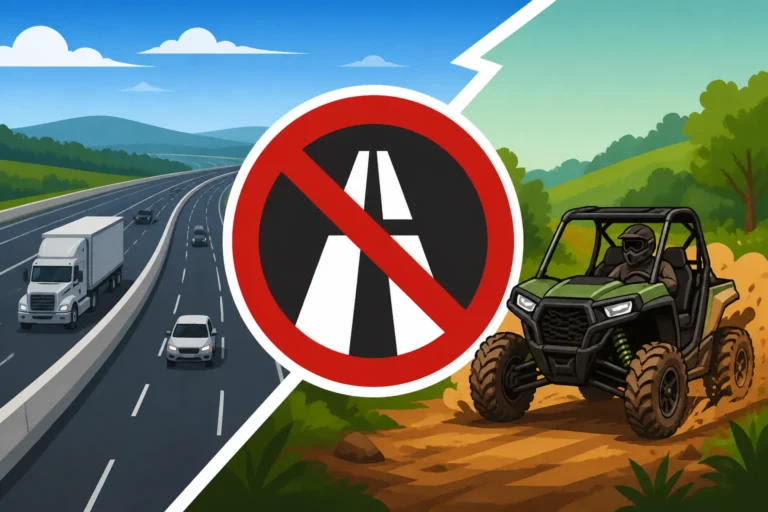
- Interstates: Absolutely forbidden. MPOHVs are explicitly prohibited from interstates for obvious safety reasons related to speed and traffic.
- Municipal (City) Streets: Unless a specific city or town has passed its own ordinance explicitly allowing MPOHV use on certain streets, they are generally off-limits. Cities often have their own rules regarding golf carts and other Personal Transportation Vehicles (PTVs), but these typically do not extend to MPOHVs without specific legislation. Always check local city ordinances.
- Private Roads Without Permission: Regardless of your MPOHV status, you cannot legally ride on private roads or property without the owner's express permission. Registration only grants access to public county roads.
Law enforcement officers are trained to recognize the difference between a county road, a state highway, and a city street. Pulling onto the wrong type of road can quickly result in a ticket and potential impoundment.
The Looming Sunset Date for Road Access
Perhaps the most critical piece of information for any Georgia UTV owner considering MPOHV registration is the upcoming "sunset" date for this specific road access. The legislation that created the MPOHV category and allowed for limited county road use for these vehicles is set to expire on July 1, 2027.
What does this mean? Unless the Georgia General Assembly takes action to renew, amend, or extend this law, the ability to register and legally operate an MPOHV on county roads will cease on that date. While it's impossible to predict future legislative action, UTV owners need to be fully aware that this provision is not permanent. This impending date has significant implications for how long you can expect to use your machine on public roads and might influence your decision to purchase or register. We strongly encourage you to read more about this in [Georgia's July 2027 Sunset on Road Access] to understand the full implications.
Before that date, enjoy the access you have, but always stay informed about any legislative updates that might affect the future of MPOHV road use in Georgia.
Summary of Georgia MPOHV Eligibility Requirements
To help visualize the criteria, here's a quick reference table:
| Feature/Requirement | Eligible MPOHV Status | Ineligible Status |
|---|---|---|
| Width | 80 inches or less | Over 80 inches (e.g., some wide sport UTVs) |
| Payload Capacity | 350 pounds or more | Less than 350 pounds (e.g., very light utility vehicles) |
| Gross Vehicle Weight | 4,000 pounds or less | Over 4,000 pounds (e.g., heavier, truck-like machines) |
| Steering | Steering wheel | Handlebars (e.g., ATVs, dirt bikes) |
| Speed Range | 25 mph to 65 mph (capable) | Below 25 mph (too slow) or Above 65 mph (too fast for classification) |
| Seating | Non-straddle seat (bench/bucket) | Straddle seat (like a motorcycle/ATV) |
| Seat Belts | Factory-installed for all positions | Missing or non-functional seat belts |
| Lights/Mirrors | Headlights, taillights, brake lights, 1+ rearview mirror | Missing any required lighting or mirrors |
| Manufacture Date | January 1, 2000, or later | Built before January 1, 2000 |
| Operator License | Valid Georgia Driver's License | No license, suspended license, or learner's permit only |
| Insurance | Georgia liability insurance | No insurance or lapsed coverage |
| Road Access | County roads only (unless local ordinance states otherwise) | State highways, interstates, most city streets, private land without permission |
This table provides a quick overview, but always refer to the specific legal definitions and requirements when making decisions about your UTV.
Disclaimer
This article is for general informational purposes only and does not constitute professional advice. Laws, prices and regulations vary by location and change over time. Consult a qualified professional for guidance on your specific situation.