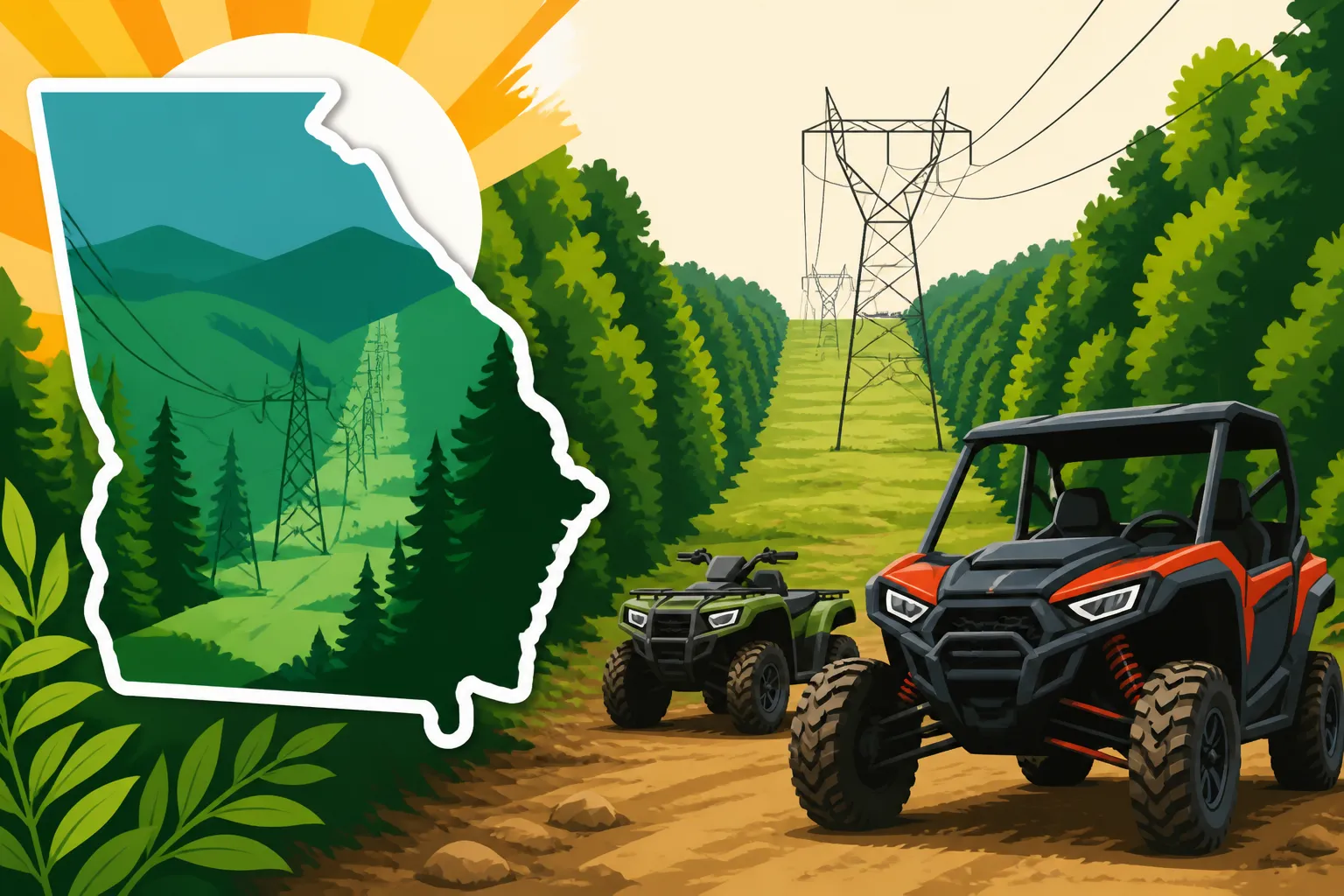
Georgia Rules for Riding a Power Line Cut
You can see it from the road: a wide, mowed strip of red clay running straight over the hills under a line of steel towers, and it looks like the perfect ATV highway. The trouble is that most riders have no idea who actually controls that ground. This guide explains Georgia’s rules for riding a power line cut, who can give permission, and how to ride one safely.
Who Actually Controls a Georgia Power Line Cut
Almost every frustrated rider I talk to starts from the same assumption. The cut is cleared, it is maintained, there are no houses on it, and the power company obviously owns it, so it must be some kind of public or semi-public space. I understand why it feels that way. When you grow up in rural Georgia, you see trucks from the local EMC or the transmission company running those corridors, you see the brush hog crews, and you see deer hunters sitting on the edges every November. It feels like common ground.
In reality, a power line cut is usually one of the most legally complicated strips of land you can ride on. It almost always involves at least two parties with rights to the same ground, and neither of them has given you anything just by leaving the brush short.
The Easement Versus the Land Underneath
In the vast majority of cases, the utility does not own the land under the wires. What it owns is an easement, which is a recorded right to use someone else’s land for a specific purpose. A typical transmission or distribution easement lets the utility build and keep towers or poles on the property, string conductors, clear and maintain vegetation, and drive its trucks and equipment in and out to do that work. The underlying property still belongs to the landowner, whether that is a family farm, a timber company, a hunting club landlord, a developer, or a county.
That distinction matters more than anything else in this article. An easement for electric transmission is a narrow grant. It gives the utility the right to do utility things. It does not give the general public a right to ride, hunt, camp, or drive there, and it usually does not let the utility hand that right out to the public either. So when a rider says “the power company doesn’t care if I ride it,” that may well be true, and it still does not answer the question, because the person whose permission you need is very often the landowner.
If you want the broader version of this idea, our breakdown of Georgia Rules for Riding a Utility Easement walks through how easements work across water lines, sewer lines, and phone corridors too. The short version is that the paper granting the easement controls what the utility can do, and Georgia property law controls everything else.
When the Utility Does Own the Strip
There are exceptions. Some corridors, especially older transmission routes or substations and the land immediately around them, were bought outright in fee simple. In those spots, the utility is the landowner, and its rules are the rules. Most utilities post their substations and fenced equipment heavily, and they treat unauthorized entry there as a security matter, not a recreation question. Even on corridor land they own outright, utilities generally do not invite the public to ride. Their liability exposure, the cost of repairing ruts around tower footings, and the security concerns around critical infrastructure all push in the same direction.
So in practice, the answer to “who controls this cut” breaks down into a few patterns:
| Situation on the Ground | Who Controls Access | What You Need Before Riding |
|---|---|---|
| Easement across private farm or timber land | The landowner, subject to the utility’s easement | Landowner permission, ideally in writing |
| Corridor owned outright by the utility | The utility | Written authorization from the utility, which is rarely given |
| Easement across a hunting club lease | The landowner, often with lease terms that limit guests | Permission from the landowner and compliance with the club’s lease |
| Easement across public land such as a WMA or national forest | The managing agency | Follow the agency’s rules, which usually limit machines to designated roads or trails |
| Easement across a subdivision common area | The HOA or property owners’ association | Association rules, which very often ban machines |
| Easement across your own land | You, subject to the utility’s easement | Nothing extra, but you still cannot interfere with utility work |
How to Find Out Who Owns a Stretch
Here is the part that trips people up: you cannot tell who owns a cut by looking at it. The towers look the same whether the land is owned by a cattle farmer or by a forestry investment fund. Fortunately, Georgia makes property ownership information fairly easy to find if you know where to look.
- Note the nearest road crossing and the county. The cut usually crosses a public road somewhere, and that crossing gives you a reference point.
- Open the county tax assessor’s online parcel map, which most Georgia counties provide, and find the parcels on either side of the crossing.
- Follow the corridor across the map. Each parcel the line crosses usually has a different owner, and the cut can pass through a dozen parcels in a few miles.
- Write down the owner names and mailing addresses shown on the parcel records.
- Check whether any of the parcels belong to a timber company, a government agency, or a club, since each of those has its own process for access.
- Reach out to each owner you would cross. A ride that only stays on one parcel needs one yes. A ride that crosses five parcels needs five.
That last step is where most people stop, because it turns a casual afternoon ride into a real project. That frustration is completely valid. But it is also the only way to ride a cut without risking a trespass charge, a confrontation with a landowner who has been dealing with strangers on his land for years, or a ruined relationship with neighbors you may need later.
What Georgia Law Says About Riding a Power Line Cut
There is no single Georgia statute titled “power line cut riding.” Instead, the rules come from several pieces of law working together: criminal trespass, the rules on where off-highway machines can operate, helmet and age rules, and the general rules on interfering with utility property. Once you see how they fit together, the picture is actually fairly clear.
Criminal Trespass Is the Main Risk
Georgia’s criminal trespass law is the piece that most often applies to cut riders. In broad terms, a person commits criminal trespass when they knowingly enter someone else’s land after receiving notice that entry is forbidden, or when they remain on the land after being told to leave. Notice can come in several forms, including a verbal warning from the owner or an authorized person, a written notice, or posted signs at the boundaries. The same statute also covers intentionally damaging another person’s property in a way that does not rise to criminal damage, which matters when your tires are tearing up a pasture or a mowed corridor.
Criminal trespass in Georgia is a misdemeanor. That sounds minor until you think about what comes with it: a court date, possible fines, possible probation, and a record. On top of that, landowners can pursue civil claims for the cost of repairing ruts, washed-out terraces, cut fences, or damaged gates. Our deeper look at Georgia Trespass Law for ATV Riders covers the posting rules, the difference between notice and no notice, and what a deputy typically does when a landowner calls.
One thing I want to stress, because I hear it so often: “There was no sign” is not a permission slip. A landowner who has never posted his land can still tell you to leave, and once he does, staying or coming back is trespass. And many Georgia landowners consider a gate, a cable across the cut, or a fence line crossing the corridor to be plenty of notice.
Where Off-Highway Machines Are Allowed to Operate
The second layer is the general rule about where an ATV or UTV can run at all. Off-highway machines in Georgia are mainly designed and regulated for off-road use, which means private land with permission, private parks, and designated public trails. Our overview of Georgia ATV Rules on Private Property explains the baseline: on private land, the owner’s permission is the starting point, and state rules on helmets, age, and safe operation still follow you.
A power line cut becomes trickier where it meets public roads. Corridors cross county roads, state routes, and sometimes divided highways. Riding along the shoulder to get from one section of cut to another, or ripping straight across a state route at an angle where the cut happens to meet it, is exactly where riders get ticketed. If you are on a machine that is registered under Georgia’s multipurpose off-highway vehicle program, county road use comes with its own conditions, and state routes may generally only be crossed, not ridden. An ordinary quad is not a road machine at all. Before you plan a ride that hops across pavement, read Crossing a Georgia State Highway on a UTV so you understand what a legal crossing looks like and when it is off limits entirely.
Utility Equipment Is Off Limits
The third layer is the utility’s own property: towers, poles, guy wires, anchors, gates, locks, markers, and access roads. Damaging any of it can bring criminal and civil consequences, and some utility facilities are treated as critical infrastructure with stronger protection. Even if a landowner gives you permission to ride his section of a cut, that permission does not extend to climbing, bumping, tying off to, or riding through utility equipment.
This shows up in everyday ways that riders do not think about:
- Using a tower leg or an anchor as a winch point when you are stuck.
- Driving between a guy wire and its pole, or catching a wire with a roll cage or a gun rack.
- Cutting or unhooking a cable gate the utility installed to keep vehicles out.
- Removing or bending a marker post or a warning sign.
- Spinning tires near a tower footing until the soil around the concrete washes out.
Every one of those can turn a permitted ride into a damage claim, and some of them can be dangerous enough to end in a hospital visit.
Helmets, Ages, and the Rules That Follow You Everywhere
The fourth layer is the set of operating rules that apply no matter whose land you are on. Georgia requires riders under 18 to wear a helmet when operating or riding an ATV, and that rule reaches private land, not just public trails, apart from narrow exemptions for things like certain agricultural work. Our article on Georgia Under-18 Helmet Rule on Private Land explains exactly how that rule reaches the back forty. Engine size and age guidance for younger riders also apply, and they are worth taking seriously on a corridor where speeds climb fast on long straightaways.
Alcohol is the other one. A long, empty cut on a Saturday evening invites cooler-in-the-bed riding, and a crash out there is serious because help is often far away. Georgia law and common sense both say to keep alcohol out of the equation when you are operating a machine.
The Legal Pieces at a Glance
| Legal Issue | What Triggers It on a Cut | Practical Takeaway |
|---|---|---|
| Criminal trespass | Riding after notice, posted signs, or being told to leave | Get permission from each landowner whose parcel you cross |
| Damage to property | Ruts, washed terraces, broken gates, cut fences | Ride dry ground, stay on the existing track, close gates |
| Utility equipment | Contact with towers, anchors, guy wires, cable gates | Treat every utility structure as untouchable |
| Road rules | Riding shoulders or crossing state routes between sections | Plan crossings in advance and avoid pavement on unregistered machines |
| Helmet and age rules | Riders under 18 without helmets, kids on oversized machines | Apply the same safety rules you would on a park trail |
| Public land rules | Corridors through WMAs or national forest land | Follow the agency’s designated road and trail rules |
How to Get Permission to Ride a Cut
This is the section most riders skip, and it is the one that actually gets you riding. Landowners in Georgia are not uniformly hostile to ATVs. Plenty of farmers ride themselves, and plenty of them would rather know who is on their land than have strangers sneaking through. The trick is asking the right way and making it easy for them to say yes.
Asking the Landowner the Right Way
I have watched people get a flat no for asking the wrong way and a happy yes for asking the right way, on the very same farm. The difference is almost always about respect and specificity. A vague “can we ride your land sometime” sounds like an invitation to every kid in the county. A clear, limited request sounds like a neighbor.
Here is a process that works:
- Visit in person if you can, at a reasonable hour, and do not show up on your machine. Pull into the driveway in a truck, knock on the door, and introduce yourself with your name and where you live.
- Be specific about what you want. Say which section of the cut you want to ride, roughly how many machines, and how often. “Two machines, my son and me, on the stretch between Old Mill Road and the creek, a couple of Saturday afternoons a month” is far easier to approve than an open-ended request.
- Ask about the rules before they have to tell you. Ask which gates to use, whether there is cattle or crops to avoid, whether there are hunters on the land during season, and whether there are days they do not want anyone out there.
- Offer something real in return. That might be help mending fence, reporting trash dumpers, checking on the back of the property for them, or simply letting them know when you see something wrong.
- Ask whether they are comfortable putting the permission in writing. A short signed note with names, dates, and the area is enough for most people.
- Exchange phone numbers so they can reach you, and so you can show a deputy who to call if anyone questions you.
- Follow up after your first ride, thank them, and mention anything you noticed, like a downed tree or a gap in the fence.
A written permission note matters for more than legal cover. It also protects the landowner, because it limits what you are allowed to do and makes it clear you are there by invitation, not by assumption. If a neighbor or deputy stops you, you are not stuck explaining that “Mr. Daniels said it was fine back in March.”
The Recreational Use Angle Landowners Worry About
The question you will hear most often from a hesitant landowner is some version of “What happens if you get hurt out there?” It is a fair worry. Georgia has a recreational property law that is designed to encourage landowners to open their land for free recreation by limiting their liability to people who use it without paying, with important exceptions, such as willful or malicious failure to guard or warn against a dangerous condition. When the landowner charges a fee for access, that protection can change significantly.
You do not need to give a landowner a law lecture, and you should not pretend to be their lawyer. But you can mention that you understand you ride at your own risk, that you carry insurance on your machine, and that you are not asking them to take responsibility for you. Many landowners also appreciate a signed acknowledgment that you accept the risks of riding. If the landowner wants to know more, point them to their own attorney or their farm insurance agent. That kind of respect goes a long way.
Hunting Clubs and Timber Land
A big share of Georgia’s power line corridors run through land that is either owned by timber companies or leased to hunting clubs, sometimes both. That adds layers you need to understand.
If the land is leased to a hunting club, the club usually has exclusive hunting rights and often has rules about guests, machines, and when members can be on the property. The landowner may not be able to give you permission without stepping on the club’s lease, and the club usually cannot give you permission to do anything beyond what its lease allows. Your best path is to contact both, starting with the club president, and be prepared for a “no” during deer season, when a cut is basically a shooting lane for every stand along its edge. Riding a cut during an active hunt is how people get hurt and how clubs lose their tempers. Our guide on Riding a Quad to a Georgia Deer Stand covers how club members typically handle machine use and what courtesy looks like around stands.
Timber company land is its own world. Many large owners require formal access agreements, recreation leases, or written permits, and they rarely allow casual riding by the general public. The haul roads they build often connect with power line corridors, and riders blur the two. If you want the details on haul roads specifically, see Georgia Rules for Riding a Timber Road, which explains why logging roads are not public roads even when they are wide and gravel.
Comparing Your Options for Legal Cut Riding
| Access Path | How Common It Is | Typical Restrictions | Effort Required |
|---|---|---|---|
| Riding a cut on your own land | Common for rural owners | Cannot interfere with utility work or equipment | Low |
| Written permission from one landowner | Fairly common with a respectful ask | Limited to that parcel, often limited to certain days | Moderate |
| Permission across several parcels | Less common | Each owner sets terms, gates and boundaries vary | High |
| Hunting club membership with machine use | Common in rural counties | Club rules, season restrictions, guest limits | Moderate to high |
| Timber company recreation access | Varies by company | Written agreements, possible fees, limited areas | High |
| Public land corridors | Limited | Agency rules usually prohibit riding outside designated roads and trails | Low effort, but little legal riding |
Riding a Power Line Cut Safely Once You Have Permission
Getting a yes is the start, not the finish. A power line cut is not a groomed trail, and the features that make it look inviting from the road are the same features that injure riders. Long sight lines make you go faster. Smooth sections end in sudden washouts. Tall grass hides stumps, rocks, and holes. And there is electrical infrastructure overhead and anchored into the ground around you.
Hazards Unique to a Cut
I have ridden enough corridors in the Piedmont and the North Georgia foothills to have a healthy fear of a few things. These are the ones I watch for every single time:
Guy wires and anchors. Poles and some structures are held in place by steel guy wires that run at an angle down to anchors buried in the ground. In tall grass or late-afternoon light, a guy wire can be nearly invisible. Hitting one at speed on a quad can throw a rider, and catching one with a UTV roll cage can stop the machine violently. Learn where every guy wire is on your section and give them a wide berth.
Erosion bars and water breaks. Utilities and landowners often build mounds of soil across the slope, called water bars or water breaks, to keep the corridor from eroding into gullies. At low speed they are a gentle bump. At speed, especially coming over a crest, they are ramps. Many riders get injured on water bars because they look like nothing until the front wheels hit them.
Fall-line climbs. Power lines run in straight lines regardless of terrain, which means many cuts go straight up and down hills rather than switching back across them. Those fall-line climbs on Georgia red clay can be brutally slick when wet and loose when dry. A rollback on a steep cut climb is a real risk, especially on a quad.
Stumps, rocks, and holes. Mowing crews leave stumps at different heights, and grass grows up around them. Armadillo and hog rooting leave holes. Old fence posts and survey markers hide in the grass.
Creek crossings and wet bottoms. Cuts cross streams and drainage ditches without regard for where a good crossing might be. Many of those bottoms stay soft long after rain, and rutting them up is one of the fastest ways to lose landowner permission.
Gates and cables. Gates across a cut may be closed one day and open the next. Cable gates in particular can be very hard to see.
Other users. Hunters, utility crews, landowners checking cows, hikers, and other riders all use these corridors. A long straight cut invites speed, and a closing speed of two machines on a blind crest is dangerous.
Electrical Safety You Cannot Ignore
Most of the time, the overhead lines on a cut are so high above you that they are not a direct hazard during normal riding. The danger comes from abnormal situations, and riders need to know exactly what to do in each.
If you see a downed line, a sagging line, a broken pole, or a tower with damage, stay far away from it, keep everyone else away, and call the utility and 911. Do not ride over or near a downed conductor, and do not assume it is dead because it is on the ground and not sparking. Energized lines on the ground can make the soil around them dangerous too. Stay back a generous distance, at least the width of a large truck or more, and keep children and pets well clear.
Never raise anything tall under a line. That includes whip flags on tall poles, antennas, ladders for deer stands, and anything carried upright in a UTV bed. Never climb a tower or a pole. And if you are riding after a storm, assume the corridor may have damaged equipment and slow way down. If storm cleanup is the reason you are out there, read Georgia Rules for Riding During a Storm Cleanup first, because Georgia storm cleanup brings its own mix of utility crews, downed trees, and line hazards.
Gear and Machine Setup for Corridor Riding
The cut is not the place to show up with a bare machine and a prayer. Because help is often far away, I set up for corridor riding a little more seriously than for a park ride.
On a UTV, a solid roof and cage help with low branches near the edges and with rollovers on steep climbs, and full doors keep legs inside the machine when you hit a hidden stump. A lot of riders I know run SuperATV doors and roofs for exactly that reason, because corridor riding throws more side hazards at you than a groomed park trail does. Skid plates are another underrated upgrade. Stumps and rock outcrops in tall grass are hard to see, and a cracked oil pan or crushed CV boot ten miles from the truck makes for a long walk.
A winch is close to mandatory if your section has fall-line clay climbs or wet creek bottoms. Just remember that you can never use a tower, anchor, pole, or guy wire as your winch point. Carry a tree saver strap and use a healthy tree at the edge of the corridor instead, or a second machine. Riders who pick up a SuperATV winch for this kind of terrain usually find it pays for itself the first time a clay climb turns to grease after an afternoon shower.
Lighting matters too. Cuts are open to the sky and stay brighter than the woods around them at dusk, which tricks people into staying out later than they planned. Once you lose light, the water bars, stumps, and guy wires all become much harder to see. A light bar or a pair of SuperATV LED pods helps if you get caught out, and Georgia’s rules for riding at night are covered in Georgia Rules for Riding After Dark. My honest advice is still to plan your rides so you are back at the truck before sunset.
Here is my basic kit for a power line cut:
| Item | Why It Matters on a Cut |
|---|---|
| DOT-rated helmet and eye protection | Required for riders under 18 and smart for everyone, especially with stumps and low branches |
| Written permission note and phone numbers | Lets a deputy or neighbor confirm you belong there |
| Charged phone and a backup battery | Corridors often cross dead zones in the hills |
| First-aid kit and a tourniquet | Help may be far away and access may be slow |
| Tow strap and tree saver strap | Recovery without touching utility structures |
| Small saw or hand saw | Clearing a fallen limb you are allowed to move |
| Tire plug kit and compact air pump | Stumps and rocks puncture tires |
| Water and a snack | Long straight cuts in summer are hot and exposed |
| Bright vest or flag in hunting season | Visibility to hunters along the edges |
Riding Etiquette That Keeps Permission Alive
The single biggest reason landowners revoke permission is not crashes. It is damage, noise, and disrespect. A few ruts in a wet bottom can turn a friendly farmer cold in one weekend, and that reputation spreads to every other rider in the area.
- Ride only when the ground is dry enough not to rut. If your tires are leaving grooves deeper than an inch or two, turn around.
- Stay on the existing track. Do not create new lines, do not widen muddy spots by going around them, and do not climb the cut banks.
- Leave every gate the way you found it. Open gates stay open, closed gates get closed behind every machine.
- Keep speeds reasonable, especially over crests and near blind corners at the edges of the corridor.
- Keep the noise down near houses, barns, and livestock. Our page on Georgia Noise Complaints About Quads explains how quickly sound carries in rural hollows and why loud exhausts get riders run off.
- Avoid riding during hunting season unless the landowner and club have specifically cleared it, and never ride through an active hunt.
- Pack out everything you bring in, and pick up trash you find. It is one of the easiest ways to earn goodwill.
- Report problems to the landowner promptly: downed fences, gates left open by others, dumping, signs of other trespassers, or damaged utility equipment.
If Something Goes Wrong
Crashes on cuts tend to happen far from pavement, so plan ahead. Before every ride, tell someone at home which section you will be on, which road you are parking near, and when you expect to be back. Drop a pin on your phone where you park.
If someone is hurt, call 911 and give the nearest road crossing and the county. Mention the power line corridor and any tower numbers you can see, since utility structures are often labeled with identifiers that can help responders figure out exactly where you are. Send someone to the road to meet the ambulance if it is safe to do so. Do not try to move a rider with a suspected spine injury unless there is an immediate danger.
Afterward, think about the reporting side. Depending on the circumstances, such as serious injuries or a crash involving a public road crossing, Georgia’s crash reporting rules may come into play. The details are in Georgia Accident Reporting for a UTV Crash. Let the landowner know as well, both as a courtesy and because they need to know what happened on their property.
Special Situations Riders Ask About
Every corridor is different, and a lot of the questions I get fall into a few gray zones. These are the ones that come up again and again.
When the Cut Crosses Public Land
Some Georgia corridors run through wildlife management areas, national forest land, state parks, or other public property. Riders sometimes assume that because the land is public, the cut is open. It usually is not. Public land agencies generally restrict machines to specific roads and designated trails, and a power line corridor is usually neither. On WMAs, motor vehicle rules tend to be strict about where and when you can drive, and on national forest land, OHV riding is generally limited to designated trail systems with their own permits and season dates.
If a cut crosses public land and you want to know whether any of it is open, contact the managing office for that specific property and ask. Do not rely on a forum post, a neighbor, or what you saw other people doing. The ticket you get is yours, not theirs.
When It Is Actually a Pipeline, Not a Power Line
Gas and petroleum pipelines also carve long cleared corridors through Georgia, and from a distance they can look very similar to a power line cut. The difference is that the hazards are buried. Pipeline corridors often have yellow or orange marker posts, and the ground above the pipe has its own rules about digging, heavy loads, and disturbance. Many pipeline operators actively discourage vehicle traffic over their lines. Our full breakdown of Georgia Rules for Riding a Pipeline Right of Way covers marker posts, call-before-you-dig rules, and why pipeline corridors are often even less friendly to machines than power line cuts.
Utility Crews and Herbicide Work
Utilities maintain their corridors on cycles. Some years you will see mowing crews, some years tree trimming crews with bucket trucks, and sometimes herbicide crews spraying brush along the edges. Occasionally helicopters inspect or trim lines. If you see crews working, stay well clear, do not ride through their work area, and give them the corridor. Their trucks and equipment need the track you are using, and they have every right to be there under the easement.
Freshly sprayed areas are also worth avoiding for a few days, both for your own exposure and because you do not want to track herbicide into a landowner’s hayfield or garden. If you are not sure what a crew is doing, wave, stop well short of them, and ask.
Riding Your Own Section of a Cut
If a power line crosses your own land, you are in the best position of anyone. You can ride your section, invite friends, and set the rules, subject to the utility’s easement. That easement usually lets the utility enter, clear vegetation, and maintain its equipment, and it usually limits what you can build or plant in the corridor. Riding on it is generally consistent with ownership, but you cannot block access, damage equipment, or create conditions like deep ruts and berms around structures that interfere with maintenance.
It is also worth thinking about who else might use your section. Neighbors and strangers sometimes treat a cut as a shared highway, riding from one end of the county to the other across everyone’s land. If you want to stop that, posting your boundaries clearly and talking to adjoining landowners is the usual starting point, and the trespass discussion earlier in this guide applies to people coming onto your land just as it applies to you on someone else’s.
Kids and New Riders on a Cut
Power line cuts are tempting places to let kids ride because they look wide open with no traffic. I get it. But the long straightaways encourage speeds that young riders cannot manage, and the water bars, stumps, and steep fall-line climbs are exactly the hazards inexperienced riders do not recognize. Georgia’s helmet requirement for riders under 18 applies on private land, and the general rule of matching a child to an appropriately sized machine applies too. If you want kids to learn, start them on a flat, short, well-known section, walk it first, and stay close.
A Quick Comparison of Corridor Types
Riders often lump every cleared strip together, but each kind of corridor has its own access patterns and hazards.
| Corridor Type | Who Typically Holds Rights | Main Hidden Hazards | General Access Outlook |
|---|---|---|---|
| Electric transmission cut | Landowner plus transmission utility easement | Guy wires, water bars, fall-line climbs, tower footings | Landowner permission needed on each parcel |
| Electric distribution line | Landowner plus local utility or EMC easement | Poles, anchors, low-hanging service drops near homes | Usually tight against yards and roads, rarely good riding |
| Gas or petroleum pipeline | Landowner plus pipeline company easement | Marker posts, buried pipe, washouts, operator restrictions | Often actively discouraged by operators |
| Railroad bed, active or abandoned | Railroad or successor owner | Trains on active lines, trestles, ballast, drainage | Active lines are strictly off limits |
| Timber haul road | Timber company or landowner | Log trucks, soft shoulders, gates | Written access agreements are common |
Frequently Asked Questions
Is a power line cut public property in Georgia?
Usually not. Most cuts are private land with a utility easement on top. The utility has rights to build, maintain, and access its lines, but the public does not gain a right to ride just because the corridor is cleared. Treat a cut as private land unless you know otherwise.
Can the power company give me permission to ride?
In most cases, the utility cannot give you permission to ride on land it does not own, because its easement covers utility purposes only. Where the utility owns the corridor outright, it can grant permission, but utilities very rarely do for recreational riding. In practice, landowner permission is what you need.
What if there are no signs on the cut?
No signs does not mean open. Georgia trespass law treats verbal warnings, written notices, and posted signs as forms of notice, and a landowner can tell you to leave at any time. Gates and cables across the corridor also send a clear message. Ask before you ride.
Can I get a trespassing charge for riding a cut?
Yes. If you enter after notice, remain after being told to leave, or damage the property, you can face criminal trespass, which is a misdemeanor in Georgia, and the landowner may also pursue repair costs. Riders also sometimes get cited for road violations when they ride shoulders or cross highways between sections of the cut.
Do I need a helmet on a power line cut?
If the rider is under 18, Georgia requires a helmet on an ATV, including on private land, apart from limited exemptions such as certain agricultural work. Adults are not covered by that requirement in the same way, but corridor hazards like guy wires, stumps, and water bars make a helmet a smart choice for everyone.
Can I ride a cut during hunting season?
Only if the landowner, and any hunting club with rights on the land, has clearly allowed it. Cuts are favorite shooting lanes, and riding through an active hunt is dangerous and disrespectful. Many landowners and clubs simply close their corridors to machines during deer season.
What should I do if I find a downed line on a cut?
Stop, stay far away, keep everyone back, and call 911 and the utility. Do not ride over or near the line, and do not try to move it. Assume every downed conductor is energized.
Can I ride from one road to another using the cut?
Only with permission from every landowner along the way, and only if any road crossings you make are legal for your machine. Riding along road shoulders between cut sections or crossing state routes on an unregistered machine is a common way to get a ticket.
Can I use a tower or pole as a winch anchor if I get stuck?
No. Never attach anything to utility structures, anchors, or guy wires. Use a healthy tree with a tree saver strap or a second machine for recovery, and if neither is available, walk out and come back with help.
Disclaimer
This article is for general informational purposes only and does not constitute professional advice. Laws, prices and regulations vary by location and change over time. Consult a qualified professional for guidance on your specific situation.