Georgia Rules for Riding After Dark
Many of us love taking our ATVs and UTVs out, whether for work or play, and sometimes that means riding as the sun dips below the horizon, or even long after dark. But the peace and quiet of a night ride in Georgia can quickly turn into a stressful encounter with law enforcement, or worse, a dangerous situation, if you don't understand the specific rules about operating your off-road vehicle after hours on various types of land. This guide will walk you through Georgia's regulations for riding after dark, distinguishing between public roads and private property, and helping you ensure your machine is properly equipped and you're operating within the law.
The Complexities of Public Road Riding After Dark in Georgia
Georgia's stance on ATVs and UTVs on public roads is often a source of confusion for riders, and this confusion only multiplies when you start talking about operating these vehicles after dark. The key differentiator in Georgia is whether your machine qualifies as a Motorized Play Vehicle (MPV) or a Multipurpose Off-Highway Vehicle (MPOHV), and subsequently, if it's registered for limited road use. Without this understanding, hitting a public road at night can be risky, both legally and physically.
What "Street Legal" Actually Means in Georgia for Off-Road Vehicles
In many states, the term "street legal" implies a full registration and ability to operate on most public roads, much like a car. However, in Georgia, it’s a much more nuanced concept, especially for ATVs and UTVs. Generally speaking, traditional ATVs, the kind you straddle with handlebars, are not considered street legal in Georgia and cannot be registered for road use, day or night. This is because they typically fail key eligibility criteria, such as [Why a Straddle Seat Disqualifies a Machine] or [Why Handlebars Disqualify a Machine].
The category that can achieve limited street legality is the MPOHV, which primarily includes side-by-sides or UTVs that meet a specific set of criteria. These criteria are quite stringent and include things like a steering wheel, a non-straddle seat, factory-installed seat belts, and specific speed and weight limits. If your side-by-side meets all these requirements and you go through the [Georgia MPOHV Registration Explained] process, you can obtain a special branded certificate of registration and a license plate. This registration allows for limited road use, primarily on county roads, but it doesn't suddenly make your UTV a car. The term "street legal" for an MPOHV in Georgia is really "county road legal" under specific conditions, and those conditions absolutely extend to nighttime operation.
Navigating County Roads vs. State Routes After Sundown
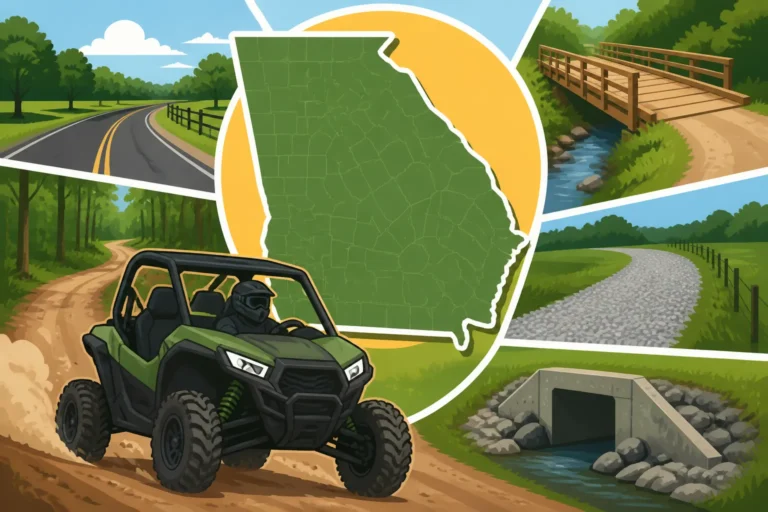
Even with an MPOHV registration, where you can ride after dark is critically important. Georgia law is clear: MPOHVs are generally permitted only on "county road systems" and not on state highways or interstate highways. This is a fundamental rule that doesn't change when the sun goes down. A county road might be a paved country lane, a gravel road, or even a dirt path maintained by the county. [Georgia MPOHV Road Rules: County Roads Only] explains this in detail.
The danger, especially at night, comes when riders inadvertently or intentionally venture onto a state route. State routes are often better lit and appear safer, but they are strictly off-limits for MPOHVs, even if registered. Crossing a state route at a designated intersection is usually permissible, but riding down it for any distance, day or night, is a violation. At night, the distinction between a county road and a state highway can be harder to spot, especially in rural areas where signage might be sparse or poorly lit. It’s imperative to know your route thoroughly and recognize the road classifications. Getting caught on a state route, particularly at night when visibility is lower, significantly increases your risk of an accident and a citation from [Georgia Sheriff Enforcement on County Roads].
The Role of an MPOHV Registration in Night Operations
Possessing a valid [Georgia MPOHV Registration] is the absolute bedrock for any legal night riding on public roads in Georgia. Without this specific registration, you have no legal right to be on any public road, day or night, with your ATV or UTV. The state established this registration process to create a clear legal framework for certain types of off-highway vehicles to use county roads responsibly. This isn't just a suggestion; it's a legal requirement that empowers you to ride.
The registration itself comes with the expectation that your vehicle meets specific safety and equipment standards, many of which are crucial for night riding. The registration process ensures that your machine has the basic features that allow other drivers to see you and for you to safely navigate. If you're pulled over at night on a county road without an MPOHV plate, you're not just facing a potential equipment violation; you're facing a charge for operating an unregistered vehicle on a public road, which can lead to significant penalties. This is why understanding [What MPOHV Actually Stands For] and ensuring your vehicle complies is the first step toward safe and legal night riding on Georgia's county roads.
Essential Lighting and Equipment for Night Riding
When you consider operating any vehicle after dark, proper lighting and visibility equipment immediately become paramount. This is even more critical for MPOHVs, which often share roads with larger, faster-moving traffic. Georgia's MPOHV registration requirements are designed to ensure a basic level of safety equipment, but understanding and maintaining these components is your responsibility.
Headlights, Taillights, and Brake Lights: More Than Just Brightness
For an MPOHV to be registered and legally operated on Georgia county roads, particularly after dark, it must be equipped with specific lighting. You absolutely need functional headlights, capable of illuminating the road ahead for a safe distance, typically specified as 200 feet for low beams and 450 feet for high beams in general vehicle laws. These aren't just for you to see; they're for others to see you coming. Similarly, working taillights are crucial. They must be visible from a specific distance to the rear, ensuring that approaching vehicles know you are there.
Brake lights are perhaps the most vital communication tool when slowing down or stopping. They need to activate reliably when you apply the brakes, signaling your intentions to anyone behind you. A common issue with older or heavily used off-road vehicles is inconsistent wiring or damaged lenses, which can compromise these lights. Before venturing out after dark, always do a thorough check: turn on your lights, walk around the vehicle, and have someone press the brake pedal to ensure everything is functioning as it should. [Headlights, Brake Lights and Mirrors on the Checklist] goes deeper into these requirements.
Reflectors, Turn Signals, and Other Visibility Aids
Beyond the active lighting, passive visibility aids like reflectors play a huge role, especially if your active lights were to fail. MPOHVs in Georgia are required to have certain reflectors, typically red to the rear and amber to the front and sides, to catch the light from other vehicles. These small, often overlooked, components can make the difference between being seen or being invisible in a low-light situation.
While not always explicitly mandated for all registered MPOHVs in Georgia, turn signals are highly recommended for any vehicle sharing a public road. Hand signals can be used, but in the dark, they are much harder for other drivers to perceive. Many UTVs now come factory-equipped with turn signals, or they can be added. The goal is clear communication with other road users. Furthermore, a working horn is indispensable for alerting others to your presence, which is particularly useful when riding around blind turns or cresting hills at night. Ensuring your [Georgia Equipment a Road Machine Must Carry] is up to snuff can literally save a life.
Aftermarket Solutions and Ensuring Compliance
The good news for UTV owners is that the aftermarket industry offers a vast array of lighting and visibility upgrades. Companies like SuperATV provide everything from brighter LED headlights and taillights to complete turn signal kits and auxiliary light bars. While these can significantly enhance your ability to see and be seen, it's crucial to ensure that any aftermarket additions comply with Georgia's specific vehicle lighting laws. For example, while a powerful SuperATV LED light bar might be fantastic for illuminating a dark trail, it might be too bright or positioned incorrectly for public road use and could blind oncoming drivers. Always check local ordinances regarding auxiliary lighting on public roads.
When modifying your machine, focus on enhancing the legally required components first. Upgrading your factory headlights to a brighter, more efficient LED bulb from SuperATV can be a game-changer for night vision. Adding amber side markers or extra red reflectors can drastically improve your profile to other drivers. The key is to balance improved performance with legal compliance, ensuring your machine is not only highly visible but also operating within the bounds of the law, protecting both yourself and other motorists.
Riding After Dark on Private Land and WMA Properties
While public road riding for ATVs and UTVs in Georgia has strict regulations, private property offers a different set of considerations, and Wildlife Management Areas (WMAs) have their own unique rules that impact night riding. Understanding these distinctions is crucial for responsible and safe operation once the sun sets.
The Freedom (and Responsibilities) of Private Property Night Riding
Riding your ATV or UTV on your own private land, or on private land where you have explicit permission, offers the most freedom regarding time of day. Generally, Georgia law doesn't restrict private land use after dark, meaning you don't need a specific MPOHV registration to ride your quad or side-by-side on your farm or hunting lease at midnight. This is where most casual night riding occurs, whether it's checking fence lines, moving equipment, or simply enjoying the trails.
However, "freedom" doesn't mean "no responsibility." Even on private land, you need to think about safety. The same principles of visibility apply: you need working headlights to see obstacles, ditches, or wildlife, and taillights so anyone else riding with you can track your position. Carrying a flashlight or headlamp is always a smart idea as a backup. While you might not face a traffic citation, you are still responsible for your own safety and the safety of any passengers. Loud exhaust systems at night could also lead to neighbor complaints, even if you're on private land, so being a good neighbor is always wise. Remember, [Georgia ATV Rules on Private Property] still emphasize safe and responsible operation, even if not strictly regulated by the state for equipment like road use.
Special Considerations for Wildlife Management Areas (WMAs)
Wildlife Management Areas (WMAs) are a hybrid space – they are public lands, but they are managed for specific purposes, primarily hunting and conservation. As such, they have their own set of rules that often differ significantly from general county road laws or private land use. Many WMAs have very specific hours of operation, often tying directly to sunrise and sunset times, especially during hunting seasons. [Georgia WMA Riding Rules Explained] details these restrictions.
For example, many WMAs might allow vehicle access only during a "two-hour window around sunrise and two hours before sunset" on designated hunt days, or even prohibit vehicle use entirely during certain periods. This means that true "night riding" (i.e., hours after sunset or before sunrise) is often prohibited or heavily restricted on WMAs. You generally won't be permitted to cruise WMA roads after dark with your UTV or ATV unless it's explicitly allowed for a very specific purpose. Always check the specific regulations for the WMA you plan to visit, as rules can vary. Ignoring these rules could lead to fines or the loss of hunting privileges, regardless of how well-lit your machine might be.
Safety Best Practices When the Sun Goes Down
Regardless of whether you're on private land or a legally accessible county road, night riding introduces a host of safety challenges. Reduced visibility is the most obvious. What looks like a small puddle in daylight could be a deep rut at night. Familiar trails can become disorienting without the visual cues of sunlight.
Here are some best practices:
- Slow Down: Your reaction time needs to be greater at night. Reduce your speed significantly from your daytime pace.
- Enhance Your Lighting: Even if your vehicle meets minimum requirements, consider adding auxiliary lighting. A good SuperATV LED light bar can make a massive difference on a dark trail, illuminating obstacles that standard headlights might miss.
- Wear Reflective Gear: Riders and passengers should wear reflective vests or clothing. Even if your machine is lit up, an emergency dismount could put you in darkness.
- Ride with Others: A lone night ride means no one knows if you get into trouble. Riding with a partner or group increases safety.
- Know Your Terrain: Stick to familiar trails or roads. Exploring new territory in the dark is an invitation for trouble.
- Carry Essential Tools: A spare flashlight, charged phone, basic toolkit, and first-aid kit are even more important at night.
- Wildlife Awareness: Animals are often more active at night. Be prepared for deer, hogs, or other creatures to dart across your path unexpectedly.
By combining proper vehicle equipment with vigilant riding habits, you can enjoy the unique experience of riding after dark safely and responsibly.
Avoiding Hazards and Legal Ramifications After Dark
Riding ATVs and UTVs after dark presents a distinct set of challenges and risks. Beyond the mechanical requirements for visibility, the human element, environmental factors, and strict legal enforcement mean that nighttime operations demand an extra layer of caution and awareness.
Increased Risks: Visibility, Obstacles, and Wildlife
The most immediate and obvious risk of riding after dark is significantly reduced visibility. Even with excellent headlights, your field of vision is narrowed to a cone of light directly ahead, and peripheral vision is severely hampered. This makes it incredibly difficult to spot obstacles like fallen branches, rocks, washouts, or uneven terrain until you're right on top of them. A simple daytime trail can become a minefield of unseen hazards at night.
Furthermore, wildlife activity often peaks during dusk, dawn, and nighttime hours. Deer, wild hogs, coyotes, and other animals are more likely to be on the move, and spotting them in time to react can be nearly impossible. A collision with a large animal, especially at speed, can cause severe injury to riders and passengers, not to mention significant damage to the machine. Even on a seemingly clear county road, a deer could suddenly appear from the treeline. This reduced reaction time, combined with the presence of larger, faster vehicles that may not expect an MPOHV to be on the road, elevates the risk of serious accidents significantly.
DUI Laws and Nighttime Enforcement
It's a common misconception that because ATVs and UTVs are "off-road" vehicles, or have limited road access, the standard rules of the road regarding impaired driving don't apply. This is absolutely false. In Georgia, operating an MPOHV on a public road, or even just sitting in an MPOHV on a public road with the engine running, is subject to the same DUI laws as operating a car or truck. [Georgia DUI Law and Off-Road Machines] is crystal clear on this point. This also applies if you are operating your machine on private land if the circumstances are such that law enforcement believes you are still "in actual physical control" while impaired.
Nighttime, unfortunately, is when DUI enforcement is often at its highest. If you are operating your registered MPOHV on a county road after dark and appear to be driving erratically, or if you are stopped for an equipment violation, a deputy is highly likely to check for signs of impairment. The penalties for an MPOHV DUI are just as severe as for a car, including significant fines, license suspension, potential jail time, and increased insurance premiums. It is never worth the risk to drink and ride, especially after dark when the inherent dangers of riding are already elevated.
Penalties for Non-Compliance
Operating an ATV or UTV after dark on public roads in Georgia without proper registration or equipment can lead to a cascade of legal issues. If your machine is not a registered MPOHV and you're caught on a county road, you could face penalties for operating an illegal vehicle on a public roadway. This can include fines, court costs, and potentially having your vehicle impounded. [Georgia Penalties for an Unregistered Road Machine] are no joke.
Even if your MPOHV is registered, failing to have proper working lights (headlights, taillights, brake lights) or other required equipment can result in a citation. These are often considered "safety violations" and can still carry fines. An officer may also deem your vehicle unsafe for continued operation until repairs are made, potentially leaving you stranded or requiring your machine to be trailered. Moreover, in the event of an accident, a lack of proper lighting or registration could significantly impact insurance claims and legal liability. It's not just about avoiding a ticket; it's about ensuring your safety and legal standing in any situation that might arise.
Summary of After-Dark Riding Rules in Georgia
To help clarify the various rules and considerations for riding ATVs and UTVs after dark in Georgia, here's a quick overview:
| Scenario | Legality for ATVs (No Registration) | Legality for Registered MPOHVs | Key Considerations for Night Riding |
|---|---|---|---|
| Private Land | Generally Permitted | Generally Permitted | Requires landowner permission; focus on personal safety, adequate lighting (headlights/taillights), and respecting neighbors. |
| County Roads | Strictly Prohibited | Permitted (with proper equipment) | Requires MPOHV registration, full lighting (headlights, taillights, brake lights), reflectors, and adherence to [Georgia's 25 to 65 mph Speed Requirement]. |
| State Routes | Strictly Prohibited | Strictly Prohibited | Crossing at designated intersections is often allowed, but riding on them is illegal, day or night. |
| WMAs / Public Trails | Varies by WMA / Trail | Varies by WMA / Trail | Check specific WMA or trail regulations; most have sunrise-to-sunset hours or specific "hunt day" restrictions; night riding is rare. |
| City Streets | Strictly Prohibited | Varies by City/Ordinance | Some cities allow golf carts, but MPOHVs usually follow county road rules; always check local ordinances. |
This table highlights the stark differences based on your machine type and location. Always err on the side of caution and ensure you are in full compliance with all laws before you venture out after dark.
Disclaimer
This article is for general informational purposes only and does not constitute professional advice. Laws, prices and regulations vary by location and change over time. Consult a qualified professional for guidance on your specific situation.