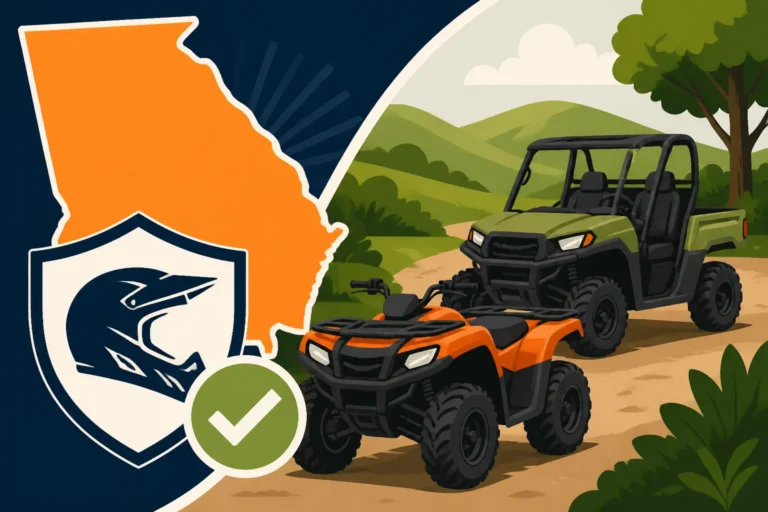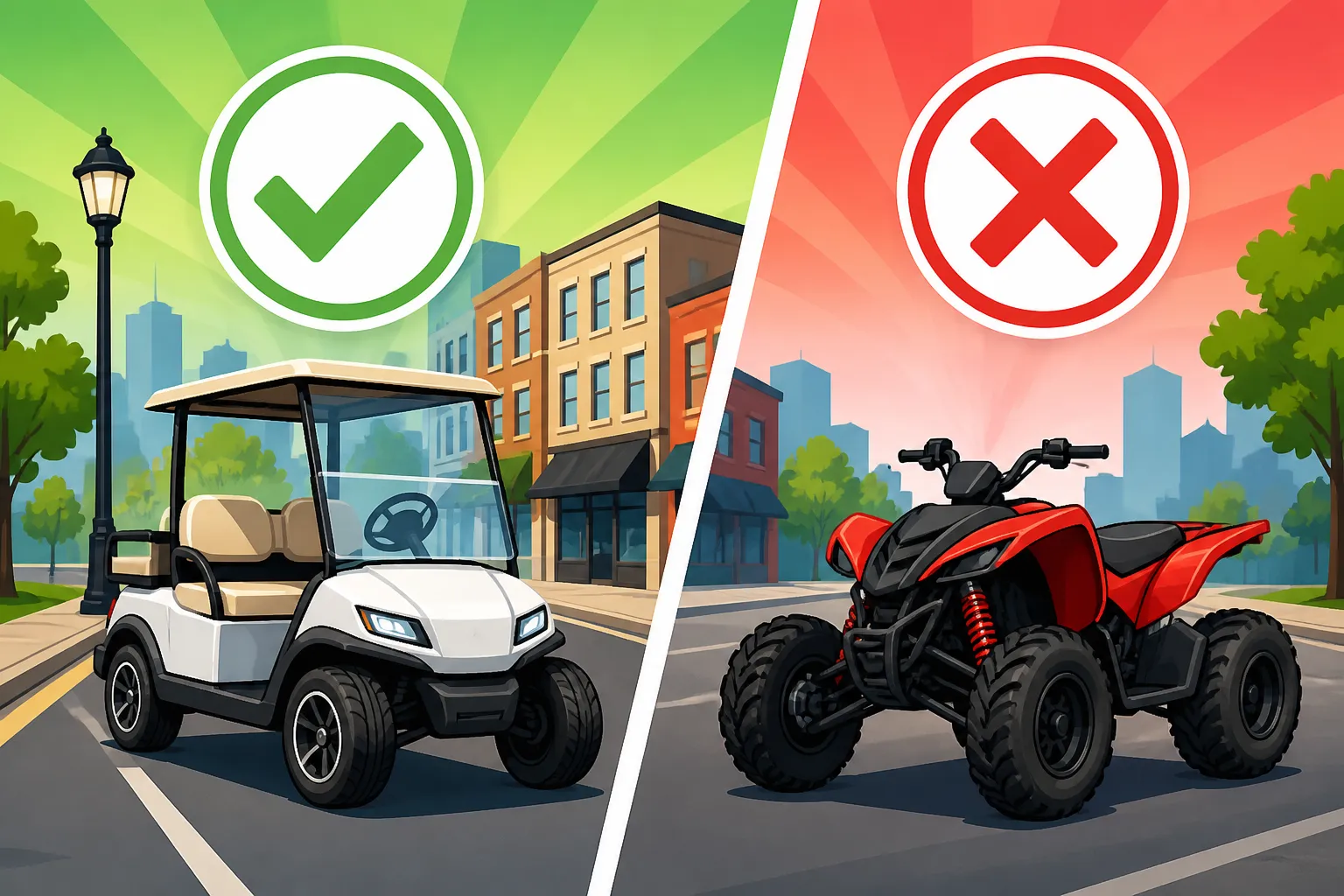
Georgia City Streets Open to Carts but Not Quads
It’s a scenario many of us have faced: you’re cruising around your neighborhood on your side-by-side or ATV, enjoying the fresh air, and you wonder why your machine can't just take you a few blocks down to the local diner or hardware store. The reality is, Georgia law draws a very distinct line between dedicated off-road vehicles like your quad or UTV and those seemingly similar, low-speed golf carts you see zipping through many Georgia city streets. This guide will walk you through why your beloved off-road machine generally isn't welcome on urban asphalt and what options exist for legitimate street-legal transportation within city limits.
The Frustrating Reality: Why Your ATV or UTV Isn't a Golf Cart (Legally Speaking)
For many off-road enthusiasts, the distinction between a UTV and a golf cart can feel arbitrary, especially when they see golf carts effortlessly navigating neighborhood streets. You might have even beefed up your UTV with turn signals, a horn, and mirrors, thinking you've done enough to make it street-ready. Unfortunately, the state of Georgia, and most local municipalities, don't see it that way. The legal frameworks defining these vehicles are vastly different, leading to frustration for those who wish their UTVs had more versatility.
The Fundamental Legal Distinction in Georgia
The core of the issue lies in how Georgia classifies these vehicles. ATVs and UTVs are primarily designed and manufactured for off-road use. They are built for rugged terrain, high ground clearance, and powerful engines, which are excellent for trails, farms, and hunting lands but not necessarily for public roadways. Golf carts, on the other hand, or more broadly, Personal Transportation Vehicles (PTVs), are specifically designed for low-speed travel on designated paths and local streets. Their construction reflects this purpose, with features like lower top speeds, lighter frames, and often more basic safety features geared for neighborhood environments.
While you might be able to find aftermarket kits from companies like SuperATV that add street-style accessories to your UTV, these modifications alone do not magically change the vehicle's legal classification or its intended purpose in the eyes of the law. A UTV's inherent design, including its suspension, braking, and crash-worthiness standards, typically does not meet the federal motor vehicle safety standards (FMVSS) required for passenger vehicles on public roads, and state laws reflect this.
What Georgia Law Says About ATVs on Public Roads
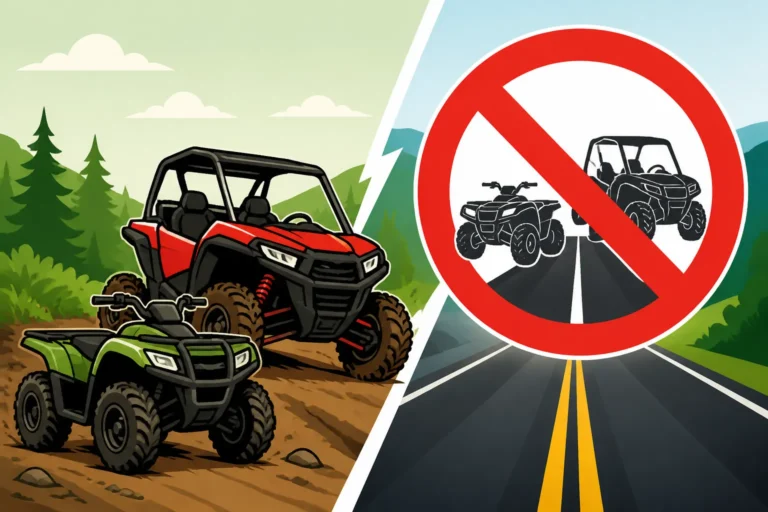
Generally speaking, Georgia law explicitly prohibits the operation of ATVs and most UTVs on public roads and highways. This isn't just a suggestion; it's a legal restriction that carries penalties. The Georgia Department of Driver Services (DDS) and local law enforcement are clear on this: ATVs are meant for private land or designated off-road trails. There are very limited exceptions, primarily related to agricultural use or crossing public roads at specific points.
However, a recent development in Georgia introduced a voluntary registration program for certain types of UTVs, classifying them as Motorized Personal Off-Highway Vehicles (MPOHVs). This program, detailed in [Georgia MPOHV Registration Explained], allows specific side-by-sides to be registered and operated on county roads only. This is a crucial distinction: MPOHV registration does not grant access to state highways, nor does it typically permit operation on city streets unless a specific municipal ordinance allows it – and for ATVs and UTVs, such ordinances are exceedingly rare, if they exist at all. The intention behind the MPOHV designation is to give farmers and rural residents a legal way to use their utility vehicles for tasks on less-trafficked county roads, not to create a blanket street-legal status for urban environments. [Why a Four-Wheeler Cannot Be Registered in Georgia] further clarifies why most traditional ATVs are excluded from even this MPOHV program.
Why the Rules Exist: Safety and Infrastructure
The differing rules for ATVs/UTVs versus golf carts aren't just about bureaucracy; they're rooted in safety and the intended use of public infrastructure. Imagine a powerful UTV, built for rugged trails, suddenly trying to navigate busy city intersections alongside cars, trucks, and motorcycles. The speed differentials, braking capabilities, and driver visibility are all significant concerns. ATVs and UTVs typically lack the crumple zones, advanced airbag systems, and structural integrity that cars are designed with to protect occupants in a collision.
Furthermore, city streets are built for vehicles that adhere to specific width, weight, and speed parameters. An off-road machine, even one with accessories like mirrors and turn signals, might not have the same turning radius, signaling visibility, or stable handling characteristics as a vehicle designed for pavement. The rules are in place to prevent accidents, ensure the smooth flow of traffic, and maintain public safety for everyone using the roads. It's about ensuring that every vehicle sharing the road meets a baseline of safety and operational standards suitable for that environment.
Understanding Golf Cart and PTV Ordinances in Georgia Cities
While your ATV or UTV might be sidelined from city streets, many Georgia cities have embraced golf carts and Personal Transportation Vehicles (PTVs) as legitimate forms of local transit. This is where the confusion often arises, as people see carts on the road and assume their side-by-side should be allowed too. The key is to understand that these are specific, locally enacted rules for a very particular type of vehicle.
How Cities Create Their Own Rules for Carts
In Georgia, individual cities and counties have the authority to pass ordinances that allow the operation of golf carts and PTVs on their public streets, provided certain conditions are met. This power stems from state legislation that grants municipalities the ability to designate specific public roads or paths for golf cart use, often where the speed limit is 25 mph or less. These ordinances are tailored to the local environment, considering factors like traffic volume, road design, and the community's needs.
A city like Peachtree City, for example, is famous for its extensive network of golf cart paths and designated streets, allowing residents to navigate much of the city without a car. These local rules dictate everything from where carts can operate, to registration requirements, age limits for drivers, and necessary safety equipment. It’s a very different legal framework than the one governing ATVs and UTVs. You'll find cities like Peachtree City have their own specific [Peachtree City Cart Registration Fees in Georgia] and rules for [Peachtree City Non-Resident Cart Cost in Georgia] to manage their unique transportation systems.
Common Features of Legal Golf Carts on City Streets
For a golf cart or PTV to be legally operated on city streets where an ordinance permits it, the vehicle usually needs to meet several specific criteria. These often include:
- Speed Limit: The cart must be capable of a maximum speed of 20 mph, sometimes up to 25 mph, but no more. This keeps them in sync with the flow of neighborhood traffic on designated low-speed roads. [Georgia Low-Speed Vehicles Capped at 20 mph] highlights this distinction.
- Safety Equipment: While not as extensive as a car, these vehicles typically require functional headlights, taillights, brake lights, turn signals, a horn, a rearview mirror, and often a safety warning sign (like a slow-moving vehicle triangle or a specific 24 by 30-inch sign) when operated on public roads. [Georgia's 24 by 30 Inch Cart Signage Rule] explains this requirement.
- Driver Requirements: Operators generally need a valid driver's license, though some ordinances may have provisions for younger drivers with specific supervision. [Georgia Cart Driver Ages by Ordinance] can vary locally.
- Registration/Permitting: Many cities require local registration or a permit for golf carts operating on their streets, which may involve a fee.
It's important to recognize that these requirements are for vehicles specifically classified as golf carts or PTVs. Trying to apply these rules to an ATV or UTV is usually a misstep because the fundamental vehicle classification is different from the outset.
Prominent Examples: Peachtree City's Path Network
Peachtree City stands out as Georgia's prime example of a city that has fully integrated golf carts into its daily transportation fabric. With over 100 miles of multi-use paths, residents rely on their golf carts for everything from commuting to school and work to running errands and visiting friends. This extensive network is a testament to what local ordinances can achieve when a community commits to an alternative transportation model.
However, even in Peachtree City, rules are strict. You won't see ATVs or UTVs on their paths or designated cart streets. The infrastructure and regulations are designed for the specific characteristics of golf carts and PTVs. Visitors looking to use their carts will also find specific rules regarding permits and fees. [Peachtree City's 100 Miles of Georgia Cart Paths] illustrates the scale of this unique system, but it's crucial to understand it's for carts, not quads or typical side-by-sides.
When Your UTV Might Get a Pass (and When It Won't)
The desire to make a UTV street legal for everyday errands is strong, and it leads many owners to look for loopholes or special considerations. While Georgia has introduced some avenues for certain UTVs on public roads, these are very specific and rarely extend to city streets. Understanding these nuances is crucial to avoid fines and potential legal issues.
The MPOHV Registration Exception for Side-by-Sides
As mentioned, Georgia now offers a voluntary registration for Motorized Personal Off-Highway Vehicles (MPOHVs), which primarily applies to side-by-side UTVs that meet a strict set of criteria. This program, which began in December 2023 ([Georgia MPOHV Registration Started December 2023]), allows these registered machines to operate on county roads. This is a significant development for rural residents and farmers who use their UTVs for work or access to property along county roads.
However, the key takeaway here for city street access is simple: MPOHV registration generally does not grant you permission to drive on state highways or, critically, on most city streets. The law is very specific about the types of roads allowed. So, while you might be able to take your registered UTV down a dirt county road to get to your hunting lease, don't expect to cruise it down Main Street in your nearest town. [Georgia UTV Road Rules by County] provides more context on where these machines are allowed.
The Crucial Differences Between an MPOHV and a City-Legal Golf Cart
This is where the distinction becomes incredibly important and often misunderstood. An MPOHV is a UTV that has been registered to use county roads based on a specific set of physical requirements. These requirements include things like a steering wheel (not handlebars), a non-straddle seat, seat belts, specific speed capabilities (25-65 mph), lights, mirrors, and specific width and weight limits. You can find more about these requirements in [Georgia's 80-Inch Width Limit for Registration] and [Georgia Requires a Steering Wheel, Not Handlebars].
A city-legal golf cart or PTV, on the other hand, is a vehicle specifically designed for low-speed use on local roads and designated paths, typically capped at 20-25 mph. These vehicles often have different safety standards, lighter construction, and are governed by local ordinances, not the state's MPOHV program. The intent, design, and legal framework are entirely separate. While an MPOHV might look more like a car than a traditional ATV, it is still legally distinct from a golf cart in the eyes of city ordinances.
| Feature | Typical ATV/UTV (Pre-MPOHV) | Georgia MPOHV (Registered UTV) | City-Legal Golf Cart/PTV |
|---|---|---|---|
| Primary Design | Off-road recreation/utility | Off-road recreation/utility | Low-speed local transport |
| Steering | Handlebars (ATV), Steering Wheel (UTV) | Steering Wheel (Required for MPOHV) | Steering Wheel |
| Seating | Straddle (ATV), Non-straddle (UTV) | Non-straddle (Required for MPOHV) | Non-straddle |
| Speed Range | Varies widely | 25-65 mph (Required for MPOHV) | Max 20-25 mph |
| Road Access | Private land, designated trails | County Roads Only | City Streets (by ordinance), designated paths |
| Registration | None (unless MPOHV) | Voluntary state registration | Local city/county permit/registration |
| Legal Basis | State law prohibits road use | State law defines MPOHV for county roads | Local city ordinances |
The "Gray Area" and Why It's Risky
Some UTV owners, seeing golf carts on the road and knowing their UTVs can be modified, might try to push the boundaries. They might add a full suite of street-legal accessories, perhaps even components from aftermarket suppliers like SuperATV, including windshields, full doors, and elaborate lighting kits, hoping it will make their UTV acceptable on city streets. While these accessories enhance safety and comfort for off-road use, they typically do not transform an off-road vehicle into a city-street-legal one.
Trying to operate an unregistered or non-compliant ATV/UTV on city streets, even if it has street-style accessories, is a gamble. You could face significant fines, your vehicle could be impounded, and you could be held liable in the event of an accident. Law enforcement officers are generally well-versed in the distinctions between these vehicle types and the relevant ordinances. They enforce the legal classification of the vehicle, not just what accessories it might have. The consequences for illegal road riding, as detailed in [Georgia Penalties for an Unregistered Road Machine], can be severe. It's simply not worth the risk.
What to Do If You Want Street Access for Your Off-Road Machine
So, if your ATV or UTV generally can't legally roam city streets, what are your options if you truly desire a low-speed, street-legal vehicle for local errands or neighborhood cruising in Georgia? It boils down to understanding the correct vehicle types and their legal applications.
Considering a Dedicated "Personal Transportation Vehicle" (PTV)
If your primary goal is to have a low-speed vehicle for local transportation within a city or community that allows it, the most straightforward and legal solution is to purchase a dedicated golf cart or Personal Transportation Vehicle (PTV). These vehicles are designed for the purpose, meet the necessary local and state requirements, and will give you peace of mind when navigating public roads where permitted.
Many manufacturers offer PTVs that are more robust than traditional golf carts, with features like enhanced seating, better suspension, and sometimes even small cargo beds, blurring the line visually with some UTVs but crucially maintaining the legal classification of a low-speed vehicle. These vehicles are built from the ground up to comply with the regulations governing their use on public streets in approved areas.
Exploring Private Land and OHV Parks
For your actual ATV or UTV, remember its true calling: off-road adventure. These machines excel in environments away from paved roads. Georgia boasts numerous fantastic opportunities for legal, exhilarating off-road riding. This includes expansive trail systems in the Chattahoochee-Oconee National Forest ([Chattahoochee-Oconee National Forest Riding]), private off-road parks like Iron Mountain Resort ([Iron Mountain Resort: Georgia's Biggest Private Park]), and various Wildlife Management Areas (WMAs) during designated periods ([Georgia WMA Rules for ATV Riders]).
By keeping your ATV or UTV to these appropriate venues, you not only enjoy it for its intended purpose but also stay on the right side of the law. There's a whole community of riders enjoying miles of trails, mud pits, and climbs across the state. [Georgia ATV Trails: Where You Can Legally Ride] can help you find the perfect spot for your next adventure. Outfitting your UTV with robust protection and performance parts from a company like SuperATV for these demanding environments makes perfect sense, enhancing your experience where your machine is truly meant to shine.
The Importance of Knowing Your Local Ordinances
Before making any decisions about street access for any type of low-speed vehicle, it is absolutely essential to check with your specific city hall or county administrative office. Local ordinances can vary dramatically from one municipality to another, even for golf carts. What's legal in Peachtree City might be strictly prohibited in a neighboring town.
Don't rely on assumptions or what you see others doing. Take the time to understand the precise rules, including allowed streets, speed limits, required equipment, and any local registration or permitting processes. This proactive step will save you potential headaches, fines, and ensure you're enjoying your machine responsibly and legally within your community. For registered MPOHVs, remember the critical distinction: [Georgia MPOHV Road Rules: County Roads Only] are the general rule, with city streets almost always off-limits.
Disclaimer
This article is for general informational purposes only and does not constitute professional advice. Laws, prices and regulations vary by location and change over time. Consult a qualified professional for guidance on your specific situation.