Georgia Visitors From Other States
If you are bringing an ATV or UTV into Georgia, an out-of-state plate, permit, or safety card may not give you the access you expect. The key is to match your ride to the land: national forest trails, wildlife management areas, private parks, and public roads have different rules. Here’s what visiting riders should check before they unload.
What Reciprocity Does and Does Not Mean
“Reciprocity” can mean different things: a state accepting another state’s vehicle registration, a trail system honoring another state’s recreation pass, or a riding area accepting a safety course completed elsewhere. Those are separate questions. There is no single out-of-state credential that automatically gives an ATV or UTV access everywhere in Georgia.
For riding on a Georgia national forest OHV trail system, plan on meeting Georgia’s permit requirements even if you bought a permit or registered your machine in another state. An out-of-state registration does not replace a Forest OHV permit. Likewise, a safety card from another state does not replace an area’s permit or access rules.
The reverse is true, too: a Georgia Forest OHV permit is not a road registration, vehicle title, or permission to ride on private land. It applies to the relevant trail system under its rules. It does not make a machine street legal or grant entry to land where riding is prohibited.
| Where you plan to ride | What an out-of-state visitor should check |
|---|---|
| Georgia national forest OHV system | The required Forest OHV permit, trail status, machine limits, and system-specific rules |
| Wildlife management area | Whether riding is allowed there, on which roads or trails, and during which times and activities |
| Private off-road park | The park’s admission, waiver, age, safety, insurance, and machine requirements |
| Public road | Whether that road is legally open to the machine and whether the vehicle and operator meet the applicable requirements |
| Private property | The owner’s permission and any applicable safety or local rules |
Start by identifying the exact place, not just the county or nearest town. A machine that can use a private park may not fit a narrow national forest trail. A forest permit may not cover a nearby WMA road. For a broader overview of the forest permit system, see Georgia’s Day and Annual Forest OHV Permits and Georgia National Forest Permits Are Per Operator.
Getting a Forest OHV Permit as a Visitor
Visitors riding on Georgia’s national forest OHV systems should check the permit rules for the specific system before travelling. The Forest OHV permit is separate from any state registration or credential you hold at home. The permit system includes day and annual options, and an annual permit can cover the designated Georgia systems described by the program. Confirm the current rules, available purchase options, and permitted locations before setting out.
Permits are associated with the operator, not simply with the machine. If two people take turns driving, each person who operates needs to meet the operator permit requirement. A passenger who does not operate is treated differently from a driver, but check the current rule for your particular situation. Do not assume that one permit covers every person in a group just because the group arrives in one vehicle. For details, see Georgia National Forest Permits Are Per Operator and Georgia OHV Permit for a Passenger.
Buy or arrange the permit before you reach the trail
Visitors may have purchase options through Recreation.gov or an appropriate ranger district, depending on the permit and current arrangements. Check the official listing or contact the relevant district before travelling. Confirm that you are purchasing the correct permit for your planned riding area; a general recreation pass or a permit from another state may not be interchangeable.
Keep the permit available while riding. Check whether the current rules require it to be displayed, carried, or both, and follow the instructions that come with it. A screenshot or confirmation on a phone may be useful, but don’t rely on a phone alone if the system or rules require something else. A printed backup can help if your phone battery dies or service is unavailable. See Printing a Permit Before You Leave and Showing a Permit on Your Phone for practical details.
Do not wait until the group reaches a closed trailhead to look for a signal, complete a purchase, or find out whether a permit is required. Trailhead services and mobile reception may be limited. Check purchase access and trail conditions before leaving home, then carry what the rules require.
The permit is not a blanket pass
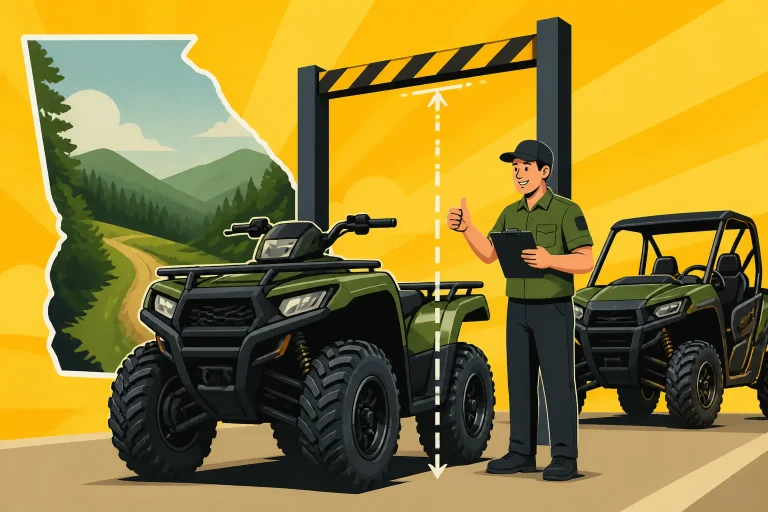
A Forest OHV permit does not guarantee that every trail is open or suitable for your machine. Some systems restrict machine width, and trails can close for weather, maintenance, or seasonal reasons. Check the system’s current notices and measure your machine if there is a width limit. A wider side-by-side may be excluded even when a narrower ATV is allowed.
A permit also does not authorize riding off the designated routes. Stay on open trails, observe signs and gates, and follow one-way or other route instructions. If a road or trail is closed, having a valid permit does not make it available.
For visitors comparing options, Georgia’s Per-Operator Permit, Not Per Vehicle explains why the operator matters, while Georgia Trails That Close After Rain and Georgia Trail Conditions Before You Drive can help with trip planning.
Out-of-State Machines, Plates, and Public Roads
A plate or registration from your home state may be useful for identifying your machine, but it does not automatically authorize riding on every Georgia road. Trail access and road access are separate. Before treating a public road as part of your route, confirm that the specific road is open to that type of machine and that the operator and vehicle meet the applicable requirements.
A machine’s home-state label is not a substitute for checking Georgia’s rules. An ATV that is allowed on some roads in another state may still be prohibited on a Georgia road. Similarly, a Georgia Forest OHV permit is for permitted off-highway riding, not a road-use credential. For an overview of the distinction, read [Georgia Rules for an Out-of-State Plate], Georgia MPOHV Road Rules: County Roads Only, and Are Side-by-Sides Street Legal in Georgia?.
Do not confuse trail permits with registration
Georgia has a specific registration process for certain machines that meet the state’s eligibility requirements. It is not a general registration option for every ATV or UTV, and registration does not mean unrestricted road use. A visitor should not assume that a home-state registration transfers into Georgia’s system or that registering a machine at home makes it eligible for Georgia road access.
If road use is part of your plan, investigate that separately from trail permits. Check the exact route, the machine’s classification, insurance requirements, and operator rules. When your trip is strictly to a designated off-highway trail or private park, avoid using public roads as informal connectors unless you have confirmed they are permitted for your machine.
For the distinction between machines that may qualify and ordinary quads, see Georgia ATV Registration Requirements and Why Georgia Will Not Register an Ordinary Quad. Those rules are not a replacement for trail-area requirements.
Ownership and paperwork are separate from permission to ride
Visitors do not necessarily need to complete Georgia’s registration process simply to trailer a machine into the state and ride in a place where it is allowed. But having the machine with you does not prove you own it, and a riding permit does not resolve an ownership question. Bring sensible documentation, especially if the machine is borrowed, recently purchased, rented, or part of a group’s equipment.
Keep your home-state registration or other ownership documents accessible, along with any rental agreement or written permission that applies. If a machine’s serial number or ownership paperwork is unclear, sort that out before travel rather than expecting a trail permit to serve as proof. See Georgia Proof of Ownership on the Trail and Georgia Stolen Vehicle Check Before Registration for related considerations.
A trailer is a separate vehicle from the ATV or UTV it carries. Confirm that the trailer is properly registered and equipped for the route you will drive. A machine’s trail permit does not cover the trailer. See Registering the Trailer Separately for that separate issue.
WMAs and Private Parks Have Their Own Rules
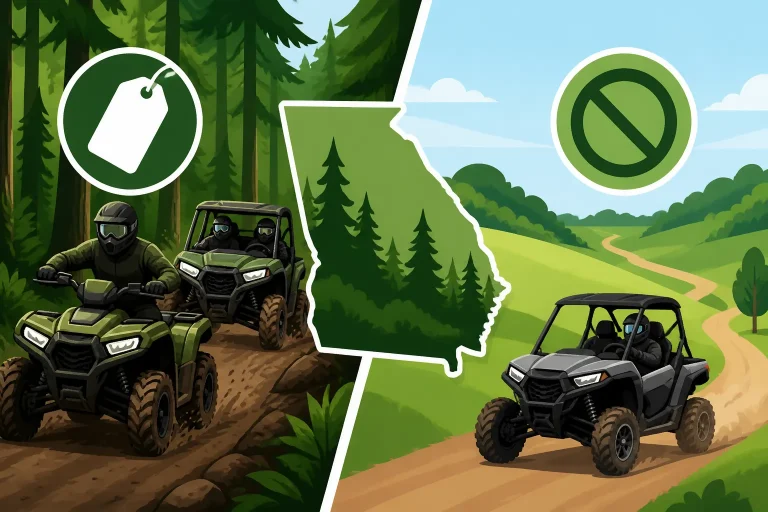
Georgia wildlife management areas and privately operated riding parks are not interchangeable with national forest OHV systems. Each can have its own permitted routes, dates, hours, age rules, and access conditions. A Forest OHV permit should not be treated as permission to ride on a WMA or private property.
Wildlife management areas
WMA access can depend on the area, the road, the season, and the activity taking place. In general, riders should not assume that a WMA is an open trail-riding destination. Some access is limited to roads, may be tied to hunting activity, and may be subject to specific time windows or age requirements. Rules can also differ on WMAs located on national forest land, where designated trails and other land-management rules may apply.
Before visiting, identify the exact WMA and check its current instructions with the relevant Georgia agency. Confirm whether a quad or side-by-side is allowed, which routes are open, whether riding is limited to hunt days or other dates, and what time restrictions apply. Ask whether any access tag or other documentation is required for that specific place. Do not infer access from a hunting license, a Forest OHV permit, or another state’s WMA permit.
The rules can be especially easy to misread when riding is allowed for a narrow purpose, such as reaching a hunting location, but not for general recreation. A road that appears suitable for ATVs may still be closed to vehicles, and gates and posted signs should be treated as meaningful restrictions. For more detail, see Georgia WMA Rules for ATV Riders, Georgia WMA Riding Only on Hunt Days, and Georgia National Forest WMAs Need Designated Trails.
If you are visiting to hunt, confirm both the hunting requirements and the vehicle-access rules. A valid hunting credential does not necessarily open every road to ATV use. Check whether riding is allowed at the time you plan to travel and whether the machine must remain on a designated route. When details are unclear, ask the managing office about that particular WMA instead of relying on a general statement about Georgia access.
Private off-road parks
Private parks set their own conditions of entry. A park may require a waiver, impose minimum ages or supervision rules, set machine-width or noise limits, or require protective equipment. Admission rules can differ from one business to another and can change, so check with the park directly before driving there.
Tell the park what you are bringing: ATV or UTV, number of riders, machine width, and whether any operator is a minor. Ask whether advance reservations are needed, what documents to bring, whether your machine needs particular safety equipment, and what happens if trails close. A park’s acceptance of your out-of-state registration or safety course does not establish access anywhere else in Georgia.
If you rent a machine, follow the rental provider’s requirements as well as the park rules. A renter may need to meet age or experience conditions, and a passenger may have different restrictions from an operator. A waiver is not a permit, and neither one changes the rules on public roads. See Georgia Private Park Waiver Forms, Georgia Private Park Minimum Ages, and Georgia Rental Requirements at a Park.
A Practical Checklist Before You Leave Home
A little checking before the trip prevents the common mistake of arriving with the wrong permit, an oversized machine, or an assumption that a home-state credential will be honored. Use this sequence for each riding location on your itinerary.
- Name the exact riding area. Record the trail system, WMA, or private park. “Riding near a national forest” does not tell you which rules apply.
- Check who manages the land. Find the official information for that system or contact its managing office. Do not rely only on a map label or a social media post.
- Confirm the permit or admission requirement. For national forest OHV riding, check the Georgia Forest OHV permit requirement and purchase options. For a WMA or private park, confirm that area’s separate access rules.
- Check machine limits. Verify permitted width, vehicle type, route restrictions, and equipment requirements. Measure the machine if a width limit applies.
- Check operator and passenger rules. Identify every person who may drive, and check age, supervision, permit, and safety requirements for each. Do not assume that a passenger rule is the same as an operator rule.
- Check dates, hours, and closures. Review current notices before leaving and again close to the ride. Weather, maintenance, hunting activity, and seasonal restrictions can affect access.
- Separate trail use from road use. Plan a legal route from your lodging or trailer parking to the riding area. Do not use an out-of-state plate or Forest OHV permit as proof that a public road is open to your machine.
- Carry relevant documents. Keep required permits available and bring ownership, rental, or permission documents when they apply. Carry a printed backup if a phone-based record is allowed but may be hard to retrieve.
- Make a backup plan. If your machine is too wide, a trail closes, or a park does not accept your paperwork, know another legal place to ride rather than improvising on closed land.
For a quick overview of the permit process, use How to Buy a Georgia Forest OHV Permit. If your group includes operators from more than one state, each operator should check the rules individually; a visitor’s residence does not remove the area’s permit or safety requirements. For a broader look at visitors, see Georgia Visitors From Alabama or the relevant state-specific visitor information.
Common assumptions to avoid
- “My other-state permit covers Georgia.” Do not assume that. Check the Georgia location’s stated permit rules.
- “My machine has a plate, so I can ride on the road.” A plate does not establish that a particular road is open to that machine.
- “The forest permit lets me ride anywhere in the forest.” It applies under the designated system’s rules; stay on routes that are open to your machine.
- “A WMA is public, so it is open for recreational riding.” Public land can have vehicle restrictions, limited access times, and purpose-specific rules.
- “The park accepted my paperwork, so it must be accepted elsewhere.” Private parks set their own entry conditions. Other land managers may have different requirements.
- “One permit covers everyone in the group.” The Forest OHV system’s permit rules focus on operators. Confirm the requirement for each person who will drive.
Frequently Asked Questions
Do visitors from other states need a Georgia Forest OHV permit?
If you plan to ride on a Georgia national forest OHV system that requires the permit, check and obtain the applicable Georgia permit even if you hold a permit or registration from another state. Confirm the specific system’s current rules before travelling.
Does my home-state ATV registration let me ride Georgia roads?
Not automatically. Registration and road access are separate questions. Check the rules for the specific road and machine, and do not treat an out-of-state plate as permission to ride anywhere.
Does one Forest OHV permit cover two people taking turns driving?
The permit requirement is tied to the operator. Each person who operates should check and meet the applicable requirement. A passenger who does not drive is not the same as a second operator; verify the current instructions for the permit.
Can I use a Forest OHV permit on a WMA or at a private park?
Do not assume so. WMAs and private parks have separate access rules. Check with the managing agency or park for the exact place you intend to ride.
Disclaimer
This article is for general informational purposes only and does not constitute professional advice. Laws, prices and regulations vary by location and change over time. Consult a qualified professional for guidance on your specific situation.