Georgia Helmet Rules for Riders Under 18
A helmet rule can feel straightforward until a ride moves from a public road to private land, or a teen climbs into a side-by-side as a passenger. Georgia’s under-18 requirement has important scope and exemption questions. Here’s how to think through the rule, choose protective headgear, and check what applies to the machine and riding location.
What Georgia’s Under-18 Helmet Rule Requires
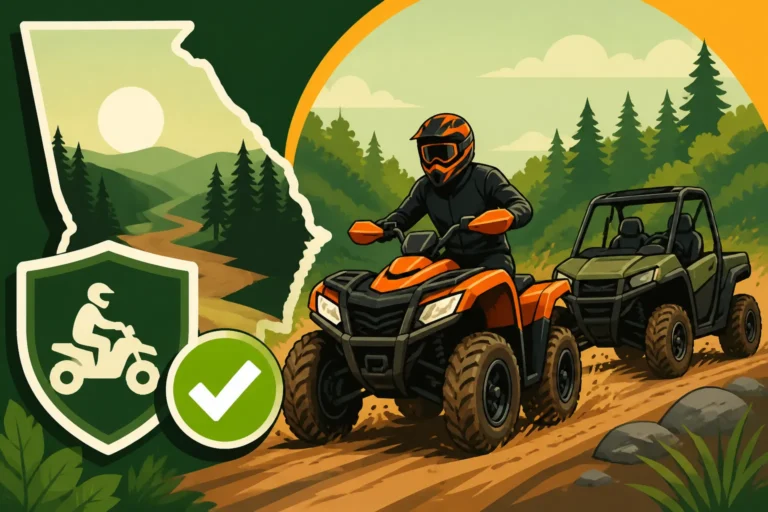
Georgia requires riders under 18 to wear protective headgear while operating or riding as a passenger on an ATV, subject to specific legal exceptions. The requirement is not simply a rule for crossing or riding on a public road. It can apply to off-road riding on private property too, so permission from a landowner does not automatically remove the helmet obligation.
That distinction matters for families who ride on their own land, visit a friend’s property, or head to a private riding park. It also matters for passengers: a teen riding in the back seat of an ATV or side-by-side should not assume that only the driver needs a helmet. For more on the age-based requirement, see Georgia ATV Helmet Law Age Limit. The related Georgia Under-18 Helmet Rule on Private Land explains why a private setting is not, by itself, a blanket exception.
The exact legal classification of a machine can affect which provisions apply. An ATV, a side-by-side, and a golf cart are not necessarily treated alike under every Georgia rule. A side-by-side may be commonly described as a UTV, but the label used in a sales listing does not settle its legal classification. If the vehicle has a steering wheel, bucket or bench seats, seat belts, and a roll cage, that doesn’t mean an under-18 rider should skip a helmet. Check the rules that apply to the specific machine, and follow any stricter requirements set by a park, event, or landowner.
| Situation | Practical approach for a rider under 18 |
|---|---|
| Riding an ATV off-road | Wear a properly fitted helmet unless a specific legal exemption applies. |
| Riding as a passenger | Wear a helmet; passenger status is not a general exception. |
| Riding on private property | Do not assume private land removes the requirement. |
| Riding a side-by-side | Wear a helmet and check the machine-specific rule as well as park requirements. |
| Taking part in farm or other work | Check whether the activity fits a narrow statutory exemption before relying on it. |
| Riding outside Georgia | Check the destination’s law; a Georgia rule does not automatically govern elsewhere. |
The easiest practical standard for families is to make helmets the default for every rider under 18, on every recreational ride. That avoids having to decide at the trailhead whether a particular patch of land, machine type, or activity falls within a legal exception. It also provides protection beyond the minimum a law can require.
Who the rule covers
The age threshold is based on the rider’s age, not ownership of the machine or who gives permission to ride. A parent allowing a teen to ride does not make the helmet optional. And a teen riding as a passenger is still riding the vehicle; being seated behind an adult does not, by itself, create an exemption.
Georgia’s rule is not a substitute for checking other safety requirements. Helmets do not make an unsafe passenger arrangement legal, and they do not change where a machine may be operated. Before heading out, confirm that the vehicle is permitted at the riding location, that it can safely carry the number of people aboard, and that passengers can use the installed restraints. Georgia Rules for Passengers on a Side-by-Side covers passenger considerations specific to those machines.
Private property and organized riding areas
Private property can create a false sense that public safety rules no longer matter. It’s true that landowners and private parks may set their own access rules, but that does not mean every state requirement disappears at a property line. Georgia’s under-18 helmet rule can reach private-land riding, while limited exceptions depend on the activity and circumstances.
A private park may also require helmets for adults, specify accepted helmet types, or impose additional gear rules. Those requirements can be stricter than the state rule. Read the park’s current rider information before making the trip; a waiver or admission payment does not replace required safety equipment. See Georgia Private Park Helmet Rules for park-specific considerations.
Exemptions, Other Rules, and Common Misreadings
Georgia has limited exceptions connected to particular work activities. They should not be treated as a general permission to ride without a helmet on private land, a farm, or a job site. The activity itself matters, and calling a recreational ride “farm use” does not necessarily make it exempt.
The safest response to uncertainty is to wear a helmet and confirm the exception with an authoritative source before a ride. A landowner’s approval, a parent’s permission, or a machine’s work-oriented design does not automatically establish that a statutory exception applies.
Work-related exceptions are narrow
Georgia law recognizes certain work-related circumstances, including specified agricultural, commercial, mining, or logging activity. The details matter: the type of work and the circumstances of the ride must fit the applicable exception. A teen riding for fun around a farm is not necessarily engaged in exempt agricultural activity simply because the ride takes place on farm property.
If a family believes an exception applies, check the wording of the current law and ask the relevant Georgia authority or a qualified legal professional about the specific circumstances. For background on two categories, see Georgia Helmet Exemption for Farm Work and Georgia Commercial Use Helmet Exemption. These are not a reason to assume that all farm or paid work is exempt.
A helmet rule is not permission to ride anywhere
A helmet addresses head protection. It does not grant road access, replace a permit, satisfy insurance rules, or determine whether a minor may operate a machine at a given location. A helmeted rider can still be in violation of a different rule.
That’s especially important when riding near public roads. Georgia has separate rules for road use, crossings, machine eligibility, and operator requirements. A plate or registration does not necessarily make an ATV street legal, and a helmet does not make an otherwise prohibited road ride lawful. Start with Georgia’s ATV Road Law Explained if road access is part of the plan.
Likewise, a trail permit may be required for a particular riding area, and private parks may have their own minimum ages, supervision rules, and machine restrictions. Permit requirements and helmet requirements answer different questions: one concerns access to a place; the other concerns protective equipment. For a broader overview of where permits fit, see Georgia OHV Permits: What You Need Before You Ride.
Visitors should check the law where they ride
A Georgia helmet rule is not a universal standard for every trip. Riders visiting from another state should check Georgia’s requirements, while Georgia residents traveling elsewhere should check the rules where they plan to ride. A home-state registration, helmet habit, or safety card does not necessarily settle the destination’s legal requirements.
A park or organized ride can also set conditions that apply to visitors regardless of their home state. Check requirements before traveling, not after arriving with a helmet that the facility does not accept. Georgia Visitors From Other States offers more context for out-of-state riders.
Choosing a Helmet and Making the Rule Easy to Follow
A legal minimum is only useful if the helmet fits, stays fastened, and is appropriate for the machine and riding conditions. For a teen, fit can change as they grow, so a helmet bought last season may no longer sit securely. Treat a helmet as personal protective equipment, not a hand-me-down item that automatically fits every family member.
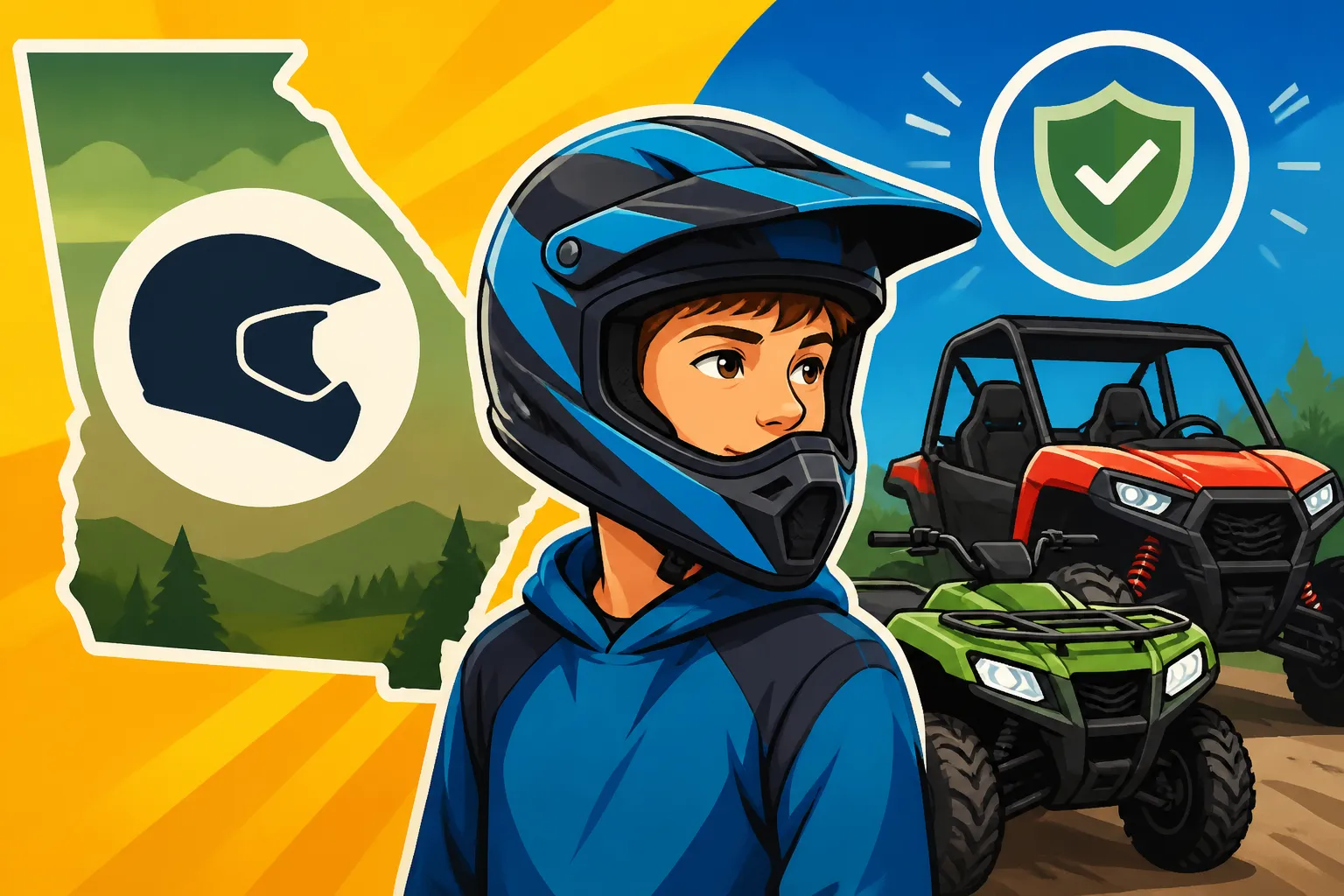
A full-face helmet designed for off-road or motorcycle use offers more coverage than a basic bicycle helmet. Choose a model intended for motorized off-road riding, and look for the applicable safety certification and labeling. A helmet’s appearance, price, or product description alone does not prove that it meets a recognized standard. When buying, read the manufacturer’s information and check that the helmet is designed for the intended use.
Check fit before the ride
A helmet should sit level on the head, cover the forehead, and feel snug without causing painful pressure. It should not rock freely when the rider moves their head. Fasten the chin strap; an unfastened helmet can come off during a crash. If the helmet shifts significantly, does not fit the rider’s head shape, or cannot be secured correctly, choose another size or model.
Also inspect the helmet before use. Look for cracks, damaged straps, loose components, or signs of a significant impact. Follow the manufacturer’s guidance on replacement and care. Do not assume a helmet is safe simply because the outside looks intact after a hard hit.
Eye protection is a separate concern. Some helmets include a face shield, while others require goggles. Pick eye protection that works with the helmet and stays in place over rough terrain. If a rider wears glasses, check that they fit comfortably with the helmet and goggles.
Build a consistent family routine
The most reliable way to avoid arguments about whether a ride is exempt is to make protective gear part of the routine:
- Check each rider’s age, machine, and planned riding location before leaving.
- Confirm that the helmet fits the person who will wear it and that the chin strap works.
- Make sure every passenger has a suitable seat and uses the machine’s restraints where provided.
- Review the park, trail, or event’s requirements, including any stricter helmet or eye-protection rules.
- Keep the helmet on for the ride, and stop if it becomes loose or damaged.
Parents can make this easier by storing helmets with the machine or riding gear, checking fit at the start of the season, and replacing equipment that no longer fits. A clear household rule—no helmet, no ride—also avoids relying on a quick judgment about whether an exception might apply.
What to do if you are unsure
If the vehicle’s classification is unclear, or a planned work activity may qualify for an exception, pause before relying on an interpretation from a seller, a social media post, or another rider. Check the current Georgia law and ask the relevant agency or a qualified professional about the specific situation. The same caution applies to penalties: a violation may have legal consequences, but the amount and process should be confirmed with an official source rather than guessed from an old post. Georgia Helmet Fine Amount is a useful topic to review, but confirm current details before acting on them.
For routine recreational riding, there is a simpler answer: have every rider under 18 wear a properly fitted helmet. It is a practical safety choice, it avoids confusion about private property and exceptions, and it is consistent with the state’s general direction for young ATV riders.
Disclaimer
This article is for general informational purposes only and does not constitute professional advice. Laws, prices and regulations vary by location and change over time. Consult a qualified professional for guidance on your specific situation.