Georgia Visitors From Florida
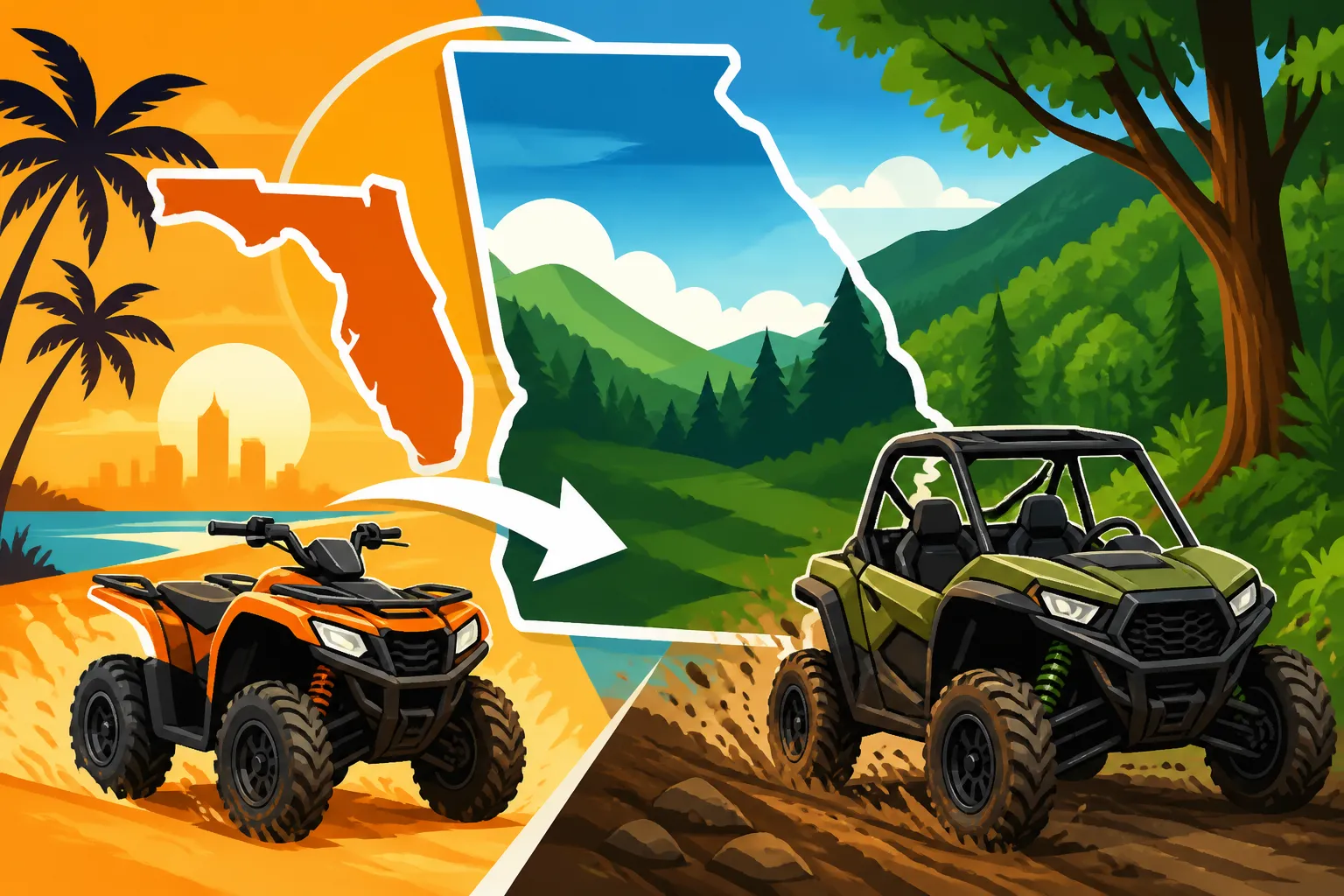
Florida riders planning a Georgia ATV or UTV trip may be unsure whether a Florida permit, plate, or insurance policy carries over. The answer depends on where you ride: a national forest trail, a wildlife management area, a private park, or a public road. Check the rules for the destination before loading up, because one permit does not cover every kind of riding.
What Florida visitors need to know before riding in Georgia
There is no single Georgia permit that automatically gives a visiting rider access to every trail or road. A Florida credential may help document ownership or registration, but it should not be treated as a substitute for a permit required at a Georgia riding area.
Start by identifying the exact place you plan to ride. Georgia’s designated national forest OHV trail systems, wildlife management areas, private parks, and public roads have different access rules. A permit for one place or type of riding may not apply anywhere else.
For designated OHV systems in the Chattahoochee-Oconee National Forest, riders generally need the appropriate Georgia forest OHV permit. It is tied to the person operating the machine, not just to the ATV or UTV. If two people take turns driving, each operator should check the permit requirement. See Georgia National Forest Permits Are Per Operator and Georgia’s Day and Annual Forest OHV Permits for how those permits work.
A Florida hunting license, trail pass, registration, or other state document does not automatically replace a Georgia forest OHV permit. For details on visiting riders, see Do Visiting Riders Need a Georgia Forest Permit? and Georgia Visitors From Other States. Check the rules for your intended trail system before departure, including whether it is open and how the permit must be displayed or carried.
The permit is only one part of trip planning. Your machine must be allowed on the chosen trail, and the trail may have width, operating-hour, or seasonal restrictions. A permit does not make a machine eligible for trails that exclude its size or type.
| Where you plan to ride | What to check before leaving Florida |
|---|---|
| Designated national forest OHV system | Georgia forest OHV permit, system access, machine eligibility, trail status |
| Wildlife management area | Current area rules, allowed roads or trails, access dates and hours |
| Private riding park | Park admission requirements, age and passenger rules, waivers, equipment |
| Private land | Permission from the landowner and any additional site rules |
| Public road | Georgia road-use eligibility, registration, insurance, driver requirements, and local access |
This distinction matters because a permit is permission for a particular type of access, not a general license to ride anywhere. A forest OHV permit does not authorize road riding, and a road registration does not necessarily grant access to a managed trail system.
Permits and reciprocity depend on the riding area
National forest OHV trails
Georgia’s forest OHV permit applies to designated OHV systems, not every road or trail in a national forest. Confirm that the location is an official OHV riding area and that your machine is allowed. Some systems have restrictions that can rule out wider side-by-sides, even if the machine has a permit and is otherwise ready to ride.
Check access conditions close to your trip. A trail can be closed for weather, maintenance, or seasonal management. A permit does not override a closure. Forest roads and OHV trails are also not interchangeable: an open road is not necessarily an open ATV trail. For broader rules about riding in the forest, see Georgia National Forest Trail-Only Rule.
If you will ride more than one forest system, confirm how the permit applies across them rather than assuming a local pass or a Florida credential will be accepted everywhere. The guidance in Georgia’s Day and Annual Forest OHV Permits can help you choose the right permit type, while How to Buy a Georgia Forest OHV Permit explains where riders can obtain one.
A permit is generally associated with an operator. If a passenger takes the controls, that person may need to meet the operator requirements and have their own permit. A passenger who never operates the machine is not the same as an additional operator, but verify the current conditions for the specific system, especially when children are riding.
Wildlife management areas
Wildlife management areas, often called WMAs, have their own access rules. Do not assume that a national forest OHV permit gives you permission to ride on a WMA, or that a WMA rule applies to a nearby forest OHV trail. Some WMA vehicle access is limited by the purpose of the visit, the time of year, the road or trail, and whether a gate is open.
Before riding, confirm whether the WMA allows ATV or UTV use at all and whether riding is restricted to designated roads. Hunting access rules can also affect when a vehicle may be used. A route that is open to hunters under certain conditions may not be available for a recreational ride on an ordinary weekend.
The most useful place to start is Georgia WMA Rules for ATV Riders. If your destination is on national forest land or has a gate, check the specific land manager’s current information too. Never move a barrier or ride around a closure to get onto a route.
Private parks and private land
A private off-road park sets its own check-in rules in addition to any state requirements. It may require a waiver, proof of ownership, safety equipment, a particular age for operators, or compliance with passenger restrictions. A national forest permit does not replace a park’s admission or waiver process. Review Georgia Private Park Waivers and Rules before you travel, and contact the park if any requirement is unclear.
On private land outside a commercial park, get permission from the landowner before unloading. A field, timber road, or informal path is not automatically open to the public just because it looks rideable. Permission should cover where you may ride and whether passengers, guests, or a group are included.
Road riding is separate from trail riding
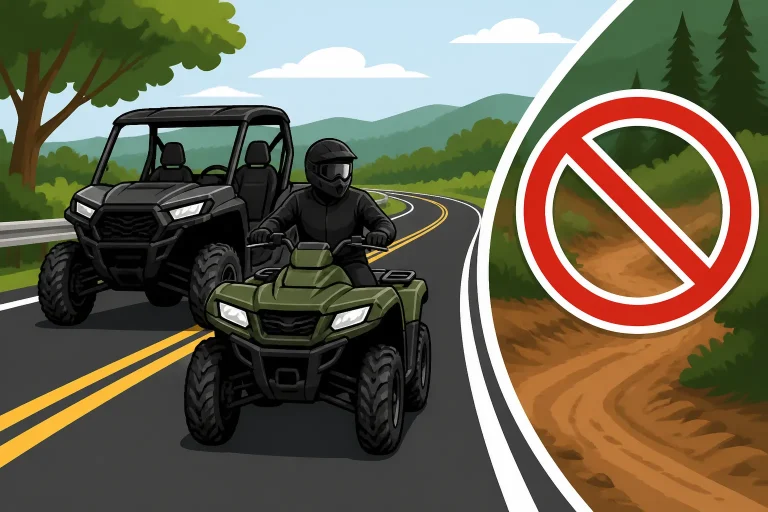
A Florida plate or registration should not be treated as automatic permission to ride on a Georgia road. Public-road access is governed separately from off-road trail access, and Georgia’s rules distinguish eligible road-use machines from ordinary ATVs and other off-highway vehicles. A machine that is legal on private land or a designated OHV trail is not therefore legal on a county road.
If road access is part of your plan, check Georgia’s requirements for the machine, its registration, insurance, equipment, and the operator. Also confirm which roads are open to the relevant type of vehicle. County-road access does not mean every road is available, and a state highway or other restricted road may remain off limits. Georgia Rules for an Out-of-State Plate and Georgia UTV Road Rules by County are useful starting points.
Do not rely on a Florida registration sticker or an OHV permit as proof that a Georgia county road is open to your machine. Ask the county or other relevant authority about the precise route before setting off. If you are only traveling to a trailhead, keep the machine on a trailer until you have reached an area where riding is permitted.
Insurance deserves a separate check. A policy that covers an ATV or UTV for off-road use may not provide the coverage needed for public-road operation. Ask your insurer to explain what the policy covers in Georgia and whether coverage changes when the machine is used on a road. Do not assume that a permit, registration, or proof of ownership is the same thing as insurance.
If your trip includes children, passengers, or multiple operators, verify the age, supervision, helmet, and passenger rules for each location. Requirements can differ between a public trail system and a private park. The rules for a passenger are not necessarily the same as the rules for a person operating the machine.
Prepare your machine and documents before the trip
A short check before loading can prevent a wasted drive or a problem at a trailhead. Keep the documents accessible, but do not assume that carrying paperwork cures a machine or access restriction.
- Choose the exact riding area. Record the system, park, WMA, or private property name. If you plan to visit more than one place, check each separately.
- Confirm the permit or admission requirement. For a forest OHV system, check Georgia’s permit rules and how each operator must carry or show the permit. For a private park, review its check-in requirements.
- Check that your machine is allowed. Look for restrictions on vehicle type, width, passenger capacity, and any other equipment requirements. This is especially important for side-by-sides at trails built for narrower machines.
- Check current access conditions. Confirm operating hours, closures, weather-related restrictions, and whether the route is open on the day you plan to ride.
- Bring useful ownership and identification records. Keep your Florida registration or other ownership documents with you if you have them. They can help identify the machine, but they do not replace a required Georgia permit or grant public-road access. For trail-specific paperwork questions, see Georgia Proof of Ownership on the Trail.
- Ask your insurer about the trip. Confirm whether the policy covers the machine in Georgia and whether coverage applies only off road or also to any planned road use.
- Check rider and passenger rules. Confirm the age and equipment requirements for every operator and passenger, including any park-specific waiver or supervision rule.
- Plan how the machine will reach the riding area. If road legality is uncertain, transport the ATV or UTV on a trailer rather than riding it to the trailhead.
Florida visitors do not need to resolve every possible Georgia rule before choosing a destination. They do need to match the paperwork and machine to the place they intend to ride. A designated forest OHV trail, WMA, private park, and public road are separate situations; checking the right rules for each is the best way to avoid arriving with the wrong permit or assuming that a Florida credential carries farther than it does.
Disclaimer
This article is for general informational purposes only and does not constitute professional advice. Laws, prices and regulations vary by location and change over time. Consult a qualified professional for guidance on your specific situation.