What an Operator Permit Does Not Cover
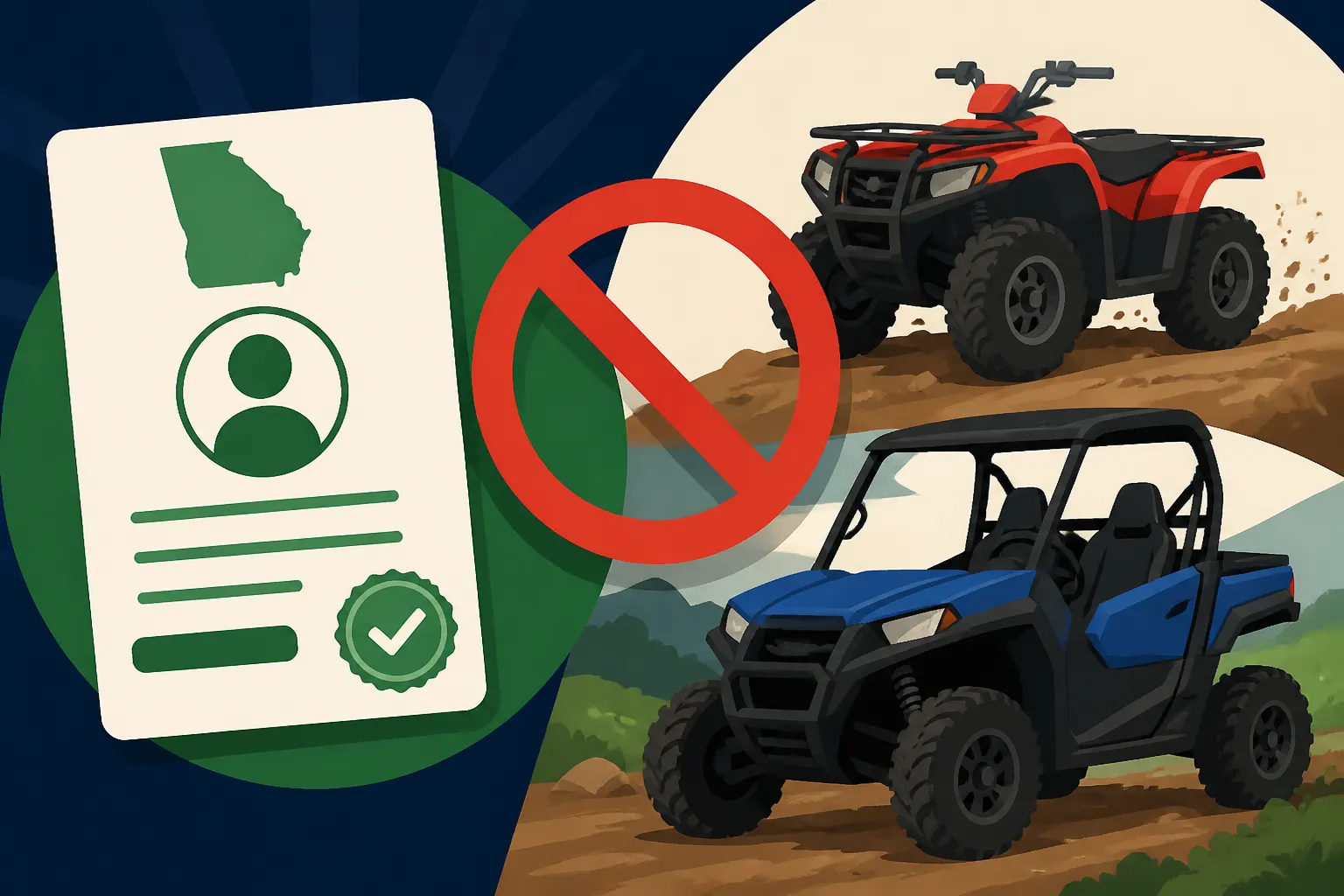
A Georgia forest OHV permit can be easy to mistake for an all-purpose pass. It is not. It addresses a specific part of a ride: the operator’s permit requirement at participating riding areas. Knowing what it leaves out helps you avoid arriving with the wrong paperwork, using a closed route, or assuming a permit makes a machine legal elsewhere.
What a Georgia operator permit is for
The Georgia forest OHV permit is tied to operating an off-highway vehicle in designated riding areas that require it. It is separate from your machine and from permission to ride anywhere you choose. Think of it as one item in a trip’s access requirements, not a registration document or a general license to ride.
The permit system is commonly described as per operator, not per vehicle. If you switch between machines during a ride, the operator’s permit requirement does not become a vehicle registration requirement. Likewise, a permit does not automatically cover other people who take turns driving. Each person who operates should check the current permit terms and carry the required proof.
Georgia’s forest OHV permit rules and available permit types are covered in Georgia’s Day and Annual Forest OHV Permits. For a closer look at why the permit follows the person driving rather than the machine, see Georgia’s Per-Operator Permit, Not Per Vehicle. The terms can differ from those at a private park, so check the rules for the exact place you plan to ride.
A permit may be required even if you already have a state registration, insurance, or other paperwork. Those documents answer different questions:
- Permit: Have you met the operator-permit requirement for this riding area?
- Registration: Is the machine registered under a separate state or local process, where applicable?
- Insurance: Is the machine covered under a policy that meets the relevant requirements?
- Ownership paperwork: Can you show where the machine came from or who owns it?
- Trail access: Is this particular machine allowed on this particular route right now?
One document does not substitute for the others. The table below shows the main limits to keep in mind.
| What you may need | What it addresses | Does an operator permit replace it? |
|---|---|---|
| Forest OHV permit | The operator-permit requirement at participating riding areas | It is the permit itself, but only for the scope described by the provider |
| State or local registration | Registration requirements for a machine in situations where they apply | No |
| Insurance | Coverage required by law, a land manager, or a riding venue | No |
| Proof of ownership | Evidence connecting the machine to its owner or seller | No |
| Trail access and machine eligibility | Whether the route is open and suitable for the vehicle | No |
| Private property permission | The landowner’s permission to ride on private land | No |
| Driver’s license or road-use requirements | Conditions for operating on a public road, where permitted | No |
The practical test is simple: identify the land manager, the riding area, and the activity. Then check each requirement separately. A permit can satisfy one access condition while other conditions remain unmet.
What the permit does not cover
Registration, plates, and road use
An OHV permit is not a state vehicle registration, title, plate, or road-use authorization. It does not make an ATV or UTV street legal, and it does not authorize riding on public roads or roads that are closed to that type of vehicle.
Georgia has a separate process for certain qualifying machines, but a machine must meet the applicable requirements, and registration does not itself open every road. See Georgia MPOHV Registration Is Voluntary and Georgia MPOHV Road Rules: County Roads Only for how those issues differ from trail access.
Do not assume an out-of-state plate or registration will satisfy a forest permit requirement, either. Conversely, a forest permit does not replace registration requirements that apply in another setting. If you are bringing a registered machine from another state, check [Georgia Rules for an Out-of-State Plate] and confirm the riding area’s own rules.
The distinction matters most when a trip includes both trail riding and road travel. A machine may be allowed on a designated trail but prohibited from the road leading to the trailhead. A permit does not change that. Plan to haul the machine legally to the staging area unless the road-use rules clearly allow it.
Insurance and liability
A permit is not an insurance policy. It does not pay for damage to your machine, injuries, damage to another person’s property, or the cost of a recovery. It also does not establish that your current policy covers riding on the specific land or in the specific activity.
Insurance rules can depend on the land manager, venue, machine, and use. A private park may have its own requirements, and a policy that covers one kind of riding may not cover every situation. Before leaving, ask your insurer what the policy covers and review the venue’s current rules.
For public-road use, insurance requirements are separate from the permit and may be different from requirements for off-road riding. Do not treat a permit receipt as proof of insurance if a law enforcement officer, park employee, or land manager asks for coverage information.
Ownership and title paperwork
The permit does not prove that you own the machine or that it was lawfully acquired. It is not a bill of sale, title, registration certificate, or substitute for ownership records.
This is especially important if you bought a used machine, inherited one, or received it without complete paperwork. Keep the documents relevant to the purchase or transfer, and check what the riding area expects operators to carry. Georgia Proof of Ownership on the Trail explains why permit paperwork and ownership evidence are different things.
If the machine’s serial number is difficult to read, altered, or inconsistent with your paperwork, do not expect a permit to resolve the problem. A permit does not clear a stolen-machine concern, validate a serial number, or fix a broken chain of ownership.
Open trails, allowed machines, and conditions
A permit does not promise that every trail is open, suitable for your machine, or available on the day you arrive. Routes may be limited by vehicle type, width, weather, maintenance, season, or other operating conditions. Gates and closures still apply.
Always check current conditions before traveling, then read the signs at the entrance and along the route. A trail map may show a route that is closed at the moment, and an open area may still have restrictions on which machines can use particular trails. The forest trail-only rule is explained in Georgia National Forest Trail-Only Rule.
A permit also does not authorize riding off designated routes. Leaving a signed trail to avoid a puddle, reach a viewpoint, or get around a closure can cause damage and may violate the land manager’s rules. Stay on routes that are open for your machine, even if a nearby track looks passable.
Safety cards, age rules, and helmets
Do not assume that buying a permit means you have completed a safety course or meet all age and supervision requirements. Permit eligibility and rider safety rules are separate questions. Georgia does not use the permit as a universal proof of training or competence.
Age rules can differ by property, trail system, or activity. A private park may set its own minimum ages, supervision rules, and waiver requirements. For riders under 18, review Georgia Under-18 Riders and the Helmet Rule as well as the specific location’s requirements. A helmet or other safety gear may still be required even when the permit has been purchased.
A permit also does not establish that a machine is safe to operate. Before riding, check the controls, brakes, tires, lights where required, protective equipment, and any features demanded by the venue. Do not rely on the permit as an inspection or mechanical sign-off.
What to check before you ride
A short check before leaving can prevent a frustrating trip. The key is to verify the operator, machine, location, and timing rather than treating the permit as a one-step approval.
- Identify the land manager. Confirm whether the riding area is on national forest land, private land, or another type of property. Similar-looking routes may have different rules.
- Check the current permit terms. Confirm which permit applies, who must hold it, how it must be displayed or carried, and where it is valid. Do not rely on an old receipt or a friend’s description.
- Confirm each operator’s status. If more than one person may drive, check the requirement for each operator. A permit purchased for one person should not be assumed to cover a different driver.
- Confirm the machine is allowed. Check vehicle type, width, trail designation, and any other restrictions. Do not assume that a permit makes every ATV or UTV eligible for every route.
- Check whether the route is open. Look for current closures, weather advisories, seasonal limits, and trailhead notices. Recheck when you arrive because conditions can change.
- Carry separate documents where relevant. Bring ownership records, registration, insurance details, identification, and any other required paperwork. A permit is not a replacement for them.
- Plan transportation to the riding area. Make sure the route from home to the trailhead does not depend on using a public road that your machine cannot legally travel.
- Read the rules for the specific site. Private parks and other properties can have separate waivers, equipment standards, noise limits, passenger rules, and fees.
The permit is most useful when you treat it as one checkpoint in that process. It can be valid while the machine is still barred from a particular trail, or the operator can have the right permit while lacking another required document. Check the full set of conditions rather than asking only, “Do I have a permit?”
If you want a sense of what may be checked at arrival, see What a Ranger Checks at a Georgia OHV Trailhead. The person checking permits may also direct you to trail restrictions or ask about compliance with other site rules. Carrying your permit does not mean you can ignore those instructions.
How permits differ across places and riders
A common source of confusion is assuming that a permit has the same reach everywhere in Georgia. It does not. A forest OHV permit applies according to the issuing program’s terms. A private riding park may require a separate admission payment, waiver, or proof of insurance. Permission from one property owner does not grant access to neighboring land.
| Riding situation | What the forest OHV permit may address | What you should verify separately |
|---|---|---|
| Riding a designated forest OHV route | The operator-permit requirement for that riding area | Route status, machine eligibility, riding hours, and current conditions |
| Riding at a private off-road park | It may not satisfy the park’s admission or permit rules | Park access, waivers, age limits, insurance, and equipment rules |
| Riding on private land | It does not provide the owner’s permission | Written or clear permission, boundaries, and any local rules |
| Riding a public road | It does not authorize road use | Registration, permitted route, license, insurance, and equipment requirements |
| Riding in a wildlife management area | It does not automatically grant WMA access | Access rules, allowed roads, dates, time windows, and any required tags or licenses |
| Riding with an out-of-state machine | It does not settle registration or reciprocity questions | The machine’s documents and the rules of the destination and route |
For a wildlife management area, do not assume that a forest OHV permit is enough to ride. WMA access can be limited to specified roads, dates, times, or activities, and rules can vary by area. Start with Georgia WMA Riding Rules Explained and verify requirements for the particular property.
Visitors from outside Georgia should also keep permit and registration questions separate. A visitor may need to meet the local riding-area permit requirement even if the machine is registered at home. A home-state registration does not automatically grant access to a Georgia trail, and a Georgia forest permit does not resolve whether the home-state paperwork is accepted for other purposes.
Passengers need separate attention, too. A passenger who never operates the machine is not necessarily treated like an operator under a per-operator permit system. But the machine’s passenger capacity, age rules, helmet rules, and site requirements still matter. If a passenger may take a turn driving, check the permit requirement for that person before the ride begins.
For a family or group, make a list of who will drive, which machines they will use, and where the group plans to ride. That simple step avoids the mistaken assumption that one person’s permit covers the whole group. It also makes it easier to confirm whether each machine fits the routes you intend to use.
Common permit misunderstandings
“I have a permit, so I can ride any trail”
No. The permit does not override trail signs, closures, vehicle limits, or land-manager rules. Use the route designated for your machine and follow posted directions. If the route status is unclear, ask the managing office before entering.
“The permit is attached to my machine”
The permit program is per operator, so do not treat it as a permanent vehicle credential. If someone else drives, verify that person’s requirement. If you change machines, the operator permit does not automatically replace any machine-specific requirements at the site.
“My registration is the same as a permit”
They serve different purposes. Registration addresses a separate legal or administrative status for the vehicle; a forest permit addresses an operator access requirement at participating riding areas. Neither document automatically replaces the other.
“The permit lets me ride on the road to the trail”
It does not. Confirm the legal route to the trailhead, and use a trailer when needed. Road-use rules and forest-trail access are separate.
“A permit means the property has no other rules”
A riding area can have safety, age, equipment, passenger, noise, or operating-hour rules in addition to its permit requirement. Private parks may use their own waiver and access systems. Review Georgia Private Park Waivers and Rules before assuming forest permit terms apply there.
“If the permit is annual, it must work everywhere”
An annual permit is still limited by the program’s stated coverage. It does not become a statewide license or grant access to every public or private riding area. Check the current terms and the rules for each destination.
When in doubt, ask the permit provider or land manager a specific question: “Does this permit meet the operator requirement for this location and date, with this machine?” That is more useful than asking whether the permit is “good in Georgia,” because the answer depends on where and how you plan to ride.
Frequently Asked Questions
Does a Georgia forest OHV permit register my ATV or UTV?
No. It addresses the operator-permit requirement for participating riding areas. Registration, title, plates, and road use are separate matters.
Does one operator permit cover everyone in my group?
Do not assume so. The permit is per operator. Check the current terms for each person who may drive; a passenger who does not operate is a different case from a second driver.
Can I use the permit at a private riding park?
Not automatically. Private parks set their own entry and operating rules. Contact the park to ask about admission, waivers, insurance, and equipment requirements.
Does a permit let me ride a closed trail?
No. Closures, signs, vehicle restrictions, and land-manager instructions continue to apply.
Disclaimer
This article is for general informational purposes only and does not constitute professional advice. Laws, prices and regulations vary by location and change over time. Consult a qualified professional for guidance on your specific situation.