Trailering Over Mountain Passes
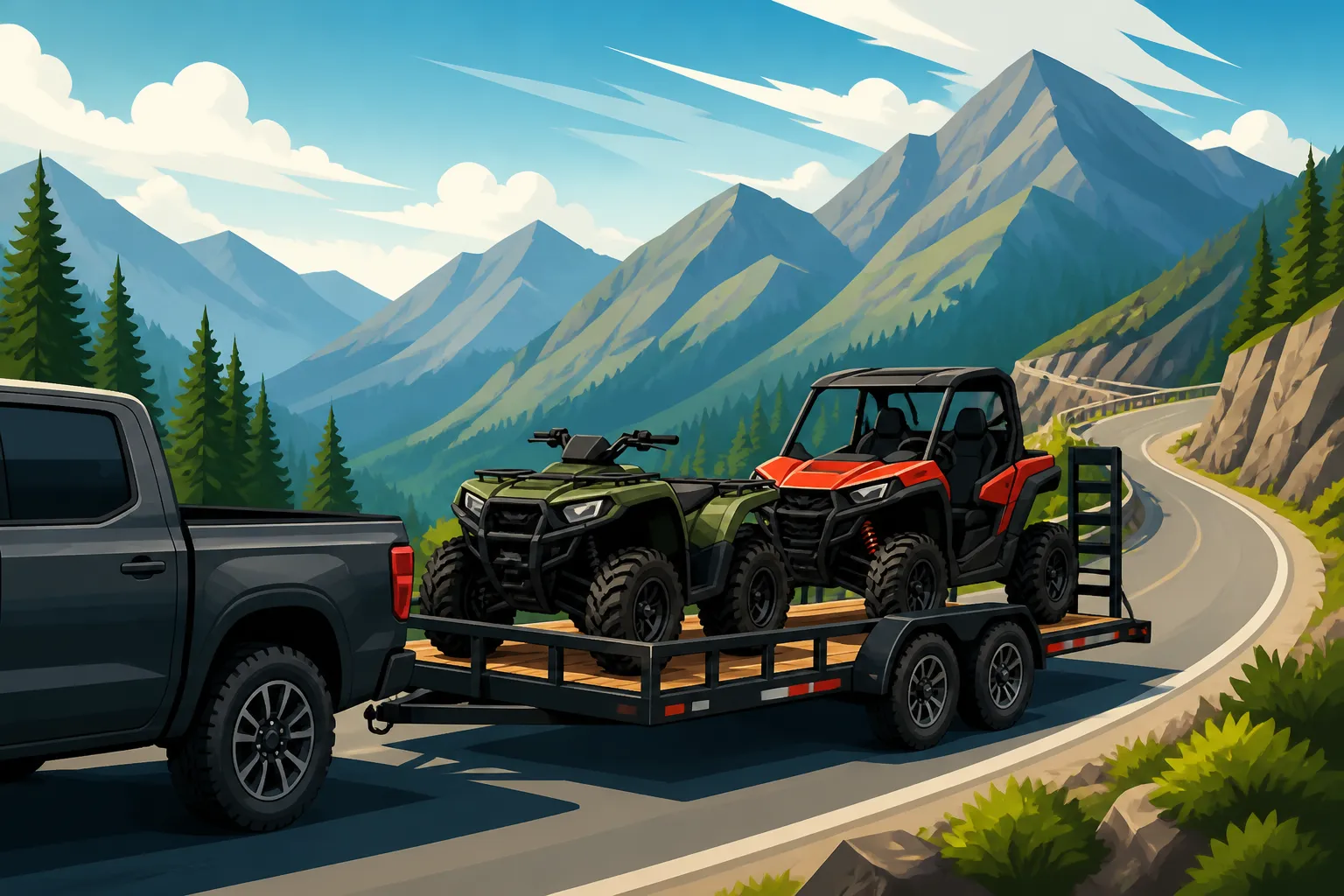
A trailer that feels stable on flat Georgia roads can behave very differently on a steep climb or a long descent. That can turn the drive to a North Georgia riding area into a stressful part of the trip, especially with a loaded UTV behind you. This guide covers how to prepare your tow vehicle, secure your machine, choose a sensible route, and manage mountain grades.
Prepare your tow vehicle and trailer before the trip
Check the full towing setup, not just the trailer
Start with the ratings for your tow vehicle, hitch, ball mount, and trailer. The weakest rating in that chain matters. Check your owner’s manual for towing and payload limits, and account for the weight of passengers, fuel, tools, cargo, and the trailer itself. A vehicle may be within its advertised tow rating but still exceed a payload or axle limit once the truck is loaded for a riding weekend.
Pay attention to the trailer’s gross vehicle weight rating and axle capacity, too. An ATV or side-by-side can be heavier than it looks, especially with accessories, a winch, a roof, a windshield, and gear onboard. If you are unsure of the loaded weight, a public scale can help you make a more informed decision before heading into the mountains.
Also inspect the parts that can cause trouble far from home: tires, lug nuts, bearings, coupler, safety chains, lights, and the breakaway system if your trailer has one. Check tire pressure when the tires are cold and use the pressure specified for the trailer. A tire that looks acceptable in the driveway may be underinflated or damaged enough to become a problem after sustained highway driving.
Load and secure the machine carefully
Park the trailer on firm, level ground before loading. Use ramps rated for the machine’s weight, secure them as directed, and have someone spot you if visibility is limited. Keep the machine centered and position its weight so the trailer has appropriate tongue weight, following the trailer manufacturer’s guidance. Too little tongue weight can contribute to sway; too much can overload the vehicle’s hitch or rear axle.
Use appropriately rated tie-downs attached to secure points on the machine and trailer. Compress the suspension enough to reduce movement, but avoid crushing or stressing parts that are not intended as tie-down points. After driving a short distance, stop somewhere safe and check the straps, coupler, lights, and trailer tires. Repeat the checks when you stop for fuel or a rest.
Before setting out, confirm that nothing can shift in the machine’s cargo bed or on the trailer. A cooler, tool box, spare tire, or loose ramp can become a hazard if it moves during braking or a turn. For a more detailed pre-trip check, Measuring Your Machine Before You Tow can help you think through fit and loading, while Carrying a Tow Strap in the Mountains covers a useful piece of recovery gear for remote areas.
Choose a route with the loaded rig in mind
Plan for grades, curves, and roadside options
A route that looks short on a map may be a poor choice for a vehicle towing a loaded trailer. Mountain roads can include steep grades, tight curves, limited shoulders, and few safe places to pull over. Before leaving, review the route using a road map or navigation tool designed for vehicles, and check for road restrictions, closures, construction, and conditions that could affect a trailer. Follow posted signs and do not assume a route suitable for a passenger car will feel comfortable with a long rig.
Around North Georgia, trips toward Blue Ridge, Chatsworth, Dahlonega, and the Cohutta area may involve changing elevations and winding approaches. The best route depends on where you are starting, the trailer’s size, and the towing vehicle. If a road looks narrow or steep on the map, choose a safer alternative where practical rather than relying on the trailer brakes to manage a difficult descent.
Keep a backup plan. Identify a few safe places where you could stop, turn around, or wait without blocking traffic. A small pull-off may not have enough room for a truck and trailer, and backing onto a narrow road can be risky. If you are meeting other riders, agree on a staging location that can accommodate trailers before you arrive; Where to Stage When a Lot Fills Up is useful for thinking through that part of the plan.
Check the riding destination and access details
Confirm that the trail system allows your type and width of machine and that the access road is appropriate for your trailer. A trailhead may be reachable by a passenger car but have tight parking, a steep entrance, or limited room to maneuver a long rig. If the parking area is full, avoid stopping where your trailer blocks the road or creates a blind spot.
Check official trail updates before driving, especially after heavy rain or storms. Conditions can change, and a trail may be closed even when the access road is open. Georgia Trail Conditions Before You Drive offers a starting point for planning, while Georgia Trailhead Restrooms and Water can help you assess what facilities are available once you arrive. For routes around the northern part of the state, Georgia Trails Near Chattanooga and Georgia Trails in the Blue Ridge Mountains can help narrow down the riding area before you plan the tow.
onX Offroad can be useful for reviewing off-road trail information and identifying the general location of riding areas. Treat it as a planning aid, not a substitute for road navigation, posted signs, or current land-manager information. Before towing, confirm the trail’s access point and parking situation with the relevant land manager or park. A trail line on a map does not necessarily mean the road leading to it is suitable for your loaded vehicle and trailer.
Drive steadily on climbs and descents
Use a controlled approach on uphill grades
Give yourself room before a climb so you can build steady momentum without speeding. Select a gear that lets the engine work comfortably and avoid abrupt acceleration or unnecessary lane changes. If traffic is moving faster, do not let pressure from other drivers push you into a pace that feels unsafe for your setup. Use a suitable turnout when it is safe and legal to do so.
Watch the temperature gauge and pay attention to changes in engine performance. If the vehicle begins to overheat or loses power, stop at a safe location as soon as possible rather than continuing uphill in the hope that the problem will disappear. Do not stop in a travel lane or on a narrow shoulder where the trailer could be struck. Allow the vehicle to cool according to the owner’s manual before checking anything under the hood.
Altitude and steep grades can affect how a vehicle performs, particularly when it is heavily loaded. Elevation and Why It Changes the Ride discusses how elevation can shape a day on the trail; the same basic planning mindset helps when you are hauling equipment into the mountains. Leave extra time for the drive so you do not feel rushed to reach a trailhead before a planned riding window.
Control speed before the descent
Reduce speed before starting down a long grade. Use a lower gear or the vehicle’s recommended engine-braking setting to help control speed, and follow the owner’s manual for towing downhill. Avoid riding the brakes continuously; excessive braking can build heat and reduce braking performance. If you need to slow down, apply the brakes in a controlled way and leave more space than usual between you and the vehicle ahead.
Trailer brakes are important to a stable setup, but they do not replace careful speed control. Check that the brake controller is set appropriately for the trailer and load, following the vehicle and controller instructions. If the trailer begins to sway, avoid sudden steering or hard braking. Follow the guidance in your vehicle’s manual for regaining control, and do not accelerate to a speed that feels unsafe simply because another driver is close behind.
Use the table below as a simple planning reminder, not as a substitute for the specifications for your particular vehicle and trailer.
| Situation | Safer approach | Avoid |
|---|---|---|
| Long uphill grade | Maintain a steady pace and use an appropriate gear | Flooring the accelerator or rushing to keep up |
| Long downhill grade | Slow before the descent and use engine braking as directed | Continuous hard braking |
| Trailer sway | Stay calm and follow the vehicle manual’s guidance | Jerky steering or sudden acceleration |
| Tight mountain road | Allow extra room and use safe turnouts | Stopping where the rig blocks traffic |
| Poor visibility or bad weather | Delay, reroute, or stop somewhere safe | Continuing because the trail reservation or plan is fixed |
Make arrival and return part of the plan
Give yourself room to park and unload
When you reach the riding area, look for a level spot before unhitching or unloading. Keep the truck and trailer out of traffic lanes and away from soft shoulders, steep edges, and places where another vehicle might need to pass. If the lot is crowded, do not force a turn that leaves you unable to maneuver. A second designated parking or staging option can save a frustrating and potentially unsafe situation.
Set the parking brake, chock the trailer wheels, and use the trailer’s support equipment as directed. Keep loading ramps stable and clear of mud or gravel that could cause a machine or person to slip. Unload with a spotter if the view from the driver’s seat is limited, and keep bystanders out of the path of the machine.
onX Offroad may help you review where the riding area sits in relation to nearby trails, but use local signs and land-manager directions for the actual entrance and parking rules. If access is unclear, stop somewhere safe and ask before driving farther into a narrow or private road. For broader planning, Georgia Riding Areas Reachable Without a Truck may also help compare destinations based on the practicalities of getting there.
Inspect before the drive home
Before leaving, walk around the trailer and check the machine’s tie-downs, trailer lights, tires, coupler, and safety chains. Mud and debris can hide damage, so take a moment to look closely at the tires and straps. Make sure the machine’s cargo is secured and that ramps are locked in their travel position.
After a full day of riding, it is tempting to load quickly and get on the road. That is also when tired riders are more likely to overlook a loose strap or forget to reconnect a trailer plug. Use the same loading routine you used before the trip, and pause for a final check before moving. If weather, darkness, or fatigue makes the return drive feel unsafe, consider resting or delaying departure rather than rushing down a mountain road.
If the trailer or tow vehicle develops a problem, move to a safe location only if you can do so without creating a greater hazard. Use warning equipment as appropriate and stay clear of traffic. A tow strap may be useful for recovery in some situations, but it is not a substitute for roadside assistance, proper equipment, or a safe recovery plan. Make sure you understand how your gear is intended to be used before relying on it.
Disclaimer
This article is for general informational purposes only and does not constitute professional advice. Laws, prices and regulations vary by location and change over time. Consult a qualified professional for guidance on your specific situation.