Where to Stage When a Lot Fills Up
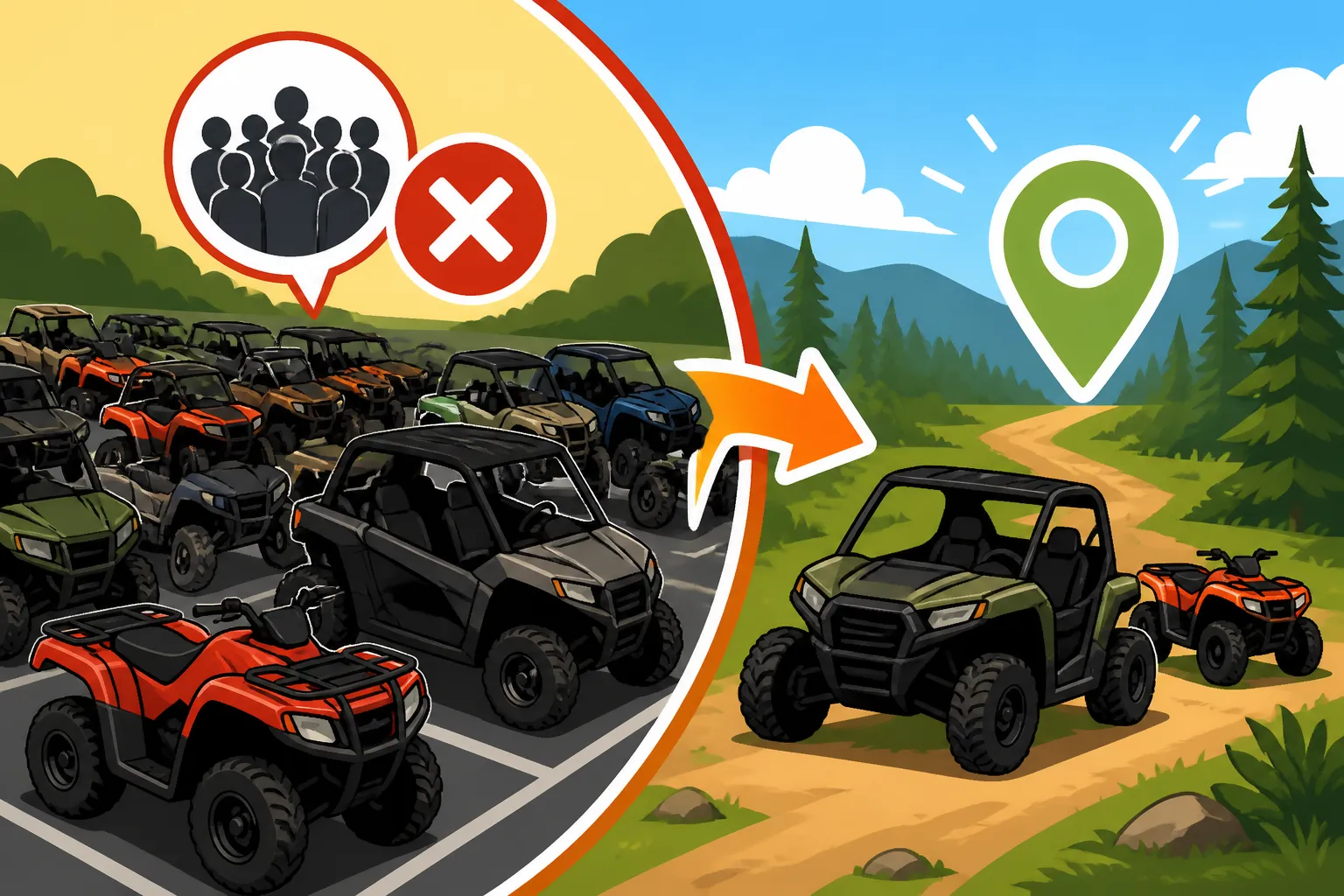
A full trailhead lot can turn a Georgia riding day into a frustrating search for somewhere to leave your truck and trailer. The safest backup is not simply the nearest patch of gravel: it has to be legal, out of the way, and practical for unloading. This guide explains how to make a staging plan, what to do when the lot is full, and when to change riding areas.
Why a Full Trailhead Lot Changes Your Plan
A parking space needs room for your whole setup
At an off-highway trailhead, the space your tow vehicle takes up is only part of the equation. A trailer needs room to maneuver, and unloading a machine can require additional clearance. A spot that looks open may be too narrow to turn around in, block another vehicle, or leave your trailer extending into a travel lane.
This is especially easy to underestimate when you arrive with a longer trailer, a wide side-by-side, or more than one machine. A tight lot that works for a truck alone may be difficult to use safely with a trailer attached. Before you pull in, look for marked spaces, posted restrictions, and room to maneuver without backing into a road or blocking the entrance.
If the lot is full, do not assume the shoulder, a gate entrance, or a turnout is an acceptable substitute. Those areas may need to stay clear for emergency vehicles, maintenance crews, other trail users, or traffic. An improvised spot can also make it hard for another vehicle to pass or turn around.
Parking outside the trailhead may not be an option
A nearby road, business, private driveway, or open-looking field is not automatically public parking. Land ownership and parking rules can change from one parcel to the next, and a gravel pull-off may be intended for maintenance or emergency access rather than visitor parking.
If you are considering an alternate location, look for clear permission or posted public parking information. Do not unload on private land because it seems unused, and do not block a gate even if there is no visible sign. A gate may serve a working forest road, utility corridor, fire access route, or private property.
It also helps to separate two questions: whether you can legally park there and whether you can legally ride from there. An alternate parking area does not necessarily provide a lawful connection to the trail system. Review Georgia Trails That Close After Rain and Reading a Forest Service Trail Sign when planning around managed trail access and posted conditions.
Make a Staging Plan Before You Leave Home
Check the trailhead and trail status first
Choose a primary riding area and identify at least one realistic backup before loading the trailer. Check the managing agency’s trail and recreation information for closures, operating details, parking guidance, and temporary notices. Conditions can change after heavy rain, maintenance work, or other disruptions, so an old trip report or saved map should not be treated as confirmation that a facility is open.
For Georgia forest riding, trail access and parking arrangements differ between systems. A plan for Houston Valley may not apply at Beasley Knob or another trailhead. Review the specific area’s information rather than assuming all locations have the same lot size, road access, or overflow arrangements. These guides can help you compare options: Georgia’s Six National Forest OHV Systems and Georgia Trail Conditions Before You Drive.
Map tools can help you understand the surrounding roads and locate possible alternatives, but they cannot grant permission to park on private property or confirm that a lot has space. Some riders use onX Offroad to review routes and get a clearer sense of the area before leaving. Check its information alongside official trail notices, posted signs, and local access rules.
Build a backup that does not depend on roadside parking
A useful backup plan has more than one destination. It might be another open trail system with an appropriate staging area, a legal campground or lodging option that allows trailer parking, or a decision to postpone the ride if there is no safe place to unload. The right fallback depends on your route, trailer size, and the rules of the destination.
Use this simple planning table to decide what to do when the primary lot is full:
| Situation | Safer next step | Avoid |
|---|---|---|
| The lot is full, but another marked space is available | Wait for a suitable space or follow posted directions | Squeezing into a space that blocks unloading or traffic |
| A sign identifies an approved overflow area | Follow the sign and any staff or ranger instructions | Assuming any nearby gravel area is approved overflow |
| No approved parking is available | Move on to a planned alternative or return later | Parking at a gate, road shoulder, or trail entrance |
| You find a possible private parking area | Ask the owner or operator for permission before unloading | Treating an open field or business lot as public parking |
| The backup trailhead is also crowded | Recheck access information and choose another plan | Driving between trailheads without confirming access |
Plan the route between your first choice and your backup before you tow. A detour that looks short on a map may involve narrow roads, steep grades, or a difficult turn with a trailer. A navigation app can help with general routing, but verify that the road is suitable for your vehicle and that the destination has lawful parking.
What to Do When You Arrive and the Lot Is Full
Pause before entering or unloading
If vehicles are queued at the entrance, stop somewhere safe where you are not blocking the road, the trailhead, or other traffic. Do not pull forward simply to see whether you can squeeze in. Watch for posted directions, staff, rangers, or other official instructions. If the lot has an attendant or a clearly identified contact point, ask whether spaces are expected to open or whether an overflow location is available.
Keep your trailer attached until you know where you are going to park. Unloading a machine in a travel lane or at the edge of a crowded lot can create a hazard, especially when other vehicles are arriving or leaving. If the only available space requires an awkward turn or leaves your trailer sticking into traffic, it may not be a safe space for your setup.
A little patience is better than improvising under pressure. When a family has driven several hours, it is tempting to make any available patch of ground work. But if it blocks access or creates a conflict with land managers, the stress can extend well beyond a delayed start.
Leave if there is no approved safe space
If no legal, suitable space is available, use the backup plan rather than parking somewhere questionable and hoping no one minds. Keep your machine secured, avoid unloading in a road or entrance area, and move to a destination where parking and riding access are clear.
This is where advance planning pays off. Save the address or map location for a second riding area, note any access instructions, and check that the alternative is appropriate for your vehicle. A map application such as onX Offroad may help you review the surrounding area, but use official sources to confirm trail status and access. For broader planning, see Georgia Trails Within Two Hours of Atlanta and Georgia Trailhead Restrooms and Water.
If the alternative involves a private park, campground, or other managed property, check its own parking and machine rules before arriving. A place that allows visitors may still have limited trailer space or specific unloading requirements. Contact the operator when the available information is unclear rather than relying on assumptions.
Keep Your Backup Plan Safe and Practical
Think about towing, unloading, and the return trip
A backup location should work for the entire outing, not just for getting the machine off the trailer. Ask yourself whether you can turn around safely, leave the tow vehicle and trailer without blocking anyone, and return to them after riding. If the site is unfamiliar, consider whether the access road is manageable for your tow vehicle and whether there is enough room to maneuver.
Weather matters, too. A muddy or soft shoulder may look usable when you arrive, then become difficult to exit after rain or repeated traffic. Georgia’s red clay can become slick when wet, so avoid turning a parking problem into a recovery problem. Review Georgia Trail Closures After a Storm before setting out if recent weather may have affected access.
If you are riding with a group, agree on what happens if the primary location is full. Decide whether everyone continues to the backup or whether the group cancels the ride. Set a meeting point that is an actual public, legal place rather than an unmarked turnout. Share the plan with drivers who may arrive separately, and make sure nobody is left searching for a place to unload alone.
Treat a crowded lot as useful information
A full lot may mean the area is busier than expected, but it can also signal that conditions or access have changed. Do not assume a crowd means the trail is open, suitable for your machine, or safe to enter. Check notices and signs before riding, and respect closures even if other vehicles appear to be going in.
If the lot is consistently full when you visit, adjust the timing of your next trip or choose a different riding area. Arriving earlier can help, but it is not a guarantee, especially on popular weekends or during favorable weather. The practical goal is to arrive with options, not to depend on beating everyone else to one parking space.
For planning a different outing, Georgia Private Off-Road Parks Compared can help you consider alternatives beyond a crowded forest trailhead. Before choosing any destination, verify its current operating information, machine restrictions, and parking arrangements. Tools such as onX Offroad can support your route planning, while the land manager or property operator remains the place to confirm permission and access.
Disclaimer
This article is for general informational purposes only and does not constitute professional advice. Laws, prices and regulations vary by location and change over time. Consult a qualified professional for guidance on your specific situation.