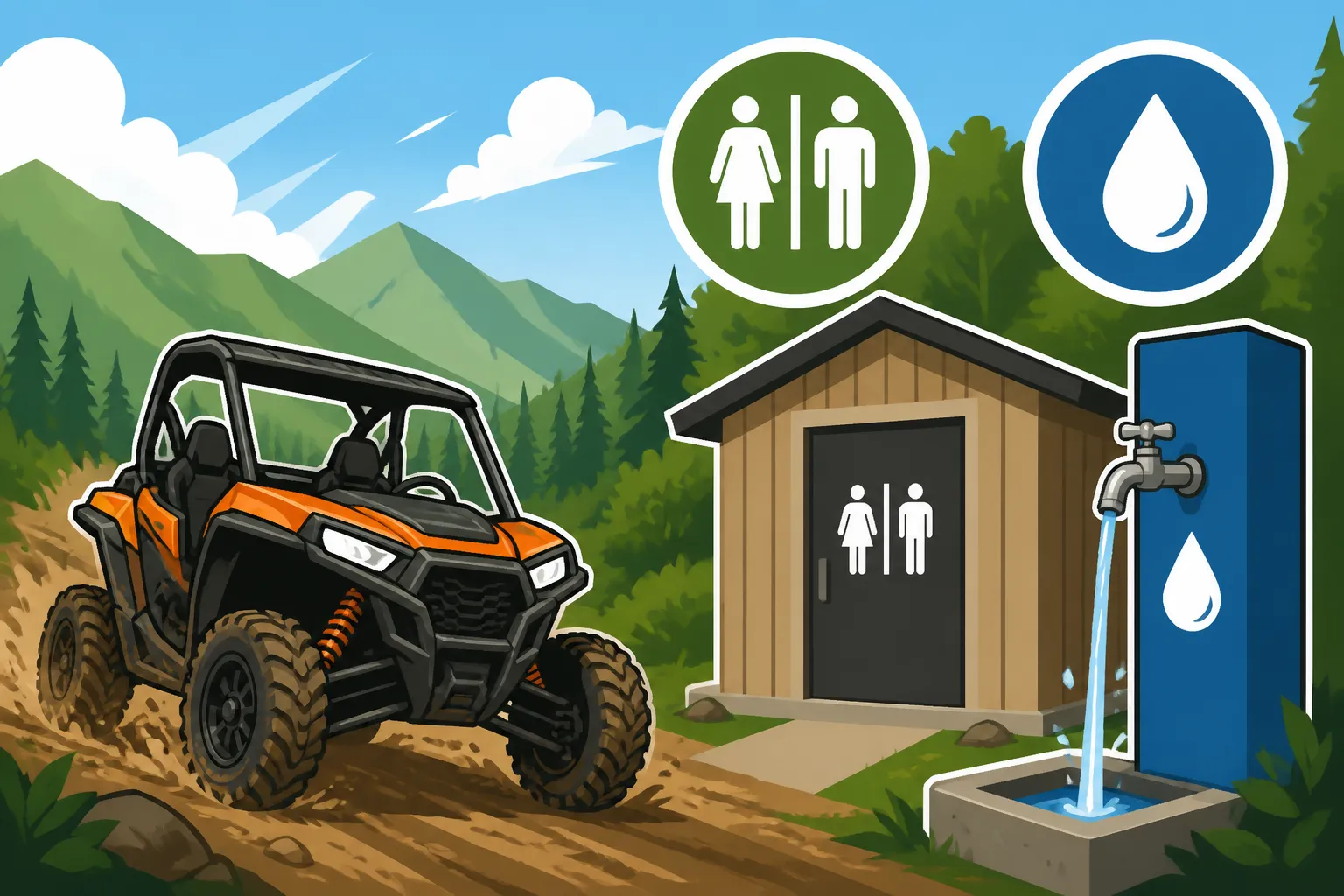
Georgia Trailhead Restrooms and Water
A ride can start with one frustrating surprise: the trailhead has parking, but no restroom, no running water, and nowhere nearby to refill a bottle. In Georgia, amenities vary by riding area and can change with closures or maintenance. This guide explains how to check restroom and water access before you haul your ATV or UTV, and how to plan a comfortable ride when facilities are limited.
What to expect at Georgia ATV and UTV trailheads
Restrooms are not guaranteed
A trailhead may have a restroom, but the word can mean different things in practice. Some sites have a vault toilet; others may have a portable unit, a flush restroom at a developed recreation area, or no restroom at all. Even when one is listed, it may be closed, out of service, or a longer walk from the parking area than you expected.
That uncertainty matters more when you’re riding with kids, older adults, or a group that plans to stay out for several hours. A family arriving at a remote trailhead near opening time may not have a convenient alternative if the facility is locked or unavailable. If anyone in your group needs reliable restroom access, treat it as a must-confirm detail—not a nice-to-have assumption.
The six National Forest OHV systems in Georgia include Houston Valley, Beasley Knob, Whissenhunt, Town Creek, Oakey Mountain, and Davenport. Their facilities are not interchangeable, and a restroom at one developed recreation area does not mean another trail system has one. Start with [Georgia's Six National Forest OHV Systems](Georgia's Six National Forest OHV Systems) to identify the riding area, then check the relevant Forest Service information or contact the managing ranger district for facility details.
Private riding parks can have different setups from public forest trailheads. Some may offer more developed visitor facilities, while others have limited services or facilities located away from the riding area. Check the park’s own rules and visitor information before you go, especially if your group is relying on a restroom being open throughout the day.
Water access is different from water you can safely drink
A water source shown on a map or mentioned in a trail description is not automatically potable drinking water. It could refer to a stream, creek, lake, or other natural source. Don’t plan to drink untreated surface water, and don’t assume a spigot is available just because the site is a developed recreation area.
For most rides, the safest plan is to bring enough drinking water for the whole outing, plus extra for delays, warm weather, or an unexpectedly strenuous ride. Georgia heat and humidity can make a route feel harder than it looked on a screen. A muddy climb, a slow-moving group, or a machine that needs attention can extend a planned short ride into a long day.
If your group wants to refill containers at the trailhead, confirm that potable water is actually available and operating. “Water nearby” is not specific enough. Ask whether there is a working drinking-water tap at the parking area, whether it is seasonal, and whether it is currently accessible. When you can’t confirm those details, pack water as if there will be no refill option.
How to check facilities before you leave
Use a reliable sequence of checks
A good pre-trip check takes a few minutes and can prevent a long, uncomfortable drive back to town. Begin by identifying the exact trail system and the access point you intend to use. Trail systems can have multiple entrances, and facilities may be located at only one of them. A listing for the broader recreation area may not describe the specific parking lot where you plan to unload.
Next, check current information from the land manager or park operator. For National Forest riding, contact the relevant ranger district if the online details don’t answer your question. Ask plainly: “Is there a restroom at this specific trailhead, and is it open?” and “Is there potable drinking water at the parking area?” These questions reduce the chance of mistaking a nearby natural water feature or campground facility for a service available to trail users.
Then check for temporary closures, maintenance notices, and access changes. A facility can be unavailable even while trails remain open. Use [Georgia Trail Conditions Before You Drive](Georgia Trail Conditions Before You Drive) as part of your planning, but confirm facility information separately if the listing does not address restrooms or water.
| What to verify | Why it matters | Practical backup |
|---|---|---|
| Exact trailhead or entrance | Facilities may be at a different access point | Save the entrance location and a nearby alternative |
| Restroom type and operating status | A listed facility may be closed or limited | Use a restroom before leaving the last town |
| Potable water availability | Natural water is not a safe refill plan | Bring enough sealed drinking water |
| Seasonal or maintenance closures | Services may be unavailable even if riding is allowed | Check again shortly before departure |
| Distance from parking | A facility may not be convenient for every rider | Plan for anyone who cannot walk far |
A navigation app can help you orient yourself and compare access points. Some riders use onX Offroad to review routes and plan where to stage, but a map app should not be treated as proof that a restroom is open or a water tap is working. Use it alongside information from the land manager or park, not instead of it. If you use onX Offroad, save the route and the trailhead location before you lose cell service.
Plan for weak or nonexistent cell service
Cell coverage can be unreliable in wooded or mountainous areas. Don’t wait until you reach the trailhead to look up a restroom location, a phone number, or directions to the nearest town. Download or save what you need ahead of time, and make sure at least one person in the group knows the plan.
Offline planning is especially useful when your preferred access point is closed and you need to switch to another entrance. onX Offroad can help with route orientation, while saved directions or a written address can help you get back to a main road. Confirm access rules before changing trailheads; not every nearby road or pull-off is a legal riding entrance. [Georgia ATV Trails: Where You Can Legally Ride](Georgia ATV Trails: Where You Can Legally Ride) is useful background when deciding whether an alternate location is actually an authorized riding area.
Before departure, share the trailhead name and your expected return time with someone who is not riding with you. If plans change, update that person when you have service. This is a simple habit, but it helps when a ride runs late because of a mechanical issue, weather, or a slower pace than expected.
Build a restroom and water plan for the ride
Pack for the least convenient scenario
If you can’t verify facilities, plan as though there will be no restroom and no potable water at the trailhead. That does not mean you need to overpack everything; it means bringing the basics that prevent a minor inconvenience from becoming a reason to cut the day short.
For water, carry a personal supply that is easy to reach without unpacking the machine. Bring more than the minimum you expect to drink, particularly during hot weather or strenuous riding. Keep a separate reserve in the tow vehicle if you have one, and make sure it is available when you return to the parking area. For longer outings, consider how you will carry water on the machine without making it difficult to ride safely.
For restroom needs, use a restroom before leaving the last town where you know one is available. Keep tissues, hand sanitizer, and a small waste bag in your day kit. Follow posted rules and Leave No Trace principles; don’t leave toilet paper, wipes, or other waste on the trail or at the trailhead. If your group includes a child or someone who needs frequent breaks, plan a shorter loop or an earlier turnaround point.
A realistic example: imagine you’re towing from Dalton toward a North Georgia riding area and expect to ride for most of the day. If you haven’t confirmed water or restroom availability, stop before the last stretch of rural road, top off your water supply, and use a known restroom. That small stop is easier than discovering at the gate that the only facility is closed.
Match your plan to the group and the conditions
The right amount of water and the right break schedule depend on the riders, the length of the route, the weather, and how difficult the terrain is. A short ride in cool weather is different from a full day of slow travel through humid conditions. Don’t rely on a single shared jug if riders are spread out or if someone may need to turn back early.
For children, make restroom breaks part of the ride plan rather than waiting until someone is uncomfortable. For a large group, agree on a rendezvous point and a way to pause safely. If one rider needs to return to the parking area, the group should know whether someone will accompany them and how everyone will regroup.
When choosing a route, consider how far you’ll be from the staging area and what happens if a machine develops a problem. [Georgia Trails Open Sunrise to Sunset](Georgia Trails Open Sunrise to Sunset) can help you think through riding-hour limits, while [Georgia Trail Ratings and What They Mean](Georgia Trail Ratings and What They Mean) can help match a route to your group’s ability. Route choice affects facility planning too: a longer or more challenging ride can make a restroom or water stop harder to reach.
Make the trailhead part of your trip checklist
Confirm the destination and a backup
Before loading the trailer, write down the exact name of the trail system, the access point, and the nearest town where you can stop for supplies. Check whether the trailhead is open and whether the road leading to it is accessible to your vehicle and trailer. A backup entrance is useful only if it is legal, open, and suitable for your setup.
If you’re comparing riding areas, don’t choose based on amenities alone. First make sure the area allows the kind of machine you’re bringing and that the trails fit your group. Then compare practical details such as parking, restrooms, water, and nearby services. [Georgia Trails With Camping](Georgia Trails With Camping) may be relevant if you’re planning an overnight stay, but campground facilities and day-use trailhead facilities are not necessarily the same thing.
Keep in mind that a facility at a campground, visitor area, or nearby business may not be available to day riders. Check access requirements and opening hours directly rather than assuming you can use a service because it appears close on a map. If the trail system has a designated staging area, use it; don’t park or ride from an unapproved roadside location.
Use a simple pre-ride checklist
A short checklist keeps the practical details from getting lost among helmets, tie-downs, fuel, and machine checks. Keep a copy in your phone or trailer so you can reuse it for different Georgia riding areas.
- Identify the specific trail system and legal trailhead.
- Check current trail and access conditions.
- Confirm whether a restroom is available at that exact entrance.
- Confirm whether drinking water is potable and operating.
- Pack water for the ride even if a refill point is listed.
- Use a restroom before leaving the last dependable stop.
- Save directions and contact information for offline use.
- Tell someone your route and expected return time.
- Carry basic hygiene supplies and pack out all waste.
- Recheck conditions before departing, especially after storms or maintenance notices.
onX Offroad can be one tool for saving route information and understanding the area, but use official land-manager or park information for closures and facility status. A saved map is helpful when cell service drops; it cannot tell you that a restroom has been locked or a water system is temporarily unavailable.
With a little preparation, restroom and water uncertainty doesn’t have to derail a Georgia ride. Confirm what you can, bring what you need, and make a backup plan for the details that can change between visits. The best plan is the one that still works if the trailhead has parking and trails—but no services.
Disclaimer
This article is for general informational purposes only and does not constitute professional advice. Laws, prices and regulations vary by location and change over time. Consult a qualified professional for guidance on your specific situation.