Georgia UTV Rules on a Dirt County Road
There’s a unique allure to Georgia’s unpaved roads, especially for those of us who own a UTV. The thought of cruising through the countryside, dust kicking up behind us, often conjures images of freedom and adventure. But if you’ve ever wondered if that idyllic scene is actually legal on Georgia’s vast network of dirt county roads, you’re not alone. Many riders find themselves scratching their heads over the state's recent and often confusing regulations. This guide is here to cut through the noise, clarify the specific rules for operating your UTV on Georgia's dirt county roads, and help you stay on the right side of the law.
Navigating Georgia's Unpaved Paths: The Basics of UTV Road Access
For years, operating an off-highway vehicle (OHV) like a UTV on public roads in Georgia was largely off-limits, confined to private lands or designated trail systems. This left many UTV owners feeling frustrated, unable to legally connect trails or access local spots without trailering their machines. The good news is, Georgia has introduced a new framework, allowing certain types of UTVs to be registered as Multi-purpose Off-Highway Vehicles (MPOHVs), thereby granting them limited access to specific public roads.
However, it’s crucial to understand that this access isn't a free-for-all. The most important distinction for UTV owners is that registered MPOHVs are generally permitted only on county roads. This is a critical point that trips up many riders. Georgia's road system is layered: you have interstates, state highways, municipal (city) streets, and county roads. While it might seem logical that a dirt road, by its very nature, would be suitable for off-highway vehicles, the legal distinction is about who maintains the road and what classification it holds. A dirt road might technically be a state route, or a city street on the outskirts, and those are generally off-limits. Your machine needs to be explicitly allowed on [Georgia County Road Systems and Where They Run].
The [Georgia MPOHV Registration Is Voluntary], meaning you don't have to register your UTV if you only ever ride on private property. But if you dream of taking your side-by-side down that winding gravel path to the fishing hole or to a friend's house a few miles away, this registration is your golden ticket. Without it, even on a remote dirt county road, you're operating an unregistered off-highway vehicle on a public thoroughfare, which can lead to fines and other penalties. It's also worth noting the specific allowance for MPOHVs to cross a state highway at designated points, but this is a crossing, not continuous travel on the state highway itself. For a full breakdown, it's wise to review [Georgia MPOHV Road Rules: County Roads Only].
Now, as you embark on this journey of understanding, it’s also important to be aware of the bigger picture. The current MPOHV road access law in Georgia has a sunset date. While you can currently register and operate your UTV on designated county roads, this particular piece of legislation is set to expire. Riders should keep an eye on [Georgia's July 2027 Sunset on Road Access] for future updates, as the rules could change significantly when that date approaches. For now, however, understanding and complying with the current MPOHV regulations is key to legally enjoying Georgia’s dirt county roads.
Understanding the MPOHV Registration: Your Ticket to Georgia's Dirt Roads
Getting your UTV registered as an MPOHV in Georgia is the foundational step for legal road access, especially if you plan to explore those scenic dirt county roads. This isn't just a simple sticker; it's a specific designation that sets your UTV apart from regular ATVs, dirt bikes, or even golf carts. Many owners are genuinely surprised by the strict requirements, thinking their UTV is already "street legal" just because it has lights. But the state has a very particular definition of what an MPOHV is and what it isn't.
First, let’s be clear: this MPOHV registration is exclusively for utility vehicles (UTVs) and side-by-sides. Regular ATVs (quads) and dirt bikes are explicitly excluded, no matter how many modifications you make. The distinguishing features center around rider position and control. For instance, the MPOHV rules demand a non-straddle seat, meaning you sit in your machine like a car, not on it like a horse or motorcycle. This immediately disqualifies ATVs and dirt bikes. Similarly, [Georgia Requires a Steering Wheel, Not Handlebars]. If your machine has handlebars, it's not eligible for MPOHV registration in Georgia.
Beyond these fundamental design elements, your UTV must pass what's often referred to as the "eight-point test" or a similar eligibility checklist based on the specific Georgia code. These points ensure that the UTV has certain safety and operational characteristics akin to a traditional vehicle, even if it's not a car. For instance, there are strict limits on size and weight. Your machine must be [Measuring Width Against the 80-Inch Limit] or less. It also needs to have a gross vehicle weight of [Weighing a Machine Against the 4,000-Pound Limit] or less and a payload capacity of [Measuring Payload Capacity Against 350 Pounds] or more. These figures are important because they prevent excessively large or small machines from being registered and ensure a certain level of utility.
Speed is another critical factor. Your MPOHV must be capable of a minimum speed of 25 mph but cannot exceed a maximum speed of 65 mph. This means [A Machine That Tops Out Below 25 mph] is out, as are those modified for extreme racing that might [A Machine That Exceeds 65 mph]. The idea is to allow machines that can keep up with the flow of slow-moving traffic on county roads but aren't highway-speed vehicles.
Finally, your UTV needs specific safety equipment to qualify. This includes factory-installed or properly functioning aftermarket [Headlights, Brake Lights and Mirrors on the Checklist]. You'll also need [Factory Seat Belts and the Eligibility Check] for every seating position. These aren't suggestions; they are non-negotiable requirements that a Georgia County Tag Office will inspect for. If your machine is missing any of these, you'll need to install them before you can complete registration. Many riders find they need to upgrade certain components to meet the stringent MPOHV requirements, and companies like SuperATV offer a wide range of aftermarket lights, mirrors, and safety harnesses that can help get your machine compliant.
Once you’re confident your UTV meets all these physical and operational criteria, you’ll then proceed with the actual registration process. This involves a visit to your local county tag office with proof of ownership, a completed MPOHV affidavit, and payment of the registration fee. It's a precise process, and understanding each step, such as those outlined in [Georgia County Tag Office Steps for an MPOHV], is crucial for a smooth experience. You’ll also need to prove you have liability insurance, so be sure to get that lined up before you head to the tag office. For a comprehensive overview of everything you'll need, check out the [Georgia Side-by-Side Registration Checklist].
| Feature | MPOHV Requirement | Why it matters on Dirt Roads |
|---|---|---|
| Seating Type | Non-straddle, bench/bucket seats | Enhanced stability and passenger safety |
| Steering Control | Steering Wheel | Predictable handling, familiar to car drivers |
| Width Limit | Max 80 inches | Fits standard road lanes, avoids encroachment |
| Gross Weight Limit | Max 4,000 lbs | Maintains road integrity, safer braking and control |
| Payload Capacity | Min 350 lbs | Supports hauling gear, tools, or passengers |
| Min Speed Capability | 25 mph | Keeps pace with agricultural/slow traffic |
| Max Speed Capability | 65 mph | Prevents use on higher-speed roads |
| Safety Equipment | Headlights, Brake Lights, Mirrors, Seat Belts | Crucial for visibility, signaling, and occupant protection |
| Insurance | Liability Coverage | Protects against financial burden in case of accident |
Essential Equipment and Operator Requirements for County Road Riding
So, you’ve done your homework, your UTV meets Georgia’s MPOHV criteria, and you’ve successfully registered it. That’s a huge step forward! But holding that shiny new MPOHV plate doesn't automatically mean you can just hop in and go tearing down any dirt county road. There are still essential equipment requirements and, critically, specific rules about who can operate the machine on public roads, even unpaved ones. These rules are in place not just for your safety, but for the safety of other road users you might encounter, whether it's a farmer on a tractor or another recreational vehicle.
First and foremost, the operator of a registered MPOHV on a public road, including dirt county roads, must possess a valid driver's license. This isn't a suggestion; it's a legal requirement. Just like driving any other vehicle on a public road, you need to be a licensed driver. This means no unlicensed minors, even if they're skilled operators off-road, can drive your MPOHV on a county road. If you're a parent, it's vital to know and enforce [Georgia Driver's License Rules for MPOHV Operators] to avoid legal trouble. Simply put, [Do You Need a License to Drive a UTV in Georgia?] – yes, you do.
Next up is insurance, which ties directly into your MPOHV registration. To get your machine registered, you must provide proof of liability insurance. This isn't an optional extra for road use; it's mandatory. This insurance protects you and others in the event of an accident. It's often overlooked by riders who only think about off-road insurance, but when you venture onto public roads, even dirt ones, the rules change. Ensure your policy meets [Georgia UTV Insurance Minimums] and that you maintain continuous coverage, as lapsing insurance can lead to registration issues down the line. A deputy checking your vehicle on a county road will almost certainly ask for proof of this. For a comprehensive look at what's required, review [Georgia Insurance Minimums for Road Use].
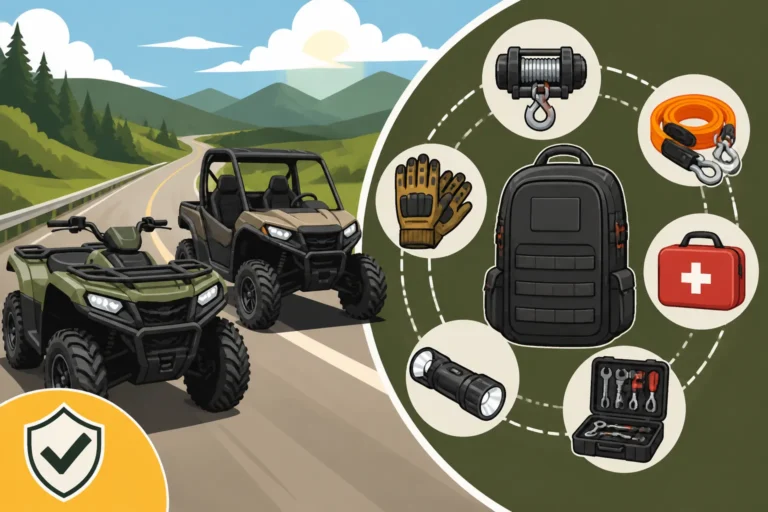
Beyond the initial registration requirements for headlights, brake lights, mirrors, and seat belts, it’s wise to consider additional safety gear, especially when riding on dusty or rural dirt roads. For those long stretches of dusty county road, especially if you're out near sunset or sunrise, having robust lighting is crucial. Many riders turn to aftermarket options from brands like SuperATV for powerful LED light bars and sturdy rearview mirrors to enhance visibility and safety, particularly if their factory lights feel insufficient for cutting through dust or dim conditions. Additionally, [Georgia Rules for Riding After Dark] stipulate that your machine must have functioning headlights and tail lights clearly visible. It's not enough to just have them; they must be on and working after dark.
And let's not forget about helmets. While the MPOHV registration generally means your machine has roll-over protection and seat belts, Georgia still has specific helmet laws concerning off-road vehicles. If the operator or any passenger is under the age of 18, they are required to wear a helmet. This rule applies both on public roads and, in many cases, on private land as well. Even if you're over 18, wearing a helmet on a dirt road, especially one with unpredictable terrain or traffic, is always a smart move. For more details, consult [Georgia ATV Helmet Law for Riders Under 18]. When riding on county roads, remember that you are sharing the road with other traffic, and being seen and protected is paramount. Make sure your UTV also has all [Georgia Equipment a Road Machine Must Carry], such as a horn, for signaling other drivers.
Common Pitfalls and Enforcement: What to Avoid on Georgia's Dirt Roads
Even with your UTV properly registered as an MPOHV and all your ducks in a row regarding equipment and licensing, there are still common mistakes that can lead to a ticket or worse when riding Georgia's dirt county roads. The nuances of the law are where many riders stumble, often out of a genuine misunderstanding rather than deliberate defiance. Law enforcement officers, particularly in rural counties, are becoming increasingly familiar with the MPOHV laws, and they're not afraid to enforce them when violations occur.
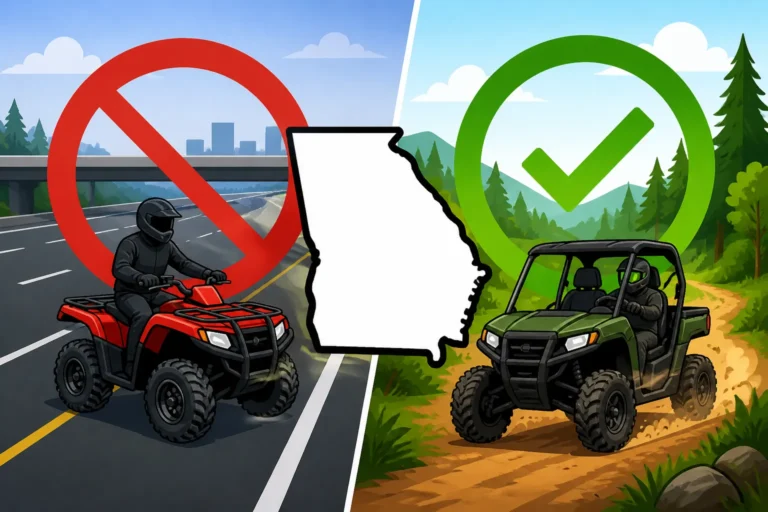
The biggest pitfall, by far, is misinterpreting where you can ride. While MPOHVs are allowed on county roads, they are strictly prohibited from state highways, interstates, and most municipal (city) streets. It’s a common sight to see a perfectly legal UTV pulling onto a state highway, only to quickly be pulled over. Even if a state highway is unpaved, it's still a state highway and off-limits for continuous travel. You can only cross a state highway at designated points and with appropriate caution, as covered in [Georgia Crossing a Georgia State Highway on a UTV]. Thinking that "dirt road" automatically equals "county road" is a dangerous assumption. Always confirm the road's classification if you're unsure. This distinction is so vital that it's worth reviewing [Why Georgia State Highways Stay Off Limits].
Another crucial point is understanding that this access doesn't extend to private property without permission, nor does it override local ordinances that might prohibit certain actions. Riding on sidewalks, for example, is almost universally prohibited, even on a dirt road next to one. Just because you're on a county road doesn't mean you can stray onto someone's field or easement without explicit consent. This can lead to trespass charges in addition to any MPOHV violations.
The consequences of non-compliance can be significant. Operating an unregistered MPOHV on a public road, riding on prohibited road types, or lacking the proper license and insurance can result in hefty fines. [Georgia Penalties for an Unregistered Road Machine] can include substantial financial penalties. In some cases, depending on the severity and nature of the violation, your UTV could even be impounded, leading to additional towing and storage fees. This can quickly turn a fun day of riding into an expensive headache, as detailed in [Georgia Impound Rules After a Violation]. Deputies are increasingly trained on [What Georgia Deputies Check on a County Road], including VIN verification, registration status, proof of insurance, and all required safety equipment.
Finally, always keep in mind that the current MPOHV road access law in Georgia is not permanent. As mentioned earlier, [Georgia's ATV Road Access Law Sunsets in July 2027]. This means that the rules allowing UTVs on county roads could change, be modified, or even be repealed entirely at that point. It’s essential for all MPOHV owners to stay informed about potential legislative changes and be prepared for what happens [Georgia Rules Once the Sunset Date Arrives]. Staying prepared on dirt roads also means having reliable parts. Investing in high-quality aftermarket axles, control arms, or skid plates from a company like SuperATV can prevent unexpected breakdowns, keeping you on the right side of the law and off the tow truck, reducing your chances of an unwanted interaction with law enforcement due to a disabled vehicle. For now, however, adhering to the current regulations is the best way to enjoy your UTV legally and safely on Georgia’s dirt county roads.
Disclaimer
This article is for general informational purposes only and does not constitute professional advice. Laws, prices and regulations vary by location and change over time. Consult a qualified professional for guidance on your specific situation.