Why Interstates Are Never Crossed
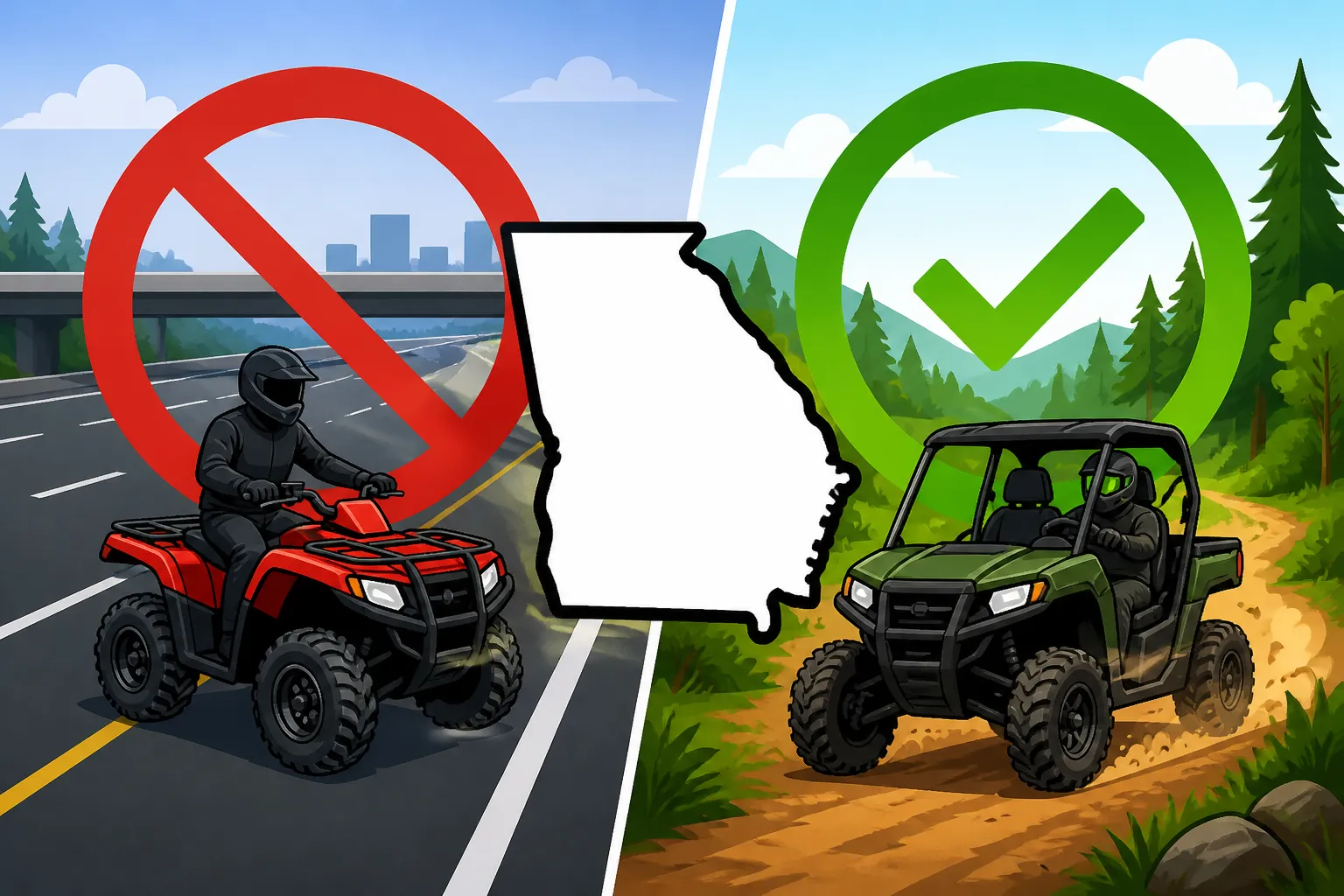
One of the most common questions I hear from folks who are new to the world of off-highway vehicles, or even seasoned riders looking to expand their horizons, is about taking their beloved side-by-sides or ATVs onto public roads. There's often a bit of confusion, especially when you start talking about crossing busy highways. Let's get straight to it: when it comes to Georgia's interstates, the answer is a resounding "no." This guide will meticulously break down exactly why interstates are completely off-limits for ATVs and UTVs in Georgia, the serious legal and safety implications, and where you can and cannot legitimately operate your machine on public pathways.
The Fundamental Rule: No ATVs or UTVs on Georgia Interstates, Period
It’s easy to get excited about the prospect of taking your machine out on the open road, especially when you’re trying to connect between riding spots or access local services. However, it's crucial to understand that Georgia’s rules for off-highway vehicles draw a very distinct and immovable line when it comes to interstate highways. These high-speed, limited-access arteries of commerce and travel are simply not designed, nor legally designated, for anything less than conventional, street-legal vehicles. This isn't just a suggestion; it's a strict legal prohibition designed for the safety of everyone on the road.
What Defines an Interstate Highway in Georgia?
When we talk about interstates, we're not just referring to any multi-lane road. Interstate highways in Georgia, like I-75, I-85, I-20, or I-16, are part of a federal system characterized by specific design standards. They are limited-access highways, meaning you can only enter and exit at designated interchanges. There are no stop signs or traffic lights, and speeds are consistently high, often 70 mph or more. These roads are built for sustained high-speed travel, carrying a massive volume of cars and large commercial trucks. You'll recognize them by their distinctive red, white, and blue shield markers. They are distinct from state routes (often marked with a white square and black text) or local county roads, which have different characteristics and, sometimes, different rules for off-highway vehicle access. The very design of an interstate, with its lack of pedestrian access, bike lanes, or low-speed vehicle provisions, immediately signals that it's an environment entirely unsuited for an ATV or UTV.
The Legal Basis for the Interstate Ban
The legal framework in Georgia is quite clear: off-highway vehicles, even those registered as multi-purpose off-highway vehicles (MPOHVs) for limited county road access, are explicitly prohibited from operating on interstate highways. This prohibition stems from a common-sense understanding of vehicle capabilities and public safety. ATVs and UTVs simply do not possess the necessary speed, acceleration, braking capacity, crash protection, or visibility to safely integrate into high-speed interstate traffic. The law is designed to prevent catastrophic accidents that would almost certainly occur if slower, less protected machines were allowed to mix with vehicles traveling at 70+ mph. It’s about ensuring that everyone on the road, including the ATV or UTV operator, is safe. Trying to interpret a loophole or a technicality here is a dangerous game, as the intent of the law is unequivocally to keep these machines off these specific high-speed thoroughfares.
Why Interstates Are So Different from County Roads and Other Permitted Crossings
It's easy to look at a map and think, "Oh, it's just a quick hop across this highway," but the reality of an interstate is vastly different from the typical dirt county road or a small state route. The sheer scale, speed, and design of interstates create an environment where off-highway vehicles are not only illegal but profoundly unsafe. Understanding this difference is key to avoiding dangerous situations and costly legal trouble.
Speed, Volume, and Design: A Dangerous Combination
Imagine trying to merge your side-by-side, which might top out at 50-60 mph, onto an interstate where traffic is flowing at 75 mph. That speed differential is immense, and the closing rate for other vehicles is incredibly fast. Drivers on interstates expect other vehicles to be traveling at similar high speeds and are not looking for a much slower, smaller machine trying to merge or cross. The multi-lane nature, combined with heavy truck traffic, creates a constant rush of wind and noise that can easily overwhelm a UTV operator, making it difficult to judge distances or hear approaching vehicles. Interstates also lack shoulders wide enough or sturdy enough for an off-highway vehicle to safely pull over in an emergency, let alone use as a temporary pathway. The concrete barriers, high overpasses, and limited visibility ramps, particularly at night, present an immediate and extreme hazard. This isn't just an inconvenience; it's a recipe for disaster. [Georgia Rules for Riding After Dark] on a county road are one thing, but on an interstate, it’s an entirely different level of danger.
The Law's Intent: Protecting Off-Highway Vehicle Riders
The laws prohibiting ATVs and UTVs on interstates are ultimately about protection, not just prohibition. Lawmakers recognize that these machines, while incredibly capable in their intended environments, are simply not built for the demands of interstate travel. They lack standard safety features found in cars, like crumple zones, extensive airbags, and hardened cabins. Their tires are designed for traction on varied terrain, not for sustained high-speed asphalt use, which can lead to rapid wear or even blowouts. The braking systems are optimized for off-road conditions, not for emergency stops from 70 mph on pavement.
Therefore, the ban isn't about denying fun or convenience; it's about safeguarding lives. Even a skilled rider on a high-performance UTV like those often modified with SuperATV aftermarket parts, would be at an extreme disadvantage against a semi-truck traveling at highway speeds. The potential for severe injury or fatality in an interstate collision involving an off-highway vehicle is astronomical, not just for the OHV operator but for other motorists involved. This protective stance is why there are no exceptions for crossing or short distances—the risk is simply too high.
What Happens If You Attempt to Cross an Interstate in Georgia?
Let's not sugarcoat it: attempting to operate an ATV or UTV on an interstate highway in Georgia is a profoundly bad idea with severe consequences. This isn't just about a minor traffic infraction; it involves serious legal penalties and, more importantly, life-threatening safety risks. Law enforcement takes interstate safety incredibly seriously, and rightfully so, given the speeds and traffic volumes involved.
Legal Consequences and Penalties
If a Georgia State Patrol trooper or a county sheriff's deputy spots you on an interstate with an ATV or UTV, be prepared for immediate action. The legal ramifications can include significant fines, court costs, and potentially more severe charges depending on the specific circumstances. Your machine will almost certainly be impounded, leading to additional towing and storage fees that can quickly add up to hundreds, if not thousands, of dollars. Furthermore, you could face charges like reckless driving, endangering other motorists, or operating a vehicle on a roadway for which it is not designated. These aren't simple warnings; these are citations that can go on your record, potentially impacting your driving privileges or even your insurance rates for your other vehicles. The penalties associated with illegal road use, even if your machine is otherwise properly registered as an MPOHV, are substantial. [Georgia Penalties for an Unregistered Road Machine] can give you an idea of the costs involved, but for interstates, the stakes are even higher. Deputies are trained to check vehicle types and their legal operating zones, as outlined in guides like [What Georgia Deputies Check on a County Road].
The Extreme Safety Risks Involved
Beyond the legal penalties, the real threat is the physical danger. Picture this: you're on your side-by-side, maybe a powerful Polaris Ranger or a Can-Am Defender, and you see an opening in interstate traffic. You floor it, trying to get across two or three lanes. But the acceleration isn't enough, or another car changes lanes unexpectedly, or a commercial truck you didn't see coming is suddenly on your tail. At interstate speeds, there is virtually no margin for error. A collision would be devastating. Off-highway vehicles offer minimal protection in a high-speed impact. Riders can be ejected, crushed, or suffer catastrophic injuries. The risk extends to other drivers, too; an unexpected, slow-moving obstacle on an interstate can trigger multi-vehicle pile-ups, endangering countless lives. Even a momentary lapse in judgment or a small mechanical issue can become a fatal event. This is why [Georgia Accident Reporting for a UTV Crash] exists – because when these machines are involved in accidents, especially on inappropriate roads, the outcomes are often severe.
Understanding Where You Can Ride or Cross
While interstates are a definitive no-go, it's important to differentiate them from other public thoroughfares where specific off-highway vehicles might have limited, legal access. Understanding these distinctions is crucial for responsible and lawful riding in Georgia. The goal is to maximize your enjoyment of your machine while staying safe and within the bounds of the law.
Legitimate Road Use on County Roads
Georgia law does allow for limited use of certain off-highway vehicles, specifically multi-purpose off-highway vehicles (MPOHVs), on designated county roads. This is a voluntary registration program that allows qualifying side-by-sides, sometimes referred to as UTVs, to operate on roads within a county that have been approved by that county's governing authority. To qualify, machines must meet strict criteria, including width limits, weight limits, speed ranges, and mandatory safety equipment like seat belts, headlights, brake lights, and rearview mirrors.
This MPOHV registration, which you can learn more about in [Georgia MPOHV Registration Explained], essentially grants a very specific, narrow exception to the general rule that off-highway vehicles cannot be on public roads. However, this exception only applies to county roads and, even then, only if the county has opted into allowing it. It absolutely does not extend to state routes, U.S. highways, or, as we've discussed, interstates. The idea is to allow rural residents or those in areas with specific needs to use their UTVs for short-distance travel on low-speed, low-traffic county roads. For example, a farmer might use a modified utility UTV with SuperATV accessories to drive from one pasture to another on a quiet county road. [Georgia County Road Systems and Where They Run] provides more context on where this limited access might apply.
Crossing State Routes at Designated Points
While riding on state routes with an ATV or UTV is generally prohibited, there can be specific instances where crossing a state route is allowed. These crossings are typically at a 90-degree angle, at an intersection, and are meant to connect two stretches of legal county road or private property. You are not meant to drive down the state route for any significant distance, but rather to traverse it directly and immediately.
The ability to cross a state route is often dependent on local ordinances and whether the specific location is marked or commonly used for such crossings. It's not a universal right and requires careful attention to signage and local regulations. Always exercise extreme caution when performing such a crossing, even if permitted. Look both ways, yield to all traffic, and make the crossing as quickly and safely as possible. Never assume a crossing is safe or legal without verifying. For more detailed information on navigating this, you might find [Georgia UTV Road Rules by County] and [Crossing a Georgia State Highway on a UTV] helpful. These provide context on the nuances of road access for these machines beyond just interstates. Remember, the overarching rule remains that ATVs and UTVs are primarily for off-road use, and any road access is a carefully legislated exception.
Here’s a quick overview of how Georgia handles MPOHV access on different types of public roads:
| Road Type | MPOHV Access (Registered Machines) | Key Characteristics & Safety Factors |
|---|---|---|
| Interstate | Explicitly PROHIBITED | High speeds (70+ mph), high traffic volume, limited access, no shoulders. Extremely dangerous for OHVs. |
| State Route | Generally PROHIBITED for riding on, potentially allowed for crossing at designated points. | Speeds vary (often 45-65 mph), moderate to high traffic, sometimes multi-lane. Crossings must be quick, direct, and safe. |
| County Road | ALLOWED (if county has opted in and machine is registered as MPOHV). | Lower speeds (often 25-45 mph), lower traffic volume, varied surfaces (paved/dirt). Specific MPOHV registration rules apply. |
| Private Land | ALLOWED (with landowner permission) | No public road rules apply, but personal safety and property rights are paramount. Ideal environment for OHVs. |
Disclaimer
This article is for general informational purposes only and does not constitute professional advice. Laws, prices and regulations vary by location and change over time. Consult a qualified professional for guidance on your specific situation.