State Routes You May Only Cross
It's a common dilemma for Georgia off-road enthusiasts: you've got your side-by-side or UTV loaded up, ready to hit some fantastic [Georgia ATV Trails: Where You Can Legally Ride] or simply get from one county road to another, but a busy state highway stands squarely in your way. That moment of hesitation, wondering if you can just quickly zip across, is something many of us have faced. This guide aims to clear up the confusion and explain exactly when and how you can legally and safely cross Georgia's state routes with your machine, emphasizing what to do and, more importantly, what absolutely not to do.
Understanding Georgia's Road Classification System
Navigating the rules for riding your off-highway vehicle (OHV) in Georgia can feel like deciphering a complex map, especially when it comes to distinguishing between different types of roads. It’s not just about "road" versus "off-road" anymore; there's a specific hierarchy, and understanding it is key to staying legal and safe.
The Hierarchy of Roads and What It Means for You
Think of Georgia's road network as a tiered system. At the very bottom, you have private land, which is generally where most ATVs and UTVs spend their time, free from state road restrictions (though local ordinances and property owner rules always apply). Then you move up to county roads. These are the backroads, the rural connectors, often unpaved, and they form the primary network where properly registered Multi-Purpose Off-Highway Vehicles (MPOHVs) can legally operate. The law creating MPOHV registration specifically opened up access to these county-maintained thoroughfares, offering a huge benefit to hunters, farmers, and recreational riders who need to get from point A to point B without trailering every short distance. You can learn more about these specific allowances in [Georgia MPOHV Road Rules: County Roads Only].
However, above county roads lie the state routes, which are usually marked with white shields bearing the letters "GA" and a number. These roads are under the jurisdiction of the Georgia Department of Transportation (GDOT) and are designed for higher speed limits and more traffic. This is where the rules get much stricter for OHVs. Finally, at the very top, you have the interstate highway system, which is a complete no-go zone for any off-highway vehicle, period. You'll never see an MPOHV legally operating on an interstate, and attempting to do so is incredibly dangerous and illegal. The crucial takeaway here is that not all "roads" are created equal when it comes to your ATV or UTV.
Why State Routes Are Generally Off-Limits
The primary reason state routes are generally off-limits for ATVs and UTVs is safety. These roads are engineered for passenger cars and trucks traveling at higher speeds, often 55 MPH or more. Your off-highway vehicle, while capable and fun, simply isn't designed to keep pace or withstand the impact of typical highway traffic. The sheer volume of traffic, the multiple lanes, and the often limited visibility at intersections make them incredibly dangerous environments for machines that are slower, less stable, and offer minimal occupant protection compared to a car.
Beyond the obvious safety concerns, there are significant legal distinctions. State routes fall under state law enforcement's purview, such as the Georgia State Patrol, who are well-versed in these restrictions. While county tag offices handle MPOHV registration, that registration explicitly grants access only to county roads. There's no provision in the MPOHV law that extends general riding privileges to state routes. Attempting to ride your UTV or ATV down a state route, even for a short stretch, is a clear violation of state law, irrespective of whether your machine is registered as an MPOHV or not. This is why it’s so critical to understand the boundaries and never assume that registration on county roads extends to state highways. [Why Georgia State Highways Stay Off Limits] delves deeper into these reasons.
The Specifics of Crossing a Georgia State Highway
So, if riding on a state route is out, what about just crossing it? This is where the nuanced understanding of the law comes into play. The goal is always to get across as quickly and safely as possible, minimizing your time on or near these high-traffic arteries.
Legal Crossing Points and Conditions
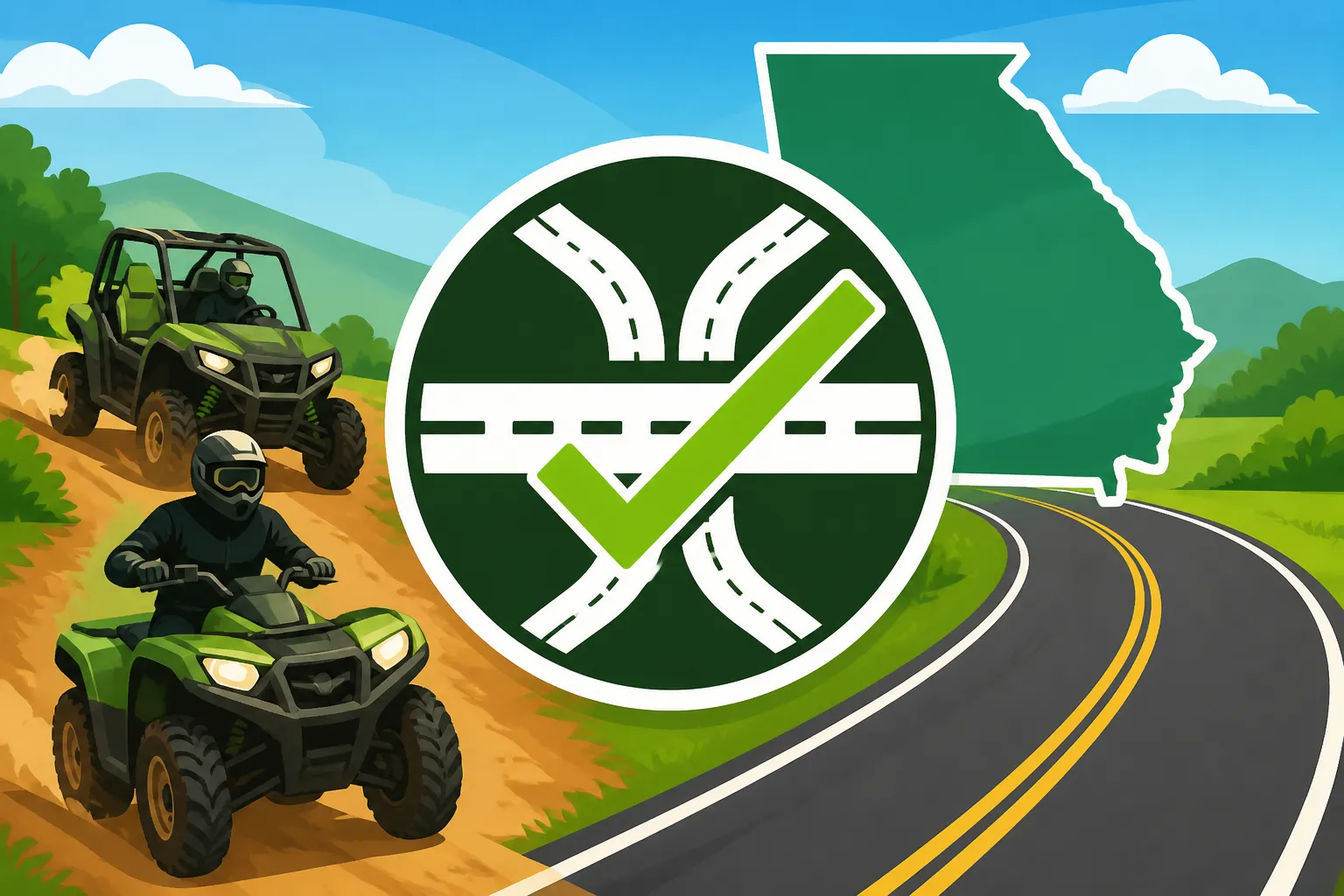
Georgia law acknowledges that sometimes, to connect two county roads, you simply have to cross a state route. The key here is "crossing," not "riding." You are permitted to cross a state-maintained highway only at an intersection, typically where a county road directly intersects with the state route. This isn't an invitation to pick any spot on the highway, pull over, and drive across the median or a field; it must be a clearly defined intersection designed for vehicle traffic. The intent is to allow for the continuation of your journey on permissible county roads, not to facilitate travel on the state route itself.
When performing such a crossing, you must take the shortest, most direct path across the state route. This means you approach the intersection from a county road, wait for a safe gap in traffic, drive straight across to the county road on the other side, and immediately exit the state route's right-of-way. You cannot turn and drive down the state route for any distance, even if it's just a few hundred feet to the next turn-off. The spirit of the law, and the practical safety consideration, is to expose your machine and yourself to state highway traffic for the absolute minimum time required. Think of it as merely passing through the state route's footprint, not entering its flow of traffic. This distinction is critical and something that [Georgia UTV Road Rules Crossing a State Route] often clarifies for riders.
Safety Protocols During a Crossing
Even when legally crossing, safety is paramount. State routes carry fast-moving vehicles, and your UTV or ATV will always be at a disadvantage. Before you even approach the intersection, slow down and assess the situation. Look far down the road in both directions for oncoming traffic. Consider using your turn signals well in advance to indicate your intention, even if you’re just crossing straight. Patience is your best friend here; never feel pressured to dart out if you don't have a wide, clear gap in traffic. It's far better to wait for several minutes than to risk an accident.
Your machine's equipment plays a huge role in your visibility and safety. Ensure your [Headlights, Brake Lights and Mirrors on the Checklist] are all in excellent working order. Bright headlights and functioning brake lights make you more visible to other drivers, especially if you’re operating near dusk or dawn. Rearview mirrors, like those available from SuperATV, are invaluable for checking traffic approaching from behind before you commit to a crossing. Some riders even add a tall, brightly colored flag to their machine, especially when crossing in areas with limited sightlines, to make their presence more obvious. Remember, the more visible you are and the more aware you are of your surroundings, the safer your crossing will be.
What to Avoid and Common Misconceptions
It’s easy to misunderstand the nuances of Georgia’s MPOHV laws, especially when it comes to state routes. However, making assumptions or taking shortcuts can lead to serious consequences, both legally and for your personal safety.
Riding Along State Routes: A Hard No
Let's be absolutely crystal clear on this point: riding your ATV or UTV along a state route, even on the shoulder or in a ditch beside it, is strictly prohibited. The allowance for "crossing" is not a loophole that permits you to travel down the highway for any distance, no matter how short. Many riders, especially those new to MPOHV registration, might incorrectly assume that because their machine can briefly cross, it can also use the shoulder for a quarter-mile to reach another county road that's just a stone's throw away. This is a dangerous and incorrect interpretation of the law.
The shoulder of a state route is still considered part of the state highway system and falls under the same restrictions as the main travel lanes. Riding on it puts you in direct conflict with traffic moving at high speeds and makes you highly visible to law enforcement. A Georgia State Patrol trooper or a county deputy will not differentiate between riding in the lane and riding on the shoulder when it comes to OHVs on state routes. Both are illegal and subject to fines and potential impoundment of your machine. The penalties for such an infraction can be significant, as outlined in [Georgia Penalties for an Unregistered Road Machine] or [Georgia Ticket Cost for Illegal Road Riding], so it’s crucial to stick to designated county roads and only cross state routes when absolutely necessary and legally permissible.
The "Just For a Second" Trap
The "just for a second" mentality is a common pitfall for many riders. You might think, "It's only a quarter-mile to that next turn-off, surely no one will notice," or "I'll just hop over to the gas station on the state route really quick." This line of thinking is not only incredibly risky from a safety standpoint but also a surefire way to attract unwanted attention from law enforcement. State routes are often patrolled more frequently than remote county roads, and your off-road vehicle stands out like a sore thumb in a traffic flow of cars and trucks.
Law enforcement officers are trained to identify vehicles that are out of place. A UTV or ATV on a state route, even for a short distance, immediately flags their attention. They interpret the law quite strictly: if you are operating an off-highway vehicle on a state route outside of a direct, perpendicular crossing at an intersection, you are in violation. There's little room for argument about intent or distance. Deputies and troopers prioritize safety on these higher-speed roads, and off-road vehicles pose a unique hazard. Avoiding this "just for a second" trap is paramount to keeping your riding legal and avoiding a frustrating, expensive encounter with the law.
Understanding Local vs. State Jurisdiction
Another common area of confusion revolves around jurisdiction. While many Georgia counties have embraced MPOHV registration and opened their county roads, this does not grant permission to ride on state routes that pass through those counties. The power of a county to regulate road access for MPOHVs is generally limited to the roads it maintains. State routes, by their very definition, are maintained by the state, and thus, state laws and regulations apply, overriding any local county-level preferences or ordinances.
So, even if you live in a county that is very ATV/UTV friendly and has extensive [Georgia County Road Systems and Where They Run] open to MPOHVs, that friendly atmosphere does not extend to the state highways within its borders. A county simply cannot pass an ordinance that permits UTVs to ride freely on a state route. This jurisdictional distinction is vital to grasp. When you're on a state highway, you're under state authority, and the rules are much more restrictive. If you have questions about specific road classifications, it's always best to consult a detailed local map or reach out to the county road department, rather than assume local enthusiasm for OHVs extends to state-maintained pavement. This is why [Can a Georgia County Close Its Roads to UTVs?] is a relevant read to understand the limits of county power.
| Action | Allowed on State Routes | Prohibited on State Routes | Notes |
|---|---|---|---|
| Direct Crossing at Intersection | Yes | No | Must be the shortest, most direct path, connecting two permissible roads. |
| Riding Along the Shoulder | No | Yes | Shoulder is considered part of the state route. |
| Riding in Travel Lanes | No | Yes | Extremely dangerous and illegal. |
| Turning onto a State Route (Briefly) | No | Yes | Cannot ride on the state route for any distance, even to turn at the next intersection. |
| Waiting at an Intersection | Yes | No | While waiting to cross, ensure your machine is off the state route's main travel lanes if possible. |
| Utilizing Machine Equipment | Yes | No | Headlights, brake lights, and mirrors are crucial for safety during allowed crossings. |
Planning Your Route Around State Routes
The best strategy for dealing with Georgia's state routes when you're on your ATV or UTV is to avoid them as much as possible. With a little foresight and planning, you can significantly reduce the need for risky crossings and ensure a more enjoyable, stress-free ride.
Mapping Your Off-Road Journey
Before you even load up your machine, dedicate some time to mapping out your intended route. This is where modern technology, combined with a good old-fashioned paper map, becomes invaluable. Use GPS apps or online mapping services that allow you to distinguish between state, county, and private roads. Many of these services offer satellite views that can help you identify dirt roads or trails that might not be clearly marked on standard road maps. Look for ways to connect your desired riding areas exclusively using county roads, even if it means taking a slightly longer, more circuitous route.
The goal is to identify a network of [Georgia County Road Systems and Where They Run] that keeps you entirely off state highways. Sometimes, a county road might run parallel to a state route for a significant distance, offering a perfectly legal alternative. Other times, you might find an underpass or an old bridge that allows you to bypass a state route entirely. Planning this way not only keeps you compliant with the law but also enhances the experience; after all, most off-road enthusiasts prefer the scenic, less-trafficked routes anyway. Companies like SuperATV often provide GPS systems and accessories that can be mounted directly to your UTV, making trail navigation and route planning even easier on the go.
What to Do If a State Route Is Unavoidable
Despite the best planning, there will be instances where crossing a state route is truly unavoidable to reach your destination. Perhaps it's the only practical way to connect two extensive county road systems, or you need to access a specific [Georgia ATV Trails: Where You Can Legally Ride] trailhead that requires a single, short crossing. In these situations, the most critical advice is to execute the crossing with extreme caution and strict adherence to the law. Always use the designated intersection, ensure maximum visibility, and never, ever compromise on waiting for a completely clear window in traffic.
For longer distances or routes that would require multiple state route crossings, the smartest and safest option is often to trailer your machine. Load up your ATV or UTV onto a trailer, drive your truck or tow vehicle down the state route, and then unload your machine once you're on the permissible county road or at your destination. This completely eliminates the risk of illegal operation or an accident on the state highway. While it might feel like an extra step, it's a small price to pay for peace of mind and staying on the right side of Georgia's laws. Remember, the MPOHV registration is a privilege for specific road types, and respecting those boundaries is crucial for its continued success.
Disclaimer
This article is for general informational purposes only and does not constitute professional advice. Laws, prices and regulations vary by location and change over time. Consult a qualified professional for guidance on your specific situation.