Georgia Has No State ATV Safety Course
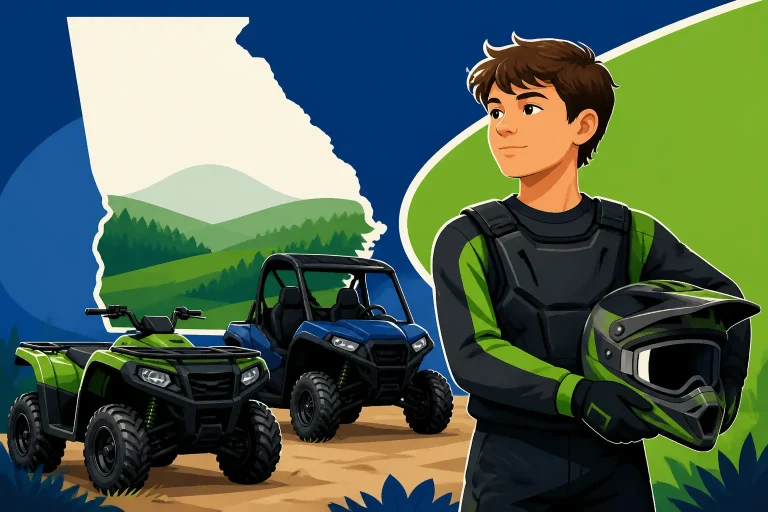
Georgia does not require every ATV or UTV rider to complete a state safety course or carry a statewide operator education card. That can make it hard to know what you need before riding, especially if you are visiting from another state or bringing a new rider. The key is to separate state course requirements from permits, age rules, landowner conditions and basic preparation.
What Georgia’s lack of a state course requirement means
Georgia does not have a universal state ATV safety course that every rider must pass before operating an off-highway machine. In general, you should not expect to show a Georgia-issued ATV course card just to establish that you have completed a statewide training requirement.
That is a narrow point, not a promise that every ride is unrestricted. “No state course required” does not mean:
- You can ride on any public land or road.
- Every trail system admits every age group.
- A private park cannot require training, a waiver or a rider orientation.
- You can ignore helmet, passenger, equipment or supervision rules.
- A permit or permission to ride is the same thing as proof of training.
Georgia’s state-level course rule is only one part of the decision. The place where you intend to ride may have its own entry requirements, and the kind of machine you operate can affect which rules apply. A quad used on a private property trail, a UTV used on a national forest OHV trail and a side-by-side registered for a limited public-road use are not necessarily treated alike.
It also helps to distinguish a formal course from practical instruction. A rider may not need a state card, but learning how to control a machine, judge terrain and ride within personal limits can prevent injuries and costly damage. A course is one way to build those skills; a careful, supervised learning plan is another. Neither replaces permission to ride in a particular place.
For the broader distinction between course requirements and other entry rules, see Georgia OHV Permits: What You Need Before You Ride. That distinction is central: a permit gives access under particular conditions; it does not certify that the operator has completed training.
Permits, age rules and land access are separate questions
Before riding, work through four separate questions:
- Where are you riding? A national forest trail, wildlife management area, private park, private property and public road can each have different rules.
- What permission or permit is required there? A land manager, park operator or private owner may require one.
- Who may operate the machine there? Age, supervision and license rules can vary with the location and use.
- Does the machine itself meet the rules? Width, equipment, registration or other requirements may matter.
A safety course does not answer those questions. Nor does having a permit or a registration automatically answer all of them.
National forest OHV trails
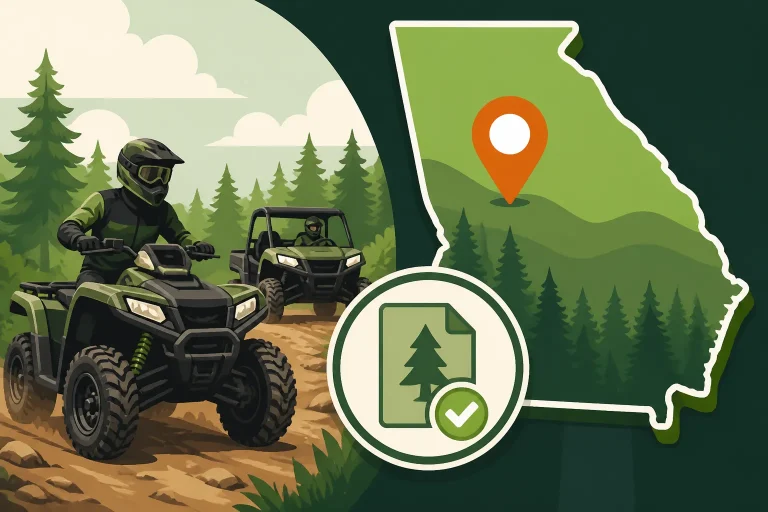
On Georgia national forest OHV systems, riders should check the current access rules and permit conditions before traveling. Forest permits are an access requirement, not a substitute for operator training, and they do not authorize riding on every forest road or trail. Trail designation, closures, machine width and other site rules still matter.
Georgia’s forest permit arrangement is described as applying to the operator rather than simply to the vehicle. A rider should confirm current terms, where the permit is valid and how it must be displayed or carried. The practical details are covered in Georgia National Forest Permits Are Per Operator and One Annual Permit Covers All Six Georgia OHV Systems.
Do not assume that a permit held by a parent or friend covers every person taking a turn at the controls. If more than one person will operate, verify what each operator needs. Likewise, do not assume a permit is proof that a rider has taken a safety class. It is not a course completion card.
Trail rules can also restrict a machine even when the operator has the correct permit. A narrow trail system may not accept a wide side-by-side, and temporary closures can change where riding is allowed. Check the official land-manager information close to the trip, then follow signs and gates at the trailhead.
Wildlife management areas
Wildlife management areas have their own access rules. Riding may be limited to designated roads, certain dates or specific times, and conditions can depend on the property and activity taking place. A general statement that Georgia does not require a statewide ATV course does not override those restrictions.
Age is especially important. Georgia WMA riding rules include an operator age restriction, and the relevant rule is not the same as a general course requirement. Check the rules for the specific WMA and the planned day before taking a younger rider. Georgia WMA Minimum Age of 16 explains the age issue, while Georgia WMA Rules for ATV Riders covers the broader access framework.
A safety class cannot make an otherwise prohibited ride permissible. If the date, road, age or access condition does not qualify, having a course certificate does not change that. On the other hand, a rider who meets the access rules may still benefit from training, even when no course card is requested.
Private parks and private land
Private parks can set conditions for entry and participation. Those conditions may include a waiver, a minimum age, supervision, a rider briefing, restrictions on passengers or a requirement to use specified protective gear. A park can also limit access based on machine type or trail difficulty.
Read the park’s rules before booking or unloading. Ask whether its requirements apply to the driver, every passenger or both; whether a parent or guardian must be present for minors; and whether riders may switch machines during the visit. Do not treat a general state rule as a guarantee of admission. Georgia Private Park Age Minimums and Georgia Private Park Waiver Forms are useful starting points when planning a visit.
On private property that is not a commercial park, permission still matters. Get clear approval from the landowner or authorized manager and follow any boundaries or conditions they set. A safety course does not grant access to private land, and riding across an easement, timber road or neighboring parcel without permission can create a separate problem.
Public-road use is a different category
A course card is not a road-use permit, vehicle registration or driver’s license. Georgia’s rules for off-highway trails and public roads are different, and many ATVs are not eligible for ordinary public-road use. Some qualifying machines may fall under a separate registration framework, but registration does not make every road open to them.
Before planning a road trip on a machine, check whether the machine qualifies, whether it is properly registered and insured where required, and which roads are actually open to that use. Start with Georgia MPOHV Road Rules: County Roads Only and Are Side-by-Sides Street Legal in Georgia?. Do not rely on a safety course certificate, a plate from another state or a dealer’s description as proof that a specific Georgia road is legal.
What visiting riders should know about reciprocity
Visitors often ask whether a safety card earned in another state is required, accepted or useful in Georgia. The simplest answer is to separate training recognition from ride access.
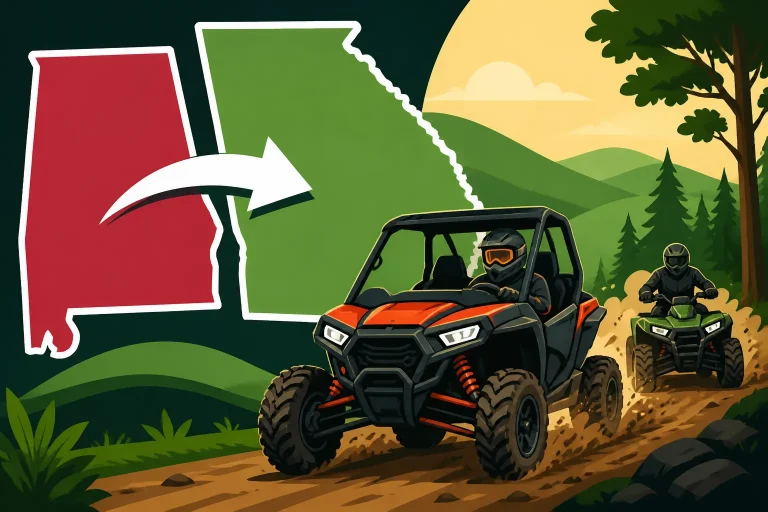
Georgia has no general statewide ATV course card that every rider must present. So a visiting rider should not assume they need a Georgia course card just because their home state offers or requires one. Nor should they assume that an out-of-state card waives Georgia’s local permit, age, land-use or park rules.
A course card can still be useful evidence of training. A private park, rental provider, organized event or other operator may have its own policies. Those policies can apply to local and visiting riders alike. Ask the specific facility or organizer what it accepts instead of relying on a broad claim about reciprocity.
Before traveling, use this checklist:
- Confirm that the place you plan to ride is open to the public or that you have permission.
- Check whether the site requires a permit, reservation, waiver or orientation.
- Verify the age and supervision rules for each rider.
- Check machine restrictions, including width limits and passenger requirements.
- Review closures, hours and trail designations.
- Bring any course documentation you already have if a park or event has asked for it.
- Do not assume an out-of-state registration authorizes public-road riding in Georgia.
- Make sure every operator knows how to control the machine they will actually ride.
For more on permits for nonresidents, see Do Visiting Riders Need a Georgia Forest Permit?. For road-use questions, check Georgia Rules for an Out-of-State Registered UTV. Reciprocity claims can be too broad: acceptance of a course card, if relevant to a particular venue, does not automatically transfer every permission or qualification from one state to another.
When a provider’s rule is unclear, ask in concrete terms: “Does this requirement apply to each operator? Will you accept my certificate from another state? Is the requirement mandatory for entry, or do you recommend it?” If the answer affects a planned trip, get the information directly from the land manager, park or organizer and keep a copy with your trip documents.
How to build riding skills without a state-mandated card
No statewide course requirement does not mean you have to learn by trial and error. A beginner can gain a safer foundation through formal instruction, supervised practice and a gradual increase in difficulty.
Formal course options may be available through organizations, manufacturers, local programs or riding facilities. Offerings and eligibility can change, so confirm the provider’s current curriculum, age limits, location and whether training uses the same type of machine you intend to ride. Some courses focus on basic ATV operation; a UTV course may address different controls, passenger considerations and vehicle dynamics. A certificate from one class should not be treated as proof of skill on every machine.
See Georgia Safety Course Options That Exist for the distinction between courses that may be available and a state-required credential. Even if you choose not to take a formal class, the subjects in What a Course Teaches a New Rider offer a useful checklist for what to learn.
Use a staged learning plan
- Read the machine’s owner’s manual. Learn the controls, starting and stopping procedure, load limits, maintenance checks and the manufacturer’s warnings. Pay special attention to passenger instructions; some machines are designed for one rider, while others are built to carry passengers in designated seats.
- Begin with the right-sized machine. A powerful or heavy machine can be difficult for a new rider to control. Match the vehicle to the operator’s experience, physical ability and intended terrain rather than choosing based only on engine size or appearance.
- Practice in a controlled, permitted area. Choose level, open ground away from traffic, obstacles, water and other riders. Have an experienced adult supervise from a safe position. Do not practice on a public road or land where you do not have permission.
- Learn the basic controls before adding speed. Practice starting, stopping, smooth acceleration, controlled turns and looking ahead. Learn how the machine responds to braking and changes in surface before attempting hills or tight trails.
- Add terrain gradually. Move from flat ground to mild slopes and uneven surfaces only when the rider can manage the basics. Avoid steep grades, deep mud, fast turns and water crossings until the rider has the skill and judgment to assess them.
- Teach trail communication and spacing. Riders should understand how to signal a stop, maintain distance, yield appropriately and avoid following so closely that they cannot react. Keep beginners with a responsible group, not at the back where they may feel pressured to catch up.
- Stop when conditions exceed the rider’s ability. Turning around is a sound decision. A beginner who can identify when not to proceed is learning an important part of safe riding.
The purpose is not to imitate a course in a weekend. It is to build dependable habits and recognize limits. A rider who can operate smoothly on a flat practice area may still be unprepared for steep, rutted or slippery terrain. Skill on one machine also does not automatically transfer to another: a quad and a side-by-side differ in seating, steering, weight, braking feel and passenger setup.
What useful instruction should cover
A well-rounded introduction should include more than where the throttle and brake are. The rider should understand:
- How to inspect tires, brakes, steering, lights and controls before riding.
- How to use the machine’s safety features, including a tether or other shutoff if equipped.
- How to carry only the number of passengers and amount of cargo the machine is designed for.
- How added cargo can affect stability and stopping.
- Why sharp turns at speed, side slopes and sudden steering inputs can cause a rollover or loss of control.
- How to approach hills cautiously and when to avoid them.
- Why water depth and bottom conditions can be hard to judge.
- How to ride at a speed that leaves room to stop within visible, clear trail.
- What to do if the machine breaks down, someone is injured or the group becomes separated.
- How to respect trail signs, closures, other users and private property.
No single list replaces the owner’s manual or site-specific instruction. But these are sensible topics to cover before a new rider joins a group on a real trail.
| Situation | Is a Georgia state course card generally the key requirement? | What to check instead |
|---|---|---|
| Riding a designated national forest OHV trail | No | Current permit, trail designation, closures, machine limits and operator-specific conditions |
| Riding on a WMA | No | WMA access rules, age limits, dates, hours and allowed roads |
| Entering a private off-road park | Not necessarily | Park policy, waiver, age and supervision rules, orientation and machine restrictions |
| Riding on private property | No | Landowner permission, boundaries and any conditions of use |
| Using a machine on a public road | No | Machine eligibility, registration, insurance, operator requirements and road access |
| Visiting from another state with a course card | The card does not settle access | Whether the specific site accepts it and what Georgia permits or local rules still apply |
Safety gear and preparation matter even without a course mandate
A course requirement is not the same as a safety standard. Riders should choose protective equipment based on the machine, terrain, weather, rider age and the likelihood of a fall or collision. Follow applicable law and the site’s rules, then consider what protection is appropriate for the conditions.
A properly fitting helmet is a sensible starting point. Check the applicable helmet requirements for the rider’s age and riding location, and choose a helmet intended for the kind of riding involved. Fit matters: a helmet that shifts, pinches or does not fasten correctly may not provide the protection the rider expects. For more detail, see [Georgia Helmet Rules for Riders Under 18].
Eye protection helps keep dust, insects and debris out of the eyes. Gloves, sturdy over-the-ankle footwear and clothing that covers exposed skin can reduce scrapes and improve comfort. A UTV’s seat belt and protective structure are not reasons to skip other safety steps; use the equipment as the manufacturer instructs, and keep arms and legs inside the vehicle.
If buying gear through a general retailer or Amazon, check sizing, the product’s intended use and applicable safety markings rather than relying on a listing title or a product photo. When possible, try helmets on in person or use the manufacturer’s fitting guidance. Amazon can be convenient for items such as gloves or eye protection, but convenience does not confirm that a specific item fits a particular rider or meets a riding site’s rules.
Carry basic supplies suited to the trip: water, a charged phone or another communication plan, a first-aid kit and tools appropriate to the machine. In remote areas, cell service may be unreliable. Tell someone where you are going and when you expect to return. For longer rides, plan for fuel, weather changes, recovery needs and the possibility of waiting for help.
For families, gear selection should be individual, not “close enough.” A child’s helmet should fit the child, and a child should not be carried on a machine unless it is designed and approved for that passenger arrangement. Do not let a child ride as a passenger merely because a seat is available or because another machine in the group has room.
Amazon may be one place to compare basic protective gear, but a product page cannot assess a rider’s fit or replace the machine manual. If a park or event specifies equipment, ask whether it has exact requirements before purchasing. Keep receipts and model information if you need to confirm what you bought, but do not assume that an item is accepted just because it is described as ATV gear.
Common misunderstandings and a practical pre-ride check
The most common mistake is treating “no state course” as shorthand for “no rules.” In practice, it means only that a universal state course credential is not the general gatekeeper. Access and safety obligations remain.
Here are a few other misunderstandings to avoid:
- “I have a permit, so I’m trained.” A permit is not a skills assessment. It may authorize access under its terms, but it does not show that an operator has mastered the machine.
- “I took a course, so I can ride anywhere.” Training does not give permission to enter closed land, use an undesignated route or ignore a property’s rules.
- “My home-state card covers Georgia.” A course card may document training, but it does not automatically satisfy Georgia site permits, local rules or road requirements.
- “A road plate makes my ATV street legal.” Registration and road access are separate questions. Confirm the machine’s eligibility and the route before riding.
- “A beginner can learn on any open trail.” A trail that is legally open may still be too difficult for a novice. Choose terrain based on skill and conditions.
- “A passenger can ride if they can hold on.” Passenger use depends on machine design and applicable rules. Never improvise seating.
- “A course is pointless if it is optional.” Voluntary training can teach skills a new rider has not yet developed and can expose unsafe assumptions before they become an emergency.
Before loading up, use this practical check:
- Confirm the exact riding location and its current operating status.
- Check the land manager’s or park’s requirements directly.
- Verify permits and access documents for each person who will operate.
- Confirm each rider’s age and supervision arrangements meet the site’s rules.
- Make sure the machine is allowed on the intended trail and is in good working order.
- Review passenger capacity, load limits and required equipment in the manual.
- Fit helmets and other protective gear before leaving home.
- Agree on a pace, meeting point and plan if the group becomes separated.
- Set a clear rule that any rider can stop or turn back without pressure.
- Keep the ride within the least experienced operator’s ability.
If a rider is new, the best first outing is usually short, controlled and uncomplicated. Choose a familiar area with easy terrain, avoid riding in a large fast-moving group, and leave time for practice before fatigue sets in. Fatigue, pressure to keep up and overconfidence can undo good preparation.
A clear answer to the course question
Georgia does not impose one statewide ATV safety course and operator card as a universal prerequisite for riding. But that answer should not be stretched into a broader claim that courses, permits or other rules never matter. A forest trail may require a permit; a WMA may impose age, date or road restrictions; a private park may set its own admission conditions; and public-road use has separate requirements.
For a Georgia resident or visitor, the practical approach is straightforward: identify the specific riding location, check its current rules, confirm the operator and machine are eligible, and decide how the rider will learn safe control before tackling difficult terrain. If a facility requires training or proof of training, follow that facility’s policy. If it does not, training can still be a worthwhile choice, especially for new operators and young riders.
Keep the categories separate. A safety course teaches skills. A permit or permission addresses access. Registration concerns the machine and its legal status for a particular use. None of those automatically replaces the others. When in doubt, ask the authority that controls the land or facility, and get the answer before you travel.
Disclaimer
This article is for general informational purposes only and does not constitute professional advice. Laws, prices and regulations vary by location and change over time. Consult a qualified professional for guidance on your specific situation.