What Counts as Agricultural Activity
A farm setting alone does not make every ATV or UTV ride agricultural activity. In Georgia, the distinction matters when a rider is relying on an agricultural-work exception to a safety rule. The useful question is what the machine and rider are doing at that moment. Here’s how to separate genuine farm work from recreation and understand what the exception does—and does not—change.
What Georgia Means by Agricultural Activity
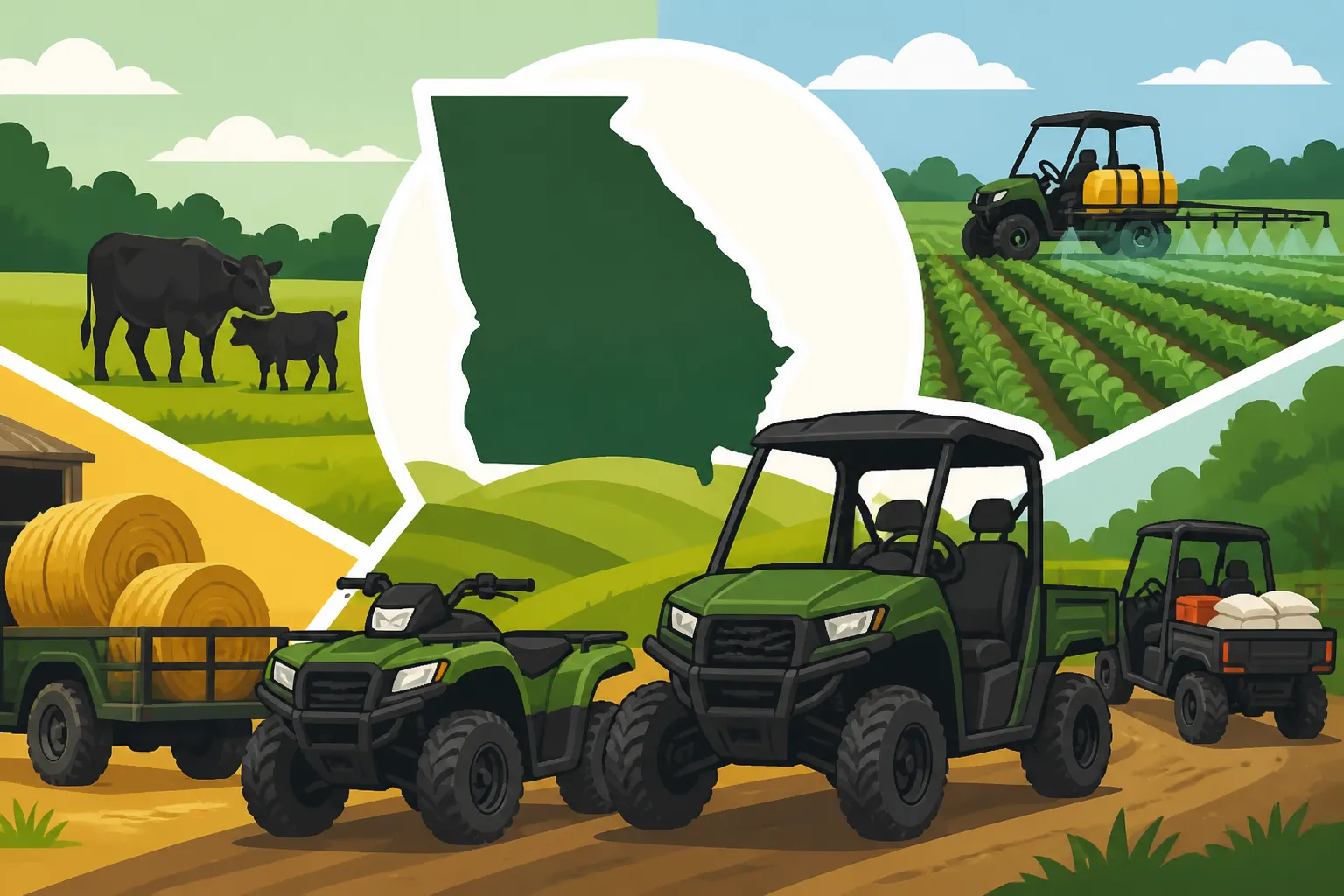
Agricultural activity is work connected to operating a farm or carrying out a genuine agricultural task. It is the purpose of the ride—not simply where the machine is driven—that matters. An ATV used to check livestock, carry tools to repair a fence, or move supplies between farm work areas is being used differently from one taken out for a recreational lap.
That distinction is important when a rider or family is considering Georgia’s farm-work exception to an ATV helmet requirement. The exception is tied to agricultural use; it should not be treated as a general “farm property” exemption. For the related rule, see Georgia ATV Helmet Law for Riders Under 18 and Georgia Farm and Logging Helmet Exemption.
Examples of work that may fit an agricultural purpose include:
- Checking livestock, water troughs, or pasture conditions as part of regular farm duties.
- Carrying feed, tools, fencing supplies, or other equipment needed for farm work.
- Inspecting or maintaining fences, gates, crops, irrigation systems, or farm roads.
- Moving between work areas while carrying out an assigned agricultural task.
- Supporting a farm operation by transporting supplies or equipment where the machine is a practical work tool.
These examples are not a checklist that automatically makes a ride exempt. A machine carrying a tool might still be on a recreational outing, and a rider heading to a work area might be taking a route or detour for fun. The facts as a whole matter: the task, the reason for the trip, the route, and whether the machine is actually being used in the work.
A farm address, a landowner’s permission, or farm equipment nearby does not settle the question by itself. Nor does owning a UTV primarily for farm use mean every trip in it counts as agricultural activity. Use can change from one ride to another.
Work Rides and Recreational Rides Are Not the Same
It can help to ask a simple question: if the farm task disappeared, would the rider still be making this trip? If the answer is yes because the goal is trail riding, sightseeing, or visiting friends, the ride is probably recreational rather than agricultural. If the trip is being made to perform a real farm duty, the work connection is clearer.
| Situation | How to think about the purpose |
|---|---|
| Carrying feed to livestock as part of a regular chore | A clear agricultural-work purpose |
| Hauling tools to repair a farm fence | A clear agricultural-work purpose |
| Driving between fields to inspect crops | A likely farm task, depending on the actual work |
| Taking a recreational ride around a farm after chores | Recreation, even though it happens on farm property |
| Riding to a hunting spot on farmland | Hunting access is not automatically farm work |
| Giving a child a ride around the property | Recreation, not an agricultural task |
| Driving to a neighbor’s property for a social visit | Not agricultural activity merely because both properties are farms |
| Moving supplies for a farm business as part of assigned work | Potentially work-related; the details and applicable rules matter |
There are ordinary situations that can be mixed. A rider may start out carrying supplies and then continue around the property for fun. Or someone may use a UTV to reach a field, then spend time riding trails after finishing the job. It is sensible to treat the recreational portion as recreational instead of assuming the work purpose covers the entire outing.
Purpose also matters for a passenger. A child riding along on a work trip is not necessarily performing agricultural work just because an adult is. If the exception is relevant, consider the rider’s role and the purpose of the trip rather than assuming that a working driver makes every passenger’s ride exempt.
When the purpose is unclear, the safer and simpler choice is to follow the applicable helmet rule. Wearing an appropriate helmet avoids having to rely on a narrow exception and remains prudent even when a work-related exception may apply. For more on the general distinction between work and non-work exceptions, see Exemptions for Farm and Commercial Work.
Hunting and property access
A farm may be used for agricultural operations and also for hunting, but those uses are not interchangeable. Riding to a deer stand, checking a hunting area, or moving through a property for recreation does not automatically become agricultural activity because the land is a working farm. A specific task connected to farm operations is different from using the machine to support a personal outing.
The same caution applies to hunting-club land, timber roads, and other rural properties. Permission to ride is not proof that a ride is agricultural work. The owner’s permission answers whether the rider may be on that property; it does not necessarily answer which safety rules apply. Georgia Rules for Riding a Pasture and Georgia Rules for Riding a Timber Road address separate questions about where a rider may go.
What the Agricultural Exception Does Not Change
An agricultural-work exception is limited. It does not turn an ATV or UTV into a road-legal vehicle, replace a permit, authorize access to land without permission, or remove unrelated safety duties. Treat each rule separately rather than treating “farm use” as a pass for the whole ride.
Road access and registration
If a machine is driven on a public road, the rules governing that road and vehicle still matter. A farm task does not by itself make a road open to ATVs or UTVs. Georgia’s rules for public-road access are different from the question of whether a particular ride is agricultural activity. See Georgia’s ATV Road Law Explained and Georgia MPOHV Road Rules: County Roads Only for the separate road-use issues.
Registration is another separate question. Some eligible machines may be registered as MPOHVs, but registration does not make every road legal or remove other operating requirements. Likewise, an unregistered machine does not become exempt from road restrictions just because it is being used for farm work. Start with Georgia MPOHV Registration Explained if you need to understand the registration category.
Public trails and permits
A private farm chore and a ride on a public off-highway vehicle system are different activities. A farm-use exception does not automatically waive a forest OHV permit or the rules for a particular trail. Check the land manager’s requirements before riding on public land, even if the machine is normally used for agricultural work. Georgia OHV Permits: What You Need Before You Ride explains why permit requirements are a separate issue.
A landowner’s permission also does not override a gate closure, posted restriction, or other access rule. If a route leaves the farm and enters public land or someone else’s property, check the rules for that place rather than relying on the machine’s usual farm role.
Other safety and operating rules
The agricultural exception should not be assumed to cover unrelated equipment, age, supervision, or passenger requirements. A rider should check the rule that applies to the specific machine and location. If the ride includes public roads, the relevant road requirements remain a separate concern. If it takes place at a private park, the park’s own rules may add requirements.
Agricultural work can also involve hazards that a helmet alone will not address. Passengers should ride only in seats designed for them, seat belts should be used where fitted, and loads should be secured so they do not shift or block the driver’s view. Keep riders clear of machinery, livestock, steep slopes, and work areas where the operator cannot see them.
How to Evaluate a Specific Ride
When a ride may qualify as agricultural activity, focus on concrete facts rather than broad labels like “farm use.” A short check before riding can help a family, farm employee, or landowner make a more careful decision.
- Identify the task. State the farm job in plain terms: checking a water line, delivering feed, inspecting a fence, or carrying equipment.
- Connect the machine to that task. Consider whether the ATV or UTV is being used as a practical means to complete the work, rather than as the main attraction of a recreational ride.
- Look at the whole trip. A work-related destination does not necessarily make every detour or extra ride part of the job.
- Consider each rider separately. A driver’s work task does not automatically make a passenger’s purpose agricultural.
- Check the location. Private farm property, a public road, a forest trail, and a riding park can each have different access and operating rules.
- Follow the safer option if uncertain. If it is difficult to explain how the ride directly supports farm work, do not rely on the exception as a reason to skip a helmet.
For a farm with regular machine use, it can be helpful to keep basic records of assigned work and operating procedures. A note identifying the task, the machine, and who is responsible for it may help explain why a work trip was made. Records do not create an exemption where one does not apply, but clear, ordinary documentation is more useful than relying on a general claim that the machine is “for the farm.”
Farm owners can also set a simple policy: use helmets for all riders, separate work trips from recreational rides, and make sure young riders understand that permission to ride is not the same as permission to use public roads or trails. A consistent safety policy is easier to apply than trying to decide after an incident whether a particular ride counted as work.
The practical takeaway is narrow but important: agricultural activity means a real farm-related task, not simply being on farm property or owning a work-capable machine. When the trip is recreational, treat it as recreation and follow the rules that apply to that ride and location.
Disclaimer
This article is for general informational purposes only and does not constitute professional advice. Laws, prices and regulations vary by location and change over time. Consult a qualified professional for guidance on your specific situation.