One Annual Permit Covers All Six Georgia OHV Systems
Georgia’s annual OHV permit can simplify repeat visits to the national forest, but it is easy to mistake it for a vehicle registration or assume it makes every trail suitable for every machine. Here’s what the pass covers, why each operator needs one, and what to check before choosing a trail.
What the annual OHV permit covers
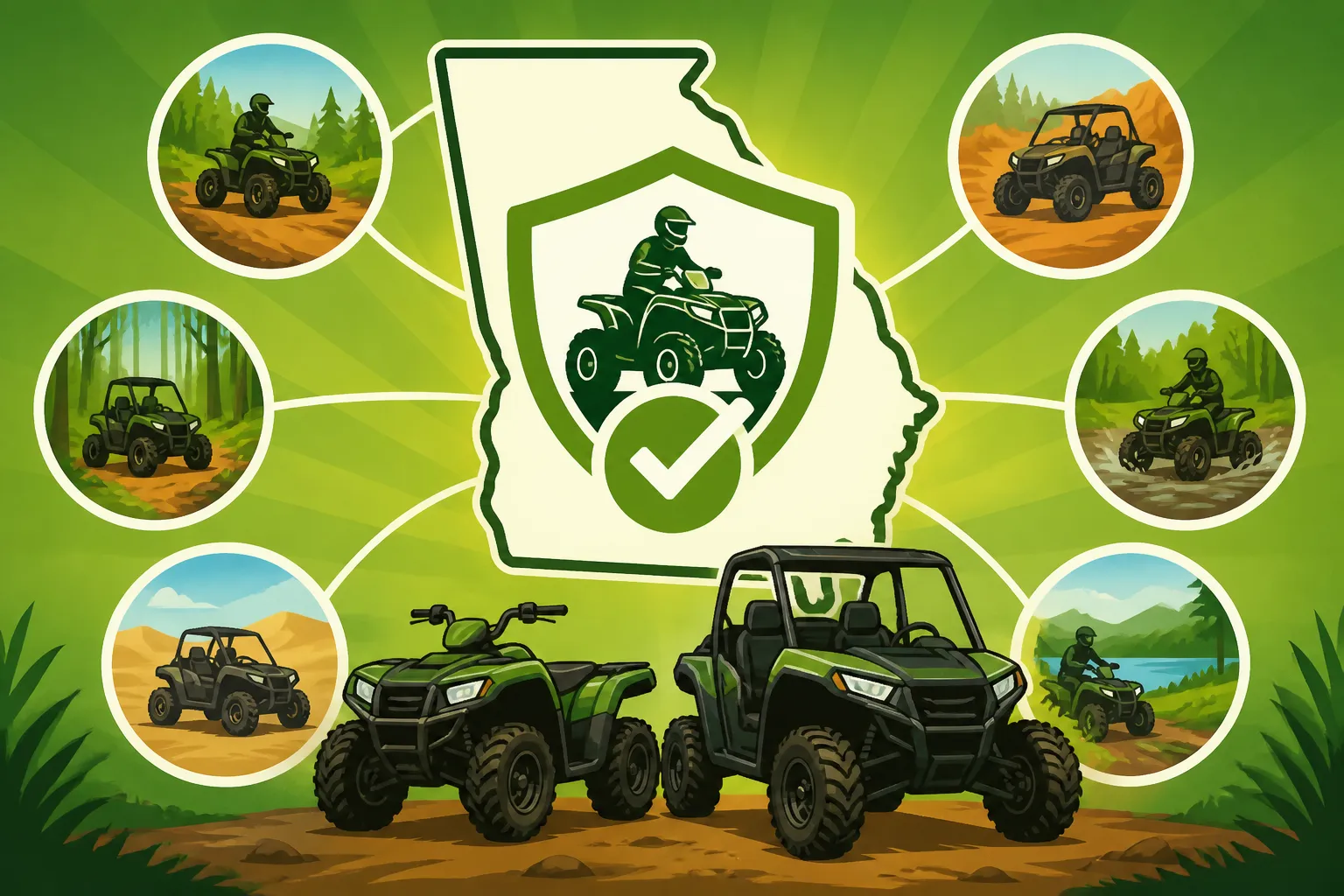
The Forest Service annual OHV permit is valid at six Georgia OHV trail systems: Houston Valley, Whissenhunt, Beasley Knob, Town Creek, Oakey Mountain and Davenport. It gives a permit holder access to the permit program at those systems; it does not guarantee that a particular trail is open or that a particular vehicle can use it.
According to the Forest Service, OHV permits are issued per person, not per vehicle, and each operator must have a permit to comply with the rules. If two people take turns driving the same machine, each operator needs a permit. A passenger who is not operating does not need an operator permit just for riding along, though separate passenger and vehicle restrictions may apply at the site.
The Forest Service annual OHV pass costs $50 per operator per year, while a day pass costs $5 per operator per day, as of November 2026. Check the Forest Service’s official purchase instructions for the system you plan to visit, since payment and display directions can differ by location. For Davenport, the Forest Service says annual pass holders must purchase and print the pass ahead of time and display it in the tow vehicle.
| System covered by the annual pass | A useful compatibility detail |
|---|---|
| Houston Valley | The Forest Service sets a 50-inch width restriction for vehicles on the trails. |
| Whissenhunt | The Forest Service describes the trails as suitable for motorcycles and ATVs less than 50 inches wide. |
| Beasley Knob | The Forest Service lists four-wheel-drive vehicles, motorcycles and ATVs among the vehicles allowed. |
| Town Creek | The Forest Service allows ATVs and four-wheelers on Loop B, but says Jeeps, side-by-sides and other UTV-type vehicles are not allowed. |
| Oakey Mountain | The Forest Service manages the trails for ATVs and dirt bikes with less than a 48-inch axle width; Jeeps, Hummers and other four-wheel-drive vehicles are prohibited. |
| Davenport | The Forest Service describes the trails as suitable for motorcycles and ATVs and sets a 50-inch width limit for ATVs. |
The table is a starting point, not a substitute for checking a trail’s current rules. Each system can have its own vehicle restrictions, trail designations and closures. A pass that covers all six systems does not make all six systems interchangeable for a UTV or side-by-side. For more help narrowing down suitable places, see Georgia ATV Trails That Allow Side-by-Sides and Georgia ATV Trails That Ban Side-by-Sides.
The pass is also separate from Georgia’s vehicle registration process. Multipurpose off-highway vehicle registration became voluntary on December 1, 2023, according to the Department of Revenue, and a registered MPOHV does not receive a title. That registration is not the same as a Forest Service OHV permit, and neither document replaces the other. See Georgia’s Day and Annual Forest OHV Permits for more on the permit program and Georgia MPOHV Registration Is Voluntary for the separate state registration question.
What the pass does not authorize
An annual pass does not override a trail’s vehicle limits. This matters especially for owners of UTVs and side-by-sides: a machine may qualify as a multipurpose off-highway vehicle under Georgia rules but still be too wide, or be the wrong type of vehicle, for a particular Forest Service trail.
For example, the Forest Service restricts Oakey Mountain to OHVs with less than a 48-inch axle width and says the trails are managed for ATVs and dirt bikes. At Town Creek, Loop B is designated for ATVs and four-wheelers, while Jeeps, side-by-sides and other UTV-type vehicles are not allowed on the trails. Houston Valley has a 50-inch width restriction and does not allow pickups or four-wheel-drive vehicles on its OHV trails. Check the rules for the exact route and machine before setting out; do not rely on a general description of the system or a dealer’s classification of your vehicle.
Width is not the only concern. Forest Service rules restrict trail use to vehicles less than 50 inches wide unless a trail is specifically designated for full-size vehicles. That is a general trail-use rule, not a promise that every trail with that width allowance is open to every type of machine. Some areas have narrower limits, and some permit only motorcycles or ATVs. Measure the machine as the trail operator instructs and confirm whether the rule applies to overall width, axle width or another measurement.
The permit also does not provide road access. The Forest Service says ATVs and multipurpose off-highway vehicles are prohibited on Forest Service roads, and Georgia House Bill 121 prohibits MPOHVs, low-speed vehicles and motorized carts from being driven on Forest Service Roads in the Chattahoochee-Oconee National Forest. A designated OHV trail is different from a forest road. Stay on the signed, authorized route, and do not use a road to connect trails unless it is specifically open to your vehicle.
Georgia vehicle registration is another distinct issue. The Department of Revenue has a separate eligibility test for registering an MPOHV, including requirements for steering controls, seating, safety equipment, speed capability, width and weight. Meeting that state test does not guarantee that a machine may ride a specific Forest Service trail. Conversely, an annual Forest Service permit is not a state registration or road-use authorization. For a closer look at the state vehicle category, read What MPOHV Actually Stands For and Georgia’s 80-Inch Width Limit for Registration.
Age and operator requirements still matter, too. The Forest Service allows motor vehicles on designated OHV trails only if the operator is of legal age to obtain a state driver’s license or is accompanied by a legally licensed driver. That trail rule is separate from the permit requirement: a permit does not make an otherwise ineligible operator legal to ride alone. Georgia’s broader age and vehicle rules can differ by machine type, so check the applicable requirements before bringing a young rider. Georgia Supervision Rules for Minors can help clarify the distinction.
Check trail conditions and local restrictions before you go
A valid annual pass is useful only when the intended trail is open and your vehicle meets its rules. The Forest Service closes OHV trails during wet conditions to prevent damage and erosion. Conditions can change after rain, and a system may close even if the pass is valid and the machine fits the stated limit. Check current notices before driving to the trailhead; Georgia Trail Conditions Before You Drive and Georgia ATV Trail Map Downloads are useful next steps for planning.
Maps matter because vehicle use is limited to designated roads, trails and areas. The Forest Service’s Motor Vehicle Use Maps identify where motor vehicles are allowed, and using or possessing a motor vehicle contrary to those designations is prohibited. A route visible on a general map is not automatically an authorized OHV route. Follow posted signs and stay on the route designated for your vehicle type.
Other site rules can affect a trip even when the trail is open. The Forest Service sets sound limits for vehicles, restricts operation to designated OHV trails, and requires operators to meet its licensing or accompaniment rule. Trail hours and seasonal closures also vary by system. For example, the Forest Service says Whissenhunt and Davenport operate from sunrise to sunset and close from January 1 through March 31 for resource protection. Check the destination’s current page rather than assuming those details apply to every trail.
Before leaving, verify the following:
- The annual pass is valid for the system you plan to visit, and each person who will operate has a permit.
- Your machine type and measured width meet the rules for the specific trail, not just the system in general.
- The trail is currently open, including after wet weather or during seasonal restrictions.
- The route is designated for motorized use and for your vehicle type.
- You have followed the system’s instructions for buying, printing or displaying the pass.
- The operator meets the applicable age and licensing requirements.
If a vehicle does not fit the trail rules, do not try to make it work by relying on the annual pass. Choose a system that permits that machine, or select a trail type that matches it. The permit fee covers access under the program’s rules; it does not change the Forest Service’s limits or prevent a closure.
The Forest Service says violations of OHV restrictions can result in fines of up to $5,000 and/or up to six months in prison. Those consequences are a good reason to check the map, signage and current site rules rather than assuming that a pass alone settles the question.
A practical way to plan repeat rides
For riders who visit more than one of the covered systems, the annual pass can be simpler than buying a day pass each time. Its main advantage is that the same operator pass is valid at Houston Valley, Whissenhunt, Beasley Knob, Town Creek, Oakey Mountain and Davenport. Its limitation is just as important: it is tied to the operator, not the machine, and it does not erase differences between trail systems.
Start with the machine, not the pass. If you own a side-by-side, check the vehicle-type restrictions before planning around the annual pass. Some covered trails are limited to ATVs or motorcycles, and some have width restrictions that may exclude a larger machine. If you ride a narrow ATV, still check the specific system’s rules, because limits can vary and a trail may have restrictions beyond width. Measuring Your Machine Before You Tow may help you prepare, but use the Forest Service’s method and local rules for the final decision.
Then choose the destination and verify its conditions. For the six systems covered by the annual pass, the Forest Service’s system-specific information is more useful than a general list of Georgia riding areas. A trail may be closed due to wet conditions or resource protection, or a particular loop may be reserved for a different vehicle type. For instance, Town Creek’s Loop A is restricted to two-wheeled vehicles, while Loop B is designated for ATVs and four-wheelers. That distinction shows why checking only the system name is not enough.
Finally, make sure each operator has the required pass and follows the purchase and display instructions. If the group includes several people who may take turns driving, plan for each operator to have a permit. If only one person will operate, the permit requirement applies to that operator; carrying another person’s pass does not satisfy it. A simple waterproof document sleeve, available from outdoor retailers or Amazon, can help protect a printed pass or trail paperwork in a tow vehicle, but it is just storage, not a substitute for the official pass or display instructions.
The most useful way to think about the annual permit is as a reusable operator pass for the six named Forest Service OHV systems. It can simplify repeat visits, but trail choice, vehicle compatibility, closures and operator eligibility remain separate checks. Confirm those details before each trip, especially when you are bringing a side-by-side or visiting a system you have not ridden before.
Sources
- Forest Service — Chattahoochee-Oconee National Forest | Frequently Asked Questions about Motorized Use on the National Forest | Forest Service (checked November 3, 2026)
- Forest Service — Chattahoochee-Oconee National Forest | Off-Highway Vehicles (OHV) | Forest Service (checked November 3, 2026)
- USDA Forest Service — Chattahoochee-Oconee National Forest | Roberts Bike Camp OHV Trails | Forest Service (checked November 3, 2026)
- Forest Service — Chattahoochee-Oconee National Forest | Beasley Knob OHV Trail System | Forest Service (checked November 3, 2026)
- USDA Forest Service — Chattahoochee-Oconee National Forest | Davenport Mountain OHV Trails | Forest Service (checked November 3, 2026)
- USDA Forest Service — Chattahoochee-Oconee National Forest | Houston Valley OHV Trails | Forest Service (checked November 3, 2026)
- USDA Forest Service — Chattahoochee-Oconee National Forest | Locust Stake OHV Trail System | Forest Service (checked November 3, 2026)
- Forest Service — Chattahoochee-Oconee National Forest | Oakey Mountain OHV Trails | Forest Service (checked November 3, 2026)
- USDA Forest Service — Chattahoochee-Oconee National Forest | Rock Creek ORV Trail | Forest Service (checked November 3, 2026)
- USDA Forest Service — Chattahoochee-Oconee National Forest | Tatum Lead ORV Trail | Forest Service (checked November 3, 2026)
- USDA Forest Service — Chattahoochee-Oconee National Forest | Town Creek OHV Trails | Forest Service (checked November 3, 2026)
- USDA Forest Service — Chattahoochee-Oconee National Forest | Whissenhunt OHV Trails | Forest Service (checked November 3, 2026)
- USDA Forest Service — Chattahoochee-Oconee National Forest | Windy Gap, Milma Creek, and Tibbs OHV Trails | Forest Service (checked November 3, 2026)
Disclaimer
This article is for general informational purposes only and does not constitute professional advice. Laws, prices and regulations vary by location and change over time. Consult a qualified professional for guidance on your specific situation.